
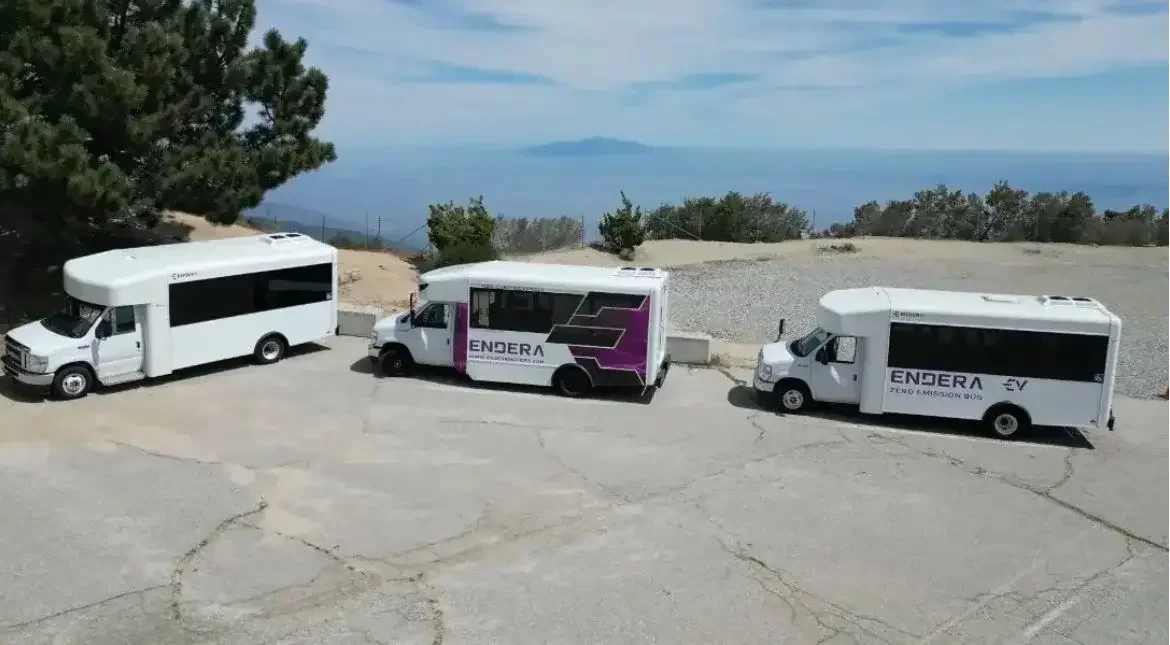
Missouri's commercial shuttle market draws from a wider range of industries than most mid-continent states — Branson's tourism and entertainment corridor, the airport and corporate infrastructure of Kansas City and St. Louis, major university systems in Columbia and Springfield, and a healthcare footprint that spans both urban campuses and rural service areas. For fleet operators across these markets, the shuttle bus decision is a capacity, reliability, and total cost decision rolled into one.
Endera manufactures Class 4 B-Series commercial shuttles in ICE, propane, CNG, and full-electric configurations on Ford E450 and Chevrolet Express cutaway chassis. Missouri fleet operators — whether running airport loops, resort circuits, employee shuttles, or healthcare transport — get a purpose-built commercial vehicle with a single warranty and a single point of service accountability.
Ready to optimize your routes? Contact Endera's fleet specialists today to design a custom configuration blueprint for your Missouri operation.
Why Missouri Fleets Choose Commercial Shuttle Solutions
Missouri's transportation geography rewards operational flexibility. The Missouri Department of Transportation oversees an infrastructure network that spans dense urban corridors and long rural connectors — a range that creates genuinely different operational requirements for shuttle fleets in different parts of the state.
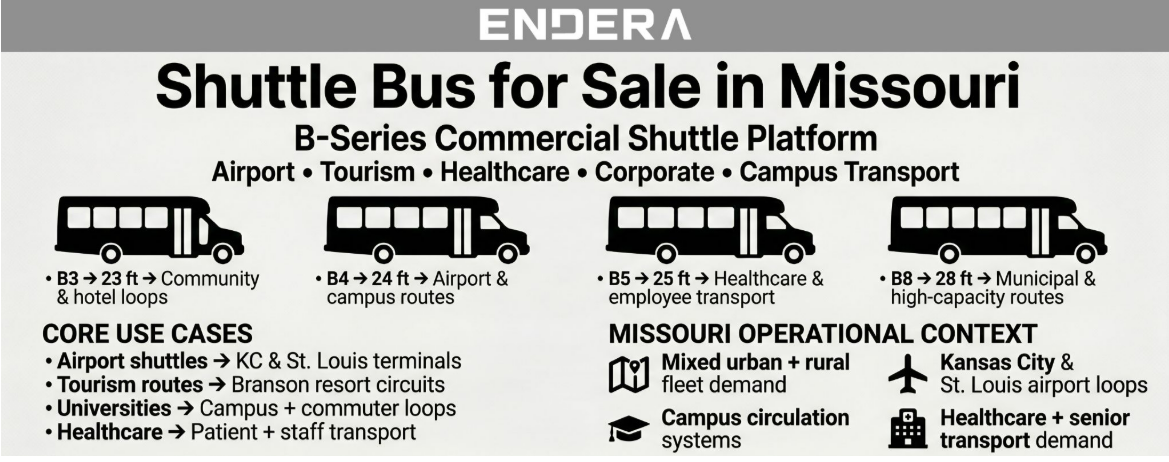
A hotel shuttle running Kansas City airport loops has different cycle intensity than a Branson resort circulator or a Columbia university campus loop. What they share is the need for a vehicle built for sustained daily commercial use — not a converted passenger van accumulating structural fatigue on routes it wasn't engineered for. The B-Series is built on medium-duty Ford E450 and Chevrolet Express cutaway chassis specifically rated for these operational demands.
The B-Series Lineup for Missouri Fleets
Endera is the only American vertically integrated OEM for Class 4 electric shuttles — body assembly and powertrain installation handled at the same Ottawa, Ohio facility. Buyers receive one warranty document and one compliance certification, not split coverage from a chassis supplier and a separate body upfitter.
Missouri Shuttle Use Cases: Where the B-Series Fits
Missouri's commercial shuttle demand concentrates across several distinct markets, each with different operational requirements.
Airport and Tourism Transportation
Kansas City International and Lambert-St. Louis International both support high-frequency parking and hotel shuttle operations. The B4 handles these fixed-route airport loops efficiently — predictable daily mileage, overnight depot charging if electric, and enough capacity to keep per-trip costs manageable. Branson's entertainment and resort corridor generates shuttle demand tied to seasonal tourism peaks, where vehicle reliability and passenger comfort directly affect guest experience.
Universities and Healthcare Campuses
University of Missouri, Missouri State, and Washington University in St. Louis operate campus circulation and off-campus transport programs requiring ADA-compliant configurations and real-time dispatch capability. Missouri's major health systems — Barnes-Jewish, Saint Luke's, Mercy — run patient transport and campus shuttle programs with similar requirements. The B5's higher capacity handles larger employee circuits; the B4 serves fixed campus loops and medical transport routes where stop frequency matters more than total passenger count.
Corporate, Senior, and Community Transport
Missouri's pharmaceutical, logistics, and financial employer base in Kansas City and St. Louis generates ongoing employee shuttle demand between transit hubs and corporate campuses. Senior living communities — particularly in suburban St. Louis and Kansas City — operate resident transport programs requiring accessible configurations. Flat-floor B-Series models with 800 lb Braun ADA lifts meet ADA accessible transportation requirements and FTA Part 37 transportation service regulations as delivered, without aftermarket modification.
Electric vs. ICE: The Missouri Fleet Decision
Missouri's operational diversity means neither powertrain is universally correct. Urban and suburban operators running fixed daily routes with depot access are strong EV candidates. Rural operators and those with irregular routes should evaluate ICE or propane as the current-cycle solution.
Why Shuttle Fleets Are Ideal EV Candidates
Shuttle operations have the structural characteristics that make EV adoption most practical — predictable routes, daily return to depot, and scheduled downtime for overnight charging. The Electrification Coalition identifies shuttle and transit operations among the highest-ROI EV deployment environments. According to Atlas Public Policy's Midwest electrification analysis, the region is seeing accelerating commercial fleet EV adoption as infrastructure expands and operating economics improve.
The FTA Low or No Emission Vehicle Program provides federal funding for electric shuttle purchases by transit agencies and qualifying contracted operators. The Missouri Department of Natural Resources oversees clean transportation initiatives that support fleet electrification across commercial categories. Endera's grant navigation services help Missouri operators identify applicable programs and structure purchases accordingly.
When ICE or Propane Makes More Sense
Operators with long inter-city routes, multiple unconnected depots, or facilities without charging infrastructure should consider ICE or propane as a current-cycle solution. Propane reduces fuel costs 30–40% versus gasoline per DOE Alternative Fuels Data Center data and qualifies for clean fuel programs that diesel replacements typically cannot access. All B-Series configurations share the same platform — standardizing on Endera now doesn't foreclose an EV transition on the next procurement cycle.
Total Cost of Ownership: Fleet Economics for Missouri Operators
Electric drivetrains reduce maintenance spend 30–40% versus diesel — fewer moving parts, no oil changes, and regenerative braking extending pad life on high-cycle routes. The International Council on Clean Transportation tracks commercial fleet EV economics across vehicle classes, confirming that the operating cost advantage of electric compounds meaningfully over a full service lifecycle.
The U.S. Energy Information Administration publishes current Missouri electricity rates for operators modeling per-mile energy cost against existing fuel spend. For Missouri fleet managers running five or more vehicles, the combination of lower operating costs and federal funding that offsets acquisition cost changes the financing conversation considerably compared to a straight ICE purchase at sticker price.
Charging Infrastructure and Fleet Planning
Depot readiness is the primary barrier for most first-time EV shuttle buyers. The DOE Alternative Fuels Data Center provides route-specific charging cost modeling tools for Missouri operators planning EV deployment.
Endera's turnkey charging solutions handle site assessments, DC fast charger procurement, and metering installation as a single engagement — removing infrastructure coordination from operators managing other priorities simultaneously. DC fast charging is standard on every Endera EV unit, enabling rapid turnaround between shifts for high-cycle Missouri operations.
Get Your Fleet Spec'd
Several 2026 B-Series units are available for immediate delivery through Endera Stock, including ADA-configured flat-floor models and standard passenger layouts. For operators working within formal procurement or grant-aligned purchasing cycles, Endera provides full specification documentation and compliance materials.
To discuss fleet configuration, powertrain options, or financing for your Missouri operation, contact Endera's sales team.
FAQs
What B-Series configuration works best for Missouri airport and hotel operations?
The B4 (24 ft) handles Kansas City and St. Louis airport parking loops and hotel transfers efficiently — enough capacity to keep per-trip costs manageable without the footprint of a larger bus. Electric B4 models suit high-cycle fixed routes well. Branson resort operators running longer scenic circuits may find the B5 (25 ft) better matched to passenger volume and route length.
Are electric shuttle buses practical in Missouri?
Yes, for fixed-route urban and suburban operations. Predictable daily mileage, overnight depot charging, and the operational characteristics of hotel, airport, and campus routes all align with electric shuttle strengths. Rural operators with long inter-city routes or no existing charging infrastructure should evaluate ICE or propane as a current-cycle solution and transition to electric on the next procurement cycle.
Do B-Series shuttle buses require a CDL in Missouri?
Most B-Series configurations fall below the federal CDL threshold — under 26,001 lbs GVWR and fewer than 16 passengers including the driver. Missouri operators running for-hire commercial transport should confirm state-specific licensing requirements, as for-hire passenger carrier rules may add licensing layers beyond the standard CDL threshold.
What ADA accessibility options are available for Missouri fleet operators?
Flat-floor B-Series configurations include 800 lb Braun ADA lifts installed at the manufacturing stage, meeting FTA Part 37 accessibility requirements. For senior living communities, healthcare transport, and any operation serving passengers with mobility needs, OEM-installed lift systems provide unified warranty coverage and cleaner compliance documentation than aftermarket modifications.
What are the long-term operating cost differences between electric and ICE shuttles?
Electric drivetrains reduce maintenance spend 30–40% versus diesel over a full service lifecycle — fewer moving parts, no oil changes, and regenerative braking that extends pad life on high-cycle routes. Fuel savings compound further, particularly for Missouri operators running 8 to 12 daily cycles. The EIA publishes current Missouri electricity rates for operators who want to model per-mile energy cost before purchasing.
Are there federal funding programs for Missouri commercial shuttle fleet operators?
Private commercial operators don't access FTA grants directly — those are reserved for public transit agencies and qualifying contractors. However, federal clean vehicle incentives and Missouri DNR clean transportation programs may apply to commercial EV shuttle purchases. Endera's grant navigation services help Missouri operators identify which programs apply to their specific ownership structure.
How does Endera Dispatch benefit Missouri shuttle fleet managers?
Endera Dispatch provides AI-powered routing, real-time GPS tracking, geofence management, state-of-charge monitoring for EV units, and custom reporting dashboards at no additional cost. For Missouri operators managing multiple routes across airport, healthcare, and campus programs, Dispatch provides unified fleet visibility without requiring separate telematics systems for ICE and electric vehicles.