
Maine's commercial shuttle market is small but operationally specific. High-frequency seasonal service runs at ski resorts and along the coastal tourism corridor, where summer demand is critical. Year-round demand comes from Portland's hotel growth, university transit, and major healthcare networks.
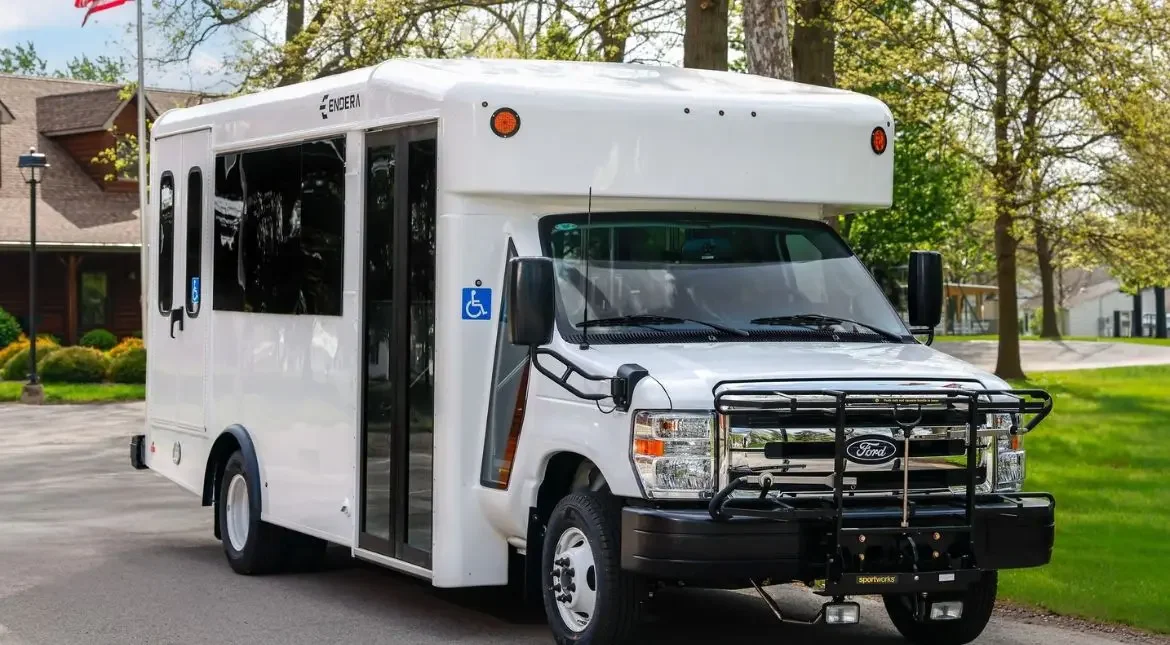
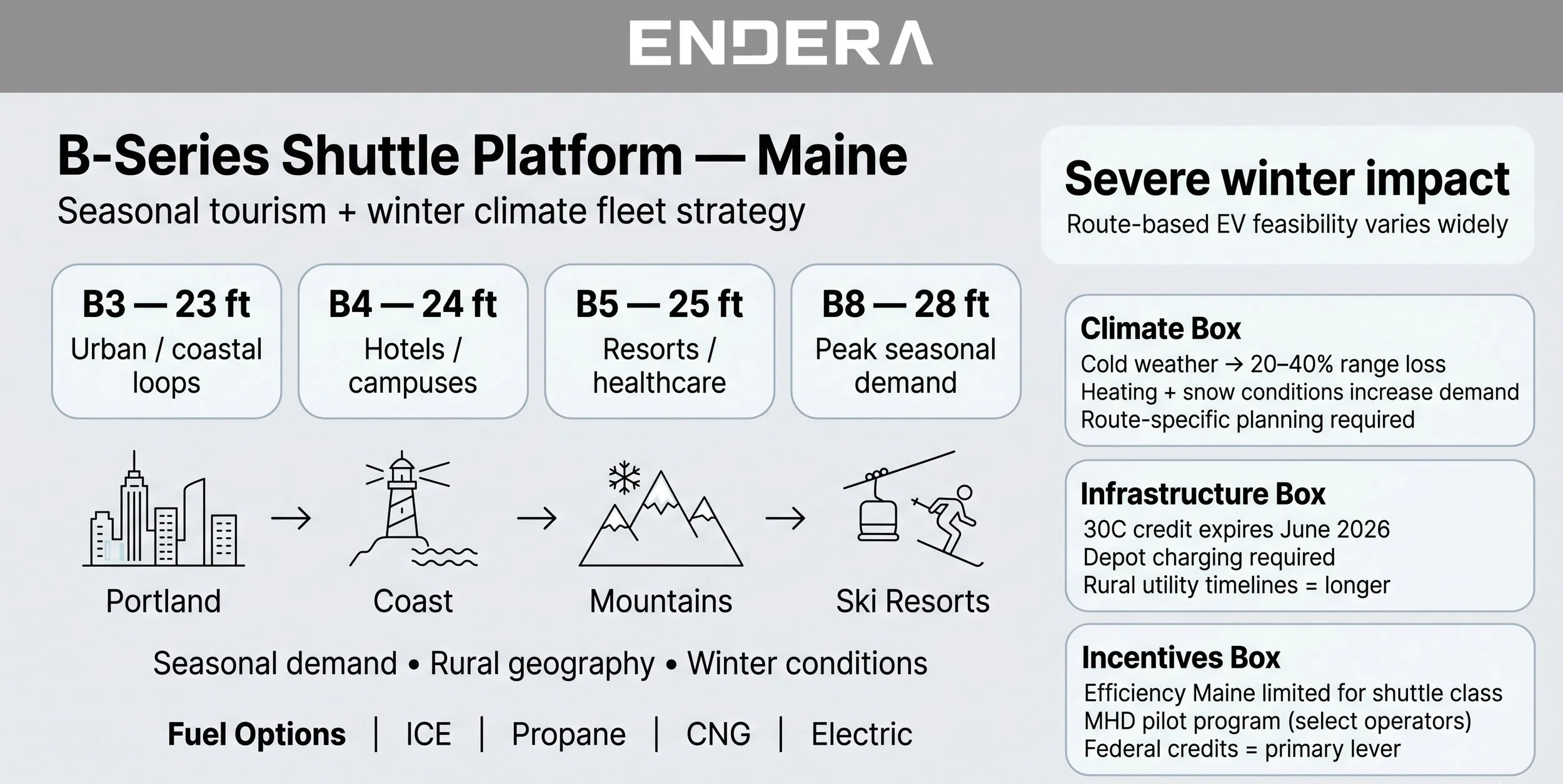
Endera's B-Series — the B3, B4, B5, and B8, ranging from 23 to 28 feet — covers Maine's range of shuttle applications. ICE, propane, CNG, and full electric configurations are available on Ford E450 and Chevrolet Express cutaway chassis, manufactured at Endera's Ottawa, Ohio facility.
Maine winters are a real variable in the fuel equation — connect with an Endera fleet specialist today to find a configuration that performs year-round, not just in the shoulder season.
Maine's Fleet Landscape: Progressive Policy, Demanding Conditions
A State With Real EV Ambitions and Real Winter Constraints
Maine has set meaningful EV adoption targets — 220,000 EVs and PHEVs by 2030, 100% ZEV state fleet purchases by 2030, and a requirement that 75% of school bus acquisitions be zero-emission by 2035.
Maine joined the multi-state ZEV memorandum of understanding and has an active Efficiency Maine incentive infrastructure. The policy direction is clear. What makes Maine different from most mandate-aligned states is the climate it's asking fleets to operate in. Sustained sub-zero temperatures in northern Maine and the mountains, significant snow loads, and heating-heavy operating conditions create EV range reductions that need to be built into deployment planning from day one — not discovered after a bus runs short on a January ski resort route.
Efficiency Maine's Commercial Programs
Efficiency Maine administers Maine's primary EV incentive programs for businesses and nonprofits. Commercial electric van rebates of up to $14,000 are available through April 30, 2026 — but these are structured around van-category vehicles with an $80,000 MSRP cap, which means they apply to lighter commercial vehicles rather than Class 3 shuttle buses in the B-Series range.
Maine also operates a medium and heavy-duty EV pilot program (2023–2026) through Efficiency Maine for businesses with 500 or fewer employees, offering demonstration grants for qualifying MHD EV deployments. The 30C federal charging credit — up to $100,000 per installed port — applies to depot charging installations through June 30, 2026 and is the most significant federal tool currently available to Maine fleet operators planning EV charging infrastructure.
Real Winter Range Degradation for Maine Shuttle Operations
Beyond the Generic "Cold Weather" Warning
Most EV content acknowledges that range decreases in cold weather — but that framing is too vague to support real fleet planning in Maine. NREL cold-weather EV performance research and DOE guidance show that Class 3 shuttle buses operating in Maine-level winter conditions typically experience 20–40% effective range degradation, driven by heating load, reduced battery efficiency, and diminished regenerative braking effectiveness at low temperatures.
Commercial shuttle fleets face additional penalties beyond lab testing: frequent door openings on hotel and resort routes, prolonged idle heating during passenger loading, and low-speed stop-and-go circulation patterns all increase energy draw per mile in ways that compound the cold-weather battery penalty.
Route-Level Performance Bands for Maine
Range loss varies by route in Maine. Ski resort loops see the biggest drop (30–45%) due to elevation, idling, and heating. Coastal routes face 25–35% variability from wind and dispersed stops, while university circulators are more stable at 15–25%. This makes EV planning route-specific — fleets need winter buffers factored in before purchase to avoid operational gaps.
Maine Winters and EV Performance: What Operators Need to Know
Cold Weather Changes the Range Equation Significantly
Maine’s winters significantly reduce EV range due to cold-related battery loss and heating demand. For operators at ski resorts or coastal routes, this isn’t theoretical — it directly impacts planning. A B4 or B5 that meets range in October may perform very differently in February on the same route.
What It Means for Maine Deployment Planning
Short, depot-based routes can handle Maine’s winter range loss with overnight charging and careful planning. Longer or more complex routes — like ski resorts, coastal, and rural operations — need deeper evaluation before going electric. Real-time monitoring helps in operation, but route-level planning must happen upfront. Where winter range is uncertain, ICE and propane B-Series options offer more consistent reliability.
The B-Series Lineup for Maine Operations
Four Models Covering Maine's Shuttle Markets
The B3 (23 ft) is a compact ICE model ideal for tight urban and coastal routes. The B4 (24 ft) and B5 (25 ft) add capacity and offer both ICE and electric options, suited for resorts, campuses, and healthcare shuttles. The B8 (28 ft) is built for high-volume routes where maximum passenger capacity is needed.
Chassis Serviceability in a Geographically Spread Market
All B-Series models are available on Ford E450 or Chevrolet Express cutaway chassis — platforms with the broadest service network coverage available in Maine, including in smaller markets across the coast and in the mountains where a specialized bus service center isn't accessible. Maine's geography — long distances, seasonal road conditions, and dispersed population centers — makes chassis serviceability a more practical consideration than in dense urban markets.
Fleet Decision Framework: Maine Routes and the Right Configuration
Matching the Vehicle to Maine's Operating Environments
| Use Case | Recommended Model | Fuel Type | Why |
|---|---|---|---|
| Ski resort ground transport (Sugarloaf, Sunday River) |
B4 / B5 | ICE or Propane | Cold + grade + variable demand |
| Portland hotel / downtown loop | B3 / B4 | EV or ICE | Urban; shorter routes; depot charging viable |
| Coastal tourism (Bar Harbor, Camden) | B3 / B4 | ICE or Propane | Seasonal, variable, limited depot access |
| University transit (UMaine, Bowdoin, Bates) | B4 / B5 | EV or CNG | Defined routes; campus infrastructure potential |
| Healthcare campus (Maine Medical, Northern Light) | B4 / B5 | EV or ICE | Defined schedules, reliability priority |
For Portland-based operators with depot charging and relatively short urban routes, the electric B4 and B5 are operationally viable — and the 30C federal credit makes depot infrastructure installation financially meaningful before June 30. For ski resort and coastal operators facing severe winter conditions and variable route profiles, ICE and propane configurations offer the operational reliability those environments require.
Incentives: What Maine Operators Can Actually Access in 2026
Efficiency Maine Programs and Their Shuttle Bus Applicability
Maine's Efficiency Maine commercial van rebates are designed around lighter commercial vehicles — the $80,000 MSRP cap and van category eligibility mean they don't directly apply to Class 3 shuttle buses in the B-Series range. That's an important distinction that many operators miss when evaluating Maine's incentive picture.
The medium and heavy-duty EV pilot program does apply to larger commercial vehicles for qualifying businesses with 500 or fewer employees — operators in this category who haven't yet explored the program should contact Efficiency Maine directly to assess eligibility before the 2026 pilot window closes.
The 30C Credit Is the Primary Near-Term Tool
The 30C charging equipment credit — up to $100,000 per installed charging port — remains available for commercial depot charging installations through June 30, 2026. For Maine fleet operators planning EV configurations, this is the most actionable federal incentive currently available and the one with the nearest deadline.
Equipment must be physically placed in service by June 30 — not just ordered or permitted. Given Maine's rural geography, contractor availability constraints, and utility coordination timelines, starting the infrastructure planning process now is what makes June 30 achievable. Endera's depot charging and infrastructure team coordinates site assessment, equipment procurement, and installation to keep projects on schedule.
True Cost vs. Cash Flow for Maine Operators
The EV Case Without a Deep Incentive Stack
Maine has limited incentives for Class 3+ shuttle buses. Aside from the 30C tax credit and select Efficiency Maine programs, it lacks the layered state and utility funding seen in states like Illinois or New Jersey. As a result, EV decisions rely more on long-term operating savings than upfront grants.
The Electric School Bus Initiative documents that electric vehicles save more than $170,000 in fuel and maintenance over their service life — a figure that applies comparably to commercial EV shuttles on similar operating profiles. In Maine's high-cost energy market, those operating savings over 10 years are genuine. The upfront cost gap without a deep incentive stack requires careful financing structure.
Financing Options for Maine Operators
Endera's financing team offers capital leasing and direct financing options for Maine operators who want to deploy electric configurations without relying on grant timing. Capital leasing allows operators to use vehicles while preserving capital — a useful structure in a market where the upfront cost gap between ICE and EV isn't as well offset by state programs as in some other states.
Built for Maine's Demanding Shuttle Market
Maine's shuttle operators need vehicles that hold up in severe winters, serve the coastal and mountain markets that define the state's tourism economy, and come from a manufacturer that offers genuine fuel flexibility rather than a single-path EV pitch. The B-Series delivers across four models, four fuel types, and two chassis options — with fleet software, financing support, and infrastructure coordination to back every purchase.
Maine winters are a real test for any shuttle spec. Talk to an Endera specialist today to find the right B-Series configuration for your Maine fleet.
FAQs
Which B-Series models are available for Maine operators?
All four models — B3 (23 ft), B4 (24 ft), B5 (25 ft), and B8 (28 ft) — are available in Maine in ICE, propane, CNG, and electric configurations depending on model. Contact Endera's sales team for current availability and lead times.
Do Efficiency Maine's commercial rebates apply to shuttle buses?
Efficiency Maine's commercial van rebates (up to $14,000, through April 2026) are designed around lighter commercial vehicles with an $80,000 MSRP cap — they don't directly apply to Class 3 shuttle buses. The MHD EV pilot program may apply to qualifying businesses with 500 or fewer employees for larger commercial vehicles. Contact Efficiency Maine directly to assess eligibility.
What is the 30C charging deadline for Maine operators?
The 30C credit — up to $100,000 per installed charging port — expires June 30, 2026. Equipment must be physically placed in service. Given Maine's geography and contractor availability, starting the infrastructure planning process now is essential for meeting the deadline.
How do Maine winters affect EV shuttle performance?
Cold temperatures significantly reduce effective range due to heating load and reduced battery performance. Short, depot-based routes in Portland and on university campuses absorb this well. Ski resort mountain circuits and longer coastal routes in winter require more conservative planning and may be better served by ICE or propane in the near term.
What chassis options are available in Maine?
All B-Series models are available on Ford E450 and Chevrolet Express cutaway chassis, serviced through dealer networks across Maine including coastal and mountain markets.
Do Endera shuttles comply with Buy America requirements?
Yes. With approximately 65% of components sourced domestically, Endera's manufacturing supports Buy America compliance for federally funded Maine procurement contracts.
Can I get an in-stock 2026 shuttle for fast delivery in Maine?
Yes. Endera Stock lists ready-to-deliver 2026 models available for rapid deployment without a custom build lead time.