
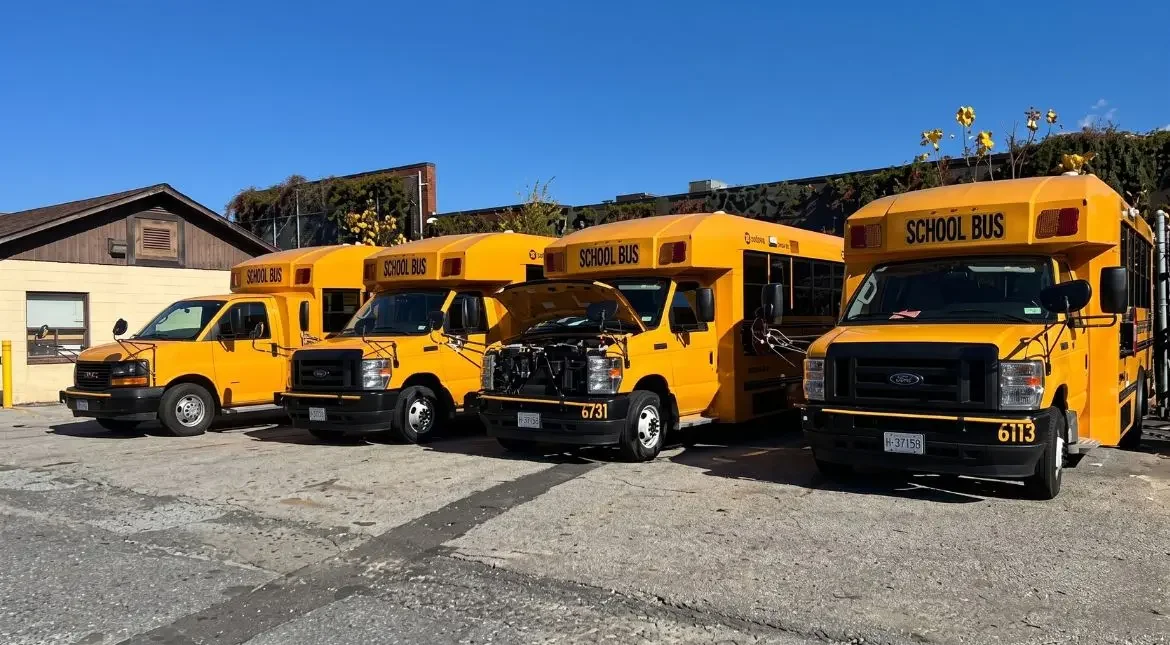
Michigan school districts operate across one of the more demanding transportation environments in the Midwest — dense suburban metro routes around Detroit and Grand Rapids on one end, and remote Upper Peninsula districts managing long rural routes through serious winter weather on the other. A Type A school bus purchase in Michigan isn't just a capacity decision; it's a reliability decision.
Endera manufactures Type A school buses in ICE, propane, CNG, and full-electric configurations on Ford E450 and Chevrolet Express cutaway chassis. For Michigan districts managing special education routes, rural pickups, or smaller-enrollment circuits where a full-size bus is operationally wasteful, the Type A format is built for the work.
Michigan winters have no patience for the wrong vehicle — contact Endera's sales team today to find the right Type A configuration for your district's routes and conditions.
What Is a Type A School Bus?
The National Congress on School Transportation defines Type A school buses as vehicles built on van or cutaway chassis designed for smaller passenger loads — typically 10 to 24 students — and route applications where a full-size Type C or D bus creates more operational overhead than it solves. Michigan's base bus specifications, maintained by Michigan School Business Officials, establish the construction standards, safety equipment, and operational requirements that Type A buses must meet before entering district service.
For Michigan districts, the Type A format solves a specific operational problem: routes that don't justify a 48-passenger bus but require a commercially built, safety-certified vehicle rather than a modified van. Special education transport, Head Start programs, rural pickups, and smaller private school routes are all applications where Type A buses are the standard tool.
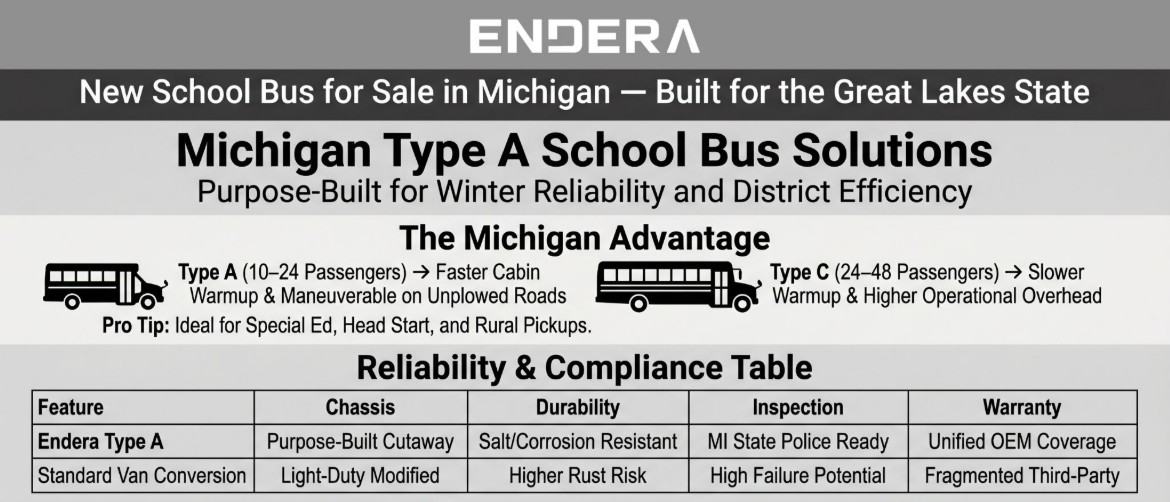
Type A vs. Type C: Which Fits Your Michigan District?
| Feature | Type A | Type C |
|---|---|---|
| GVWR | Up to 14,500 lbs | 19,501–26,000 lbs |
| Typical seating | 10–24 passengers | 24–48 passengers |
| CDL required | Generally not | Yes |
| Best fit | Special ed, rural, low-density | High-volume primary routes |
| Winter advantage | Faster warmup, easier block heating | Larger capacity for high-enrollment runs |
Michigan districts commonly run both types — Type C for primary high-enrollment routes and Type A for specialized, lower-volume, and accessibility-focused applications.
Michigan Compliance and Operational Standards
The Michigan Pupil Transportation Act governs school bus equipment, operation, maintenance, and driver qualifications statewide. All school buses operating in Michigan must meet state construction and safety standards and pass annual inspections administered through the Michigan State Police School Bus Inspection program. Non-compliant vehicles are removed from service until deficiencies are corrected.
Michigan school bus drivers are required to hold a CDL with a school bus (S) endorsement — a requirement that applies regardless of vehicle size or passenger count. Districts purchasing new Type A buses should confirm driver certification status and align vehicle specifications with Michigan's base bus standards before placing orders. Endera provides full specification sheets and compliance documentation to support Michigan's formal procurement review process.
Michigan Winter Performance: What Type A Bus Buyers Should Know
Michigan winters are a fleet management variable, not just a backdrop. Cold-weather startup reliability, cabin heat performance, and chassis durability on salted and unplowed roads are practical selection criteria that don't show up on a spec sheet but determine operational performance from November through March.
Type A buses on cutaway chassis warm up faster than larger vehicles — a practical advantage when drivers need to heat the cabin before student pickup on -15°F mornings. Engine block heaters are standard practice in Michigan fleet operations, and Endera's ICE and propane configurations are compatible with standard block heating setups. According to NHTSA school bus safety research, school buses are among the safest vehicles on the road — but that safety record depends on vehicles being properly maintained for the conditions they operate in.
Corrosion and Long-Term Durability
Michigan's road salt exposure accelerates corrosion on vehicles not built to commercial structural specifications. Light-duty van conversions accumulate rust and structural fatigue faster than purpose-built cutaway chassis vehicles under equivalent use. CVSA commercial vehicle inspection standards include structural integrity checks that Michigan buses must pass annually — a standard that emphasizes the value of purpose-built commercial chassis over modified alternatives for the state's operating environment.
Fuel Options for Michigan Type A Buses
Michigan districts have access to all four powertrain configurations Endera manufactures. The right choice depends on route profile, infrastructure, and where the district sits in its electrification timeline:
ICE (gasoline): Widest parts and service availability across Michigan; reliable cold-weather startup with block heaters; lowest infrastructure barrier
Propane: Typically reduces fuel costs 30–40% versus gasoline per DOE Alternative Fuels Data Center data; burns cleaner than diesel; performs reliably in Michigan winters with proper cold-weather equipment. Michigan has active propane adoption among school fleets
CNG: Lower fuel cost than diesel; works best for districts with existing natural gas infrastructure; less widely available in rural Michigan
Electric: Best for fixed routes with overnight depot charging; federal funding covers vehicles and charging; battery range drops 15–25% in cold weather — districts should confirm daily route mileage against winter-adjusted range before specifying electric
All four configurations are built on the same Type A platform — a district can standardize on Endera and shift powertrain on the next procurement cycle without changing manufacturers.
ADA Accessibility for Michigan School Districts
Special education transport drives a significant share of Type A bus procurement across Michigan's districts and Intermediate School Districts (ISDs). ADA accessible transportation guidelines and FTA Part 37 transportation service regulations define the compliance requirements that commercially operated accessible transport must meet — requirements that apply to district-operated special education routes as much as to private contractors.
Endera's flat-floor Type A configurations include 800 lb Braun ADA lifts installed at the manufacturing stage, configurable seating across 4-to-6 section layouts, and wheelchair securement positions. For Michigan ISDs and special education programs, OEM-installed accessibility equipment provides better compliance standing and unified warranty coverage than post-sale retrofits sourced from a separate vendor.
New vs. Used: The Michigan District Decision
New Type A school buses typically start around $80,000 and range to $150,000 depending on powertrain and configuration. Used Type A buses in serviceable condition run $20,000–$60,000 — lower upfront, with tradeoffs that accumulate over the ownership period in Michigan's climate.
Michigan's road salt and freeze-thaw cycles accelerate corrosion on vehicles that have already logged years of service. Deferred maintenance, worn ADA systems, and outdated safety equipment are common in district surplus buses. Federal clean bus funding programs — which typically exclude used vehicles — further shift the economics toward new for districts with any available grant pathway. Endera's grant navigation and financing services help Michigan districts identify applicable programs and structure purchases to reduce net acquisition cost.
Ready to Spec a Bus for Your Michigan District?
New 2026 Type A models are available for immediate delivery through Endera Stock for districts with pressing replacement timelines. For districts working within Michigan's formal procurement process or cooperative purchasing structures, Endera provides full specification documentation, compliance materials, and grant application support.
Michigan winters separate reliable buses from costly mistakes — make sure yours is the former. Contact Endera's sales team today to discuss fleet configuration, powertrain options, or Michigan procurement requirements.
Frequently Asked Questions
What are Michigan's base bus specifications for Type A school buses?
Michigan School Business Officials maintain base bus specifications that define construction standards, safety equipment requirements, and operational durability benchmarks for school buses purchased by Michigan districts. These specifications govern body construction, emergency exits, lighting, wheelchair accessibility, and chassis standards. Endera's Type A buses are built to meet or exceed these requirements as delivered, with full documentation available for Michigan's procurement review process.
Do Michigan school bus drivers need a CDL to operate a Type A bus?
Yes. Michigan requires school bus drivers to hold a CDL with a school bus (S) endorsement — a requirement that applies regardless of vehicle GVWR or passenger count. Districts purchasing Type A buses should confirm driver certification status before placing vehicles in service. The Michigan Pupil Transportation Act governs driver qualifications alongside vehicle standards.
How does Michigan's climate affect Type A bus selection and maintenance?
Cold-weather startup reliability, cabin heating performance, and corrosion resistance are the primary climate-driven selection criteria for Michigan fleets. Type A buses on cutaway chassis warm up faster than larger vehicles, reducing cabin preheat time before student pickup. Annual Michigan State Police inspections include structural integrity checks — purpose-built commercial chassis withstand Michigan's road salt exposure better than light-duty van conversions under equivalent daily use.
Is propane a good fuel option for Michigan school buses?
Yes. Propane typically reduces fuel costs 30–40% compared to gasoline equivalents and performs reliably in Michigan winters with appropriate cold-weather equipment. Michigan has active propane adoption among school fleets, and propane buses are eligible for clean fuel grant programs that diesel replacements typically are not. For districts seeking a cleaner alternative without the infrastructure commitment of full electrification, propane is the strongest near-term option.
Are electric Type A buses practical for Michigan school routes?
Electric buses work best on fixed routes with predictable daily mileage and overnight depot charging. Michigan's cold winters reduce battery range 15–25% — districts should confirm winter-adjusted route mileage before specifying electric. Federal funding through the EPA Clean School Bus Program covers both vehicles and charging infrastructure, which changes the acquisition cost calculation significantly for qualifying districts.
What ADA accessibility options are available on Endera's Type A buses?
Endera's flat-floor Type A configurations include 800 lb Braun ADA lifts installed at the manufacturing stage, with seating configurable across 4-to-6 section layouts to accommodate wheelchair securement and ambulatory seating. For Michigan ISDs and special education programs, OEM-installed equipment provides unified warranty coverage and stronger compliance standing than post-sale retrofits.
How does cooperative purchasing work for Michigan school districts buying new buses?
Michigan school districts can access cooperative purchasing contracts that allow them to buy from pre-approved vendors without running a separate competitive bid process. These contracts reduce administrative burden and can shorten procurement timelines considerably. Endera's sales team can confirm whether current cooperative purchasing pathways apply to a given district's procurement structure and provide supporting documentation for contract-aligned purchases.