
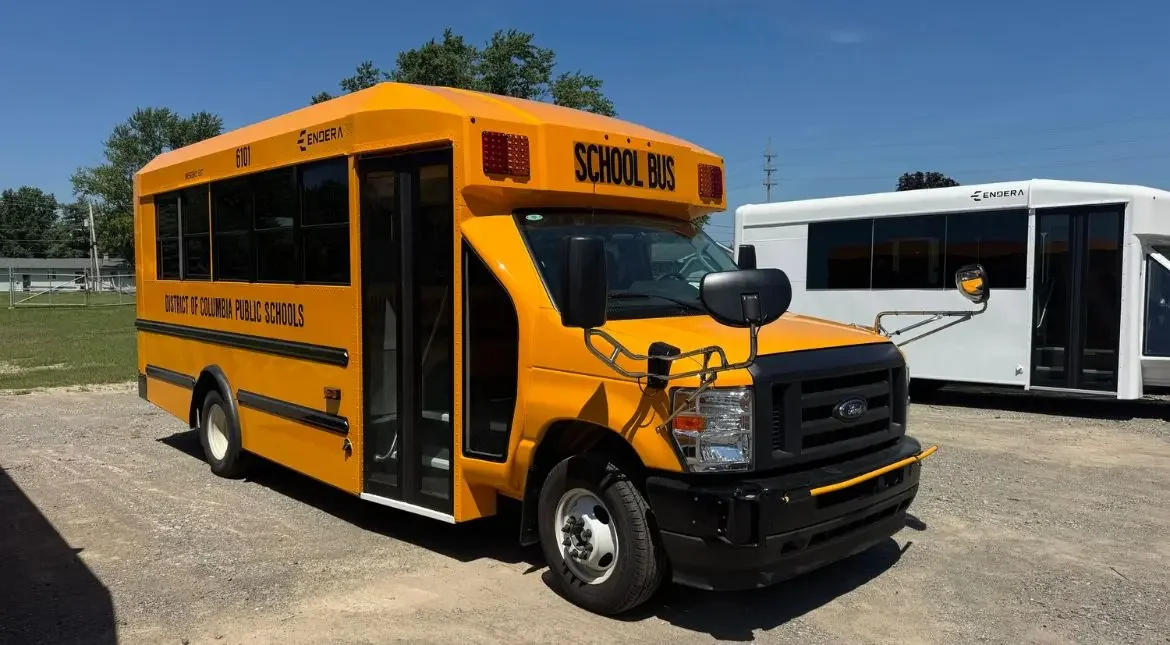
Georgia school districts making a new bus purchase face a choice that's less obvious than it looks: factory-built OEM vehicle or a modified van conversion. Both can carry passengers. Only one is engineered from the ground up for school transportation, carries a unified warranty, and meets Georgia's construction standards as delivered rather than as modified after the fact.
Endera manufactures Type A school buses in ICE, propane, CNG, and full-electric configurations on Ford E450 and Chevrolet Express cutaway chassis — purpose-built at a single facility in Ottawa, Ohio. For Georgia districts prioritizing safety certification, fleet standardization, and long-term durability, the distinction between factory-built and converted matters.
Ready to optimize your routes? Contact Endera's fleet specialists today to design a custom configuration blueprint for your district.
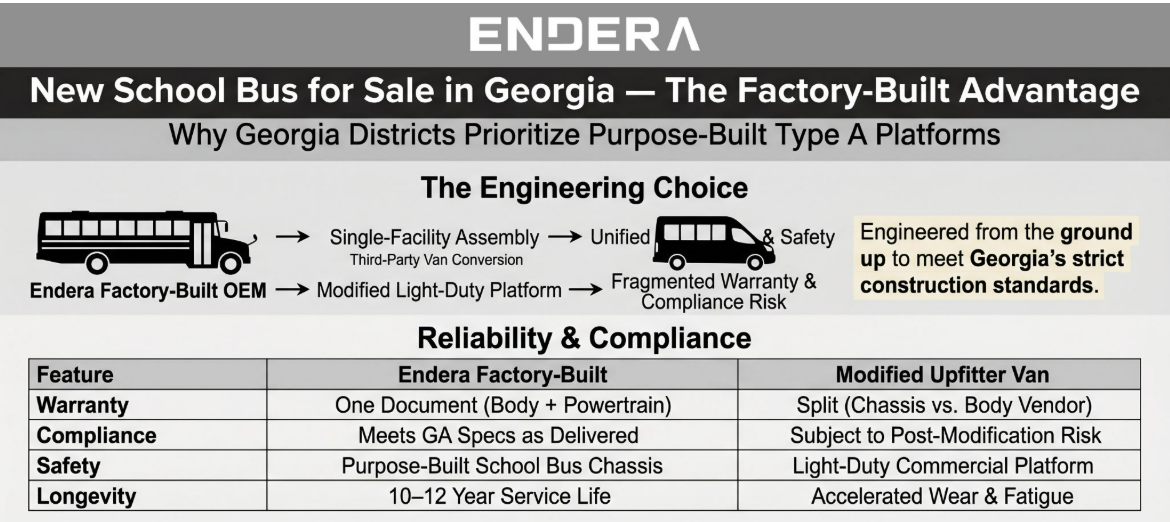
What "Factory-Built" Means for Georgia School Districts
A factory-built school bus is manufactured as a complete vehicle by a single OEM — body assembly, powertrain installation, safety equipment, and compliance certification all handled under one quality control process. The alternative is an upfitter model: a commercial van or chassis modified by a third-party company to function as a school bus.
The difference shows up in three areas that matter to Georgia districts. First, warranty coverage — factory-built vehicles carry a single warranty document from one manufacturer, while upfitter-modified vehicles split coverage between chassis and body vendors. Second, compliance documentation — Georgia's School Bus Specifications Manual defines exact construction and safety standards; factory-built buses meet these as delivered. Third, structural integrity — NHTSA school bus safety standards apply to purpose-built school buses, not converted vans, which means the safety engineering behind a factory bus is fundamentally different from a modification applied to a light-duty platform.
What Is a Type A School Bus?
The Georgia DOE Pupil Transportation Division classifies Type A buses as smaller cutaway chassis vehicles designed for more than 10 passengers — built for routes where a full-size Type C or D bus creates more operational overhead than the route demands. The National Congress on School Transportation provides the national specifications Georgia's standards draw from.
Georgia transportation guidance specifically associates Type A buses with special-needs transport, Head Start programs, lower-density routes, and daycare operations. These are applications where passenger count is lower, stops are more frequent, accessibility equipment is often required, and vehicle maneuverability matters more than raw capacity.
Type A vs. Type C: Matching the Bus to the Route
| Feature | Type A | Type C |
|---|---|---|
| GVWR | Up to 14,500 lbs | 19,501–26,000 lbs |
| Typical seating | 10–24 passengers | 24–48 passengers |
| CDL required | Generally not | Yes |
| Best fit | Special ed, Head Start, low-density | High-volume primary routes |
| Operational cost | Lower fuel and maintenance | Higher overhead per route |
Georgia districts commonly run both types — Type C for primary enrollment routes and Type A for specialized, accessibility-focused, and smaller-capacity applications where a 48-passenger bus is the wrong tool.
Why Georgia Districts Choose Type A Buses
Georgia's transportation landscape spans urban density in metro Atlanta and long rural routes across the state's southern and eastern counties. Type A buses serve both environments effectively — compact enough for tight neighborhood streets in Fulton County, durable enough for longer rural pickups in districts where one route covers 30 miles.
According to Bureau of Transportation Statistics data, rural student transportation demand remains consistent regardless of enrollment trends in urban centers. Georgia's rural counties maintain steady Type A procurement cycles for exactly this reason — smaller populations, narrower roads, and lower-density stops create routes that a full-size bus handles inefficiently.
Special Education and Accessible Transport
Special education transport is the largest single driver of Type A bus demand across Georgia's districts and ISDs. ADA accessible transportation requirements and FTA Part 37 transportation service regulations define the compliance standards that school districts must meet for accessible student transport.
Endera's flat-floor Type A configurations are available with 800 lb Braun ADA lifts installed at the manufacturing stage — meeting federal accessibility standards without aftermarket modification or split warranty coverage. For Georgia districts serving students under IDEA and ADA requirements, OEM-installed accessibility equipment simplifies both compliance documentation and post-sale service accountability.
Georgia Compliance and Safety Requirements
Georgia school buses must meet construction and equipment standards defined in the Georgia School Bus Specifications Manual and pass inspections enforced through the Georgia Department of Public Safety. Vehicles that fail inspection are removed from service until deficiencies are resolved.
Georgia school bus drivers must hold a CDL with a school bus endorsement — a state-specific requirement applicable regardless of vehicle GVWR or passenger count. CVSA inspection standards govern fleet compliance checks that Georgia operators are subject to, reinforcing why factory-built vehicles with documented compliance histories are lower-risk procurement choices than modified alternatives.
Fuel Options for Georgia Type A Buses
Georgia's mild climate removes some of the cold-weather constraints that affect fuel selection in northern states — but operating cost, emissions, and infrastructure readiness still drive the decision:
ICE (gasoline): Widest service availability; lowest infrastructure barrier; straightforward maintenance across Georgia's dealer network
Propane: Reduces fuel costs 30–40% versus gasoline per DOE Alternative Fuels Data Center data; lower emissions; Georgia districts including Henry County Schools have approved propane bus purchases for fleet expansion
CNG: Lower fuel cost than diesel; best for districts with existing natural gas infrastructure
Electric: Fixed routes with overnight depot charging; the EPA Clean School Bus Program covers vehicles and charging equipment for qualifying Tennessee districts; Georgia's mild climate makes electric more operationally predictable than in northern states
All four configurations are built on the same Type A platform — a district can standardize on Endera and transition powertrain on the next procurement cycle without changing manufacturers.
New vs. Used: The Factory-Built Advantage
New factory-built Type A school buses typically start around $80,000 and range to $150,000 depending on powertrain and configuration. Used Type A buses in serviceable condition run $20,000–$60,000 — lower upfront, but without the warranty, compliance documentation, or funding eligibility that new vehicles carry.
Used buses purchased outside formal district channels often lack complete maintenance histories, carry deferred service needs, and are ineligible for federal clean bus funding programs regardless of their condition. For Georgia districts with any available grant pathway, Endera's grant navigation and financing services help identify applicable programs and structure purchases to reduce net acquisition cost on new vehicles.
Get Your Fleet Spec'd
New 2026 Type A models are available for immediate delivery through Endera Stock for districts with urgent replacement timelines. For districts working within Georgia's formal procurement process, Endera provides full specification documentation, compliance materials, and grant application support.
To discuss fleet configuration, powertrain options, or Georgia procurement requirements, contact Endera's sales team.
Frequently Asked Questions
What makes a factory-built school bus different from a converted van?
A factory-built school bus is engineered as a complete vehicle by a single OEM — body, powertrain, safety equipment, and compliance certification handled under one quality control process. Converted vans are modified by third-party upfitters after the base vehicle is built, splitting warranty coverage and compliance accountability across multiple vendors. Georgia's School Bus Specifications Manual requires specific construction and safety standards that factory-built buses meet as delivered.
What does Georgia's school bus specifications manual require for Type A buses?
The Georgia School Bus Specifications Manual defines body construction standards, safety equipment requirements, lighting specifications, wheelchair lift compatibility, and chassis criteria that Type A buses must meet before entering district service. Endera's Type A buses are built to meet or exceed these standards, with full documentation provided for Georgia's procurement and inspection review process.
Do Georgia school bus drivers need a CDL to operate a Type A bus?
Yes. Georgia requires school bus drivers to hold a CDL with a school bus endorsement, which applies regardless of vehicle size or GVWR. This requirement goes beyond the standard federal CDL threshold and is enforced by the Georgia Department of Public Safety. Districts purchasing new Type A buses should confirm driver certification before placing vehicles in service.
Are there funding programs available for Georgia school districts buying new buses?
Yes. The EPA Clean School Bus Program provides federal funding for electric and clean-fuel bus replacements, and Georgia districts are eligible to apply. State-level alternative fuel incentives may also apply for propane or CNG purchases. Used buses are typically ineligible for these programs. Endera's grant navigation services help Georgia districts identify applicable funding and manage applications alongside the procurement process.
How does propane compare to diesel for Georgia school bus operations?
Propane reduces fuel costs 30–40% versus diesel equivalents per DOE Alternative Fuels Data Center data, while producing significantly lower particulate and NOx emissions. Georgia's mild climate makes propane a practical alternative without the cold-weather complications it can present in northern states. Georgia districts including Henry County Schools have already moved toward propane fleets — a sign that the state's procurement environment is receptive to alternative-fuel adoption.
What ADA accessibility options are available on Endera's Type A buses?
Endera's flat-floor Type A configurations include 800 lb Braun ADA lifts installed at the manufacturing stage, with seating configurable across 4-to-6 section layouts to accommodate wheelchair securement and ambulatory seating. All configurations meet FTA Part 37 accessibility requirements. For Georgia special education programs, OEM-installed equipment provides better compliance standing and unified warranty coverage than post-sale retrofits.
How long does a new Type A school bus last under Georgia operating conditions?
Purpose-built Type A school buses on medium-duty cutaway chassis typically operate 10 to 12 years under daily use with proper maintenance. Georgia's mild climate reduces weather-related wear on body and mechanical components compared to northern states. Annual inspection compliance per Georgia DPS standards and adherence to CVSA maintenance benchmarks are the primary factors in reaching full service life.