
Kentucky takes a cautious policy approach to EVs, with no state purchase incentives, an annual EV highway fee, and restrictions on California-style emissions mandates. However, the state is simultaneously seeing major investment in EV battery manufacturing from companies like Ford and Toyota, signaling long-term industrial momentum toward electrification.
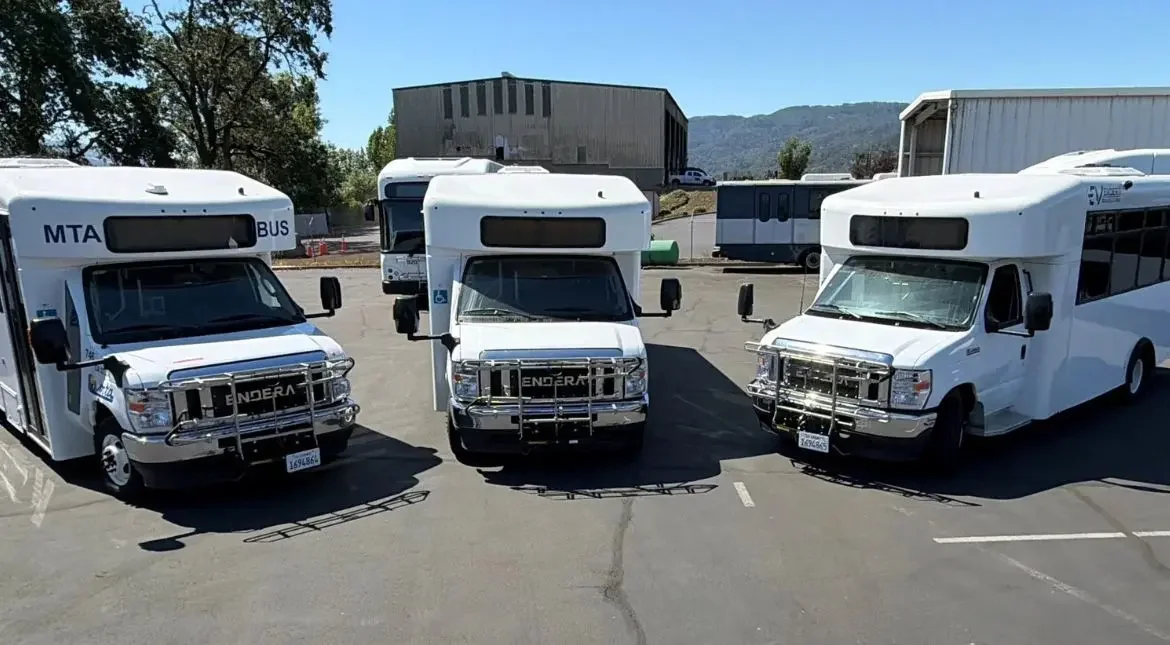
For commercial shuttle operators, the choice between EV, ICE, propane, or CNG depends on route needs, infrastructure, and lifecycle costs rather than policy direction. Endera's B-Series (B3–B8), built in Ohio on Ford E450 and Chevrolet Express chassis, supports all of these operating paths.
Buy the vehicle that fits your operation today — not the one a mandate might require in a state that hasn't issued one. Talk to an Endera specialist today to find the right configuration for your Kentucky fleet.
Kentucky's Fleet Landscape: What Shapes the Decision
No Mandate, But Real Operating Diversity
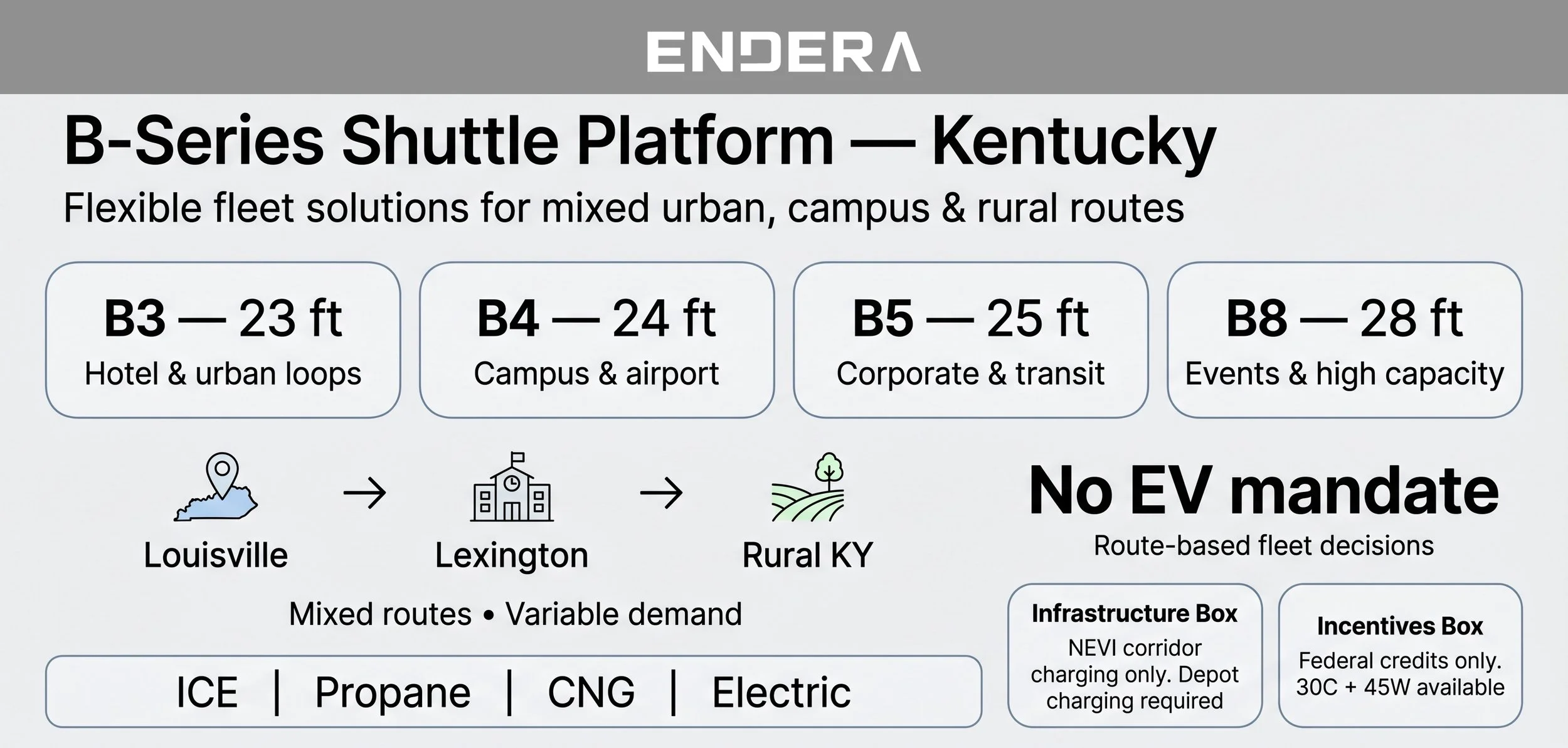
Kentucky has no statewide electrification requirement for commercial vehicle fleets. State law specifically prohibits adopting California's Advanced Clean Cars standards, and the policy direction favors operator flexibility over mandate-driven timelines.
What Kentucky does have is a genuinely varied commercial shuttle market: university transit at UK and U of L, hospitality and tourism operations in Louisville and Lexington, horse country resort and event shuttles, medical center operations, and corporate campuses tied to the growing manufacturing sector in central Kentucky. Each of these environments has different capacity needs, different route profiles, and different relationships with electrification.
Kentucky's EV Battery Manufacturing Moment
Kentucky's emergence as a domestic EV battery production hub isn't just economic news — it's relevant to commercial fleet operators thinking long-term about supply chain stability and service infrastructure.
As Ford's BlueOval City in Hardin County and Toyota's battery facility in Liberty come online, the state's commercial EV service ecosystem will deepen alongside them. For operators considering the B4 or B5 electric variants today, that trajectory matters: Kentucky's EV maintenance and service landscape will look meaningfully different in three to five years than it does now, which reduces the long-term service risk of early EV adoption.
The B-Series Lineup for Kentucky Operations
Four Models Covering Kentucky's Shuttle Markets
The B3 (23 ft) is a compact ICE model ideal for hotel loops in Louisville and Lexington, campus routes, and tight urban pickups. The B4 (24 ft) and B5 (25 ft) offer more capacity with ICE and electric options, suited for university transit, airport, medical, and corporate shuttle routes. The B8 (28 ft) is designed for high-volume needs like events, busy corridors, and peak-demand transport such as Kentucky Derby operations.
Proximity to Ohio: A Supply Chain Advantage
Every B-Series shuttle is manufactured at Endera's Ottawa, Ohio facility — a short distance from Kentucky's northern border. That geographic proximity translates into shorter lead times for Kentucky operators compared to vehicles shipped from distant manufacturing locations, and easier access to direct factory support when questions arise. With approximately 65% of components sourced within Ohio, the domestic supply chain credentials also support Buy America compliance for Kentucky operators accessing federal transit funding.
Fleet Decision Framework: Kentucky Routes and the Right Configuration
Matching the Vehicle to the Kentucky Operating Environment
| Use Case | Recommended Model | Fuel Type | Why |
|---|---|---|---|
| Louisville hotel / downtown loop | B3 / B4 | ICE or Propane | Urban maneuverability, lower volume |
| Airport ground transport (SDF) | B4 / B5 | EV or ICE | Defined cycles; EV viable with depot charging |
| University transit (UK, U of L) | B4 / B5 | EV or CNG | Predictable schedules, campus infrastructure |
| Horse country resort / event shuttle | B4 / B5 | ICE or Propane | Seasonal demand, variable routes |
| Medical center / corporate campus | B5 | EV or ICE | Defined schedules, reliability priority |
For Kentucky operators at Louisville Muhammad Ali International Airport (SDF) or running defined corporate campus loops, the electric B4 and B5 offer compelling long-term economics when federal credits offset the upfront gap. Operators at San Diego International Airport, a comparable high-frequency EV deployment, have forecasted nearly $20,000 in annual savings per vehicle versus LPG or CNG — a figure that scales across even a small Kentucky fleet over a full service cycle.
Why Public Charging in Kentucky Doesn't Solve Shuttle Operations
Corridor Charging vs. Depot Charging — A Fundamental Mismatch
Kentucky's NEVI buildout — with $31.6 million obligated and roughly 46 fast-charging sites planned along designated Alternative Fuel Corridors — is real infrastructure progress. But it's designed for highway travel, not fleet operations.
NEVI stations are concentrated along interstates and major parkways to support long-distance, pass-through traffic: drivers stopping occasionally between cities. Shuttle fleets operate on an entirely different model — predictable daily cycles, fixed routes, and the need for consistent, repeatable charging at a central depot. Public DC fast chargers along Kentucky's corridors don't align with how shuttle vehicles actually run routes.
Depot Charging Is a Requirement, Not a Preference
Fleet operators can’t rely on public charging for daily shuttle service. Depot charging is essential, allowing overnight charging, consistent readiness, and stable operations—something NEVI corridor stations don’t provide.
Public DC fast chargers also carry reliability risks since uptime, access, and pricing are outside operator control. For Kentucky fleets, the key question is depot readiness, not statewide charging availability. Endera’s turnkey depot charging services help operators build that infrastructure before vehicles are deployed.
Incentives for Kentucky Fleet Operators
Federal Programs Are the Primary Tool
Kentucky has no state-level vehicle purchase rebate for commercial EV fleets. The federal IRS commercial clean vehicle credit (45W) is the most meaningful financial tool available for Kentucky operators considering electrification — applying directly to qualifying commercial EV purchases. The 30C charging equipment tax credit covers up to $100,000 per installed charging port through June 2026, making it a time-sensitive opportunity for operators planning depot charging installations alongside a vehicle purchase.
State and Utility Programs Worth Knowing
Kentucky’s Light-Duty ZEV Infrastructure Program offers grants covering up to 50% of Level 2 and DC fast charger installation costs, though it is currently closed and expected to reopen in 2026. Operators planning depot charging should monitor its return and coordinate timing with financing support.
Utilities like LG&E, KU, and Touchstone Energy Cooperatives also offer time-of-use rates, with off-peak charging as low as $0.04–$0.06 per kWh, helping reduce operating costs for overnight charging.
True Cost vs. Cash Flow Reality
The Honest Picture for Kentucky EV Buyers
Electric shuttles have lower long-term operating costs due to cheaper energy and reduced maintenance. However, Kentucky’s limited state incentives mean the upfront cost gap with ICE narrows more slowly than in states with stronger programs.
Higher initial capital costs and potentially tighter financing can also create cash flow pressure in the first few years, even though long-term ROI remains positive.
When CNG and Propane Make More Sense in Kentucky
For Kentucky operators running longer or more variable routes — particularly in rural central and eastern Kentucky where charging infrastructure is thin — CNG and propane remain the practical choice in 2026. Kentucky explicitly recognizes propane, CNG, and electricity as clean transportation fuels under state policy, and the state's 50% alternative fuel vehicle requirement for light-duty state fleet vehicles signals a policy environment supportive of multi-fuel approaches.
Endera's lineup covers all of these options on the same platform, allowing Kentucky operators to choose the fuel type that fits their current infrastructure without changing vehicle families as conditions evolve. Endera's financing team can model the full lifecycle cost across fuel types for Kentucky operators based on their specific routes and infrastructure access.
Built for Kentucky's Practical Fleet Market
Kentucky fleet operators don't need a mandate to make a good vehicle decision — they need a shuttle that fits the route, handles the climate, and comes from a manufacturer close enough to actually support the relationship. The B-Series covers the full range of Kentucky operating conditions across four models, four fuel types, and two chassis options, with fleet software, financing support, and grant coordination to back every purchase.
Make the decision on your terms, not a mandate's. Talk to an Endera specialist today to find the right B-Series configuration for your Kentucky fleet.
FAQs
Which B-Series models are available for Kentucky operators?
All four models — B3 (23 ft), B4 (24 ft), B5 (25 ft), and B8 (28 ft) — are available in Kentucky in ICE, propane, CNG, and electric configurations depending on model. Contact Endera's sales team for current availability and lead times.
Does Kentucky have state EV incentives for fleet purchases?
Kentucky has no state-level vehicle purchase rebate for commercial EV fleets. The primary financial tools are federal — the IRS commercial clean vehicle credit and the 30C charging equipment credit (through June 2026). The state's Light-Duty ZEV Infrastructure Program for charging installation grants is expected to reopen in 2026.
Are electric shuttles practical for Kentucky's climate and routes?
For shorter, defined routes in Lexington, Louisville, and on university or medical campuses, electric configurations are operationally viable. Kentucky's winters add a range consideration — cold temperatures increase heating load and reduce effective battery range. Endera's Dispatch platform provides real-time state-of-charge monitoring to help operators manage seasonal variability.
What chassis options are available in Kentucky?
All B-Series models are available on Ford E450 and Chevrolet Express cutaway chassis, serviced through dealer networks across Kentucky including Louisville, Lexington, and smaller regional markets.
Do Endera shuttles comply with Buy America requirements?
Yes. With approximately 65% of components sourced domestically, Endera's manufacturing supports Buy America compliance for federally funded Kentucky procurement contracts.
Does Endera offer in-stock vehicles for fast delivery in Kentucky?
Yes. Endera Stock lists ready-to-deliver 2026 models available for rapid deployment without a custom build lead time.
How do I get pricing or a spec sheet for Kentucky fleet purchases?
Spec sheets and floor plans are available on Endera's shuttle bus page. For pricing and configuration discussions, contact Endera at hello@enderacorp.com or call +1 (419) 523-3593.