
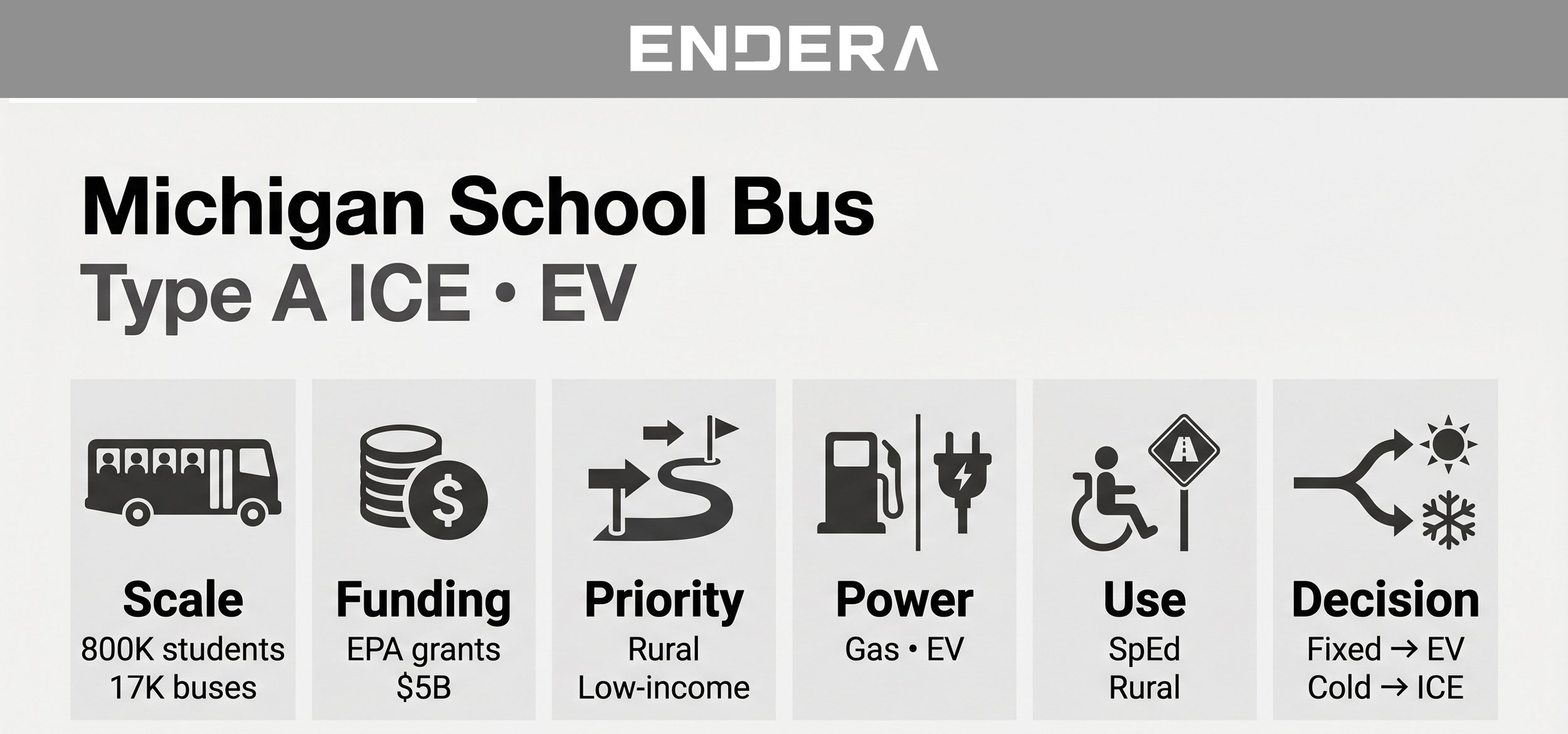
Michigan transports approximately 800,000 students annually across a fleet of roughly 17,000 school buses — a scale that makes fleet procurement one of the more consequential budget decisions a district transportation department makes. For districts managing aging diesel equipment, the question isn't whether replacement is coming; it's whether the next purchase is the right one.
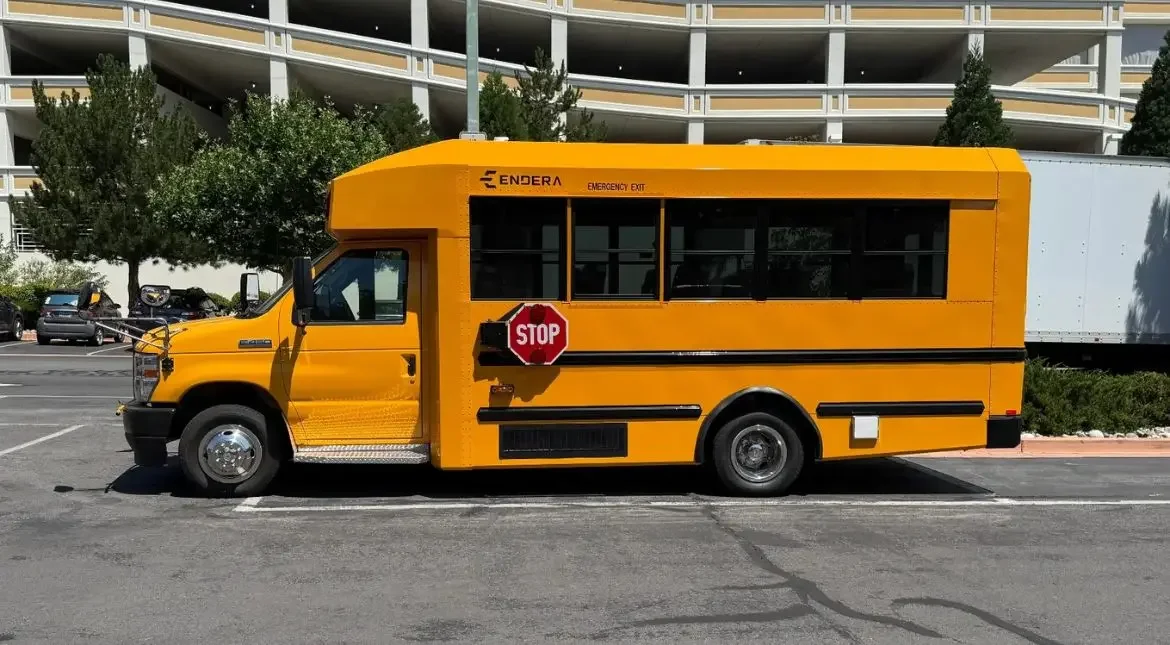
Endera manufactures Type A school buses in ICE, propane, CNG, and full-electric configurations on Ford E450 and Chevrolet Express cutaway chassis. Michigan's mix of dense urban districts and dispersed rural routes makes the Type A format — smaller, flexible, and available in multiple powertrains — a practical fit across a wide range of district profiles.
The next replacement cycle will come whether your district is ready or not — contact Endera's sales team today to start the conversation before the timeline tightens.
How Michigan School Districts Are Funding New Buses
Michigan has been one of the most active states in the country on clean school bus procurement. A $125 million state-funded clean bus program deployed approximately 322 electric buses across roughly 100 districts — and those funds were fully allocated, with the final round distributing $44 million to 27 districts. State-level funding has effectively been exhausted, but federal programs remain open.
The EPA's Clean School Bus Program carries a $5 billion nationwide funding pool running through 2026, with roughly 95% of awards directed toward zero-emission electric models. Michigan districts that haven't yet applied to federal rounds are still in the window — but demand is high and application cycles are competitive. Endera's grant navigation services help districts identify applicable programs and move through the application process without dedicating internal staff to grant administration.
Priority Funding for Rural and Low-Income Districts
Michigan's funding distribution hasn't been concentrated in larger urban districts alone. According to a Clean Fuels Michigan analysis, rural and low-income districts have been explicitly prioritized in funding allocation — one earlier round directed $54 million to 138 buses in underserved communities. A Bridge Michigan report found 46 districts applied for 155 buses in a single EPA cycle, signaling that demand from smaller districts remains active well beyond the state program.
For rural Michigan districts that haven't yet pursued clean bus funding, the priority weighting in federal programs is a meaningful advantage — not a footnote.
Is a Type A School Bus Right for Your Michigan District?
Type A buses are the standard choice for special education transport, shorter rural routes, and any application where a full-size Type C or D bus creates more operational overhead than the route justifies. They carry fewer students than larger models but offer a level of maneuverability and configuration flexibility that matters when routes include narrow roads, tight school turnarounds, or accessibility requirements.
Michigan's district geography reinforces this. Districts outside Detroit and Lansing often serve spread-out populations on routes that large buses handle inefficiently. Endera's Endera 4, 5, and 6 models are configurable across 4-to-6 section layouts, with ADA-compliant lift options and storage configurations available at the specification stage — not as aftermarket additions.
ICE vs. Electric: The Right Powertrain for Michigan Routes
The powertrain decision is a function of route structure, depot readiness, and budget timing — not a single statewide answer. Michigan's cold winters add a layer of consideration for electric buyers that doesn't apply to the same degree in warmer states.
When Electric Makes Sense
Electric Type A buses perform best on fixed, predictable routes with overnight depot charging. For Michigan districts that can support the infrastructure, the long-term economics are favorable: lower fuel costs, reduced brake and drivetrain maintenance, and federal funding that often covers charging equipment alongside the vehicles. Michigan has already supported approximately 900 low- and zero-emission buses through combined state and federal programs — proof the transition is operational, not theoretical.
When ICE or Bridge Fuels Are the Better Call
Districts with no existing charging infrastructure, irregular route structures, or procurement timelines that can't absorb an EV buildout should consider ICE, propane, or CNG as a near-term solution. Propane and CNG models reduce emissions relative to diesel without the infrastructure dependency of full electric. Endera builds all configurations on the same Type A platform, so a district can standardize on a single manufacturer and add electric units as depot conditions allow.
Michigan Compliance and Certification Requirements
Michigan requires school bus drivers to complete state-approved safety training and certification before operating any school bus — a requirement that applies regardless of powertrain. For electric models, districts should plan for additional operator familiarization, particularly around charging procedures and emergency protocols that differ from ICE operations.
Vehicles must meet Michigan Department of Education school bus standards and pass annual inspections administered through the state. Endera's Type A buses are engineered to exceed industry structural integrity standards and are available in ADA-compliant configurations. For districts pursuing federally funded purchases, Endera vehicles are Buy America compliant and FTA-eligible, meeting the documentation requirements attached to federal procurement without additional certification steps.
| Metric | Figure | Source |
|---|---|---|
| Registered school buses statewide | ~17,000 | Michigan EGLE, 2026 |
| Students transported annually | ~800,000 | Michigan EGLE, 2026 |
| State clean bus program total | $125M | Electrification Coalition |
| Electric buses deployed (state program) | ~322 buses, ~100 districts | Electrification Coalition |
| Low/zero-emission buses supported (total) | ~900 | Michigan EGLE, 2026 |
| U.S. school bus market size (2025) | ~$14.8B | Fortune Business Insights |
| Projected market size (2032) | ~$23.9B | Fortune Business Insights |
The global school bus market is projected to grow from approximately $14.8 billion in 2025 to $23.9 billion by 2032, driven primarily by electrification investment and fleet modernization programs. For Michigan districts evaluating whether a new bus purchase is a sound long-term investment, the market trajectory reinforces what the state's funding activity already suggests.
A Fleet Decision That Works in Both Directions
Several 2026 Type A models are available through Endera Stock for districts with immediate replacement needs. For districts working within formal bid processes, Endera's sales team provides full specification documentation, compliance materials, and grant application support.
Your next procurement shouldn't force a choice between speed and flexibility. Contact Endera's sales team today to discuss fleet configuration, powertrain selection, or funding strategy for your Michigan district.
Frequently Asked Questions
How much does a new Type A school bus cost in Michigan after grants?
Base pricing for new Type A school buses typically ranges from $80,000 to $150,000, depending on powertrain and configuration. Michigan's $125 million state clean bus program has already been fully allocated, but the EPA's Clean School Bus Program — with $5 billion in federal funding through 2026 — remains open for Michigan districts. Individual awards have ranged from tens of thousands to over $2 million per district, depending on fleet size and program eligibility.
Does Michigan's cold climate affect electric school bus performance?
Cold temperatures reduce battery range in all electric vehicles, including school buses. Michigan districts operating electric Type A buses should account for 15–25% range reduction in winter months when calculating daily route viability. Endera provides climate-adjusted range estimates during the sales process, and DC fast charging is standard on every electric unit — allowing rapid recharge between runs during high-demand cold weather periods.
What is the difference between the Endera 4, 5, and 6 school bus models?
The Endera 4, 5, and 6 differ primarily in body section count, which determines seating capacity, storage configuration, and ADA layout options. All three models are available in ICE, propane, CNG, and full-electric powertrains on Ford E450 and Chevrolet Express cutaway chassis. Districts with specific seating or accessibility requirements can configure each model across 4-to-6 section layouts at the specification stage.
Do rural Michigan districts qualify for clean bus funding?
Yes — and rural districts are often prioritized. Federal EPA Clean School Bus Program criteria include equity weighting that favors rural and low-income districts. One Michigan funding round directed $54 million specifically to 138 buses in underserved communities. Rural districts that have not yet pursued federal funding are encouraged to apply early in open cycles given the demand volume.
Are new buses required to qualify for state and federal funding, or do used buses qualify?
Most state and federal clean bus programs — including Michigan's $125 million program and the EPA Clean School Bus Program — require the purchase of new, qualifying vehicles. Used buses typically do not meet program eligibility requirements, and older vehicles purchased through informal channels may not meet Michigan's current inspection and compliance standards. New buses also qualify for manufacturer warranties that used vehicles won't carry.
How does Endera's Type A bus handle Michigan's school bus certification requirements?
Endera's Type A school buses are engineered to exceed federal and state structural integrity standards for student transport. ADA-compliant configurations meet federal accessibility requirements without aftermarket modification. For state-certified procurement — including FTA-funded purchases — Endera vehicles are Buy America compliant and carry the documentation districts need to satisfy Michigan Department of Education and state inspection requirements.
What software tools does Endera offer to help Michigan districts manage their fleets?
Every Endera school bus is compatible with Endera Dispatch, the company's fleet management platform. It includes real-time GPS tracking, geofence management, state-of-charge monitoring for electric units, and custom reporting dashboards. For districts managing mixed ICE and EV fleets during a transition period, Dispatch provides unified visibility across both powertrain types from a single interface.