
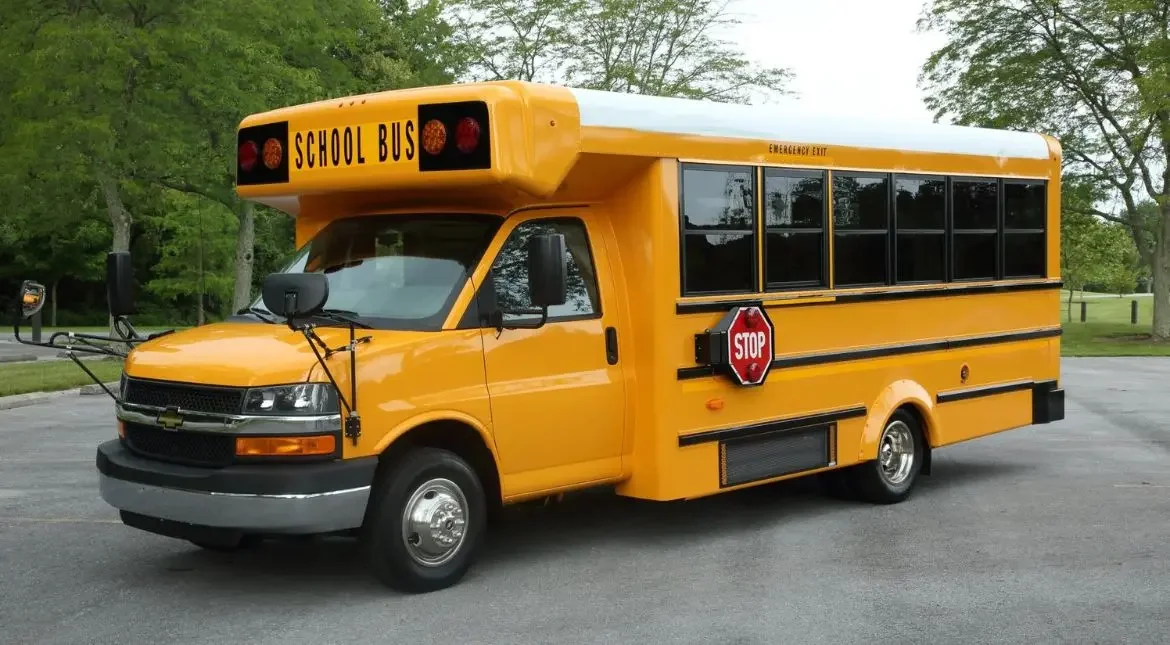
Pennsylvania moves roughly 1.4 million students on approximately 28,000 to 31,000 registered school buses every day — one of the largest student transport operations in the country. For district transportation directors, that scale means procurement decisions carry real budget weight, and the difference between the right vehicle and the wrong one compounds across a fleet over a decade of service.
Endera manufactures Type A school buses in ICE, propane, CNG, and full-electric configurations, built for the districts that need flexibility — not a single powertrain mandate. Pennsylvania's mix of dense urban corridors and rural routes makes that flexibility particularly relevant.
Make a procurement decision your district won't have to revisit in three years — contact Endera's sales team today to compare configurations and assess grant eligibility.
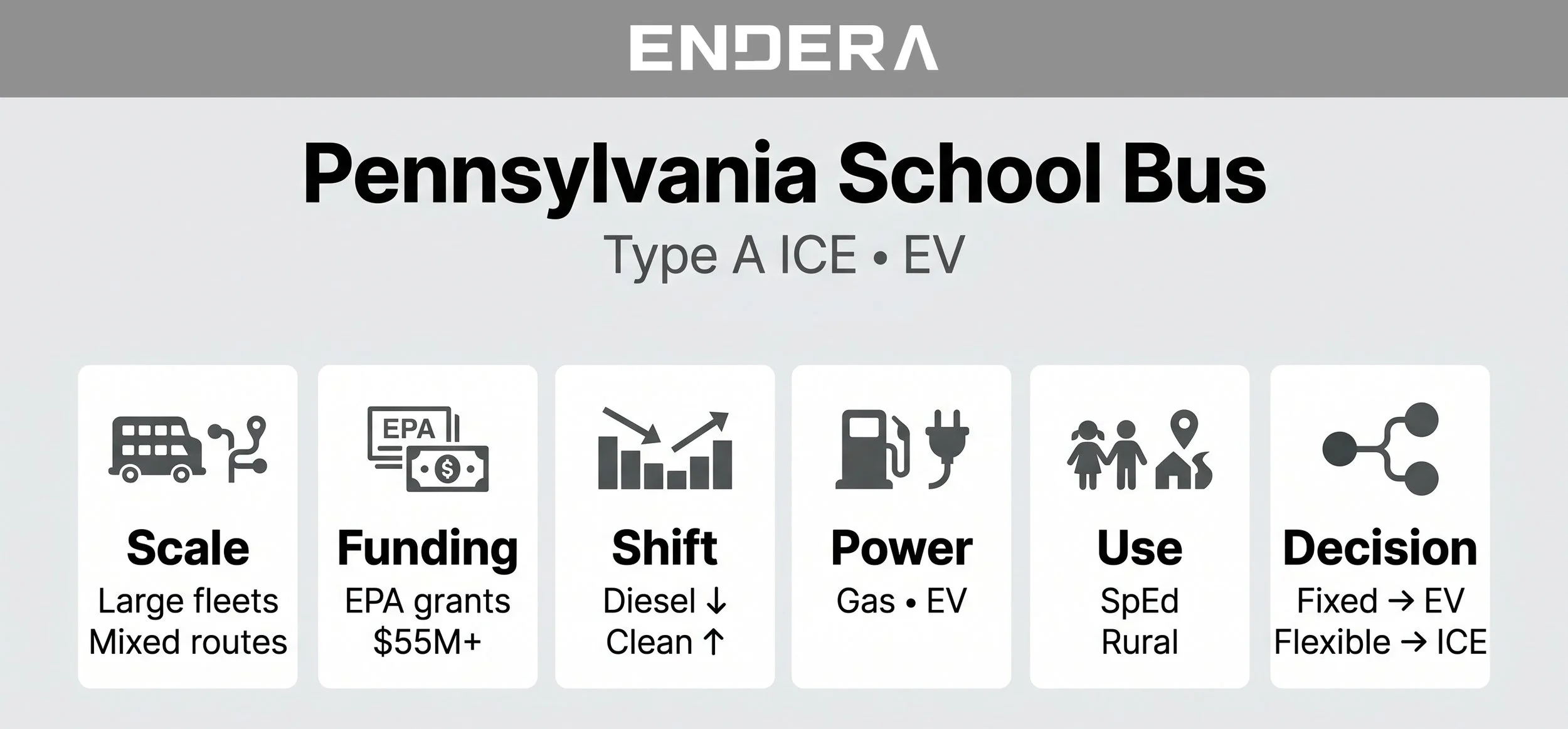
Is a Type A Bus Right for Your Pennsylvania District?
Type A school buses are smaller, purpose-built vehicles designed for routes where a full-size Type C or D bus is either unnecessary or impractical. They're the standard choice for special education transport, lower-density rural runs, and short urban loops where maneuverability matters as much as capacity.
Pennsylvania's geography reinforces this. Districts outside Philadelphia and Pittsburgh often serve dispersed student populations across roads that don't accommodate large bus footprints well. Endera's Type A lineup — the Endera 4, 5, and 6 — offers 4-to-6 section configurations for seating, ADA-compliant lift options, and storage, all on Ford E450 and Chevrolet Express cutaway chassis.
How Pennsylvania Schools Are Funding New Buses
The cost conversation in Pennsylvania has shifted significantly. The EPA has awarded $55.7 million in clean school bus rebates across the state, funding 213 buses in 21 districts. That's a single program round — not the full picture of available support.
At the national level, roughly $3 billion has already been distributed and approximately 8,500 buses replaced through EPA Clean School Bus funding alone, out of a $5 billion total program that includes both vehicles and charging infrastructure. Pennsylvania districts that haven't applied are leaving money on the table — and the application window is competitive.
Real-World Example: Small PA District, $2.3M in Funding
The funding isn't limited to large urban districts. A small Pennsylvania school district successfully secured $2.3 million through the EPA Clean School Bus Program — covering vehicles, charging infrastructure, and a portion of operational transition costs.
That case is significant because it demonstrates that rural and low-enrollment districts are eligible and competitive. Endera's grant navigation services assist districts through the application process, from identifying applicable programs to managing submission and compliance documentation.
Why Pennsylvania Schools Are Moving Away from Diesel
Diesel school buses carry a documented public health cost. Diesel exhaust exposure is linked to elevated rates of asthma, lung inflammation, and respiratory illness in children — a reality Pennsylvania's own reporting on federal clean bus funding has highlighted as a primary driver of the state's participation in EPA replacement programs.
The emissions case is also measurable. According to EPA research on emissions reduction, replacing older diesel buses with newer clean-fuel or zero-emission vehicles can reduce harmful emissions by up to 90%. For districts managing aging fleets, the health argument and the funding argument point in the same direction.
ICE vs. Electric: Choosing the Right Powertrain for PA Routes
The honest answer is that neither powertrain is universally correct for Pennsylvania districts. The right choice depends on route structure, infrastructure readiness, and where the district sits in its budget cycle.
When Electric Makes Sense
Electric Type A buses perform best on fixed, predictable routes with overnight depot charging — the profile that matches most special education and suburban loops. National market data from the Electric School Bus Initiative's 2024 market study confirms that the majority of new federal funding is flowing toward zero-emission models, making EV the more financially advantageous choice for districts that can support the infrastructure.
Lower fuel and maintenance costs reduce total cost of ownership meaningfully over a 10-to-12-year service life — and charging infrastructure costs are often covered by the same funding programs that cover the vehicles themselves.
When ICE or Alternative Fuels Are the Better Call
Districts with irregular routes, no existing charging capability, or procurement timelines that don't align with EV infrastructure buildout should consider ICE, propane, or CNG models as a nearer-term solution. Endera builds all three configurations on the same Type A platform, which means a district can standardize on a single manufacturer and add electric units to the fleet as conditions allow — rather than splitting service relationships across multiple vendors.
| Funding Program | Amount Available | Who Qualifies | Covers |
|---|---|---|---|
| EPA Clean School Bus Program | $5B nationwide | All PA districts | Vehicles + charging infrastructure |
| PA Alternative Fuels Incentive Grant (AFIG) | Up to $300K per application | PA districts + fleets | Clean/alternative fuel vehicles |
| EPA Rebate Round (PA-specific) | $55.7M awarded | 21 PA districts funded to date | Bus replacement |
| FTA Transit Grants | Varies by program | FTA-eligible operators | Buy America compliant vehicles |
Pennsylvania Compliance and Procurement Requirements
Pennsylvania school districts are required to report detailed transportation data — mileage, vehicles used, students transported — to qualify for state pupil transportation subsidies. That reporting obligation makes vehicle documentation and manufacturer compliance credentials a procurement requirement, not just a preference.
Endera's Type A buses are engineered to exceed industry structural integrity standards and are available in ADA-compliant configurations. For districts pursuing federally funded procurement, Endera vehicles are Buy America compliant and FTA-eligible — meeting the requirements attached to federal contract vehicles without additional certification steps.
Ready to Spec a Bus for Your Pennsylvania District?
New 2026 Type A models are available for direct purchase or through Endera's dealer network. For districts working within formal procurement processes, Endera's sales team provides specification documentation, compliance materials, and grant application support. Several units from Endera Stock are available for immediate delivery for districts with pressing replacement timelines.
Pennsylvania procurement decisions have long tails — get ahead of yours. Contact Endera's sales team today to discuss fleet configuration, powertrain options, or funding strategy for your district.
Frequently Asked Questions
How much does a Type A school bus cost in Pennsylvania after incentives?
Upfront pricing for new Type A school buses typically ranges from $80,000 to $150,000 depending on powertrain and configuration — but Pennsylvania districts have access to funding that substantially reduces net cost. The EPA Clean School Bus Program has awarded $55.7 million to 21 PA districts in a single round, with individual awards reaching $2.3 million or more for smaller districts. Actual out-of-pocket cost depends on the programs a district qualifies for and applies to.
What is the difference between the Endera 4, 5, and 6 school bus models?
Endera's Type A school buses — the Endera 4, 5, and 6 — differ primarily in body section count, which determines seating capacity, storage configuration, and ADA layout options. All three are available on Ford E450 and Chevrolet Express cutaway chassis in ICE, propane, CNG, and EV powertrains. Districts with specialized seating or accessibility requirements can configure each model across 4-to-6 section layouts.
Does Pennsylvania have its own school bus funding programs beyond federal grants?
Yes. Pennsylvania operates the Alternative Fuels Incentive Grant (AFIG) program, which provides up to $300,000 per application for clean and alternative-fuel vehicle purchases — including school buses. This stacks with federal EPA funding for districts pursuing electric or CNG models. State pupil transportation subsidies also offset operational costs based on fleet and route reporting, which makes accurate documentation a financial priority for district transportation departments.
Are electric school buses reliable enough for Pennsylvania's winter conditions?
Battery performance in cold weather is a real consideration for any EV operation. Endera's electric Type A buses use a 150 kWh battery pack with DC fast charging standard, and the company provides route-specific range estimates that account for climate factors. Districts in higher-elevation or colder regions of Pennsylvania should discuss winter performance expectations directly with Endera's sales team during the specification process.
Do Pennsylvania school districts need to go through a formal bid process to buy from Endera?
Many Pennsylvania school districts are required by state law to conduct competitive procurement for vehicle purchases above certain dollar thresholds. Endera's sales team provides specification documentation, compliance materials, and supporting information for formal bid submissions. Districts using cooperative purchasing contracts or state procurement vehicles should confirm whether those pathways apply to their specific purchase structure.
What health benefits are associated with replacing older diesel school buses?
Diesel exhaust contains particulate matter and nitrogen oxides linked to asthma, lung inflammation, and long-term respiratory illness — with children at elevated risk due to physiological factors and time spent on buses. EPA research indicates that replacing older diesel buses with clean-fuel or zero-emission models can reduce harmful emissions by up to 90%. Pennsylvania's participation in EPA replacement programs is partly driven by documented health outcomes in student populations served by aging diesel fleets.
How long does it take to receive a new Type A school bus from Endera?
Lead times depend on configuration complexity and whether a district is purchasing from in-stock inventory or specifying a custom build. Endera maintains ready-to-deliver units through its Endera Stock program for districts with urgent replacement timelines. Custom configurations — specific seating layouts, ADA setups, or powertrain specs — carry longer production lead times that the sales team can confirm during the initial specification conversation.