
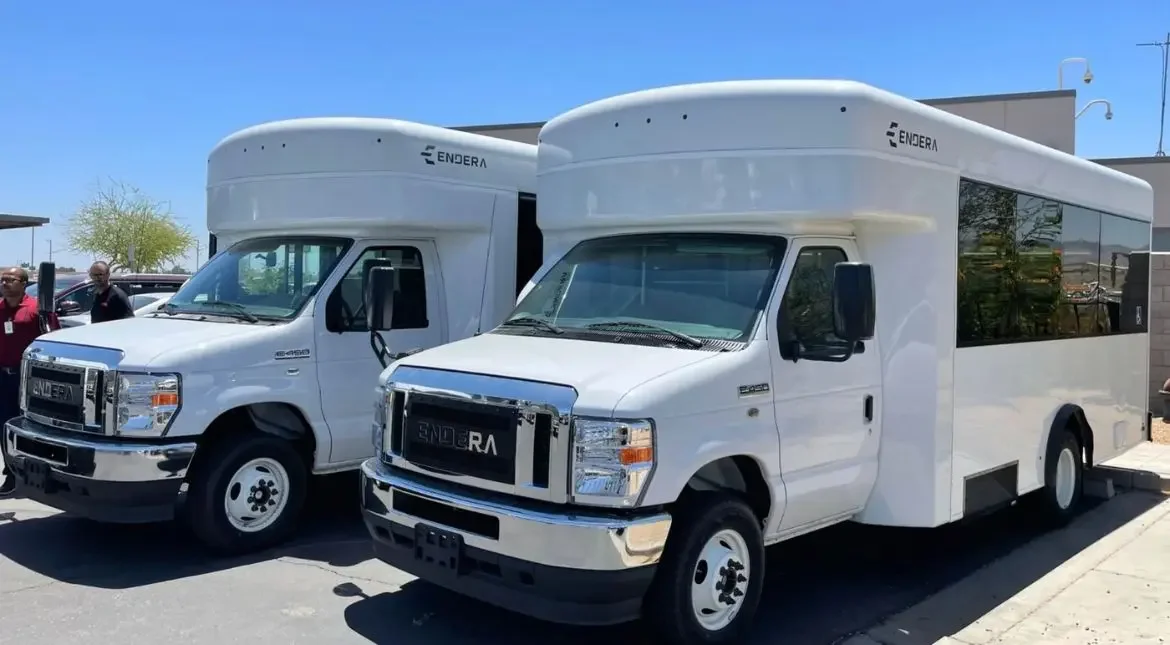
Delaware's transit infrastructure punches above its weight for a state its size. The Delaware Transit Corporation operates over 200 fixed-route buses alongside demand-response vehicles, backed by approximately $136 million in annual operating funding — and that funding base is actively supporting fleet modernization, not just operations. For private operators, hotels, corporate campuses, and municipal contractors, that investment signals a market with consistent, ongoing demand for reliable passenger transport vehicles.
Endera manufactures Class 4 B-Series commercial shuttles in ICE, propane, CNG, and full-electric configurations on Ford E450 and Chevrolet Express cutaway chassis. For Delaware's fleet operators — public and private — the B-Series offers a right-sized, commercially built alternative to van conversions that can't sustain daily high-cycle use.
Delaware's fleet modernization window is open — connect with an Endera specialist today to find the right B-Series configuration for your operation.
How Delaware Fleets Are Funded
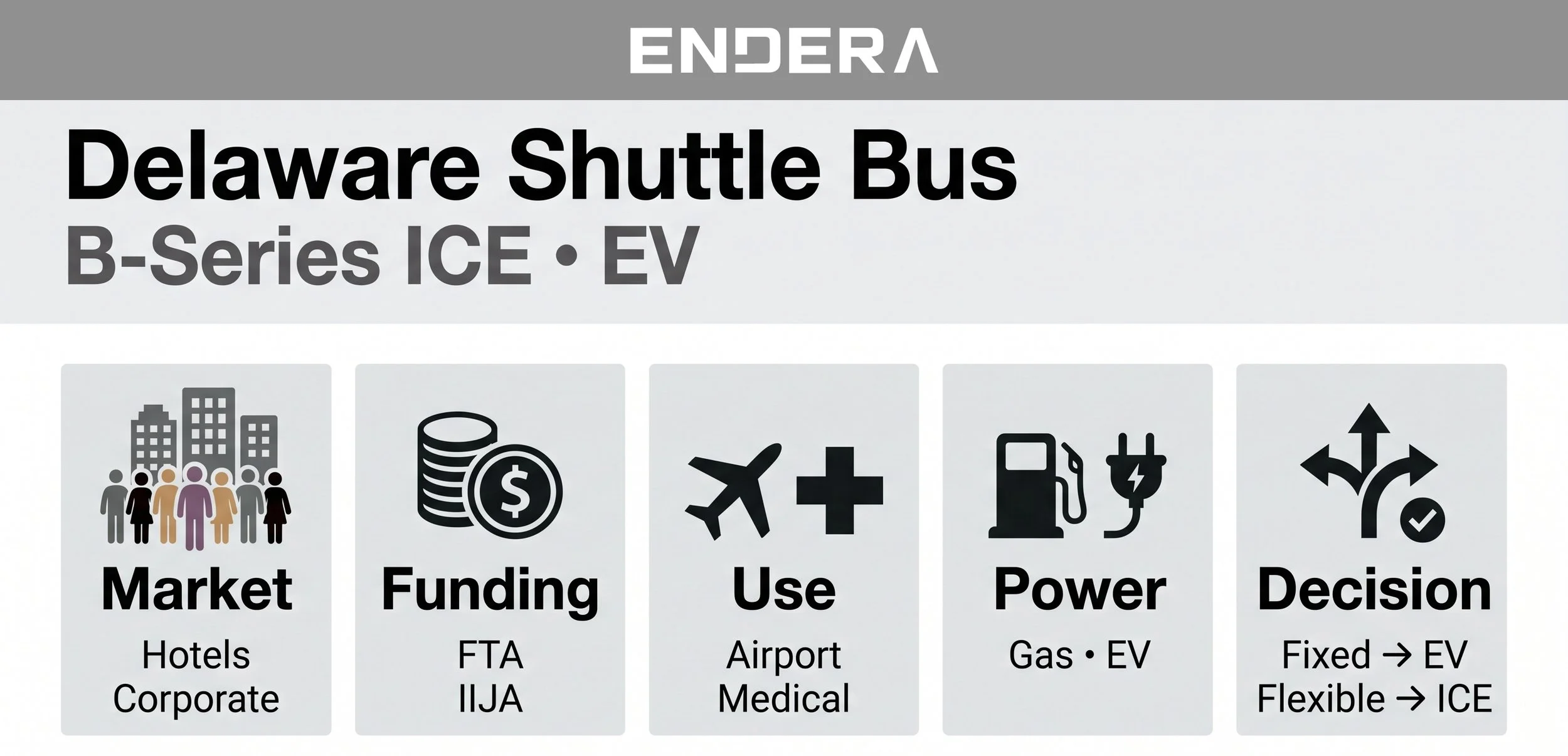
Federal investment in Delaware's fleet infrastructure is active and measurable. In 2026, the Delaware Transit Corporation secured a $14.3 million FTA Bus & Bus Facilities grant specifically for fleet upgrades and lifecycle extension — part of a consistent federal funding pipeline that has supported Delaware transit operations for years.
Private fleet operators don't access FTA grants directly, but the federal infrastructure established through programs like the Infrastructure Investment and Jobs Act (IIJA) supports EV charging deployment and fleet electrification incentives that are available to commercial operators. Endera's grant navigation and financing services help Delaware fleets identify the programs applicable to their ownership structure — whether that's a transit authority, a hotel chain, or a regional transport contractor.
When to Replace vs. Upgrade Your Shuttle Fleet
Delaware's transit experience offers a useful framework for any fleet operator weighing replacement against continued maintenance investment. When DART First State used federal grant funding to extend bus lifespans from 12 to 18 years through refurbishment, the strategy generated an estimated $7.4 million in projected savings versus full fleet replacement.
That calculus works for large transit fleets with established maintenance infrastructure — but it doesn't always apply to private shuttle operators. A converted van or aging commercial bus that requires recurring mechanical attention typically costs more to maintain past its optimal replacement point than a new purpose-built vehicle amortized over a full service life. For operators still running vehicles past the 10-year mark on high-cycle routes, the replacement math usually favors new over extended maintenance.
Delaware Shuttle Market: Who's Buying and Why
Delaware's geography concentrates its commercial transport demand. Wilmington's corporate corridor, Dover's government and hospitality activity, and the Rehoboth Beach tourism market generate distinct but consistent shuttle demand across sectors. Key buyer profiles in the state include:
Hotel and hospitality operators — airport and property loops serving Wilmington and the I-95 corridor
Corporate campuses — employee transport for financial and pharmaceutical operations based in northern Delaware
Senior and medical transport — non-emergency medical transport and assisted living shuttle services
Municipal contractors and regional operators — private carriers serving transit contract routes alongside DART
Fixed-route ridership in Delaware accounts for approximately 79% of total system usage, with millions of annual trips statewide. Private operators who hold or compete for transit contracts need vehicles that meet commercial certification standards — not modified passenger vans.
ICE vs. Electric: The Delaware Decision
Delaware is in an early but active phase of fleet electrification. DART First State has received multiple federal grants supporting electric bus deployment, and the state's transit expansion plans are designed to reach 35% more residents over the coming years — a growth trajectory that increases demand for new fleet assets across both public and private operators.
When Electric Makes Sense
Delaware's short inter-city distances and consistent daily routes make it a practical EV environment. Electric B4 and B5 models are well-suited to Wilmington corporate loops, hotel airport runs, and medical transport routes with predictable daily mileage. Endera's turnkey charging solutions — including site assessments, DC fast charger procurement, and metering installation — handle the infrastructure side of an EV transition without requiring operators to source those services separately.
When ICE or Bridge Fuels Are the Better Call
Operators running irregular routes, managing multiple depot locations, or working within procurement cycles that don't support an infrastructure buildout should consider ICE, propane, or CNG models as a current-cycle solution. All B-Series configurations share the same platform, so standardizing on Endera now doesn't lock an operator into a single powertrain for future purchases.
What Sets the B-Series Apart From Van-Based Alternatives
Delaware's smaller market size means fleet operators often evaluate converted passenger vans alongside purpose-built commercial shuttles — and the distinction matters more than the price difference suggests. Van conversions are built on light-duty platforms not engineered for the daily cycle counts, passenger loads, and route intensity that commercial shuttle work demands. Structural fatigue, suspension wear, and interior degradation accumulate faster, and the maintenance cost curve steepens earlier in the vehicle lifecycle.
The B-Series is built on Ford E450 and Chevrolet Express cutaway chassis — medium-duty platforms rated for the kind of use Delaware hotel, corporate, and transit operators actually put their vehicles through. Non-slip flooring, face-forward seating, and 70,000 BTU climate control are standard across the lineup, not optional upgrades.
Endera's Software Platform: Operational Value Beyond the Vehicle
For Delaware operators managing more than a couple of vehicles, the data layer matters as much as the hardware. Every B-Series shuttle includes Endera Dispatch — an AI-powered fleet management platform with real-time GPS tracking, geofence management, onboard edge computing, and custom reporting dashboards, all at no additional cost.
Electric operators benefit from state-of-charge monitoring and demand-based charging schedules that keep vehicles off peak-rate windows. The passenger-facing Endera Go app delivers live location and ETA data — a meaningful advantage for airport and hotel operators where wait-time perception drives reviews.
Both platforms are built and maintained in-house, meaning updates, support, and vehicle-to-software data flow through a single vendor.
Proven Performance: San Diego Airport as a Reference Point
Delaware fleet operators evaluating the electric B-Series don't have to rely on projections alone. SP+, the parking partner at San Diego International Airport, operates Endera's electric shuttle fleet on high-frequency airport loops and has forecasted approximately $20,000 in annual savings per vehicle compared to LPG and CNG equivalents.
Delaware's Wilmington-area airport and hotel shuttle operators run comparable route profiles — fixed circuits, high daily cycle counts, predictable mileage. The operating conditions that produced San Diego's savings figures translate directly to that use case. For an operator running a fleet of five vehicles, that's a projected $100,000 in annual savings at scale — a number that changes the financing conversation considerably when weighed against the upfront cost difference between ICE and EV.
The B-Series Lineup for Delaware Operators
| Model | Length | Fuel Options | Best Fit |
|---|---|---|---|
| B3 | 23 ft | ICE | Hotel loops, small urban routes |
| B4 | 24 ft | ICE & EV | Airport shuttles, corporate campuses |
| B5 | 25 ft | ICE & EV | Employee transport, larger corporate circuits |
| B8 | 28 ft | ICE | Municipal transit, high-volume group transport |
All models are built on Ford E450 and Chevrolet Express cutaway chassis, with body assembly and powertrain installation handled at Endera's Ottawa, Ohio manufacturing facility. Buyers receive a single warranty document — not split coverage across chassis and body from separate vendors.
Ready to Spec a Shuttle for Your Delaware Fleet?
Several 2026 B-Series units are available for immediate delivery through Endera Stock, including flat-floor configurations with 800 lb Braun ADA lifts, standard 14-passenger units, and multiple seating layouts ready for deployment. For operators working within formal procurement or contract bid processes, Endera's sales team provides full specification documentation and compliance materials.
Your next Delaware fleet vehicle is already built and ready to ship. Contact Endera's sales team today to discuss fleet configuration, available powertrain options, or financing for your operation..
Frequently Asked Questions
What shuttle bus sizes are available for Delaware fleet operators?
Endera's B-Series lineup spans 23 to 28 feet across four models: the B3, B4, B5, and B8. The B4 and B5 are available in both ICE and full-electric configurations, making them the most flexible options for Delaware operators planning a near-term EV transition. The B3 and B8 are ICE-only and suited to hotel loops and high-volume municipal routes respectively.
Are there federal funding programs available for private shuttle fleet operators in Delaware?
Private commercial operators don't access FTA grants directly — those are reserved for public transit agencies. However, federal programs under the IIJA and EPA's clean vehicle incentives are available to commercial fleet operators for EV purchases and charging infrastructure. Endera's grant navigation services help identify which programs apply to a specific operator's structure and assist with the application process.
What is the typical service life of a B-Series shuttle bus?
Commercial shuttle buses operating on daily high-cycle routes typically have a service life of 10 to 12 years when maintained properly. Delaware's transit experience — extending bus lifespans through structured refurbishment — demonstrates that well-maintained vehicles can run longer, but the economics depend on maintenance cost versus replacement cost at each cycle. Endera's sales team can provide total cost of ownership modeling based on route intensity and annual mileage.
Does Endera offer ADA-compliant configurations for Delaware transport operators?
Yes. Flat-floor B-Series configurations are available with 800 lb Braun ADA lifts as standard equipment, suitable for senior transport, non-emergency medical transport, and any application requiring accessible passenger loading. Current in-stock units include ADA-configured models available for immediate delivery.
What software tools does Endera provide to Delaware fleet operators?
Every B-Series commercial shuttle is compatible with Endera Dispatch, which includes real-time GPS tracking, AI-powered routing, geofence management, and state-of-charge monitoring for electric units. The rider-facing Endera Go app provides passengers with live vehicle location and ETA data. Both platforms are built and supported in-house, with no third-party telematics integration required.
How does Endera's vertical integration benefit Delaware buyers compared to upfitter-assembled vehicles?
Upfitter-assembled shuttles involve a chassis manufacturer, a separate body builder, and often a third-party electrification vendor — three separate warranty documents, three service relationships, and three potential gaps in quality accountability. Endera installs the powertrain and assembles the body at a single facility in Ottawa, Ohio, producing a unified vehicle with one warranty and one point of contact for service issues. The B4 electric shuttle's Altoona durability test score of 90.1 — the highest in its class — reflects what that integrated process produces.
Can Delaware operators purchase Endera shuttles through cooperative purchasing contracts?
Cooperative purchasing contracts depend on the specific program and operator type. Endera's sales team can confirm whether current cooperative purchasing pathways apply to a given operator's procurement structure and provide the documentation required for contract-aligned purchases. For operators outside public procurement, direct purchase through the sales team is the standard process.