
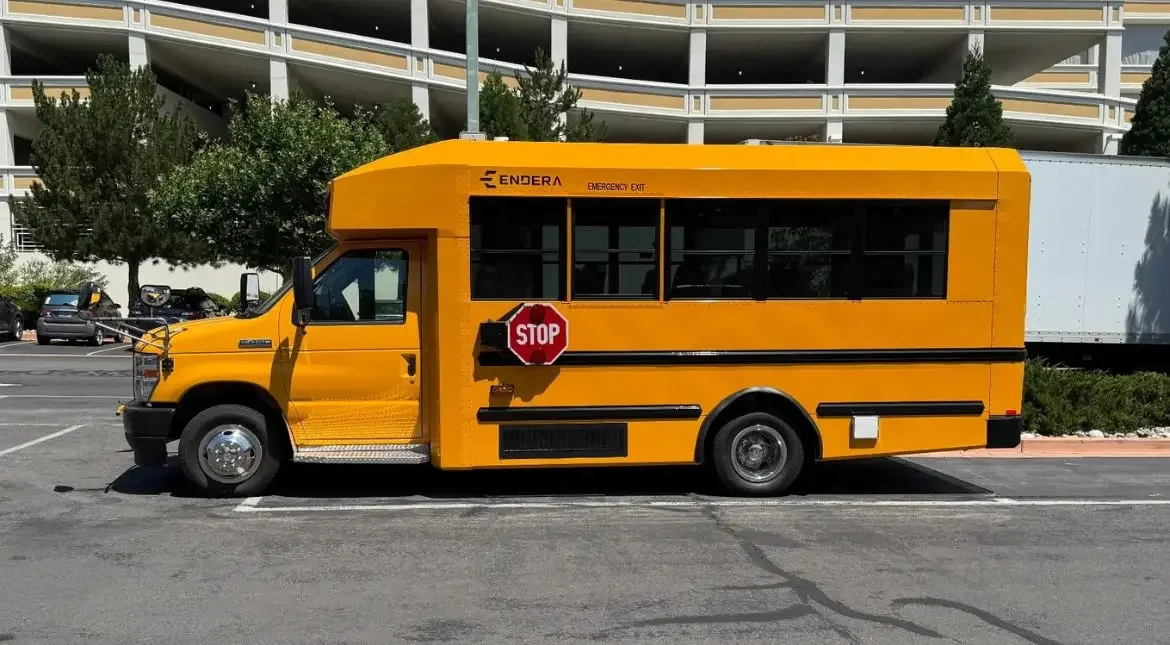
Wisconsin school districts operate in a flexible environment with no EV mandates or state purchase rebates, relying mainly on competitive federal funding cycles. While funding gaps exist between rounds, districts have successfully secured EPA-funded electric buses, supported by resources like Wisconsin Clean Cities. The key challenge is building a procurement strategy that aligns with these funding timelines.
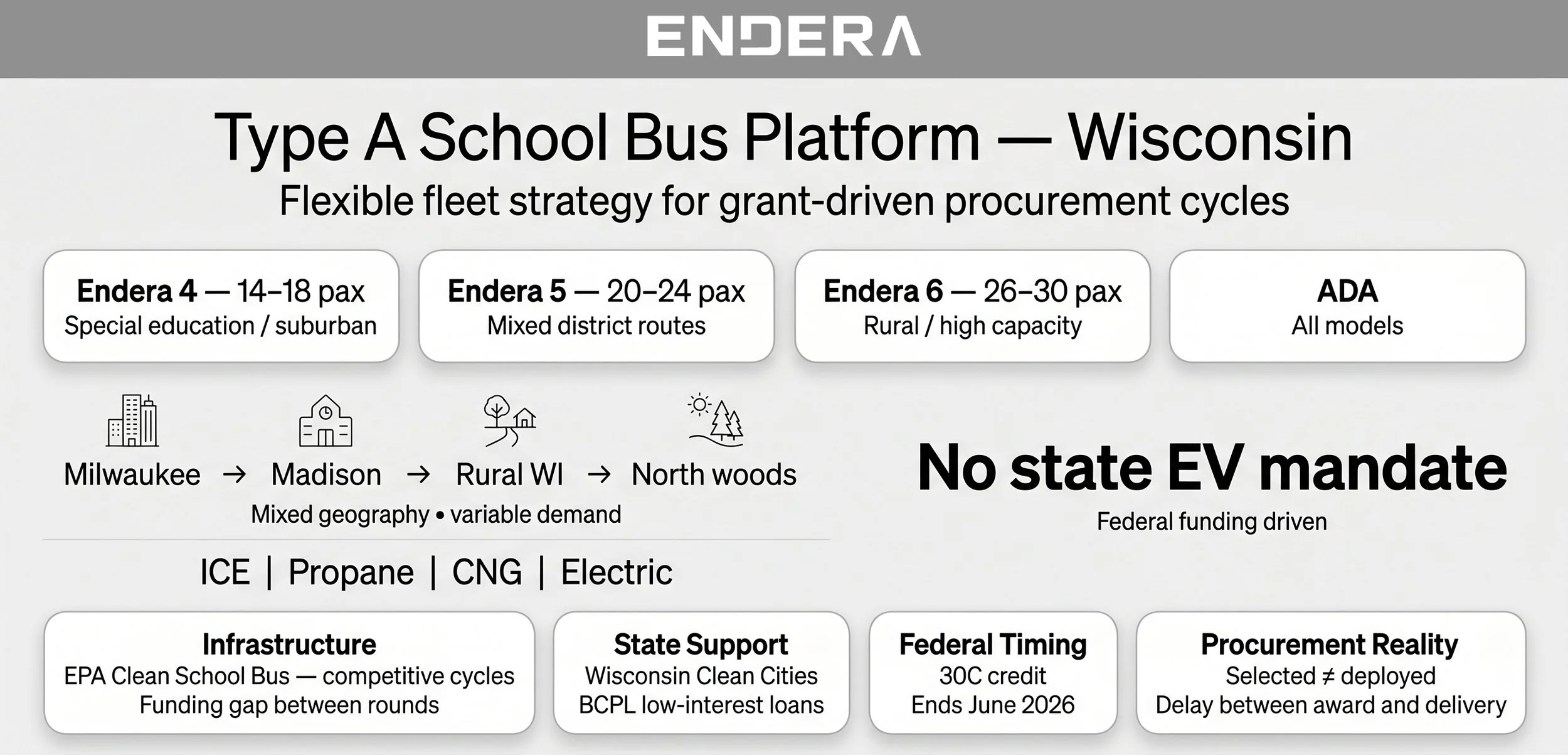
Endera's Type A school buses — the Endera 4, 5, and 6 — are available in ICE, propane, CNG, and full electric configurations, manufactured at the company's Ottawa, Ohio facility and built to serve Wisconsin's range of routes from Milwaukee suburban special education circuits to long rural runs in the north woods.
The next federal funding round won't wait — talk to an Endera specialist today to make sure your district is positioned before the window opens.
Wisconsin's School Bus Landscape: No Mandate, Real Opportunity
Federal Funding Is the Primary Tool — And It's Competitive
Wisconsin has no statewide electrification requirement for school bus fleets and no state-level vehicle purchase rebate. The EPA Clean School Bus Program is the dominant funding mechanism, and Wisconsin districts have successfully accessed it. The 2026 funding round is currently being designed following a public comment period — the program is restructuring after delays in the 2024 award cycle, and no awards are moving forward from that round.
That creates the same planning gap Wisconsin districts have navigated before: the buses on today's routes keep aging while the next funding window takes shape. Districts that treat procurement as a continuous strategy — not a one-time grant event — are better positioned when the next round opens.
Wisconsin Clean Cities and State Support Resources
Wisconsin Clean Cities is a DOE-affiliated coalition that provides direct support to Wisconsin districts navigating federal and state funding applications. Their team helps districts assess which technology fits their routes, understand local weather and infrastructure constraints, and prepare applications ahead of program deadlines — a meaningful resource for smaller districts without dedicated grant staff.
The Board of Commissioners of Public Lands (BCPL) offers low-interest loans to Wisconsin school districts for energy projects including electrification. The Wisconsin DOA also offers grants for public transit bus replacement. These state-level tools are supplementary rather than primary, but they provide pathways for districts that need to bridge funding gaps between federal award cycles.
The Funding Gap Window: What WI Districts Do Between EPA Rounds
Aging Fleets Don't Wait for Federal Cycles
The EPA Clean School Bus Program has consistently attracted more applications than available funding, with districts applying for billions while only a fraction was awarded in each cycle. As of 2026, the program is in a restructuring period with no 2024 awards moving forward. Wisconsin districts can't simply wait. Diesel buses continue to age, maintenance costs rise, and operational failures don't align with grant timelines. Districts that navigate this most effectively treat the gap as a preparation window — not a pause.
Treating Procurement as a Continuous Strategy
Practical strategies for Wisconsin districts during funding gaps include phased procurement—using ICE or propane buses now while reserving EVs for routes best suited to electrification when funding arrives. Pre-specifying vehicles also helps districts act quickly when awards are announced.
Conditional purchase agreements can further reduce risk by tying orders to funding approval. Endera supports Wisconsin districts in aligning vehicle selection with funding timelines so they’re ready to move when the next EPA funding round opens.
The Funding Gap Window: What WI Districts Do Between EPA Rounds
"Selected" Is Not the Same as "Funded and Deployed"
Most EPA-linked content implies a simple sequence: funding is announced, districts apply, buses arrive. The EPA Clean School Bus Program operates through a multi-stage federal process where selection is only one step in a longer administrative and operational chain — covering application, review, selection, documentation, payment processing, and final delivery, with each phase requiring separate compliance and verification before funds are fully realized.
Between selection and delivery, Wisconsin districts often face delays from procurement rules, supply chain timing, infrastructure setup, and utility coordination. Even after award approval, reimbursement depends on completing required documentation and purchase orders.
The main challenge isn’t eligibility for federal funding, but the time lag between award notification and full operational readiness, which can take months or longer when all elements must align.
Procurement Strategy Is the Competitive Advantage
Districts that pre-specify vehicle configurations, prepare procurement frameworks in advance, and align infrastructure planning early are better positioned to convert future EPA selections into actual fleet deployment without delay. The districts that struggle aren't the ones that failed to apply — they're the ones that won an award without having the purchase order, the charging infrastructure plan, or the utility coordination ready to execute immediately. Winning an award is the beginning of the administrative process, not the end of it. Endera works with Wisconsin districts on exactly this preparation — aligning vehicle specifications, purchase structures, and infrastructure planning before the award notification arrives, so the operational chain can move without delay the moment it does.
The Endera Type A Lineup for Wisconsin Districts
Three Models for Wisconsin's Range of School Transportation
The Endera 4, 5, and 6 cover 14 to 30 passengers across 4 to 6 section configurations, with options for standard seating, ADA-compliant wheelchair lifts, and storage layouts for special education and general student transport.Wisconsin’s Type A routes range from short, predictable suburban special education circuits in Milwaukee and Madison—well suited for electrification—to longer rural northern routes with limited charging access and fewer backup options.
Endera’s integrated manufacturing allows districts to configure buses to specific needs rather than adapting to a standard design.
Built Close, Delivered Faster
Endera's manufacturing facility in Ottawa, Ohio sits just across Wisconsin's eastern border via I-90 and I-94. That geographic proximity translates into shorter lead times for Wisconsin districts compared to vehicles shipped from distant facilities, and easier access to direct manufacturer support. With approximately 65% of components sourced within Ohio, the domestic supply chain also supports Buy America compliance for federally funded Wisconsin district purchases.
What Wisconsin Districts Pay: The Per-Bus Financial Picture
Federal Programs After the 2025 Changes
The 45W commercial clean vehicle credit — which previously provided up to $40,000 per electric school bus — was eliminated for vehicles acquired after September 30, 2025. The 30C charging equipment credit — up to $100,000 per installed charging port — remains available for equipment placed in service through June 30, 2026. For Wisconsin districts planning depot charging installations, that deadline is actionable now: equipment must be physically placed in service, not just purchased or contracted. Endera's team helps districts coordinate installation timelines to capture this credit before it closes.
A Simplified Per-Bus Cost View
| Scenario | Approximate Cost |
|---|---|
| Diesel / propane Type A bus | $90K–$130K |
| Electric Type A bus | $300K–$400K |
| EPA Clean School Bus grant (priority district) | Up to $325K including infrastructure |
| Net cost after EPA funding | Near parity or modest premium |
For Wisconsin districts that qualify for EPA priority status — rural communities, low-income districts — the effective per-bus cost after grant funding approaches diesel parity. For non-priority districts, a premium remains but is significantly reduced. Without EPA funding, the upfront gap is real, which is why the BCPL loan program and phased procurement strategies matter for districts that need to move before the next grant cycle opens.
Built for Wisconsin's Practical School Transportation Market
Wisconsin districts make good fleet decisions without mandate pressure — and the best ones treat procurement as a multi-year strategy rather than a single grant application. Endera's Type A lineup covers every fuel type Wisconsin routes require, and the team behind it knows the current funding landscape, including what changed in 2025, well enough to help districts build a plan that actually works.
Build a procurement strategy that survives the next funding gap. Talk to an Endera specialist today to find the right Type A configuration and funding strategy for your Wisconsin district.
FAQs
Is there a school bus electrification mandate in Wisconsin?
No. Wisconsin has no statewide electrification requirement for school bus fleets. Districts choose fuel type based on operational fit, infrastructure readiness, and available funding.
Which Endera Type A models are available for Wisconsin districts?
The Endera 4, 5, and 6 are all available in ICE, propane, CNG, and full electric configurations, with ADA-accessible layouts for special education transport on both Ford and Chevrolet cutaway chassis.
What funding is available for Wisconsin school districts buying electric buses?
The EPA Clean School Bus Program is the primary mechanism — the 2026 round is being designed following public comment. The 30C charging equipment credit (through June 2026) applies to depot charging installation. BCPL loans provide low-interest financing for school energy projects. Wisconsin Clean Cities helps districts navigate application processes.
Is the 45W vehicle tax credit still available for Wisconsin districts?
No. The 45W commercial clean vehicle credit was eliminated for vehicles acquired after September 30, 2025. The 30C charging credit remains available through June 30, 2026.
How does Wisconsin's cold weather affect electric school bus performance?
Cold temperatures reduce effective range due to heating load and reduced battery performance. Short, depot-based routes in urban areas absorb this well. Longer rural routes require conservative range planning. Endera's Dispatch platform provides real-time state-of-charge monitoring to help districts manage seasonal variability.
Do Endera buses comply with Buy America requirements?
Yes. With approximately 65% of components sourced domestically from Endera's Ohio facility, Endera's buses support Buy America compliance for federally funded Wisconsin district purchases.
How do Wisconsin districts work with Endera on grant timing?
Endera's grant advisory team helps Wisconsin districts prepare EPA applications, align vehicle selection with funding timelines, and structure purchases — including phased procurement and conditional ordering — so districts are positioned to move when the next funding round opens.