
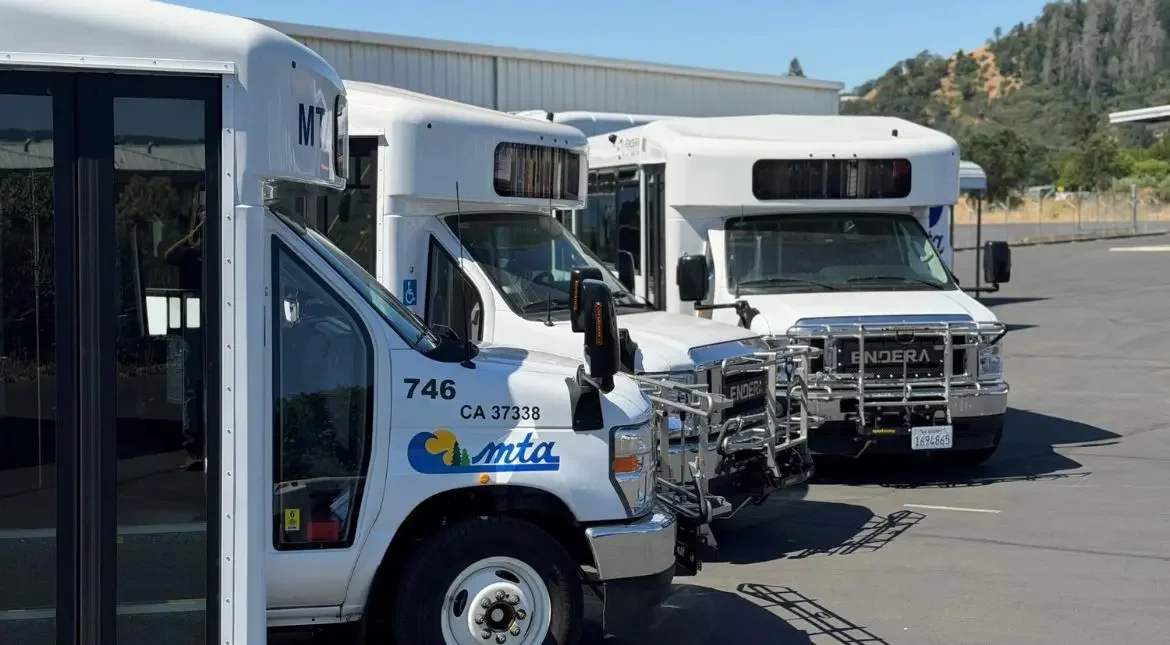
Connecticut's shuttle market combines dense Northeast demand with strong EV policies. The state follows California's Advanced Clean Cars II and Advanced Clean Trucks standards, has joined the ZEV MOU, and will require state agencies to purchase only ZEVs starting in 2026. For operators serving hotels, universities, casinos, and Bradley International Airport, the policy direction is clear and supported by one of the densest charging networks in New England.
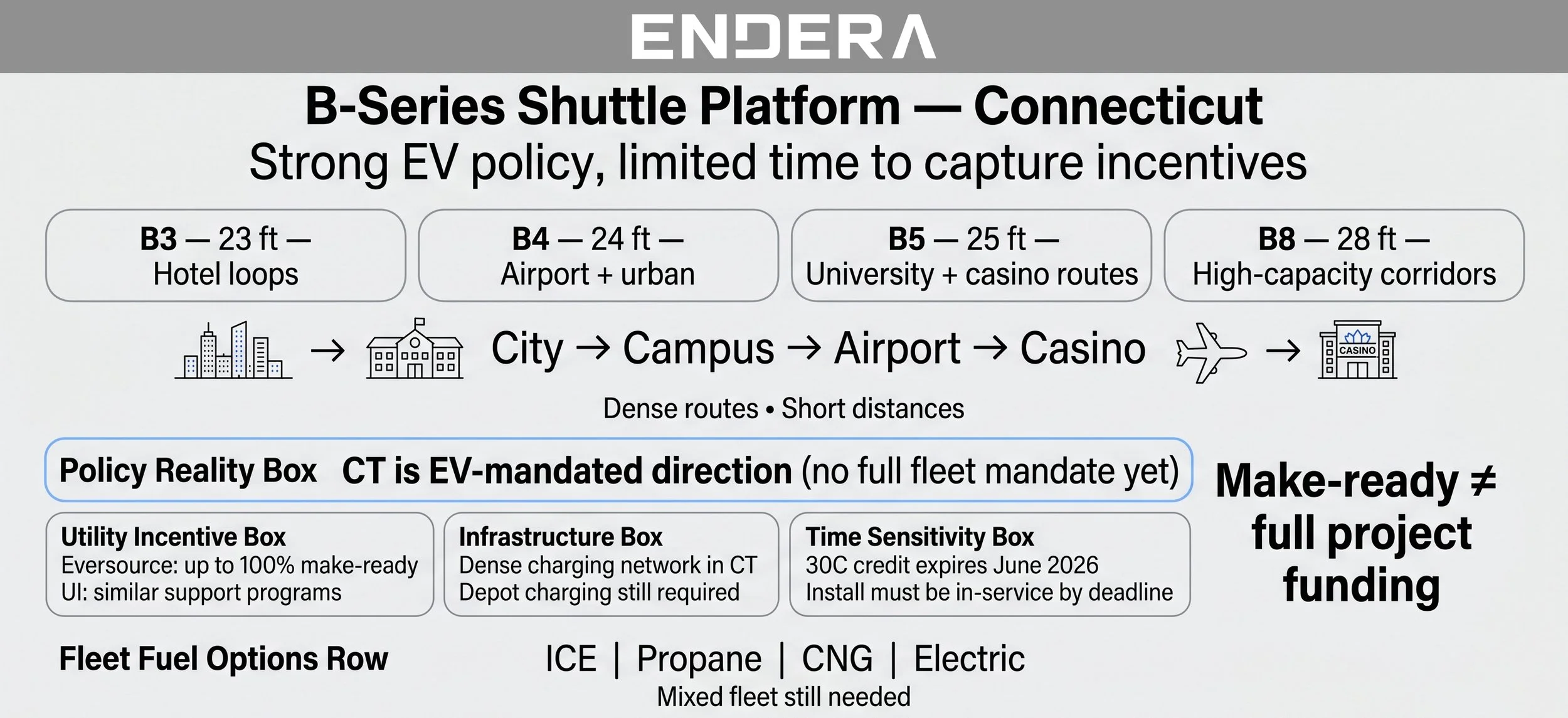
Endera's B-Series (B3–B8, 23–28 ft) is available in ICE, propane, CNG, and electric configurations on Ford and Chevrolet chassis, built in Ohio. In Connecticut, strong EV policies, utility incentives, and dense charging infrastructure make electrification more viable than in many states — but the 30C credit expiring in June 2026 means the infrastructure funding window requires timely planning.
The 30C window closes in June 2026 — connect with an Endera fleet specialist today to lock in your configuration before the infrastructure incentive disappears.
Connecticut's Fleet Landscape: Mandate Direction, Active Incentives
A Pro-EV Policy Environment That's Already Binding
Connecticut's adoption of California's Advanced Clean Trucks requirements means manufacturers must sell an increasing percentage of zero-emission trucks in Connecticut beginning with model year 2026. That applies to the vehicle supply side — manufacturers — but the policy signal for fleet operators is unmistakable.
State agencies face ZEV procurement requirements starting January 1, 2026. The state has published a feasibility study for bulk EV procurement. Connecticut is not a state where the commercial EV transition is a future consideration. It's happening in the procurement cycle right now.
Charging Infrastructure Is Genuinely Usable in Connecticut
Connecticut has over 1,400 public EV charging stations — a high density for its size — with Eversource and United Illuminating both operating robust commercial EV charging programs. For Connecticut shuttle operators with depot charging, the public network serves as a reliable supplement rather than a gap. For operators without depot infrastructure, the utility programs make building it significantly more affordable:
Eversource offers up to 50% of EVSE costs and up to 100% of make-ready costs for qualifying workplace and fleet installations. United Illuminating offers equivalent support in New Haven and Bridgeport. The 30C federal charging credit stacks on top of both, covering up to $100,000 per installed port through June 30, 2026.
What "100% Make-Ready" Actually Covers — and What It Doesn't
The Distinction That Changes the Budget
Connecticut's EV charging incentives are frequently described as covering "up to 100% of make-ready costs" — but that framing obscures a meaningful financial reality for fleet operators. Make-ready refers specifically to the upstream electrical infrastructure required to bring power to the charging location: transformer upgrades, trenching, conduit, and service connection work.
According to Eversource Energy, these utility-side costs can be fully or largely covered for qualifying projects under its EV charging programs. That's real, and it addresses the most unpredictable component of a depot installation — the site work that can balloon a project budget with a single unexpected utility requirement.
What the Operator Still Pays
EVSE equipment, installation beyond program limits, panel upgrades, networking, and software/maintenance are typically not covered under “make-ready” definitions. DOE guidance also separates infrastructure from equipment when determining eligibility.
As a result, remaining out-of-pocket costs for a Connecticut depot can still range from about $20,000 to $80,000+ per site, depending on complexity and capacity, and scale with additional chargers.Utility incentives reduce risk but don’t fully cover costs. The 30C federal credit can then apply to eligible equipment and installation, making the programs complementary rather than duplicative.
The 30C Window Is Closing — What CT Operators Need to Know
The Timeline From Decision to Operational Charger
The 30C charging equipment credit expires June 30, 2026, and equipment must be physically placed in service — not just purchased or permitted — by that date.
In Connecticut, the documented timeline from quote to operational charger runs approximately 8 to 12 weeks: site assessment and quote (weeks 1–2), permitting (weeks 2–4), incentive application preparation (weeks 4–6), installation (weeks 6–10), and inspection and commissioning (weeks 10–12). That timeline, mapped against a June 30 deadline, puts the practical start date for CT operators at no later than April 2026 — and earlier is meaningfully safer given contractor availability and utility coordination variability.
Why the Eversource and 30C Stack Matters
For Connecticut fleet operators, Eversource’s make-ready program combined with the 30C credit creates a strong incentive stack for depot charging. Eversource can cover major grid-side costs like trenching and panel upgrades, while the 30C credit applies to equipment and installation.
Proper sequencing—program registration, permitting, installation, and documentation—is key to capturing both incentives. Endera’s team helps manage this process to ensure projects stay within program requirements and maximize available funding.
The B-Series Lineup for Connecticut Operations
Four Models for CT's Diverse Shuttle Markets
The B3 (23 ft) is a compact ICE model suited for hotel loops in the Gold Coast, university circulators, and tight urban routes across Connecticut.
The B4 (24 ft) and B5 (25 ft) offer more capacity with ICE and electric options, ideal for airport service at Bradley, corporate shuttles along I-95, casino routes, and major universities like Yale and UConn.The B8 (28 ft) is designed for high-volume use such as casino peaks, events, and busy corridor transit.
Chassis Coverage Across Connecticut's Markets
All B-Series models are available on Ford E450 or Chevrolet Express cutaway chassis — platforms with strong dealer and service networks across Connecticut, including in eastern Connecticut's less dense markets where the casino resort operators are concentrated. Both platforms are broadly serviced throughout the state, reducing service dependency on specialized commercial bus centers.
Fleet Decision Framework: Connecticut Routes and the Right Configuration
Short Routes and Dense Infrastructure Favor Electrification
| Use Case | Recommended Model |
Fuel Type |
Why |
|---|---|---|---|
| Gold Coast hotel loop (Greenwich, Stamford) |
B3 / B4 | EV or ICE |
Short, urban; EV well matched |
| Airport ground transport (BDL) |
B4 / B5 | EV or ICE |
Defined cycles; strong utility incentives |
| University transit (Yale, UConn) |
B4 / B5 | EV or CNG |
Campus infrastructure; predictable routes |
| Casino resort shuttle (Foxwoods, Mohegan Sun) |
B4 / B5 | ICE or EV |
Variable demand, longer east CT routes |
| Corporate / I-95 corridor | B5 | EV | Short defined routes, employer charging access |
Connecticut’s small size and short shuttle routes make it well suited for EV operations, especially in the Hartford–New Haven–Stamford corridor where most routes can be covered by electric B4 and B5 models with overnight charging.
In eastern Connecticut, casino operators with longer and more variable routes may still rely on ICE or propane options where charging infrastructure is less consistent.
True Cost vs. Cash Flow Reality for CT Operators
What the Incentive Stack Looks Like in Practice
The financial case for electrification in Connecticut is stronger than in most mid-Atlantic or southern states, largely because Eversource's make-ready cost coverage removes the most unpredictable component of the infrastructure investment. When a CT fleet operator combines Eversource's program, the 30C credit, and the lower long-term fuel and maintenance costs of an electric shuttle, the payback timeline compresses meaningfully compared to a state with only federal incentives available.
The Electric School Bus Initiative documents over $170,000 in lifetime fuel and maintenance savings per electric bus — a figure that applies comparably to commercial EV shuttles on similar operating profiles. For CT operators in Eversource territory running high-frequency urban routes, those savings are on the favorable end of the national distribution.
ICE and Propane Remain Available for Operators Who Need Them
Connecticut’s policy environment supports EVs, but not all operators can fully electrify in 2026. Casino, hospitality, and smaller fleets may still rely on ICE or propane due to route variability, lack of centralized charging, or upfront cost constraints.
Endera’s B-Series offers all fuel types on a single platform, allowing Connecticut operators to transition gradually without changing vehicle families or manufacturers.
Built for Connecticut's Direction of Travel
Connecticut is moving toward electrification faster than most states, and the financial infrastructure to support that transition — Eversource's programs, the 30C credit, and a dense public charging network — is in place right now. The operators who capture the most value are the ones who move before the June 2026 infrastructure window closes, not after.
June 2026 is not far off. Connect with an Endera fleet specialist today to lock in the right B-Series configuration and Connecticut charging infrastructure strategy before the window closes.
FAQs
Which B-Series models are available for Connecticut operators?
All four models — B3 (23 ft), B4 (24 ft), B5 (25 ft), and B8 (28 ft) — are available in Connecticut in ICE, propane, CNG, and electric configurations depending on model. Contact Endera's sales team for current availability and lead times.
What utility incentives are available for CT fleet operators installing EV charging?
Eversource offers up to 50% of EVSE costs and up to 100% of make-ready costs for qualifying fleet and workplace charging installations. United Illuminating offers equivalent support in New Haven and Bridgeport. Both stack with the federal 30C credit (through June 2026). Endera's infrastructure team coordinates the application and installation process.
What is the 30C charging credit deadline, and why does the CT timeline matter?
The 30C credit — up to $100,000 per installed port — expires June 30, 2026. Connecticut's typical quote-to-operational timeline runs 8 to 12 weeks, putting the practical start date for CT operators at approximately April 2026 at the latest.
Does Connecticut have state EV mandates for commercial shuttle fleets?
Connecticut has adopted California's Advanced Clean Trucks standards (starting MY2026), implemented ZEV procurement requirements for state agencies starting January 1, 2026, and joined the multi-state ZEV MOU. Direct mandates for private commercial shuttle fleets are not yet in place, but the policy trajectory is clear.
What chassis options are available in Connecticut?
All B-Series models are available on Ford E450 and Chevrolet Express cutaway chassis, broadly serviced through dealer networks across Connecticut including in eastern CT markets.
Do Endera shuttles comply with Buy America requirements?
Yes. With approximately 65% of components sourced domestically, Endera's manufacturing supports Buy America compliance for federally funded Connecticut procurement contracts.
Can I get an in-stock 2026 shuttle for fast delivery in Connecticut?
Yes. Endera Stock lists ready-to-deliver 2026 models for rapid deployment without a custom build lead time.