
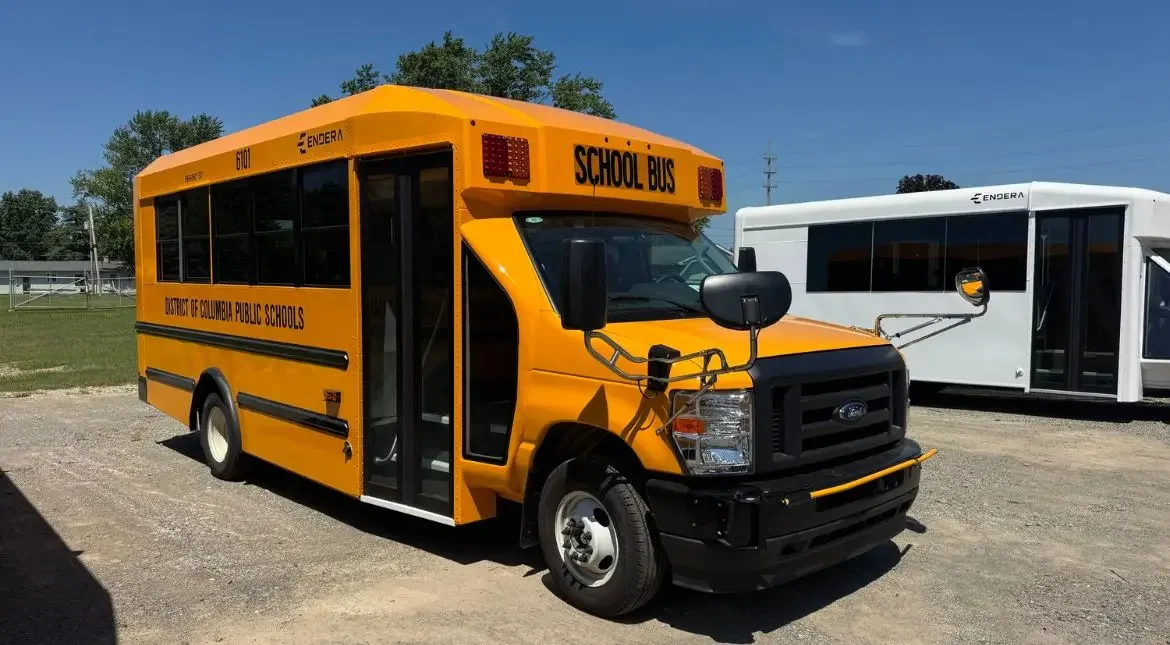
Idaho's student transportation system operates across one of the most geographically demanding environments in the country. Mountain terrain, long rural routes, and winter conditions that swing from manageable to severe within a single route create operational requirements that generic school bus recommendations don't address. For district transportation directors, the vehicle decision is also a reliability decision.
Endera manufactures Type A school buses in ICE, propane, CNG, and full-electric configurations on Ford E450 and Chevrolet Express cutaway chassis. Idaho districts managing dispersed student populations, special education routes, and rural transport need vehicles built to commercial specifications — not modified light-duty platforms.
Idaho routes have no margin for unreliability — contact Endera's sales team today to find a configuration built for the conditions your district actually faces.
What Is a Type A School Bus?
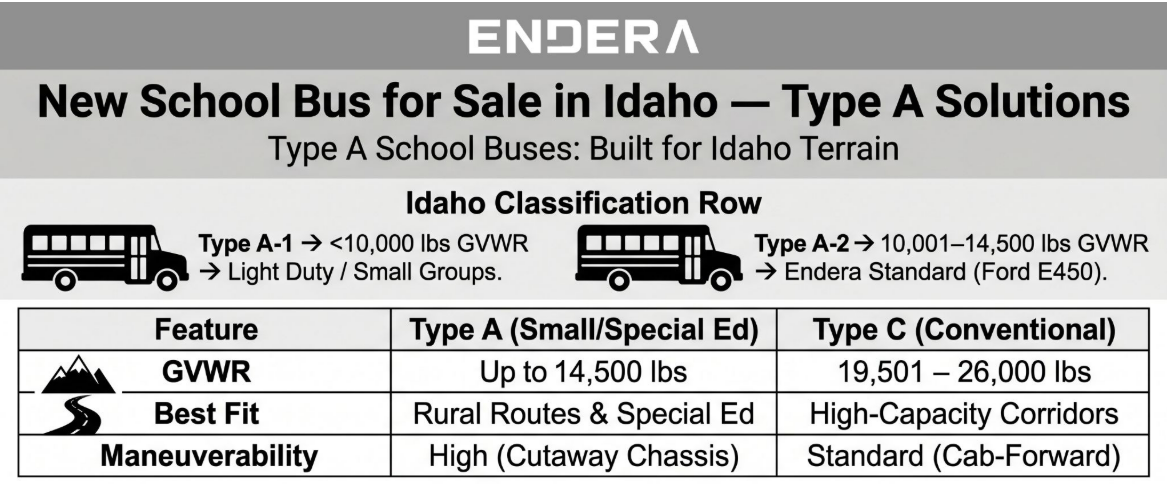
According to Idaho's Standards for School Buses and Operations (SISBO), Type A school buses are defined by GVWR — split into Type A-1 (under 10,000 lbs) and Type A-2 (10,001 to 14,500 lbs). Both are built on cutaway van or front-section body chassis, smaller than the conventional cab-over Type C buses most people picture when they think "school bus."
Type A buses seat fewer students than larger models, but that's a feature for the routes they serve — not a limitation. Special education transport, low-enrollment rural routes, and any circuit where a 48-passenger bus would run half-empty are exactly the applications where a Type A is the operationally correct choice.
Type A vs. Type C: Which Fits Your Idaho District?
| Feature | Type A | Type C |
|---|---|---|
| GVWR | Up to 14,500 lbs | 19,501–26,000 lbs |
| Typical seating | 10–24 passengers | 24–48 passengers |
| Chassis | Cutaway van | Conventional cab-forward |
| CDL required | Generally not | Yes |
| Best fit | Rural, special ed, low-density | Urban, high-capacity corridors |
Why Idaho Districts Rely on Type A Buses
The Idaho Department of Education student transportation guidelines govern fleet composition, reimbursement eligibility, and operational standards for districts across the state. Type A buses appear consistently in Idaho fleet rosters because they match the operational profile of the state's most common routing challenges.
Rural Idaho districts manage routes that can stretch 30 to 60 miles across terrain that changes with the seasons. A compact, maneuverable Type A handles mountain switchbacks, unpaved approaches to rural properties, and tight turnarounds at small school facilities better than a full-size bus. For districts managing these routes, the right-sized vehicle reduces both fuel consumption and driver stress on difficult terrain.
Special Education and ADA Transport
A large share of Type A bus demand in Idaho comes from special education programs. These routes typically involve fewer students, more frequent stops, longer on-board times, and accessibility requirements that demand ADA-compliant configurations. Idaho Code §33-1504 governs authorized vehicles for student transportation, including MFSAB configurations used for specialized student transport.
Endera's flat-floor Type A models are available with 800 lb Braun ADA lifts built into the vehicle at the manufacturing stage — meeting FTA accessible vehicle specifications without aftermarket modification. For Idaho districts managing special education routes under federal accessibility requirements, OEM-installed lift systems carry different compliance standing than post-sale retrofits.
Idaho's Terrain and Weather: What It Means for Bus Selection
Idaho's geographic range — from the Snake River Plain to the Sawtooth Range — puts operational demands on school buses that flat-terrain states don't face. NHTSA's school bus safety research identifies school buses as among the safest vehicles on the road, but that safety record depends on vehicles being matched to the routes they serve.
Cold-weather starting reliability, heating system capacity, and chassis durability on unpaved roads are practical selection criteria for Idaho districts that don't apply the same way in warmer, denser states. Endera's Type A buses are built on medium-duty Ford E450 and Chevrolet Express cutaway chassis — platforms with broad parts availability and technician familiarity in rural markets where specialized service infrastructure may not exist.
Fuel Options for Idaho Type A Buses
Idaho districts have access to all four powertrain configurations Endera manufactures, and the right choice depends on infrastructure, route profile, and budget cycle:
ICE (gasoline): Widest service availability across rural Idaho; lowest infrastructure requirement; straightforward maintenance
Propane: Lower per-mile fuel cost than gasoline; cleaner emissions; growing dealer and fueling network in Idaho. According to the DOE Alternative Fuels Data Center, propane buses typically reduce fuel costs 30–40% compared to gasoline equivalents
CNG: Best for districts with existing natural gas infrastructure; lower fuel cost than diesel; less widely available in rural Idaho
Electric: Suited for fixed routes with overnight depot charging; eliminates fuel cost entirely; federal funding often covers vehicle and charging infrastructure
All four configurations are built on the same Type A platform, which means a district can standardize on Endera and shift powertrain on the next procurement cycle without switching manufacturers.
New vs. Used: The Idaho District's Buying Decision
New Type A school buses typically start around $80,000 and range to $150,000 depending on powertrain and configuration. Used Type A buses in working condition run $20,000–$60,000 depending on age and mileage — an attractive upfront figure that requires careful evaluation.
Used buses in Idaho's climate carry rust and corrosion risk that's less prevalent in drier states. Deferred maintenance, worn ADA lift systems, and outdated safety equipment are common in district surplus vehicles. CVSA commercial vehicle inspection standards provide the framework for what fleet operators are evaluated against — and used buses often require investment to meet those standards before returning to service.
Funding That Changes the New vs. Used Math
Federal and state funding programs tip the calculus toward new. The EPA Clean School Bus Program, state grant programs, and Endera's grant navigation services help Idaho districts reduce net acquisition cost on new vehicles — sometimes substantially. Used buses are typically ineligible for these programs regardless of condition, which means the out-of-pocket gap between new and used narrows considerably once funding is factored in.
Idaho Procurement: How Districts Order New Buses
Idaho school bus purchases are subject to state procurement requirements. The Idaho School Bus Driver Manual outlines operational and inspection standards that purchased vehicles must meet before entering service. Districts typically align purchases with state reimbursement cycles and Idaho DOE approval processes.
The National Congress on School Transportation sets national specifications that Idaho's procurement standards draw from — providing a framework for specification language that districts use in competitive bid documentation. Endera's sales team provides full specification sheets, compliance documentation, and supporting materials for Idaho districts working within formal procurement processes.
Ready to Spec a Bus for Your Idaho District?
New 2026 Type A models are available for immediate delivery through Endera Stock for districts with pressing replacement timelines. For districts working through formal procurement or grant-funded purchasing cycles, Endera provides full compliance documentation and grant application support.
Idaho routes don't wait for the right procurement window — neither should your replacement cycle. Contact Endera's sales team today to discuss fleet configuration, powertrain options, or Idaho procurement requirements.
Frequently Asked Questions
What GVWR classifications define Type A school buses in Idaho?
Idaho's SISBO standards define Type A-1 buses at under 10,000 lbs GVWR and Type A-2 buses at 10,001 to 14,500 lbs GVWR. Both are built on cutaway van or front-section chassis. Endera's Type A models fall within the A-2 classification on Ford E450 and Chevrolet Express cutaway chassis with a 14,500 lb GVWR.
Do Idaho school bus drivers need a CDL to operate a Type A bus?
Most Type A school bus configurations fall below the federal CDL threshold of 26,001 lbs GVWR. Idaho-specific CDL and endorsement requirements for school bus drivers are governed by state law — the Idaho School Bus Driver Manual outlines the certification and training requirements applicable to all school bus operators in the state, which go beyond standard CDL rules.
How does Idaho's terrain affect school bus selection?
Idaho's combination of mountain routes, unpaved roads, and winter weather conditions places durability and cold-weather reliability at the top of the selection criteria for many districts. Type A buses on medium-duty cutaway chassis handle these conditions better than light-duty van conversions and offer broader parts availability in rural markets where specialized service infrastructure may be limited.
Are there federal funding programs available for Idaho school bus purchases?
Yes. Idaho districts can access the EPA's Clean School Bus Program, which has distributed over $3 billion nationally for electric and clean-fuel bus replacements. Idaho districts pursuing propane or electric Type A buses may also qualify for state-level alternative fuel incentives. Endera's grant navigation services help districts identify applicable programs and manage applications alongside the procurement process.
What ADA accessibility options are available on Endera's Type A buses?
Endera's flat-floor Type A configurations are available with 800 lb Braun ADA lifts installed at the manufacturing stage. Seating layouts are configurable across 4-to-6 section options to accommodate wheelchair securement positions, ambulatory seating, and storage. For Idaho districts serving special education populations under IDEA and ADA requirements, OEM-installed accessibility equipment simplifies compliance documentation.
How does propane compare to gasoline for Idaho school district operations?
Propane buses typically reduce fuel costs 30–40% compared to gasoline equivalents according to DOE Alternative Fuels Data Center data. Propane also produces fewer emissions and has a growing fueling infrastructure in Idaho. For rural districts not yet ready for full electrification, propane is the most practical near-term alternative — grant-eligible, lower-cost to operate, and serviceable through the existing commercial vehicle network.
How long does a new Type A school bus last under Idaho operating conditions?
Purpose-built Type A school buses on medium-duty cutaway chassis typically operate 10 to 12 years under daily commercial use. Idaho's terrain and winter conditions can accelerate wear on vehicles not built to commercial specifications — which is why purpose-built OEM vehicles outperform light-duty van conversions in long-term durability for districts running demanding rural routes. Proper maintenance aligned with Idaho's inspection intervals is the primary factor in reaching full service life.