
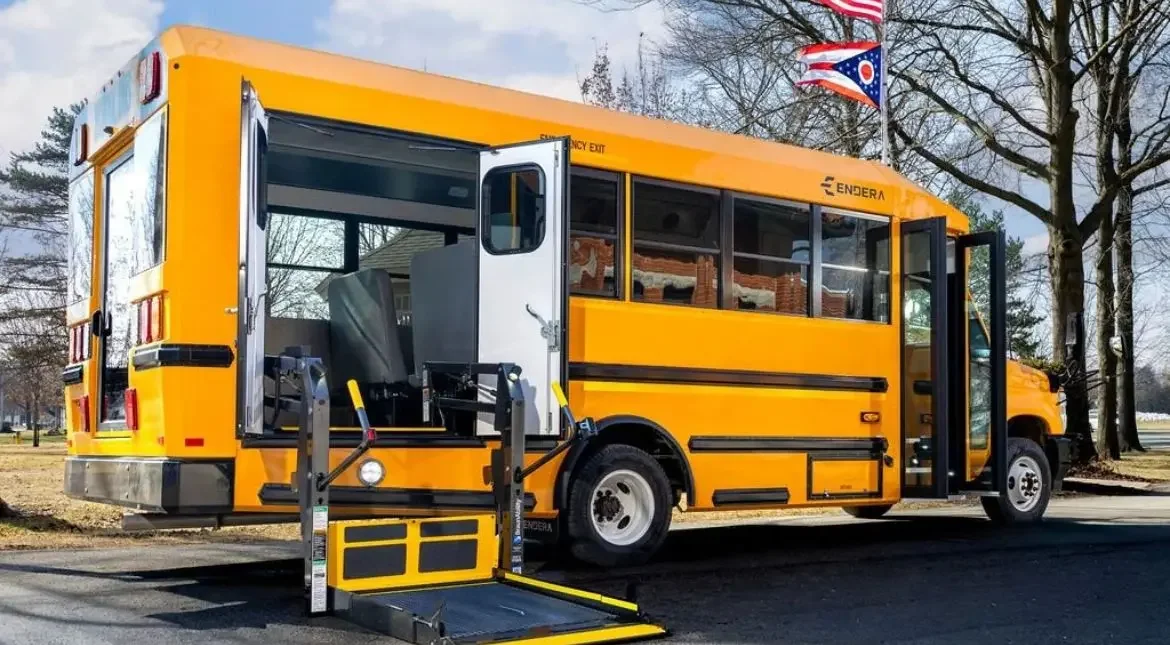
Georgia's student transportation system spans one of the widest operational ranges in the country — from Atlanta's dense suburban corridors to rural counties where a single route covers 40 miles of two-lane roads. That range means no single bus format serves every district equally, and procurement decisions require matching the vehicle to the route rather than defaulting to the largest bus available.
Endera manufactures Type A school buses in ICE, propane, CNG, and full-electric configurations on Ford E450 and Chevrolet Express cutaway chassis. For Georgia districts managing special education transport, lower-density rural routes, or urban circuits where maneuverability matters, the Type A format is the operationally correct choice.
Get the configuration right for your Georgia routes — contact Endera's sales team today to match the right model and powertrain to your district's actual needs.
What Is a Type A School Bus?
The Georgia School Bus Specifications Manual defines Type A buses as smaller buses built on van or cutaway chassis designed for transporting more than 10 passengers. They sit below Type C and D buses in size and capacity — but above converted vans and light-duty alternatives in structural integrity and safety certification.
Georgia transportation guidance specifically associates Type A and B buses with special-needs student transport, shorter routes, and lower-density applications. The National Congress on School Transportation sets the national specifications that Georgia's state standards draw from, providing a standardized framework for construction, safety equipment, and accessibility configuration requirements.
Type A vs. Type C: Which Fits Your Georgia District?
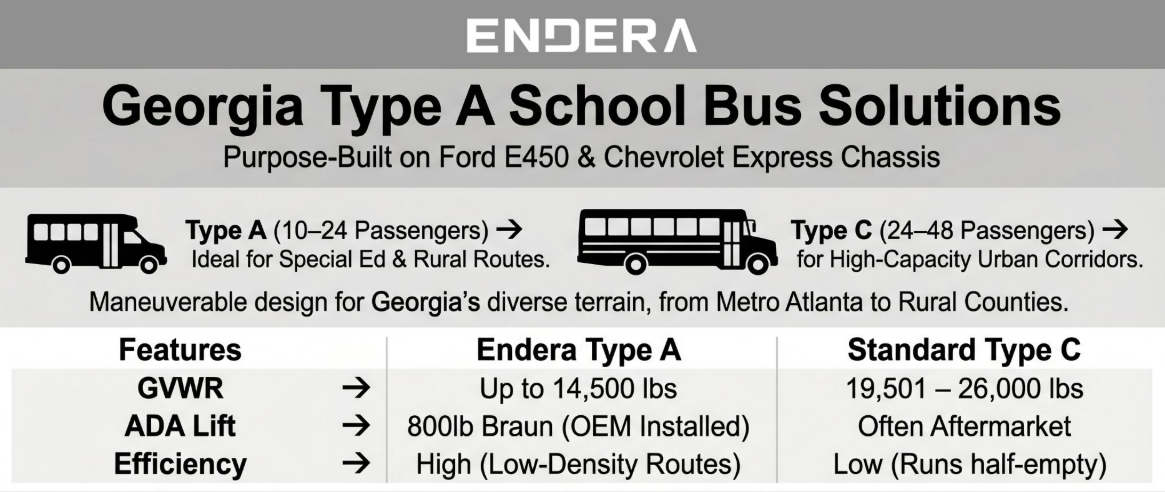
| Feature | Type A | Type C |
|---|---|---|
| GVWR | Up to 14,500 lbs | 19,501–26,000 lbs |
| Typical seating | 10–24 passengers | 24–48 passengers |
| Chassis | Cutaway van | Conventional cab-forward |
| CDL required | Generally not | Yes |
| Best fit | Special ed, rural, low-density | High-capacity district routes |
Georgia districts often run both types — Type C for primary high-volume routes and Type A for specialized, lower-enrollment, and accessibility-focused applications.
Why Georgia Schools Use Type A Buses
The Georgia DOE Pupil Transportation Division oversees fleet compliance, inspection requirements, and transportation standards for districts statewide. Type A buses appear consistently in Georgia fleet rosters for two primary reasons: special education routing and geographic efficiency.
Rural Georgia districts face routes where a 48-passenger Type C bus is operationally wasteful. Narrow roads, long distances, small student populations at each stop, and the need for frequent turning make a compact, maneuverable Type A the practical choice. According to Bureau of Transportation Statistics data, rural student transportation demand remains consistent even as enrollment concentrates in metro areas — meaning rural route procurement stays active regardless of district size trends.
Special Education and ADA Transport in Georgia
Special education transport is the single largest driver of Type A bus demand in Georgia. These routes require ADA-compliant configurations, frequent stops, longer on-board times, and vehicles sized for smaller student groups with varied accessibility needs.
ADA transportation guidelines and FTA accessible vehicle specifications define the compliance requirements for accessible student transport. Endera's flat-floor Type A configurations are available with 800 lb Braun ADA lifts installed at the manufacturing stage — meeting federal accessibility standards without aftermarket modification or split warranty coverage.
Georgia School Bus Compliance and Driver Requirements
Georgia school buses must meet state construction and equipment standards as defined in the Georgia School Bus Specifications Manual and pass regular inspections enforced through the Georgia Department of Public Safety. Non-compliant vehicles can be removed from service until deficiencies are corrected.
Georgia school bus drivers are required to hold a CDL with a school bus endorsement — a state-specific requirement that goes beyond the standard federal CDL threshold. Districts purchasing new buses should confirm that driver training and certification programs are aligned with Georgia's endorsement requirements before placing vehicles in service. Endera provides full specification and compliance documentation to support Georgia's formal procurement and inspection review process.
Fuel Options for Georgia Type A Buses
Georgia districts have access to all four powertrain configurations Endera manufactures. The right choice depends on infrastructure, route profile, and budget cycle:
ICE (gasoline): Widest service availability across Georgia; lowest infrastructure barrier; straightforward parts and maintenance
Propane: Lower per-mile fuel cost than gasoline; cleaner emissions; growing fueling network across Georgia. The DOE Alternative Fuels Data Center reports propane buses typically reduce fuel costs 30–40% versus gasoline equivalents
CNG: Best for districts with existing natural gas infrastructure; lower fuel cost than diesel; fewer rural fueling points than propane
Electric: Fixed routes with overnight depot charging; eliminates fuel cost; federal funding programs cover vehicles and charging infrastructure for qualifying districts
Georgia districts like Wilkes County Schools have already moved toward clean school bus fleets — a signal that the state's procurement environment is receptive to alternative-fuel adoption even outside major metro areas.
New vs. Used: The Georgia District Buying Decision
New Type A school buses typically start around $80,000 and range to $150,000 depending on powertrain and configuration. Used Type A buses in serviceable condition run $20,000–$60,000 — lower upfront, but with tradeoffs that compound over the ownership period.
Georgia's climate is relatively mild compared to northern states, reducing corrosion risk on used vehicles. That said, deferred maintenance, outdated safety equipment, and worn ADA lift systems are common in district surplus buses regardless of geography. CVSA commercial vehicle inspection standards define what bus operators are evaluated against during fleet inspections — used vehicles often require investment to meet current standards before returning to service.
Funding That Narrows the Gap
Federal and state funding programs significantly change the new-versus-used calculus. The EPA Clean School Bus Program has funded electric and clean-fuel bus replacements nationally, with Georgia districts eligible to apply. Used buses are typically ineligible for these programs regardless of condition. Endera's grant navigation services help Georgia districts identify applicable funding and manage applications alongside the procurement process.
Georgia's Clean School Bus Trend
Georgia is an active participant in the national shift toward cleaner school bus fleets. Propane adoption has grown steadily among Georgia districts seeking lower fuel costs without the infrastructure commitment of full electrification. Electric bus interest is increasing as federal funding has made the acquisition economics more comparable to ICE alternatives.
NHTSA's school bus safety research confirms that school buses remain among the safest vehicles on the road — and newer clean-fuel models extend that safety record while reducing the emissions exposure students experience during their daily commute. For Georgia districts managing aging diesel fleets, replacement with propane or electric alternatives is both a safety and financial decision.
Ready to Spec a Bus for Your Georgia District?
New 2026 Type A models are available for immediate delivery through Endera Stock for districts with urgent replacement timelines. For districts working through Georgia's formal procurement process, Endera provides full specification sheets, compliance documentation, and grant application support.
Georgia's flexibility is an advantage — use it before your replacement timeline forces the decision. Contact Endera's sales team today to discuss fleet configuration, powertrain options, or Georgia procurement requirements.
Frequently Asked Questions
What does Georgia's school bus specifications manual require for Type A buses?
Georgia's School Bus Specifications Manual defines construction standards, safety equipment requirements, chassis specifications, and accessibility configurations that Type A buses must meet before entering district service. Requirements cover body construction, lighting, emergency exits, wheelchair lift compatibility, and seating standards. Endera's Type A buses are engineered to meet or exceed these state specifications as delivered.
Do Georgia school bus drivers need a CDL?
Yes. Georgia requires school bus drivers to hold a CDL with a school bus endorsement — a requirement that goes beyond the standard federal CDL threshold. This applies to all school bus drivers in the state regardless of vehicle size or GVWR. Districts purchasing new Type A buses should confirm driver certification status before placing vehicles in service.
What ADA accessibility options are available on Endera's Type A buses for Georgia districts?
Endera's flat-floor Type A configurations include 800 lb Braun ADA lifts installed at the manufacturing stage, configurable seating across 4-to-6 section layouts, and wheelchair securement positions. All configurations meet FTA accessible vehicle specifications. For Georgia special education programs operating under IDEA and ADA requirements, OEM-installed accessibility equipment simplifies compliance documentation compared to post-sale retrofits.
Are there funding programs available for Georgia school districts replacing diesel buses?
Yes. The EPA Clean School Bus Program provides federal funding for electric and clean-fuel bus replacements, and Georgia districts are eligible to apply. State-level alternative fuel programs and propane incentives may also apply depending on vehicle type and district profile. Endera's grant navigation services help Georgia districts identify applicable programs and manage the application process alongside procurement.
How does propane compare to diesel for Georgia school bus operations?
Propane buses typically reduce fuel costs 30–40% compared to diesel equivalents according to DOE data, while producing significantly lower particulate and NOx emissions. Georgia's mild climate and growing propane fueling network make propane a practical near-term alternative for districts not yet ready for full electrification. Propane buses are also eligible for clean fuel grant programs that diesel replacements typically are not.
How long does a Type A school bus last under Georgia operating conditions?
Purpose-built Type A school buses on medium-duty cutaway chassis typically operate 10 to 12 years under daily use with proper maintenance. Georgia's climate is less demanding than northern states, which reduces weather-related wear on body and mechanical components. Maintenance aligned with Georgia DOE inspection intervals and CVSA standards is the primary factor in reaching full service life.
What makes Endera's Type A bus different from other manufacturers?
Endera is the only American vertically integrated OEM for Type A school buses — meaning body assembly and powertrain installation happen at the same facility in Ottawa, Ohio under a single quality control process. Buyers receive one warranty document covering both body and powertrain, one compliance certification, and one service contact. The Endera 4, 5, and 6 models are configurable across 4-to-6 section layouts in all four powertrain types, giving Georgia districts flexibility that single-powertrain manufacturers can't match.