
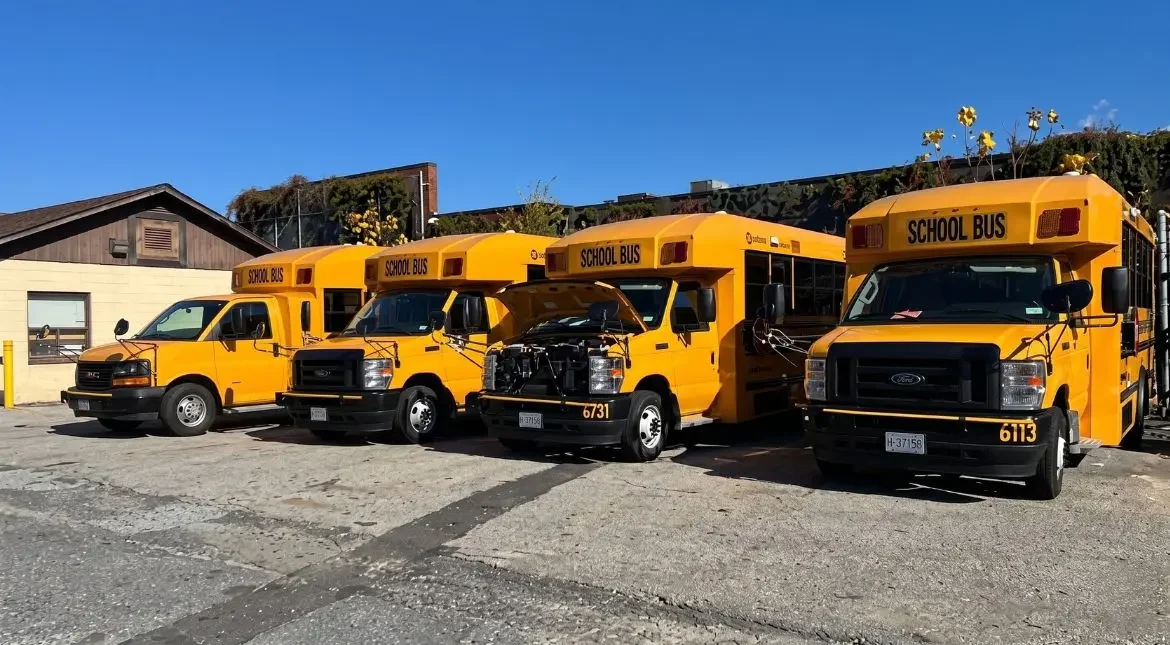
Massachusetts has approximately 8,000 fossil-fuel school buses still operating across its districts — and only around 137 electric buses deployed statewide as of early 2025. That gap represents both the scale of the replacement opportunity and the size of the funding pipeline that state and federal programs are specifically designed to move through. For district transportation directors, the state's zero-emission school bus roadmap makes the direction clear — the question is whether to act now while funding is strongest.
Endera manufactures Type A school buses in ICE, propane, CNG, and full-electric configurations on Ford E450 and Chevrolet Express cutaway chassis. Massachusetts districts navigating the transition from diesel to zero-emission fleets need a manufacturer that builds across all four powertrains on a single platform — so procurement decisions this cycle don't lock a district into a dead-end product line on the next.
Massachusetts funding is peaking now — contact Endera's sales team today to act before the pipeline starts to thin.
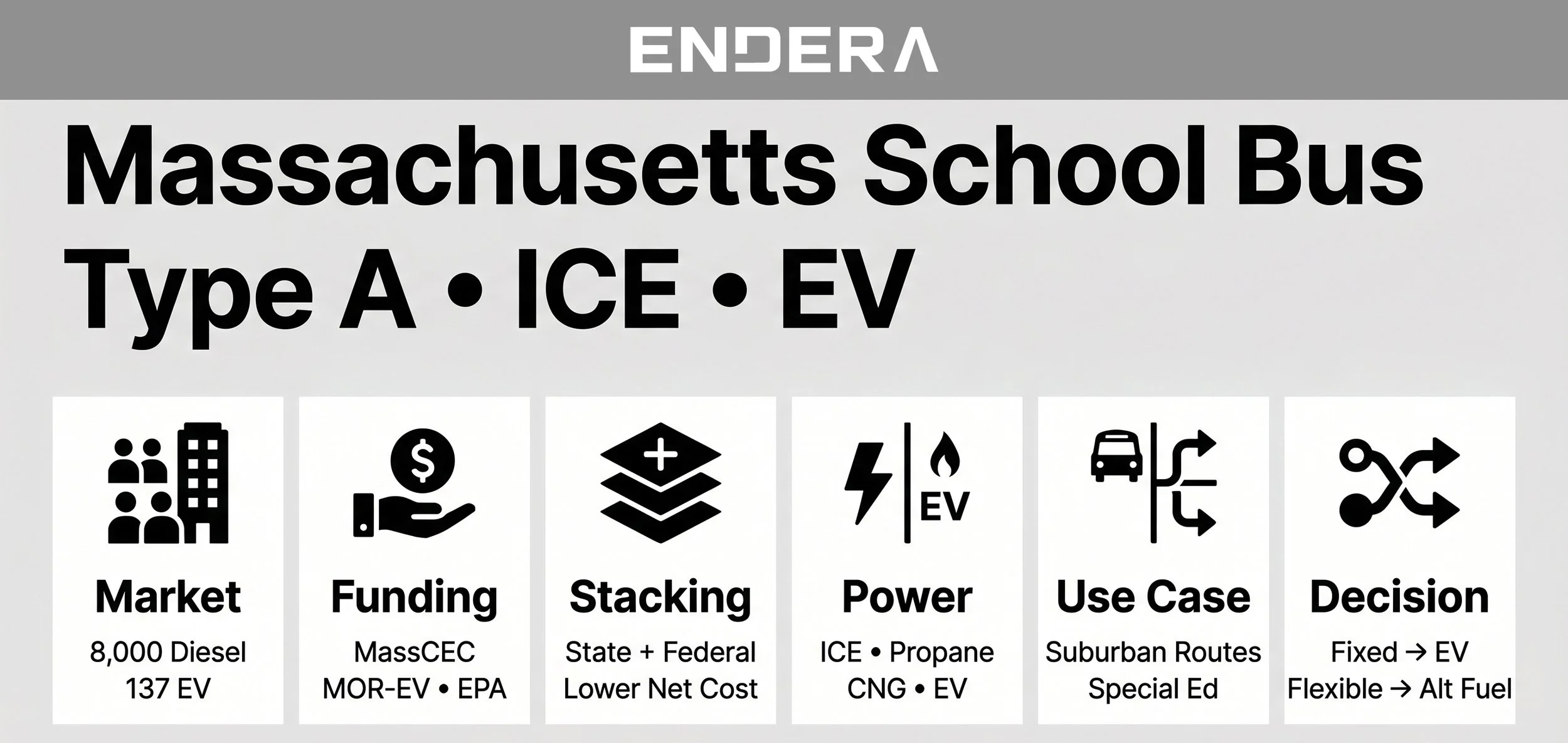
How Massachusetts Schools Pay for New School Buses
Massachusetts offers one of the more complete funding stacks in the country for school bus electrification. At the state level, the MassCEC School Bus Fleet Deployment program provides up to $2.5 million per project, covering buses, charging infrastructure, planning, and deployment support. The MOR-EV Trucks program adds stackable rebates of $15,000 to $90,000 per vehicle for qualifying electric school buses — applied on top of state project funding, not instead of it.
Federal support layers on top of both. The EPA has directed over $53 million in Clean School Bus Program funding to Massachusetts and Connecticut combined, with Boston alone receiving $20 million for 50 buses in a single award round. A subsequent round delivered over $30 million for approximately 80 buses across Worcester, New Bedford, Fall River, and additional MA districts. The $5 billion federal Clean School Bus Program runs through 2026, and Massachusetts districts with active procurement plans remain in a position to apply.
Stacking Incentives to Reduce Net Cost
The real leverage in Massachusetts is multi-source stacking. A district that combines MassCEC project funding, MOR-EV rebates, and a federal EPA award can bring the net acquisition cost of an electric Type A bus substantially below sticker — in some cases below the equivalent ICE model after all incentives are applied.
Endera's grant navigation services help districts map applicable programs to their specific fleet profile, manage application timelines across multiple funding sources, and avoid the administrative bottleneck that causes districts to miss award cycles. The complexity of stacking is manageable with the right support — it shouldn't be a reason to default to an unfunded ICE purchase.
Massachusetts' Push Toward Electric School Bus Fleets
The state's electrification direction is structural, not aspirational. Massachusetts has published a formal zero-emission school bus roadmap and is actively deploying funding to support the transition. Nationally, approximately $2 billion has already been distributed and roughly 5,000 clean buses funded through EPA programs — with Massachusetts among the more active recipient states.
With over 8,000 diesel buses still in operation, the replacement pipeline is large and the funding competition is real. Districts that apply early in open cycles — and that have specification documentation ready — are consistently better positioned than those approaching applications reactively. The EPA has funded 177 additional electric buses for Massachusetts school districts in its most recent allocation round, signaling that the state remains a priority recipient as long as districts continue to bring qualified applications. That preparation window is part of what Endera's sales process is designed to support.
ICE vs. Electric: The Right Call for Massachusetts Districts
Massachusetts' dense urban and suburban geography makes it a natural fit for electric Type A buses on most district routes. Shorter average daily mileage, fixed routing, and the availability of overnight depot charging at school facilities remove the two primary practical objections to EV adoption.
When Electric Makes Sense
Districts operating special education routes, suburban loops, or any fixed daily circuit under 60 to 80 miles are strong candidates for immediate electrification — particularly with Massachusetts' funding stack in place. Lower fuel and maintenance costs compound meaningfully over a 10-to-12-year service life, and charging infrastructure costs are frequently covered by the same programs that fund the vehicles.
When ICE or Alternative Fuels Bridge the Gap
Districts with irregular routes, no existing charging infrastructure, or procurement cycles that don't align with a depot buildout timeline should consider propane or CNG as a compliant near-term option. Both satisfy the direction Massachusetts policy is heading — cleaner than diesel, with lower infrastructure requirements than full electric — while keeping a district on Endera's platform for the EV transition on the next cycle.
Is a Type A Bus Right for Your Massachusetts District?
Type A buses are built for routes where a full-size Type C or D bus adds operational overhead without adding value — lower student density, narrower suburban streets, special education transport requiring frequent stops and accessibility equipment. Massachusetts' mix of dense urban districts and spread suburban routes makes the Type A format the most broadly applicable choice for most districts outside Boston's core.
Endera's Endera 4, 5, and 6 models are configurable across 4-to-6 section layouts with ADA-compliant lift options and custom storage. All three are available in ICE, propane, CNG, and full-electric powertrains. Because Endera manufactures both the body and the powertrain at a single facility in Ottawa, Ohio, buyers receive unified warranty coverage rather than split documentation across a chassis supplier and a separate body upfitter. For Massachusetts districts managing procurement paperwork across multiple vendors, that consolidation has real administrative value — one point of contact for specification, compliance documentation, and post-sale support rather than three.
Massachusetts Funding Snapshot
| Program | Amount | Coverage |
|---|---|---|
| MassCEC School Bus Fleet Deployment | Up to $2.5M per project | Buses, charging, planning, deployment |
| MOR-EV Trucks rebate | $15,000–$90,000 per vehicle | Electric school buses |
| EPA Clean School Bus Program | $5B nationwide (2022–2026) | Vehicles + charging infrastructure |
| Boston EPA award (single round) | $20M for 50 buses | Electric bus replacement |
| Worcester, New Bedford, Fall River award | $30M+ for ~80 buses | Electric bus replacement |
Start the Conversation for Your Massachusetts District
New 2026 Type A models are available for immediate delivery through Endera Stock for districts with pressing replacement timelines. For districts working within Massachusetts' formal procurement process, Endera provides specification documentation, compliance materials, and grant application support from initial specification through delivery.
Massachusetts funding is strongest right now — act before the pipeline narrows. Contact Endera's sales team today to discuss fleet configuration, funding strategy, or powertrain options for your district.
Frequently Asked Questions
How much does a new Type A school bus cost in Massachusetts after incentives?
Base pricing typically ranges from $80,000 to $150,000 depending on powertrain and configuration. Massachusetts districts can stack MassCEC project funding, MOR-EV rebates, and federal EPA awards — bringing net cost of an electric bus below that of an equivalent ICE model in many cases. Actual out-of-pocket cost depends on which programs a district qualifies for in a given cycle.
What is the MOR-EV Trucks program and how does it apply to school buses?
MOR-EV Trucks is a Massachusetts rebate program offering $15,000 to $90,000 per qualifying electric vehicle, including school buses. Rebates stack with federal EPA funding and MassCEC grants, making it one of the most effective tools for reducing net acquisition cost. Eligibility is based on vehicle weight class and powertrain.
How many electric school buses are operating in Massachusetts right now?
As of early 2025, approximately 137 electric buses are operating statewide against over 8,000 fossil-fuel models. Demand for EPA funding consistently outpaces available award capacity each cycle — districts with active procurement plans are better positioned to secure awards than those applying reactively.
What are Massachusetts' school bus compliance requirements for Type A vehicles?
Massachusetts school transportation must meet state safety and operational policies including construction standards and annual inspection requirements. Endera's Type A buses exceed federal structural integrity standards, are available in ADA-compliant configurations, and are Buy America compliant for federally funded purchases.
Do used school buses qualify for Massachusetts funding programs?
No. MassCEC, MOR-EV, and EPA Clean School Bus awards apply to new qualifying vehicles only. Used buses are ineligible regardless of age or condition, and won't carry the manufacturer warranties or current safety certifications that new vehicles provide.
How does Endera's Type A lineup differ across the Endera 4, 5, and 6 models?
The three models differ in body section count, which determines seating capacity, storage, and ADA layout. All are available in ICE, propane, CNG, and electric powertrains. Most Massachusetts districts running special education or suburban routes will find the Endera 4 or 5 sufficient — the Endera 6 suits higher-capacity specialized transport circuits.
What fleet management software does Endera provide to Massachusetts districts?
Every Endera school bus is compatible with Endera Dispatch, which includes GPS tracking, geofence management, AI-powered routing, and state-of-charge monitoring for EV units. For districts managing a mixed fleet during transition, Dispatch provides unified visibility across ICE and electric vehicles from a single dashboard at no additional cost.