
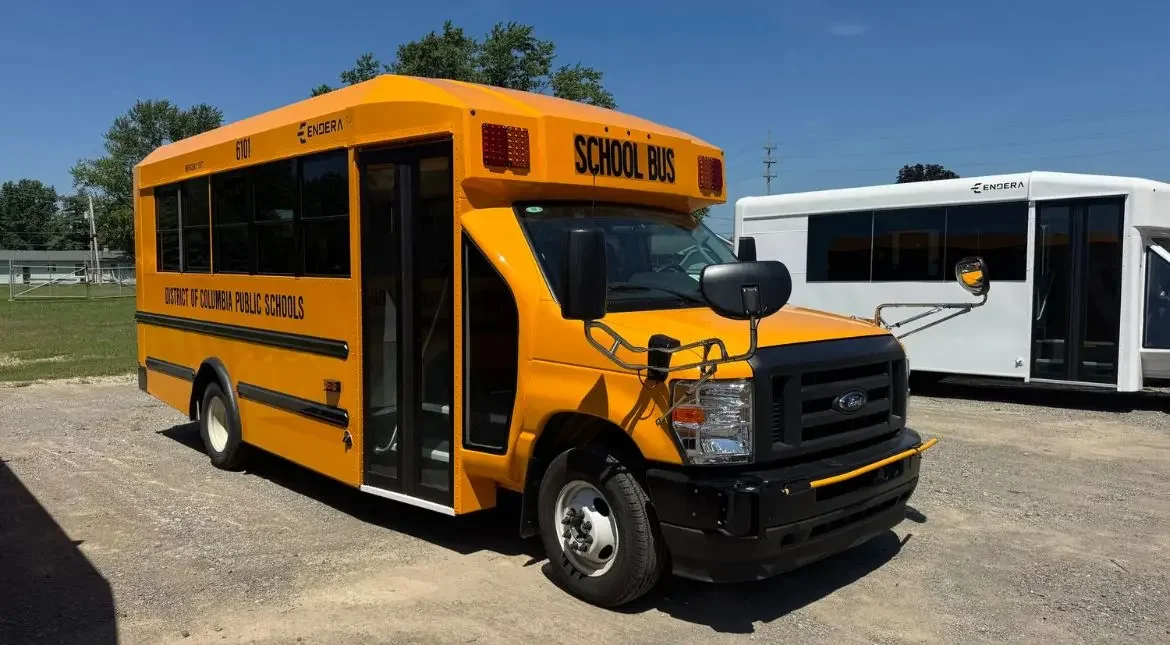
Virginia school divisions operate in a procurement environment where the phrase "Made in America" is not a marketing claim — it's a compliance threshold with direct funding implications. Districts that use federal grants to purchase school buses must work with manufacturers that meet Buy America domestic content requirements. Those that don't verify this upfront risk purchasing a bus that disqualifies the entire transaction from federal reimbursement.
Endera manufactures Type A school buses in gasoline, propane, CNG, and electric configurations from its Ottawa, Ohio facility, sourcing 65% of its supply chain domestically and assembling every vehicle in the United States. That manufacturing footprint meets the FTA's Buy America threshold and positions Endera's lineup for Virginia's federally funded procurement processes.
Protect your federal funding from the start — contact Endera's sales team today to confirm Buy America compliance documentation before your next procurement cycle.
What "Made in America" Requires for School Bus Procurement
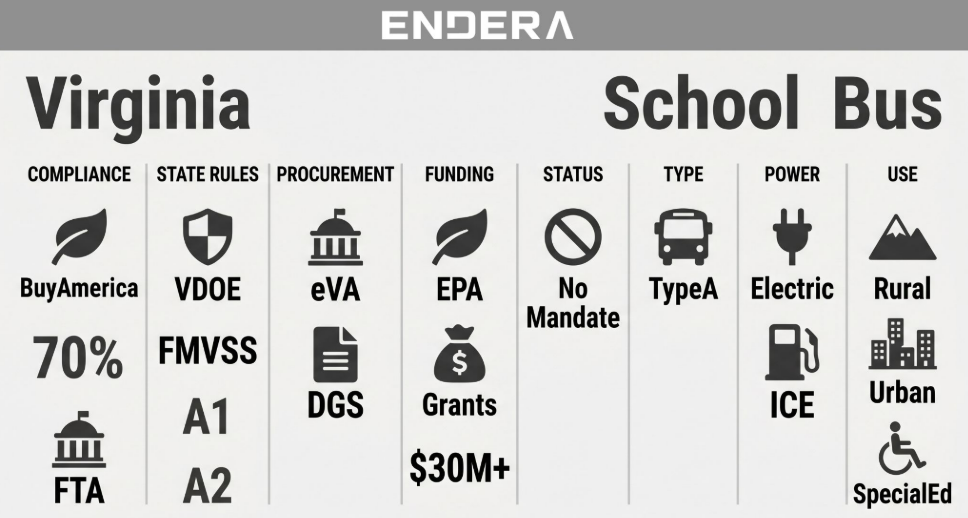
The Federal Transit Administration's Buy America program sets the domestic content standard for transit vehicle purchases funded by federal grants. For buses and rolling stock, that threshold has been set at more than 70% domestic component content since FY2020, with final assembly required to occur in the United States.
This isn't a voluntary preference. Virginia divisions using EPA Clean School Bus Program funds, FTA formula grants, or other federal transportation allocations must purchase from manufacturers that provide a pre-award Buy America certification confirming compliance. The certification documents the domestic content percentage and assembly location — and without it, the purchase is ineligible for federal reimbursement regardless of the vehicle's quality or safety record.
Virginia's School Bus Specification Requirements
The Virginia Department of Education (VDOE) establishes minimum specifications for all public school buses purchased by Virginia school divisions, developed through the VDOE's Specification Advisory Committee in collaboration with the Virginia State Police and school division transportation directors. Any bus purchased for Virginia public school use must meet or exceed these VDOE minimum standards and all applicable Federal Motor Vehicle Safety Standards.
Virginia's specs define Type A school buses in two sub-classifications: Type A1 with a GVWR of 14,500 lbs or less, and Type A2 with a GVWR above 14,500 lbs up to 21,500 lbs. Both sub-types require dual rear wheels. Where a conflict exists between Virginia's minimum specifications and federal FMVSS requirements, the federal standard controls — meaning buses must satisfy both simultaneously, not one or the other.
How Virginia Districts Actually Purchase School Buses
Virginia school divisions procure school buses through a structured process administered by the Virginia Department of General Services (DGS). VDOE enters into statewide contracts for school bus purchases through a competitive bid process, and divisions purchase through the eVA web-based procurement system — Virginia's official online purchasing portal.
This procurement structure means bus manufacturers must be established on the DGS contract to be accessible through normal division purchasing channels. For divisions evaluating Endera outside of a standing DGS contract, direct procurement is possible, but the division's procurement office will need to confirm the applicable process for their bid requirements. Endera's sales team can provide Buy America certification, VDOE compliance documentation, and specification sheets to support the procurement file.
Federal Funding Virginia Districts Have Already Accessed
Virginia has been an active recipient of EPA Clean School Bus Program funding. In the 2022 program round, Virginia school districts received $30.81 million for clean bus replacements. The 2023 round delivered nearly $26 million to fund 116 clean school buses across 18 Virginia school districts. Both rounds required Buy America compliance as a condition of award.
The EPA's Clean School Bus Program continues to offer funding in subsequent cycles, with priority given to districts replacing older diesel buses and those serving low-income, rural, or underserved communities. Endera's grant navigation services assist Virginia divisions in assessing eligibility, preparing applications, and coordinating the compliance documentation required for award finalization.
Electric vs. ICE in Virginia: What Districts Are Choosing
Virginia has no state mandate requiring zero-emission school bus purchases — procurement decisions remain with the local division based on budget, route profile, and infrastructure readiness. The federal funding data tells its own story, though: 95% of EPA Clean School Bus awards nationally go to electric buses, and Virginia's award history reflects that pattern.
| Scenario | Better Fit |
|---|---|
| No charging infrastructure in place | ICE (gas, propane, or CNG) |
| Rural routes with high daily mileage | ICE |
| Budget-constrained, no grant funding | ICE |
| EPA grant funding available | Electric |
| Urban/suburban routes under 100 miles/shift | Electric |
| Long-term fleet cost reduction priority | Electric |
Electric is the stronger long-term value when EPA grant funding covers acquisition cost — as it has for 18 Virginia school districts that have already made that transition.
Virginia Driver Requirements for School Bus Operations
Virginia school bus drivers must hold a Class B Commercial Driver's License from the Virginia DMV with both Passenger (P) and School Bus (S) endorsements. The licensing process includes passing four written CDL tests — General Knowledge, Air Brakes, Transporting Passengers, and School Buses — along with completing the Entry Level Driver Training program, which includes at least 24 hours of classroom instruction and a minimum of 24 hours of combined driving and observation training provided by the school division.
These requirements apply to all school bus types and powertrain configurations. A division transitioning from ICE to electric buses does not need to requalify its existing licensed drivers — the endorsement structure covers both vehicle types. VDOE has created a specific training curriculum for divisions implementing new vehicle types.
Type A Buses Across Virginia's District Geography
Virginia's school division geography ranges from dense suburban corridors in Northern Virginia and Hampton Roads to low-density rural counties in the Shenandoah Valley, Southwest Virginia, and the Eastern Shore. Type A buses serve the routes where larger Type C or D buses run under capacity — special education placements, small-enrollment rural runs, and program-specific transport that doesn't justify a 30-passenger vehicle.
Endera's Type A lineup — the Endera 4, 5, and 6 — covers 4–6 section configurations with ADA-compliant lift options across all powertrain types. For Virginia divisions managing mixed fleet procurement, the same manufacturer relationship, warranty structure, and service network covers both ICE and electric purchases.
Procurement-Ready Documentation
Virginia divisions moving through formal procurement need more than a price quote. They need Buy America certification, VDOE specification compliance documentation, and warranty terms structured for the division's procurement file.
Don't let missing paperwork stall your procurement cycle. Contact Endera's sales team today to request documentation, discuss configurations for Virginia's specification requirements, and confirm build timelines for both in-stock and custom-ordered units.
Frequently Asked Questions
Does Virginia require a specific Buy America certification for school bus purchases?
Yes, for federally funded purchases. Divisions using EPA Clean School Bus Program rebates, FTA formula grants, or other federal transportation funds must obtain a pre-award Buy America certification from the manufacturer confirming that the vehicle meets the 70%+ domestic content threshold and was finally assembled in the United States. This documentation is a procurement requirement — not optional — and must be on file before the award can be finalized.
How does Virginia's eVA procurement system work for school bus purchases?
Virginia school divisions purchase school buses through eVA, the state's web-based procurement portal, using VDOE statewide contracts established through DGS competitive bid processes. Divisions purchasing outside of an established statewide contract must follow their local procurement procedures and applicable competitive bidding requirements. Endera's sales team can provide the documentation and pricing information divisions need to support either process.
What Virginia-specific specifications must a Type A school bus meet?
VDOE minimum specifications require Type A buses to be classified as A1 (GVWR ≤ 14,500 lbs) or A2 (GVWR up to 21,500 lbs), with dual rear wheels required on both sub-types. All buses must meet VDOE minimum standards and applicable FMVSS requirements simultaneously. Where conflicts exist between state and federal standards, federal FMVSS controls. Endera builds to meet or exceed both thresholds and can provide Virginia specification compliance documentation on request.
How much EPA Clean School Bus funding has Virginia received?
Virginia school districts received $30.81 million in the 2022 EPA Clean School Bus Program round and nearly $26 million in the 2023 round — the latter funding 116 clean school buses across 18 school districts. Both rounds required Buy America compliance as a condition of award. Future funding rounds remain open for Virginia districts that haven't yet applied, including those that were not selected in prior cycles.
Does Virginia have a mandate to purchase electric school buses?
No. Unlike Maryland, which requires zero-emission school bus purchases beginning in FY2025, Virginia has not enacted a state-level electric bus mandate. Divisions have full flexibility to purchase ICE or electric models based on their operational needs and funding. The federal funding programs available to Virginia divisions strongly favor electric purchases, but compliance with those programs is not required — it's optional depending on whether the division pursues EPA or FTA grant funding.
Can a Virginia division purchase a used school bus instead of new?
Yes, under specific conditions. Virginia law permits school boards to purchase used school buses from another division or a licensed dealer, provided the bus conforms to the construction and design specifications in effect on the date it was manufactured, holds a valid Virginia State Police inspection, and has not reached the end of its useful life under the VDOE replacement schedule. Used buses are not eligible for EPA Clean School Bus Program funding, which requires model year 2023 or newer vehicles.