
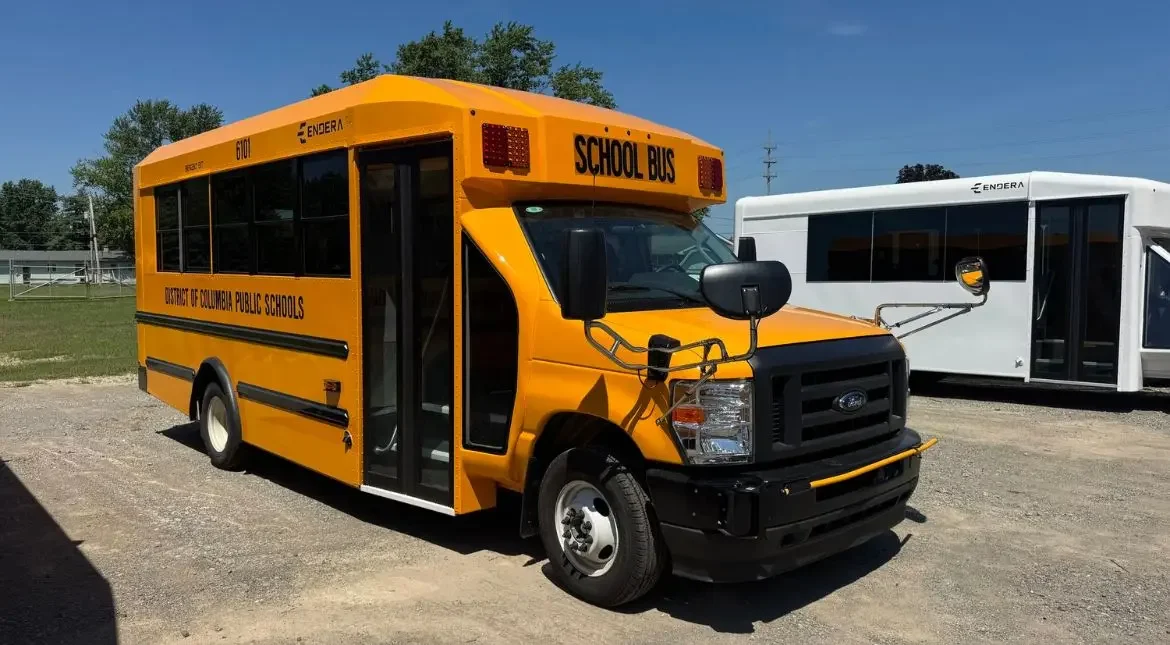
Texas school bus procurement carries a compliance weight that most other states don't match. All school buses sold in Texas must meet state specifications certified by the manufacturer before the vehicle enters service — and non-compliant buses can be pulled from operation until deficiencies are corrected. For district transportation directors, that certification requirement isn't a formality; it's the starting point for every purchase decision.
Endera manufactures Type A school buses in ICE, propane, CNG, and full-electric configurations on Ford E450 and Chevrolet Express cutaway chassis. As a vertically integrated OEM, Endera designs, engineers, and assembles both the body and powertrain at its Ottawa, Ohio facility — producing vehicles that meet Texas specifications as built, not as modified after the fact.
Don't start a Texas procurement without certification documentation in hand — contact Endera's sales team today to confirm spec compliance before your district's bid cycle opens.
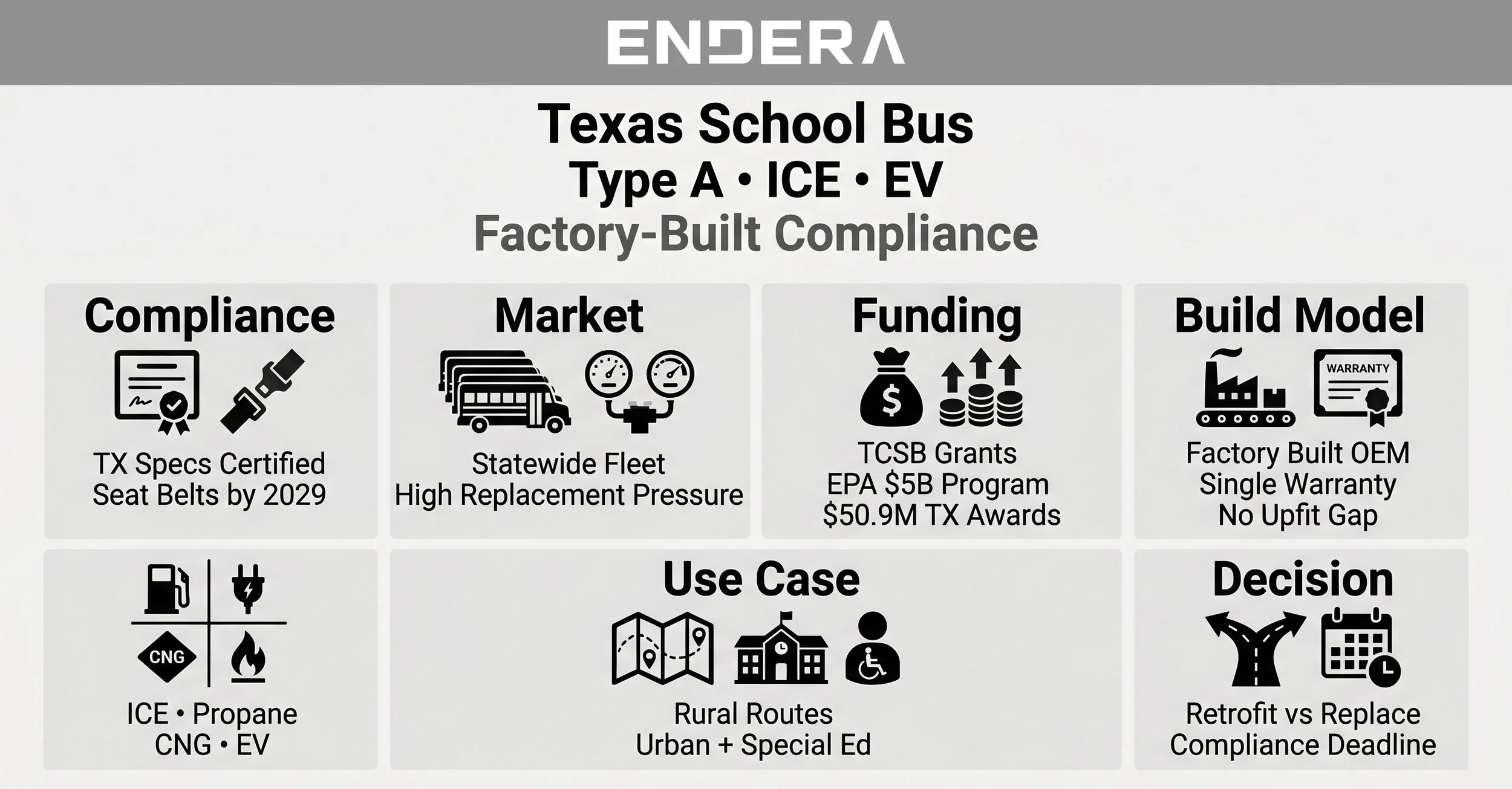
What "Factory-Built" Actually Means for Texas Districts
In the school bus market, "factory-built" is a meaningful distinction. Most shuttle and bus alternatives start as a commercial chassis or van that is then modified by a third-party upfitter — a separate company that adds the body, seating, safety equipment, and any powertrain modifications. That multi-step process creates gaps in accountability: the chassis manufacturer isn't responsible for the body, the upfitter isn't responsible for the chassis, and warranty claims become a negotiation between vendors.
Endera builds the body and installs the powertrain at the same facility under one quality control process. The result is a single warranty document, a single compliance certification, and a single point of contact for any post-sale issue. For Texas districts required to document compliance with state specifications at the point of purchase, that integration removes a layer of procurement risk that modified-vehicle purchases carry by default.
Why Texas Districts Are Replacing Buses Faster
Texas school bus replacement isn't only driven by age. A state law now requires all school buses to be equipped with three-point seat belts, with full compliance required by 2029. For many districts, retrofitting existing buses with seat belt systems is more expensive than replacing them — particularly on older high-mileage vehicles where the seat belt retrofit cost is layered on top of ongoing mechanical maintenance.
That mandate has accelerated the replacement cycle across Texas. Districts that were planning bus purchases in the 2027–2029 window are pulling those decisions forward to avoid the cost of retrofitting vehicles that are already due for replacement. New Endera Type A buses are built with current safety standards from the factory — no retrofit required, no compliance gap to manage.
How Texas Schools Fund New Bus Purchases
Texas operates one of the more active state-level clean bus funding programs in the country. The Texas Clean School Bus Program (TCSB), administered by the Texas Commission on Environmental Quality, offers grants to replace older diesel buses — specifically those from model year 2006 or earlier — with newer cleaner-fuel or zero-emission alternatives. Both public school districts and charter schools are eligible.
Federal funding adds substantially to the available pool. The EPA awarded $50.9 million to Texas districts through the Clean School Bus Program, funding 144 clean buses across 13 districts in a single round. Austin ISD, Fort Worth ISD, and San Antonio ISD are among the named recipients, with individual awards reaching approximately $7.9 million. Across all rounds, 45 Texas districts have already received federal funding for bus replacement — a pipeline that continues to grow as the $5 billion national program runs through 2026.
Endera's grant navigation services help Texas districts identify applicable TCSB and federal programs, build compliant procurement documentation, and manage application submissions without diverting transportation staff to grant administration.
What Types of Buses Texas Districts Are Buying
Texas's multi-fuel adoption reflects the state's geographic and operational diversity. The North Central Texas Council of Governments clean bus program reports that over 70 Texas districts are already operating propane buses — the largest alternative-fuel adoption footprint of any fuel type in the state outside of diesel. Electric bus deployment is growing, with federal awards increasingly directed toward zero-emission models.
Nationally, approximately $2.6 billion has been distributed and roughly 8,000 buses replaced, with about 95% of EPA awards going to electric models in recent cycles. That trend is reaching Texas — but propane and CNG remain strong choices for districts where charging infrastructure isn't yet in place. Endera builds all four powertrain configurations on the same Type A platform, giving Texas districts a path to start with the fuel type that fits current infrastructure and transition to electric on the next procurement cycle.
ICE vs. Electric for Texas School Districts
Texas's scale and geographic spread make the powertrain decision more variable than in smaller northeastern states. Urban districts with fixed routes and established facilities are strong candidates for electric Type A buses — particularly with federal funding covering both the vehicle and charging infrastructure. Rural districts operating long, irregular routes with no depot charging should consider propane or CNG as a near-term solution.
When Electric Makes Sense
Fixed special education routes, suburban loops, and any circuit under 60 to 80 miles per day are operationally suited to electric operation. Districts that have already received or are applying for EPA Clean School Bus funding — where roughly 95% of recent awards are directed toward electric models — should specify electric to maximize award eligibility. Endera's turnkey charging solutions handle site assessment, DC fast charger procurement, and metering installation as a single engagement.
When ICE or Propane Bridges the Gap
Districts in West Texas, the Panhandle, or other areas with long route distances and limited infrastructure should consider propane or ICE as the current-cycle choice. The TCSB grant program funds propane replacements alongside electric — so alternative-fuel purchases still access state incentives even when full electrification isn't operationally viable yet.
Texas Funding at a Glance
| Program | Amount | Who Qualifies | Covers |
|---|---|---|---|
| Texas Clean School Bus Program (TCSB) | Varies by application | Public districts + charter schools | Diesel replacement with cleaner alternatives |
| EPA Clean School Bus Program | $5B nationwide (2022–2026) | All TX districts | Vehicles + charging infrastructure |
| EPA TX Award (single round) | $50.9M — 144 buses | 13 TX districts funded to date | Clean bus replacement |
| Named district awards | Up to ~$7.9M each | Austin ISD, Fort Worth ISD, San Antonio ISD | Electric bus fleets |
Is a Type A Bus Right for Your Texas District?
Type A buses serve the routes that larger buses can't handle efficiently — special education transport, smaller student populations, rural routes where a 48-passenger bus runs half-full, and urban applications where maneuverability and stop frequency matter. Texas districts span both extremes, and the Type A format is the standard tool for the routes that don't fit a full-size bus profile.
Endera's Endera 4, 5, and 6 models are configurable across 4-to-6 section layouts with ADA-compliant lift options. All three are available in ICE, propane, CNG, and full-electric powertrains. Unified warranty coverage across body and powertrain is included — no split documentation between chassis and body vendors.
Spec a Bus for Your Texas District
New 2026 Type A models are available for immediate delivery through Endera Stock for districts with urgent replacement timelines. For districts working within Texas procurement systems or formal bid processes, Endera provides full specification documentation, compliance certifications, and grant application support.
Texas compliance requirements don't leave room for spec mistakes. Contact Endera's sales team today to confirm compliance documentation, fleet configuration, or funding strategy for your district.
Frequently Asked Questions
Why does "factory-built" matter for Texas school bus compliance?
Texas requires manufacturers to certify that buses meet state specifications before sale. Factory-built vehicles from a vertically integrated OEM like Endera carry that certification as a standard part of the build — not a post-modification add-on. Modified van-based alternatives may require additional documentation to demonstrate compliance, adding procurement risk and timeline.
What is the Texas Clean School Bus Program and how does it work?
The TCSB program, run by the Texas Commission on Environmental Quality, offers grants to replace diesel buses from model year 2006 or earlier with cleaner-fuel or zero-emission alternatives. Both public districts and charter schools are eligible. Applications are reviewed competitively, and funding can be combined with federal EPA Clean School Bus awards for districts pursuing electric replacements.
Does Texas require seat belts on new school buses?
Yes. Texas law mandates three-point seat belts on school buses, with full compliance required by 2029. New Endera Type A buses are built to current safety standards, including seat belt requirements, from the factory. Districts buying new vehicles now avoid the retrofit cost that older buses will require to meet the 2029 deadline.
Which Texas school districts have already received federal clean bus funding?
Austin ISD, Fort Worth ISD, and San Antonio ISD are among 45 Texas districts that have received federal Clean School Bus Program funding, with individual awards reaching approximately $7.9 million. The EPA has awarded $50.9 million to Texas in a single funding round, covering 144 buses across 13 districts. Additional rounds remain open through 2026.
Are propane buses eligible for Texas clean bus grants?
Yes. The Texas Clean School Bus Program funds propane and other alternative-fuel replacements alongside electric models. For districts where charging infrastructure isn't yet viable, propane offers a grant-eligible path to fleet modernization without the depot buildout commitment. Over 70 Texas districts already operate propane school buses.
How does Endera's Type A bus compare to modified van-based alternatives?
Van-based alternatives are built on light-duty platforms not rated for daily high-cycle school bus use. Structural fatigue, suspension wear, and warranty fragmentation accumulate faster on modified vehicles than on purpose-built commercial platforms. Endera's Type A buses are built on medium-duty Ford E450 and Chevrolet Express cutaway chassis with body and powertrain assembled at a single facility — producing a vehicle with one warranty, one compliance certification, and one service contact.
What fleet management tools does Endera provide to Texas school districts?
Every Endera school bus is compatible with Endera Dispatch, which includes real-time GPS tracking, geofence management, AI-powered routing, and state-of-charge monitoring for EV units. For Texas districts managing large or geographically dispersed fleets, Dispatch's edge computing onboard hardware enables real-time data processing without relying on consistent cellular coverage across rural routes.