
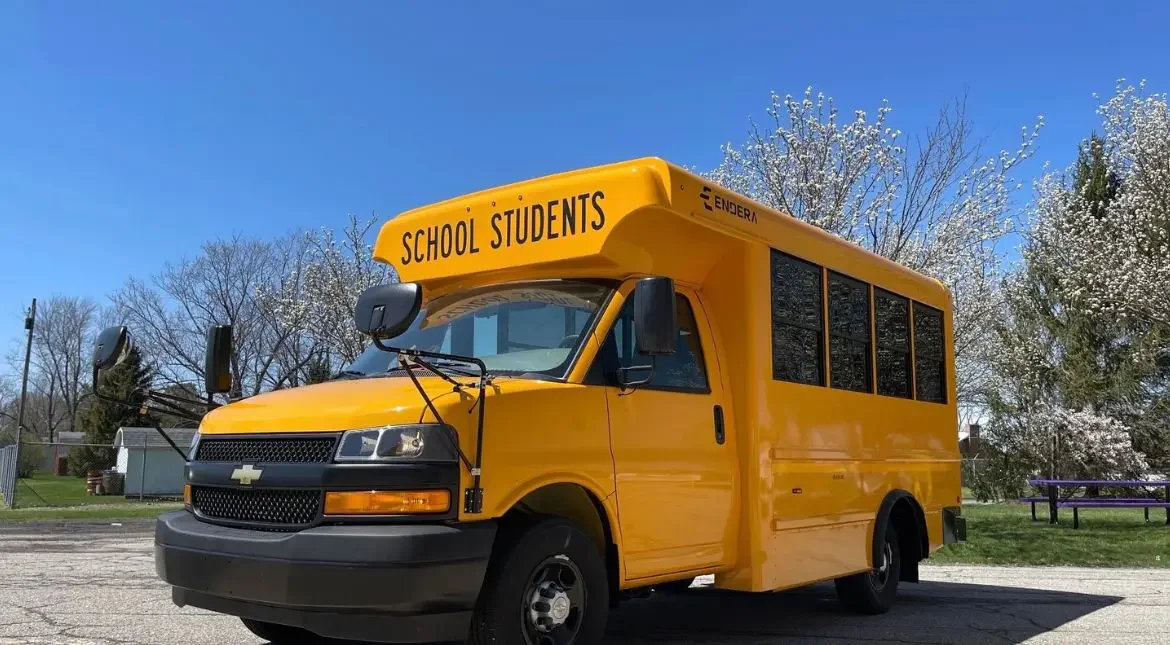
Hawaii's school bus market is unique, with procurement handled statewide through HIDOE rather than individual districts. The state has already secured nearly $5M in EPA funding to begin electrifying its fleet, and has a legally binding goal of full transportation decarbonization by 2045. Because Hawaii imports almost all of its fossil fuels, electrification is driven not only by policy but also by energy cost and security considerations.
Endera's Type A school buses — the Endera 4, 5, and 6 — are available in both ICE and full electric configurations, manufactured at the company's Ottawa, Ohio facility and shipped to Hawaii for deployment.
Hawaii's decarbonization timeline is legally binding — contact Endera's sales team today to discuss vehicle specs, shipping logistics, and funding options for HIDOE procurement teams.
Hawaii's School Transportation Landscape: One District, One Decision
The Single-District Structure Changes the Procurement Dynamic
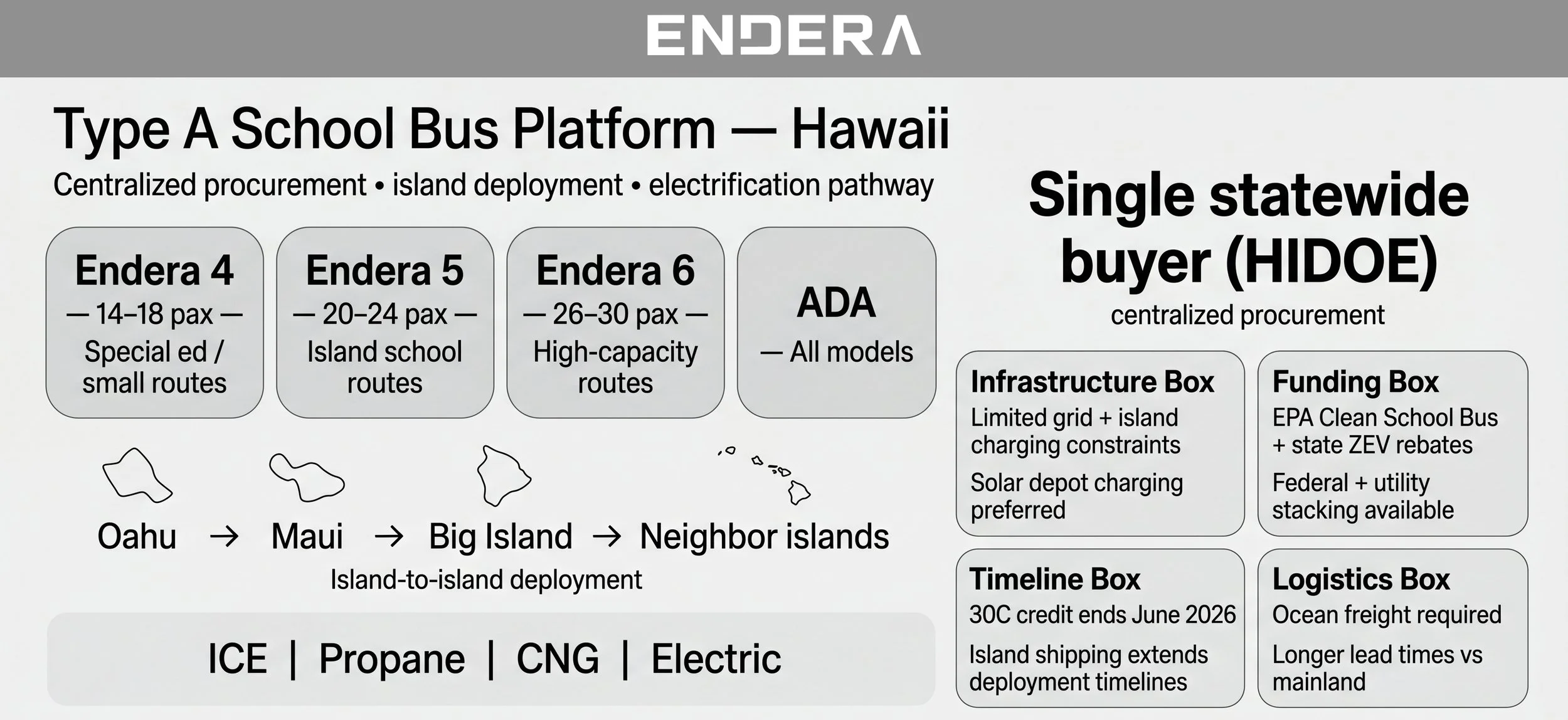
Unlike other states with many independent districts, Hawaii has a single buyer: HIDOE. This allows it to pursue federal funding at scale, including a $4.99M EPA award for 25 statewide buses, 20 of which are electric.
While this centralized model improves procurement efficiency, it also raises the stakes—any vehicle or vendor decision impacts the entire state transportation system rather than just one district.
Hawaii's Clean Energy Goals and What They Mean for School Buses
Hawaii's commitment to zero emissions across all transportation sectors by 2045 is backed by state law, and the transportation sector — including school buses — is a direct target. The state's Hawaii State Energy Office (HSEO) offers rebates of up to 45% of the replacement cost for qualifying medium and heavy-duty zero-emission vehicles. That rebate structure — applied to the incremental cost of replacing a diesel vehicle with a ZEV — is one of the more significant state-level incentives available anywhere in the country for commercial and institutional fleet electrification.
Hawaii's Incentive Stack: What HIDOE Can Actually Access
State Rebates, Utility Programs, and Federal Credits
Hawaii's layered incentive environment is stronger than most people expect for a non-mandate state. The HSEO's medium and heavy-duty ZEV rebate program covers up to 45% of the incremental replacement cost — a meaningful offset for a Type A electric bus.
Hawaiian Electric's eBus Pilot and Charge Up Commercial programs offer DC fast charger rebates up to $35,000 per charger for commercial installations, with additional funding available for retrofit projects. Hawaii Energy provides charger rebates starting at $2,000 for single-port Level 2 and up to $35,000 for DC fast charging projects. The federal 30C charging equipment tax credit — up to $100,000 per installed port — remains available through June 30, 2026, stacking on top of utility rebates for depot charging installations.
The EPA Clean School Bus Program in Hawaii's Context
Hawaii has already secured EPA Clean School Bus funding, including a $4.99M award, and the 2026 round is now being developed after a public comment period. As in all states, being selected doesn’t mean immediate deployment.
HIDOE must still complete procurement steps, documentation, infrastructure setup, and utility coordination before reimbursement is released. Early planning—vehicle specs, purchase frameworks, and charging plans—helps turn funding awards into actual buses in service without delays.
Award ≠ Deployable Fleet: The Hidden Implementation Gap
What "Funded" Actually Means in Practice
EPA Clean School Bus funding is often simplified as a direct path from award to deployment, but in reality it involves multiple stages—selection, award, payment approval, and closeout—before funds are released.
The EPA requires compliance with rules like Buy America and infrastructure readiness, meaning funding is only disbursed after all requirements are met. For HIDOE, the $4.99M award is confirmed, but turning it into buses on routes takes months or even years of administrative and logistical work.
Hawaii's Island Geography Amplifies Every Dependency
After EPA award notification, HIDOE must complete specifications, procurement paperwork, utility approvals, and depot infrastructure planning before manufacturing and shipping can begin. EPA allows a multi-year window for this process, reflecting the gap between funding and readiness.
In practice, deployment can take 12–36 months depending on infrastructure and logistics. Hawaii’s island geography adds further delays through shipping times, utility coordination, and depot construction. The key takeaway is that EPA funding is a structured process, not immediate delivery, requiring careful sequencing to reach operational deployment.
The Endera Type A Lineup for Hawaii Operations
Three Models for HIDOE's Transportation Needs
The Endera 4, 5, and 6 cover 14 to 30 passengers across 4 to 6 section configurations, with options for standard seating, ADA-compliant wheelchair lifts, and storage layouts for special education and general student transport. Hawaii's Type A routes serve specialized student transport, rural and remote school access across the islands, and smaller routes where a full-size bus would be chronically underutilized. The configurability of Endera's lineup — driven by manufacturing the body and powertrain under one roof — means HIDOE can specify exactly the floor plan each route requires.
ICE Configurations Remain Available
Not all Hawaii routes are ready for electrification yet, and Endera’s Type A lineup is designed for that. The Endera 4, 5, and 6 come in ICE, propane, CNG, and electric options on Ford and Chevrolet chassis.
For routes without established charging—especially on neighbor islands—ICE and propane offer reliable service without new infrastructure. The shared platform also allows HIDOE to operate a mixed fleet with consistent maintenance across fuel types.
Island Logistics: What Changes About Procurement and Delivery in Hawaii
Shipping Timelines Add to Lead Times
Every vehicle sold in Hawaii arrives by ship, which adds meaningful time and cost to what would be a straightforward delivery in a continental state. Endera's Ottawa, Ohio manufacturing facility builds vehicles to order, but Hawaii buyers need to factor ocean freight transit time — typically several weeks from a West Coast port — into their delivery planning. For HIDOE procurement cycles tied to academic-year timelines, that additional lead time is a real scheduling variable. Engaging Endera's sales team early in the process allows the production schedule and shipping timeline to be aligned with HIDOE's deployment needs rather than discovered at the last minute.
Electricity Costs and the Solar Opportunity
Hawaii’s high electricity rates can make EV operation seem costly, but the picture is more nuanced. Solar-integrated depot charging can significantly reduce energy costs by relying on rooftop solar instead of expensive grid power.
For HIDOE facilities, combining solar with depot charging can lower per-kWh costs substantially. Endera’s turnkey depot charging services include site assessment and installation, with solar integration considered from the start.
Total Cost of Ownership: The Hawaii-Specific Picture
Why Electrification Makes Particular Sense in Hawaii
The financial case for electric school buses in Hawaii is especially strong because the state imports nearly all its diesel fuel, meaning costs are tied to volatile global markets. Electric buses, especially when charged with solar, replace imported fuel with local energy.
Studies like the Electric School Bus Initiative show over $170,000 in fuel and maintenance savings per bus nationally, and in Hawaii those savings are likely even higher due to elevated diesel prices.
The 30C Deadline and What It Means for HIDOE
The federal 30C charging equipment tax credit — up to $100,000 per installed charging port — expires June 30, 2026. Equipment must be physically placed in service by that date, not just purchased or permitted. For Hawaii, where shipping and installation timelines are longer than the continental US, that deadline requires earlier action than most states. A depot charging installation that might take 8 weeks in Ohio might take 12 to 16 weeks in Hawaii once shipping and utility coordination are factored in. HIDOE facilities planning to capture this credit should be in active planning conversations now — not after the spring procurement cycle closes.
Built for Hawaii's Unique School Transportation Environment
Hawaii's school bus market doesn't look like any other state — single district, island logistics, high energy costs, and a legally binding clean energy timeline. Endera's Type A lineup is built to serve that environment across every fuel type, with the flexibility to support HIDOE's electrification goals at whatever pace its infrastructure and funding make achievable.
Hawaii's 2045 decarbonization deadline starts with the procurement decisions being made right now. Contact Endera's sales team today to discuss the right Type A configuration and Hawaii-specific delivery timeline for your procurement.
FAQs
How does Hawaii's single school district structure affect school bus procurement?
HIDOE is the sole school district in Hawaii, meaning all school bus procurement is centralized at the state level. This creates procurement efficiency — Hawaii has successfully accessed EPA Clean School Bus funding at scale — but also means vehicle selection decisions affect the entire state transportation program.
What state incentives are available for Hawaii school bus electrification?
The HSEO medium and heavy-duty ZEV rebate program covers up to 45% of the incremental replacement cost for qualifying zero-emission vehicles. Hawaiian Electric and Hawaii Energy offer DC fast charger rebates up to $35,000 per project. The federal 30C credit (through June 2026) stacks on top of utility programs.
Which Endera Type A models are available for HIDOE?
The Endera 4, 5, and 6 are available in ICE, propane, CNG, and electric configurations, with ADA-accessible layouts for special education transport on both Ford and Chevrolet cutaway chassis.
What is the 30C deadline, and why does it matter more in Hawaii?
The 30C charging equipment tax credit expires June 30, 2026, with equipment required to be physically placed in service by that date. Hawaii's longer shipping and installation timelines mean HIDOE needs to start infrastructure planning earlier than mainland states to capture this credit.
How does Hawaii's high electricity cost affect the EV operating cost calculation?
High grid electricity rates create a strong incentive for solar-integrated depot charging, where vehicles charge from rooftop solar rather than peak-rate grid power. For HIDOE facilities that can support solar, the per-kWh operating cost of an electric fleet can be substantially lower than grid-rate estimates suggest.
Do Endera buses comply with Buy America requirements?
Yes. With approximately 65% of components sourced domestically, Endera's manufacturing supports Buy America compliance for federally funded Hawaii procurement contracts.
How does ocean freight affect delivery timelines for Hawaii?
All vehicles shipped to Hawaii require ocean freight from a West Coast port, typically adding several weeks to delivery timelines beyond continental US lead times. HIDOE buyers should engage Endera's sales team early in the procurement process to align production and shipping schedules with deployment needs.