
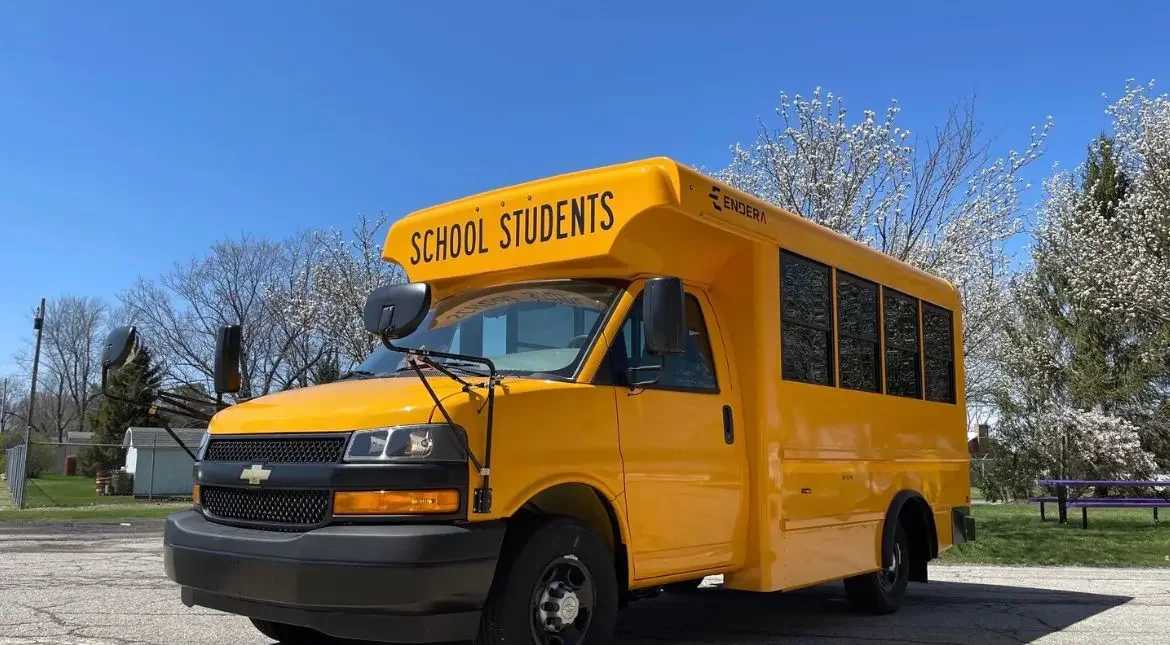
North Carolina has invested heavily in electric school buses, with over $26.7M in EPA grants funding 114 buses and $30.1M from the Volkswagen Settlement supporting 161 replacements, including 43 electric buses. For eligible districts — especially in Tier 1 and rural areas — stacked funding from federal, state, utility, and tax credit programs can cover up to 100% of project costs, according to the NC Clean Energy Technology Center.
Endera's Type A school buses — the Endera 4, 5, and 6 — are available in ICE, propane, CNG, and full electric configurations on Ford and Chevrolet cutaway chassis, manufactured at Endera's Ottawa, Ohio facility. For North Carolina districts that haven't yet accessed this funding — or that are preparing for the next EPA cycle — understanding what's available and how to stack it is the difference between paying full price and paying nothing.
Don't leave North Carolina funding on the table — contact Endera's sales team today to map out what your district actually qualifies for.

100% Funding Is the Exception — Not the Baseline
Who Actually Qualifies for Full Coverage
The idea that NC districts can electrify at zero cost is real — but it's a best-case scenario that requires multiple eligibility layers to align perfectly. As the NC Clean Energy Technology Center documents, full coverage is concentrated among a subset of districts — primarily Tier 1 counties and EPA priority applicants.
Priority districts in North Carolina receive higher per-bus awards and are more likely to achieve near full funding, especially in rural and high-need areas where stacked programs can cover almost all costs.Non-priority districts, often suburban or urban, typically face lower caps and still have a significant funding gap per bus even after applying all available programs.
What Breaks the Stack
Even for eligible North Carolina districts, “fully funded” EV projects require precise coordination across multiple programs and can easily fall apart due to timing or compliance issues.
Differences in priority status, missed deadlines between EPA, 30C, and utility programs, scrappage documentation errors, or location-based eligibility limits can all reduce or eliminate funding. As a result, full cost coverage is not guaranteed and depends on careful planning and execution across several programs.Endera’s grant advisory team helps districts confirm eligibility and align timelines before making procurement commitments.
What NC Districts Actually Pay Per Bus: The Braided Funding Reality
When the Stack Covers Everything
North Carolina's funding environment for prioritized districts is among the strongest in the country. According to the NC Clean Energy Technology Center, for Tier 1 county and rural NC districts, the combined funding stack looks like this:
| Funding Source | Amount |
|---|---|
| EPA Clean School Bus grant | Up to $325K–$345K (including infrastructure) |
| NC DPI school bus funding | Up to $100K |
| Duke Energy charger prep credit | Available for qualifying installations |
| IRS elective pay (30C) | Up to $100K per charging port |
| Net cost (prioritized district) | Near zero for qualifying projects |
For non-prioritized NC districts — suburban and urban districts outside Tier 1 or rural designations — the stack is smaller but still meaningful: EPA awards at the standard tier provide up to $170K–$250K, and the 30C credit applies to charging infrastructure regardless of district type. The honest message for NC districts is that the type and amount of federal funding you qualify for depends heavily on your district's classification — and most districts don't know their classification until they've actually looked it up.
The Funding Cycle Gap
The EPA Clean School Bus Program is currently between cycles — the 2024 round is not moving forward and the 2026 program is being designed. That gap creates a planning window, not a reason to wait. NC districts that prepare now — vehicle specifications confirmed, infrastructure planned, utility coordination started, scrappage documentation assembled — are positioned to move immediately when the next cycle opens.
Districts that wait until an award notification to begin those steps consistently face the 12–36 month execution pipeline that turns a funding announcement into an operational delay.
The Endera Type A Lineup for North Carolina Districts
Three Models, Configured for NC's Transportation Needs
The Endera 4, 5, and 6 cover 14 to 30 passengers across 4 to 6 section configurations, with options for standard seating, ADA-compliant wheelchair lifts, and storage for special education and general student transport.
North Carolina’s Type A fleet ranges from short, predictable urban special education routes in cities like Charlotte, Raleigh, Durham, and Greensboro—well suited for electrification—to longer rural routes in the mountains and coastal plain with limited charging infrastructure.Endera’s integrated manufacturing allows districts to configure buses to specific needs and route requirements.
ICE and Propane as Bridge Fuel Configurations
Not every North Carolina district is ready for full electrification across all routes. Endera’s Type A lineup (Endera 4, 5, and 6) offers ICE, propane, and CNG options on Ford and Chevrolet chassis, allowing districts to electrify suitable routes while maintaining reliable service where charging infrastructure isn’t available.
Propane is widely accessible in North Carolina and can qualify for EPA funding at lower tiers. For rural and coastal areas, propane and CNG offer a lower-emission transition option without requiring new infrastructure.
Infrastructure Reality: Power Availability Is the Real Constraint
Utility Coordination Comes First — Not Last
Most NC district procurement timelines assume the bus is the long lead item. In practice, electrification starts with the grid. Electrifying a depot requires early engagement with the local utility — whether Duke Energy, Dominion Energy NC, or an electric cooperative — to assess available capacity, rate structures, and interconnection requirements.
The Electric School Bus Planning Guide emphasizes that charging infrastructure development must happen in parallel with vehicle selection. Transformer procurement alone can take 24 to 104 weeks. Permitting, trenching, and interconnection studies add further delays. NC districts that treat infrastructure as an afterthought to the bus purchase routinely find the execution pipeline stretching well beyond the expected deployment window.
Duke Energy's Charger Prep Credit Changes the Infrastructure Math
Duke Energy offers a charger preparation credit that helps reduce EV infrastructure costs for eligible North Carolina districts in its service area. When combined with the federal 30C credit (expiring June 30, 2026), it can significantly lower depot charging expenses beyond EPA bus funding.
Since Duke serves much of central and western NC, early utility coordination is key. Endera’s turnkey depot charging services help manage site assessment, installation, and utility engagement together.
NC's Health and Environment Case for Electric School Buses
Diesel Exhaust and North Carolina's Student Population
The health case for electric school buses is especially relevant in North Carolina, particularly in Tier 1 and rural counties with vulnerable student populations. Diesel exhaust is a known carcinogen, and exposure during boarding and unloading is highest when buses idle near students.
Electric buses eliminate this exposure entirely, which is significant for districts with older diesel fleets and fewer resources. In these cases, health benefits and funding opportunities align toward electrification.
Quieter Routes for Students With Sensory Needs
Type A buses in North Carolina serve a disproportionately high share of students with special needs — the smaller, accessible vehicle is the standard for special education transport across the state. Electric powertrains produce significantly less interior noise than diesel alternatives, which matters specifically for students with sensory sensitivities, autism spectrum conditions, or other needs where environmental noise creates stress. A quieter ride isn't a luxury feature on a special education bus. It's a functional improvement in the quality of every student's school day.
Procurement Strategy: What NC Districts Should Do Now
Preparation Is the Competitive Advantage
North Carolina districts that successfully use EPA funding are those ready to act immediately after selection, not just those with strong applications.
This includes pre-specifying vehicle configurations, planning depot charging and utility coordination in advance, and preparing scrappage documentation for older diesel buses. Endera helps districts align vehicles and infrastructure with funding timelines before the next EPA cycle opens.
The 30C Credit Before It Closes
The 30C charging equipment credit — up to $100,000 per installed charging port — expires June 30, 2026. Equipment must be physically placed in service by that date. For NC districts planning depot charging installations, starting the infrastructure process now — not after the next EPA award cycle opens — is what makes June 30 achievable given utility coordination and contractor timelines.
North Carolina's Funding Window Is One of the Strongest in the Country
For NC's prioritized districts, the math on electric school bus adoption is genuinely compelling — the funding stack can reach 100% of project costs for qualifying applications. For districts outside priority tiers, the combined federal and state tools still reduce the premium substantially. The districts that capture this funding aren't the ones with the best grants teams — they're the ones that prepared before the deadline pressure arrived.
North Carolina's funding stack is one of the best in the country — but only for districts that show up early. Talk to an Endera specialist today to find the right Type A configuration and NC funding strategy for your district.
FAQs
What funding is available for North Carolina school districts buying electric school buses?
NC prioritized districts (Tier 1, rural, historically under-resourced) can access a braided funding stack including EPA Clean School Bus grants (up to $345K), NC DPI school bus funding (up to $100K), Duke Energy charger prep credits, and 30C charging credits. For qualifying districts, combined funding can cover 100% of project costs. Endera's grant advisory team assists NC districts with identifying eligibility and coordinating applications.
Which Endera Type A models are available for North Carolina districts?
The Endera 4, 5, and 6 are available in ICE, propane, CNG, and electric configurations, with ADA-accessible layouts for special education transport on both Ford and Chevrolet cutaway chassis.
Is the EPA Clean School Bus Program currently accepting applications?
No. The 2024 cycle is not moving forward and the 2026 program is being designed. NC districts should use this period to prepare applications, infrastructure plans, and scrappage documentation so they can execute quickly when the next cycle opens.
What is the 30C charging credit deadline for NC districts?
The 30C credit — up to $100,000 per installed port — expires June 30, 2026. Equipment must be physically placed in service. NC districts planning depot charging should begin the infrastructure process now.
How does Duke Energy's charger prep credit work for NC school districts?
Duke Energy offers a charger preparation credit for qualifying EV charging installations in its service territory. When stacked with the 30C federal credit, it reduces depot infrastructure costs meaningfully. NC districts in Duke territory should engage Duke's business support team early in the infrastructure planning process.
Do Endera buses comply with Buy America requirements?
Yes. With approximately 65% of components sourced domestically, Endera's manufacturing supports Buy America compliance for federally funded NC district purchases.
What is NC's Tier 1 county designation and why does it matter for school bus funding?
North Carolina's Tier 1 counties are the state's most economically distressed, and EPA Clean School Bus funding prioritizes these districts with higher per-bus award amounts. Many rural and historically under-resourced NC counties qualify, making the braided funding stack most favorable for exactly the districts where transportation budgets are tightest.