
Illinois is a leading state in electric school bus adoption, backed by strong funding and infrastructure. The Driving a Cleaner Illinois Program has invested nearly $108M to fund over 120 electric buses and dozens of charging sites, with additional grants awarded in 2025. ComEd is adding millions more annually for buses and charging infrastructure, and projects like East St. Louis School District's new 25-bus charging depot show the transition is actively underway — not theoretical.
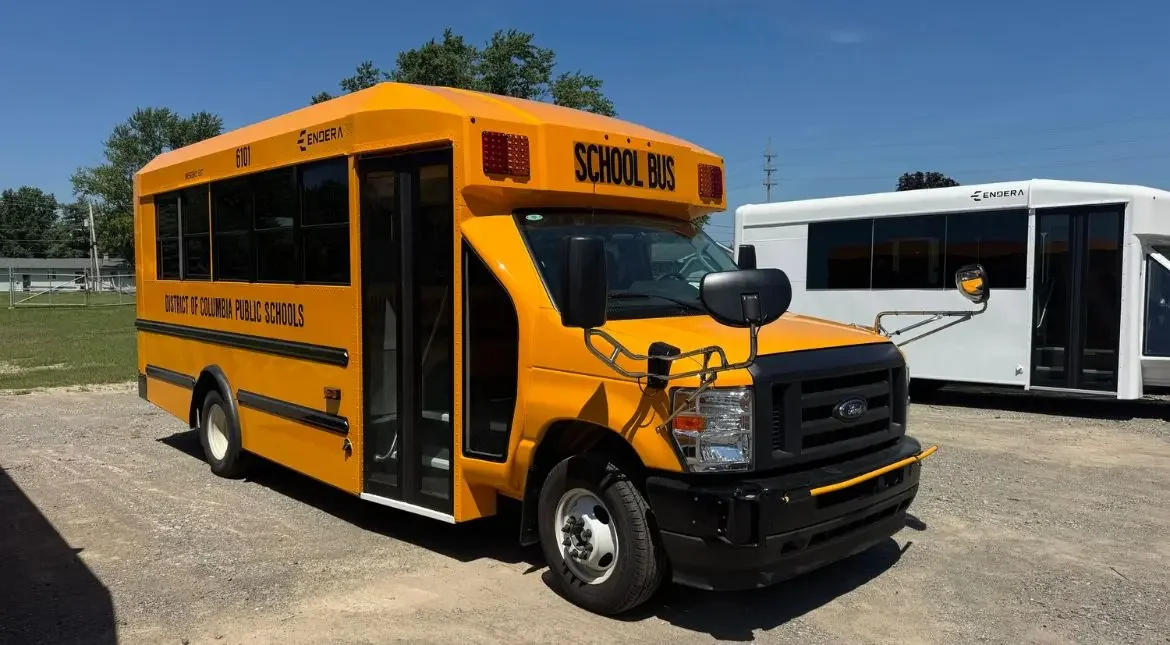
Endera's Type A school buses — the Endera 4, 5, and 6 — are available in ICE, propane, CNG, and full electric configurations on Ford and Chevrolet cutaway chassis, manufactured at Endera's Ottawa, Ohio facility.
For Illinois districts from the Chicago suburbs to downstate counties, there's a configuration and funding pathway worth understanding — and a procurement strategy worth building before the next program cycle creates deadline pressure. Illinois funding is active and moving fast — contact Endera's sales team today to build a procurement strategy before the next cycle deadline arrives.
Illinois's School Bus Funding Landscape: Multiple Active Programs
The Driving a Cleaner Illinois Program
Illinois EPA's Driving a Cleaner Illinois Program — funded by Illinois's VW Settlement allocation — has been the most active state-level electric school bus funding mechanism. It has supported 122 electric school buses across priority counties including the Chicago metro area and Metro-East, as well as Champaign, DeKalb, LaSalle, McLean, Peoria, Sangamon, and Winnebago counties. The program has run through five funding rounds with additional rounds anticipated.
For Illinois districts in priority counties, this is the most direct path to state-funded electric school bus support — and the program has a track record of active operation that many states' equivalent programs don't.
ComEd's Beneficial Electrification Plan: A New Layer
The Illinois Commerce Commission approved ComEd's 2026–2028 Beneficial Electrification (BE) Plan in March 2025, committing $5.5 million per year for electric school bus rebates and $15.6 million per year for EV Make-Ready infrastructure costs. That's $16.5 million in school bus rebates and nearly $47 million in make-ready support over three years — for ComEd service territory, which covers northern Illinois including Chicago and the suburbs. Ameren Illinois operates an equivalent program for central and southern Illinois. Both utilities are actively funding the infrastructure side of electric school bus deployment, not just the vehicle purchase. For Illinois districts that have been deferring electrification because of infrastructure cost uncertainty, the utility make-ready programs address exactly that barrier.
Funding Stack Reality in Illinois: Why No Single Program Covers the Full Cost
Four Layers, But Rarely All Four at Once
Illinois districts pursuing electric school buses are typically presented with a fragmented view of funding — VW Settlement grants, utility rebates, federal incentives, and tax credits described as separate opportunities. In practice, deployment depends on how these programs interact as a stacked model, where each layer offsets only a portion of total project costs and gaps remain unavoidable.
The Driving a Cleaner Illinois Program forms the base layer — covering vehicle replacement and charging infrastructure for qualifying districts — but awards are competitive and vary by county prioritization. It's a foundation, not a complete solution. ComEd's Beneficial Electrification initiatives add a second layer through vehicle rebates and make-ready infrastructure support, reducing electrical upgrade costs but not covering full site buildouts or all interconnection requirements.
Timing Mismatch Is Often the Bigger Problem Than Program Availability
The EPA Clean School Bus Program adds a third federal layer — but it's cyclical and competitive, meaning districts may or may not receive awards depending on application windows and scoring criteria in any given cycle.
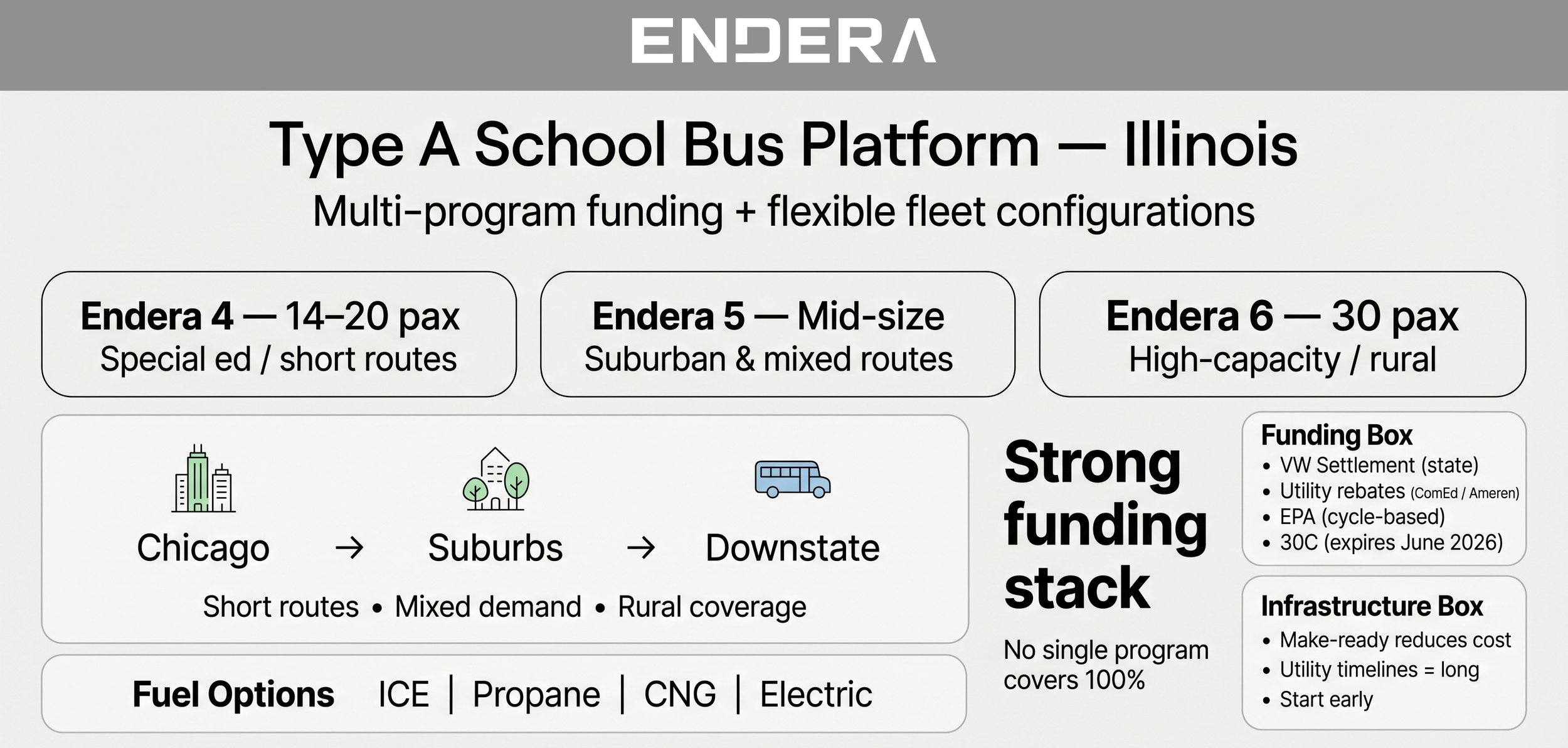
The 30C tax credit adds a fourth funding layer for charging infrastructure, but expires June 30, 2026. A fully stacked Illinois district combines state, utility, federal grant, and tax credit funding — but most districts only access one or two layers at a time. Timing gaps between funding cycles often matter more than program availability. Endera's grant advisory team helps districts map their eligibility across all four layers before committing to procurement.
What Illinois Districts Actually Pay: The Funding Stack
When Programs Align Well — and When They Don't
Illinois's multi-program environment creates real funding opportunities — but as with every braided funding scenario, full coverage is the exception, not the baseline. Districts in priority counties (particularly environmental justice communities and lower-income areas) qualify for higher grant awards through the Driving a Cleaner Illinois Program and receive preferential selection. Districts outside priority designations access the same programs but at lower award tiers. ComEd's utility rebates apply to all ComEd customers, but the make-ready coverage is subject to program terms, capacity, and eligibility for specific cost categories.
| Funding Source | What It Covers |
|---|---|
| Driving a Cleaner Illinois (VW Settlement) | Vehicle purchase + charging infrastructure |
| ComEd School Bus Rebate ($5.5M/year) | Electric bus purchase rebates |
| ComEd EV Make-Ready ($15.6M/year) | Infrastructure costs (both sides of meter) |
| EPA Clean School Bus (when available) | Vehicle + infrastructure (federal layer) |
| 30C charging credit (through June 2026) | Up to $100K per charging port |
For priority Illinois districts, the stack of state VW grants, utility rebates, and federal credits can cover a substantial portion of vehicle and infrastructure costs. For non-priority districts, the utility programs still provide meaningful infrastructure support that reduces the capital barrier to electrification. The 30C federal credit expiring June 30, 2026 is the most time-sensitive element — depot charging installations need to be placed in service by that date to qualify, which means the infrastructure process needs to start now.
The Endera Type A Lineup for Illinois Districts
Three Models for Illinois's Range of School Transportation Needs
The Endera 4, 5, and 6 cover 14 to 30 passengers across 4 to 6 section configurations, with options for standard seating,Endera's Type A lineup accommodates ADA-compliant wheelchair lifts, special education, and general transport configurations. Illinois routes vary widely — from shorter suburban runs in the Chicago collar counties to longer rural routes downstate where charging infrastructure is less established. Because Endera manufactures both the body and powertrain in-house, districts can specify the exact floor plan they need rather than adapting to a generic template.
ICE and Propane for Districts Not Yet Ready to Electrify
Not every Illinois district is in a priority county, not every route is short enough for today's EV range with current depot infrastructure, and not every district has the administrative capacity to navigate multiple concurrent funding applications. The Endera 4, 5, and 6 are available in ICE, propane, and CNG configurations on both Ford and Chevrolet cutaway chassis — giving Illinois districts the flexibility to electrify their most eligible routes first while maintaining reliable operations elsewhere.
Propane qualifies for state and federal program funding at lower award tiers and is accessible across Illinois's dealer network. CNG is viable in larger downstate markets with existing natural gas infrastructure.
Infrastructure Reality: Power Availability Is the Real Constraint
Utility Coordination Is Where Projects Succeed or Fail
Illinois offers strong electric school bus infrastructure support, but execution remains the universal challenge — charging infrastructure must be developed in parallel with vehicle selection, not after. Transformer procurement alone can take 24 to 104 weeks, with full utility upgrades often stretching 18 to 24 months. ComEd and Ameren Illinois make-ready rebates reduce costs, but don't shorten the timeline. Districts that begin utility conversations now, before a vehicle award is confirmed, will be best positioned to deploy on schedule when funding clears.
ComEd's V2G Pilot: What It Means for Illinois Districts
ComEd is actively piloting vehicle-to-grid (V2G) technology with Illinois electric school buses — a program where school buses that are stationary during peak grid hours can feed power back to the grid, generating revenue or credits for the district. It's genuinely pioneering work, and the grid timing alignment is real: school buses are stationary during daytime peak hours when the grid needs power most. V2G is still a pilot with documented challenges — worth watching, but not yet a primary reason to buy electric. Fuel and maintenance savings remain the core value case for most districts.
Procurement Strategy: What Illinois Districts Should Do Now
The EPA Gap Is a Preparation Window
The EPA Clean School Bus Program is between cycles — the 2024 round stalled and the 2026 program is being redesigned. But Illinois districts don't need to wait. The Illinois EPA's Driving a Cleaner Illinois program runs independently and has additional rounds anticipated, and utility funding operates on its own schedule. Districts that confirm vehicle configurations, start utility coordination, and develop infrastructure plans now will be ready to move when the next program opens — without rebuilding the pipeline from scratch.
Using This Window to Build Charging Infrastructure
The 30C federal charging credit expires June 30, 2026. For Illinois districts that haven't yet installed depot charging, this deadline is a reason to act now rather than waiting for a bus award. A district that builds charging infrastructure now — capturing the 30C credit and ComEd's make-ready rebates — will have operational infrastructure in place when the next Driving a Cleaner Illinois grant round opens, rather than needing to build it under the compressed timeline of the award execution sequence.
Illinois Is Already Moving — Districts That Prepare Now Will Lead
Illinois has the state programs, the utility funding, and the track record to support meaningful electric school bus deployment. The districts that lead this transition aren't waiting for a federal program to restart — they're using state and utility programs now, building infrastructure before the 30C window closes, and positioning themselves to move immediately when each new funding round opens.
Illinois's funding environment rewards preparation, not reaction. Talk to an Endera specialist today to find the right Type A configuration and Illinois funding strategy for your district.
FAQs
What state funding is available for Illinois school districts buying electric school buses?
The Driving a Cleaner Illinois Program provides VW Settlement grants for electric school buses and charging infrastructure, with additional rounds anticipated. ComEd's Beneficial Electrification Plan allocates $5.5M/year for school bus rebates and $15.6M/year for EV Make-Ready costs (2026–2028). Ameren Illinois operates equivalent programs for central and southern Illinois.
Which Endera Type A models are available for Illinois districts?
The Endera 4, 5, and 6 are available in ICE, propane, CNG, and electric configurations, with ADA-accessible layouts for special education transport on both Ford and Chevrolet cutaway chassis.
What is the 30C charging credit deadline for Illinois districts?
The 30C credit — up to $100,000 per installed charging port — expires June 30, 2026. Equipment must be physically placed in service. Illinois districts planning depot charging should engage utility coordination and installation planning now.
Do Illinois districts need to be in a priority county to access electric school bus funding?
No — but priority designation (environmental justice communities, lower-income areas) qualifies for higher award tiers and preferential selection in the Driving a Cleaner Illinois program. Districts outside priority areas can still access state and utility programs at standard tiers.
Is the 45W commercial vehicle credit still available for Illinois school bus purchases?
No. The 45W credit was eliminated for vehicles acquired after September 30, 2025. The 30C charging infrastructure credit remains available through June 30, 2026.
Do Endera buses comply with Buy America requirements?
Yes. With approximately 65% of components sourced domestically, Endera's manufacturing supports Buy America compliance for federally funded Illinois district purchases.
How does Endera help Illinois districts navigate the funding landscape?
Endera's grant advisory team helps Illinois districts identify which programs apply to their specific county and district profile, prepare applications, align vehicle selection with program timelines, and coordinate infrastructure planning with utility make-ready programs.