

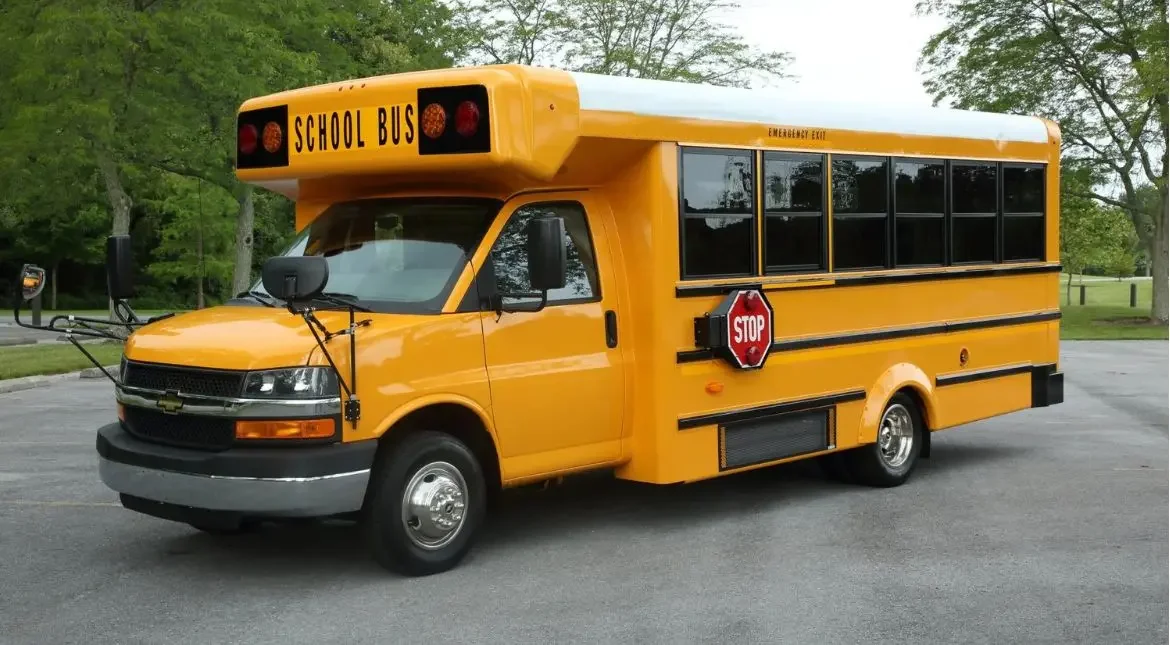
Kansas districts evaluate Type A buses without a state mandate or purchase rebate, and with EPA Clean School Bus funding currently between cycles. However, Evergy provides strong utility support, including a School Bus Electrification Consortium, technical assistance, and low overnight rates ($0.03–$0.04/kWh). Some districts, like Caney Valley USD 436, have already deployed electric buses. The key decision is whether current routes and infrastructure justify electrification now or preparation for later adoption.
Endera‘s Type A school buses — the Endera 4, 5, and 6 — are available in ICE, propane, CNG, and full electric configurations on Ford and Chevrolet cutaway chassis, manufactured at Endera’s Ottawa, Ohio facility. For Kansas districts from the Johnson County suburbs to the rural Flint Hills and High Plains, there’s a configuration and procurement strategy worth building — whether you’re ready to electrify now or preparing for the next funding cycle.
Ready to optimize your routes? Contact Endera’s fleet specialists today to design a custom configuration blueprint for your district.
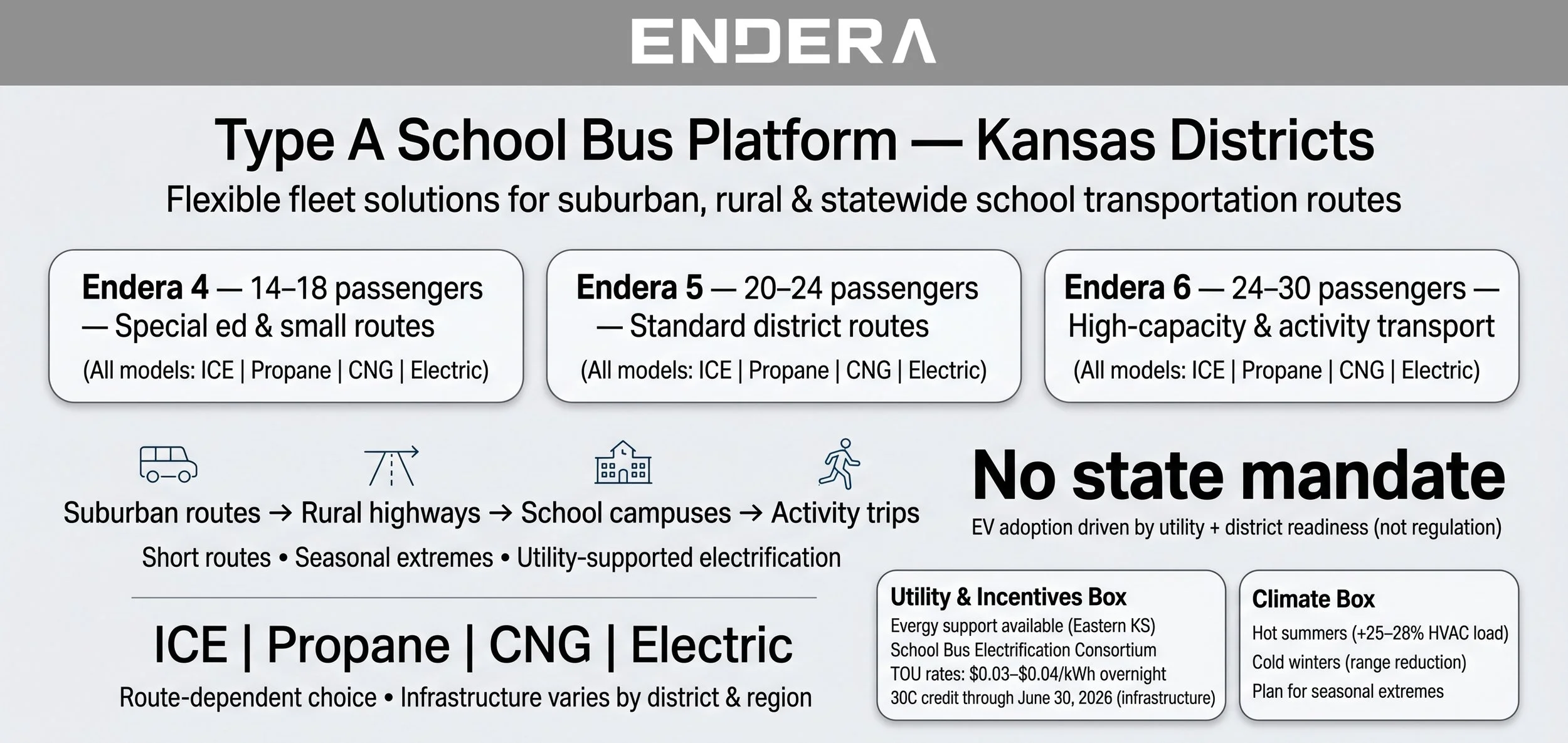
Kansas’s School Bus Landscape: No Mandate, Real Utility Support
Evergy’s School Bus Electrification Consortium
Evergy — which serves Kansas City, Topeka, and much of central and eastern Kansas — actively supports school bus electrification. Its School Bus Electrification Consortium helps districts with EPA funding, charging rates, and infrastructure planning. This utility-as-partner model is relatively rare, and districts in Evergy territory should engage before the next EPA funding cycle.
Overnight Charging Rates That Change the Economics
Evergy’s TOU rates offer off-peak overnight charging as low as $0.03–$0.04/kWh, among the lowest in the US. Because school buses charge overnight at depots, they align well with these low-demand hours. For Kansas districts on TOU plans with depot charging, EV per-mile energy costs become highly competitive with diesel or propane, strengthening long-term operating savings.
Kansas Weather: Both Variables Matter for EV Planning
Kansas has both hot summers and cold winters, which affect EV performance year-round. Research shows extreme heat can increase energy use by about 25–28% due to HVAC demand, while cold weather reduces range through heating needs and lower battery efficiency. Districts planning EV adoption need to model seasonal extremes to understand real-world range on the worst operating days, not just average conditions.
Kansas Type A routes are generally short and predictable, making them well-suited to EVs. In most urban and suburban districts, seasonal range impacts can be managed with depot charging and route planning. However, rural western Kansas routes with higher daily mileage face tighter margins and may be better suited to propane or CNG for now. Endera Dispatch helps monitor state of charge in real time to manage seasonal variability.
The Endera Type A Lineup for Kansas Districts
The Endera 4, 5, and 6 cover 14 to 30 passengers across 4 to 6 section configurations, with options for standard seating, ADA-compliant wheelchair lifts, and storage layouts for special education and general student transport.
Kansas’s Type A fleet spans suburban special education routes in the Johnson County and Sedgwick County school systems — shorter, predictable, and well suited for electrification — to rural routes in western Kansas districts where a 60+ mile daily circuit makes range planning more consequential. The configurability of Endera’s lineup means Kansas districts can specify exactly the floor plan their student population requires.
The Endera 4, 5, and 6 are available in ICE, propane, and CNG configurations on both Ford and Chevrolet cutaway chassis. For rural Kansas districts covering longer routes, operating in areas without depot charging infrastructure, or working within tight annual operating budgets that can’t absorb the upfront EV premium without grant support, propane and ICE configurations are practical choices that don’t require waiting for infrastructure that doesn’t exist yet. Propane qualifies for EPA program funding at the lower award tier and is accessible across Kansas’s dealer network.
Funding Reality for Kansas Districts in 2026
The EPA Program Gap and What Districts Should Do Now
The EPA Clean School Bus Program is currently between cycles — the 2024 round is not moving forward and the 2026 program is being redesigned. That gap is a preparation window. Kansas districts that use this period to pre-specify vehicle configurations, develop infrastructure plans, and build the documentation their utility partner needs for interconnection assessment are positioned to move quickly when the next cycle opens. The districts that struggle aren’t the ones that failed to apply — they’re the ones that started the execution pipeline after the award notification arrived.
The State Tax Credit Kansas Districts Should Know About
Kansas offers a state tax credit of up to $2,400 per qualified alternative fuel vehicle through the Kansas Department of Revenue. For school districts that qualify as tax-exempt entities, the mechanics of accessing this credit require coordination with a tax advisor — but the credit exists and is worth investigating before procurement commitments are finalized. The 30C federal charging equipment credit — up to $100,000 per installed charging port — expires June 30, 2026. Equipment must be physically placed in service by that date. Kansas districts planning depot charging should be in active planning conversations now.
| Funding Source | What It Covers |
|---|---|
| EPA Clean School Bus (when available) | Vehicle + infrastructure (next round in development) |
| Kansas state AFV tax credit | Up to $2,400 per qualifying alternative fuel vehicle |
| 30C charging credit (through June 2026) | Up to $100K per charging port |
| Evergy TOU overnight rates | $0.03–$0.04/kWh off-peak — reduces operating cost |
Evergy Grid Capacity Reality: Why Location Inside Kansas Determines EV Feasibility
School bus electrification depends not just on the utility, but on local grid capacity within its service area. In Kansas, Evergy’s interconnection readiness varies by location. Kansas City metro areas like Johnson and Wyandotte counties generally have stronger distribution infrastructure and faster interconnection timelines due to higher existing load. Depot location can therefore be as important as utility coverage when planning EV deployment.
In the Topeka and Lawrence corridor, grid conditions are more variable, often requiring moderate upgrades like transformer or service changes that can take 6–18 months. Rural areas, including the Flint Hills and western Kansas, face greater constraints due to long feeder distances, lower load, and limited substation access, making full upgrades more likely before installing high-capacity charging.
As outlined in federal planning resources from the DOE Joint Office of Energy and Transportation and the AFDC electricity infrastructure guidance, utility coordination and interconnection planning frequently determine deployment speed more than vehicle availability or funding cycles. For Kansas districts, the key issue isn’t Evergy support but whether a specific depot can handle 4–10 buses charging at once without triggering costly upgrades or delays. Endera’s infrastructure team evaluates this at the site level before procurement decisions are made.
Infrastructure Reality: Power Availability First
Depot charging in Kansas requires early coordination with the local utility (Evergy, Westar, or rural cooperatives) to assess capacity, rates, and interconnection needs. Utility timelines — especially transformer procurement, which can take 24–104 weeks — often drive deployment schedules more than vehicle delivery. Evergy districts should start with its School Bus Electrification Consortium, while rural co-ops require direct engagement with their fleet teams.
For Kansas depot charging, the key constraint is the June 30, 2026 deadline for the 30C credit. Early utility coordination and installation planning are essential to meet this timeline. Districts that act now can capture 30C and Evergy rebates, have infrastructure ready ahead of the next federal funding cycle, and avoid rushed implementation after awards are announced.
Get Your Fleet Spec’d
Kansas’s utility support infrastructure — especially in Evergy territory — is more developed than most Midwest states for school bus electrification. The EPA program gap is a preparation window, not a reason to wait. Districts that engage Evergy’s consortium, develop infrastructure plans, and position themselves for the next funding cycle are the ones that will transition smoothly rather than scrambling when the deadline pressure arrives.
To discuss fleet configuration, powertrain options, or Kansas procurement requirements, contact Endera’s fleet specialists.
FAQs
Is there a school bus electrification mandate in Kansas?
No. Kansas has no statewide electrification requirement for school bus fleets and has not adopted California’s emissions standards.
Which Endera Type A models are available for Kansas districts?
The Endera 4, 5, and 6 are available in ICE, propane, CNG, and electric configurations, with ADA-accessible layouts on both Ford and Chevrolet cutaway chassis.
What is Evergy’s School Bus Electrification Consortium?
Evergy — Kansas’s dominant utility in the eastern half of the state — operates a consortium to help school districts navigate EPA funding, understand charging rate structures, and coordinate infrastructure. Districts in Evergy territory should contact Evergy’s business or fleet team directly to engage.
How low are Evergy’s overnight EV charging rates?
Evergy’s TOU plans offer off-peak overnight rates as low as $0.03–$0.04 per kWh for enrolled commercial customers. For school buses that charge overnight, these rates significantly improve the long-term operating cost case compared to diesel or propane.
Is the 45W vehicle credit still available for Kansas districts?
No. The 45W commercial clean vehicle credit was eliminated for vehicles acquired after September 30, 2025. The 30C charging infrastructure credit remains available through June 30, 2026.
Do Endera buses comply with Buy America requirements?
Yes. With approximately 65% of components sourced domestically, Endera’s manufacturing supports Buy America compliance for federally funded Kansas district purchases.
How does Kansas’s climate affect EV school bus performance?
Kansas districts face both summer heat (25–28% range increase from HVAC demand) and cold winters (heating load range compression). Both must be factored into route-level planning, not just average conditions. Short, predictable suburban routes absorb both variables well with overnight charging; longer rural routes in western Kansas require more conservative margin planning.