
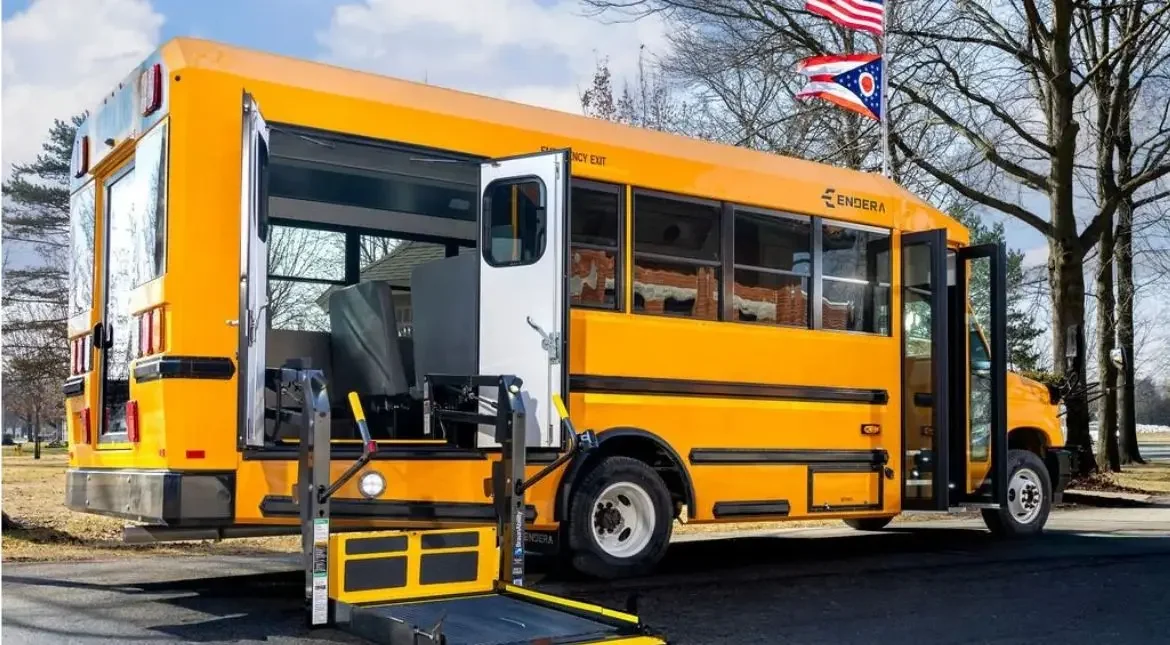
Accessible student transportation isn't an optional feature for school districts — it's a federal compliance requirement with legal and operational consequences when it falls short. The bus itself is only part of the equation; the lift system, securement layout, aisle clearance, and structural floor reinforcement all have to work as an integrated system before a vehicle can legitimately claim ADA compliance.
Endera manufactures Type A school buses with ADA-compliant flat-floor configurations as a standard offering — not an aftermarket option. Wheelchair lifts, securement positions, and accessible seating layouts are installed at the Ottawa, Ohio manufacturing facility as part of the original build, not added by a third-party upfitter after the fact.
Ready to optimize your routes? Contact Endera's fleet specialists today to design a custom accessible configuration blueprint for your district.
What Makes a School Bus ADA-Compliant?
ADA accessible transportation requirements establish the baseline standards for wheelchair accessibility in public and school transportation. FTA Part 37 transportation service regulations define the specific technical requirements: lift dimensions, securement system specifications, aisle clearance minimums, and the operational protocols drivers must follow when loading and unloading wheelchair users.
Compliance isn't self-certified. Buses used in publicly funded transportation programs — including school districts receiving federal or state funding — are subject to inspection against these standards. A vehicle with a lift installed by an upfitter without proper structural reinforcement or securement anchoring doesn't meet ADA requirements regardless of whether a lift is physically present.
What Is a Type A Accessibility Bus?
Type A school buses are built on cutaway van chassis — smaller, more maneuverable than full-size Type C or D buses, and specifically suited to the routing characteristics of special education transport. The National Congress on School Transportation identifies Type A buses as the standard format for smaller student populations, accessible routes, and any application where a full-size bus creates more operational overhead than the route demands.
The flat-floor design that makes Type A buses ADA-compatible also makes them operationally easier for accessible transport. Lower floor height reduces lift travel distance, entry and exit time decreases, and the cabin environment is easier for staff to manage during student loading and unloading. The U.S. Department of Transportation accessibility framework reinforces that accessible vehicle design should reduce barriers at every stage of the transport experience — not just meet the minimum technical threshold.
Wheelchair Lift Options: What Buyers Need to Know
Wheelchair lift selection is one of the most important procurement decisions in an accessible bus purchase. The two primary lift types for Type A school buses are side-entry and rear-entry configurations, each with distinct operational characteristics.
Side-Entry Lifts
Side-entry lifts load from the curbside door — the most common configuration for school bus accessible transport. They allow wheelchair users to board without repositioning the vehicle and give attendants better visibility during loading. Endera's flat-floor configurations use 800 lb Braun ADA lifts installed on the side entry as standard equipment. The 800 lb capacity accommodates power wheelchairs and larger mobility equipment that lighter-rated lifts can't safely handle.
Wheelchair lift systems vary significantly in rated capacity, platform size, and maintenance requirements. Capacity and platform dimensions should be confirmed against the actual mobility equipment used by the student population — not assumed based on average specifications.
Rear-Entry Lifts
Rear-entry configurations are less common in Type A school buses but used in specific operational contexts where side loading isn't practical. They require the vehicle to be positioned differently at stops and generally add loading time compared to side-entry systems. For most school district special education applications, side-entry is the operationally preferred format.
Seating and Securement Layouts
Accessible bus configurations involve a tradeoff between wheelchair positions and ambulatory seating capacity. Common layouts for Type A buses include:
2-wheelchair + 6 ambulatory passengers — the most common configuration for mixed special education routes
4-wheelchair + 2 ambulatory passengers — for routes serving primarily wheelchair users
Fold-away seating — allows the same space to serve both configurations depending on the route load
FTA Part 37 regulations require a minimum of one wheelchair securement position per vehicle, with tie-down and occupant restraint systems that meet federal specifications. Endera's configurations include compliant four-point tie-down securement and lap/shoulder belt systems as standard equipment.
The U.S. Department of Education's accessibility guidance reinforces that districts have an affirmative obligation to provide accessible transportation to students with disabilities — layout decisions should reflect actual student population needs, not just minimum compliance.
Electric ADA Buses: Why Accessibility Programs Are Looking at EV
Electric Type A buses offer specific operational advantages for accessible student transport that go beyond fuel cost. A quieter cabin environment reduces sensory stress for students with autism spectrum conditions or sensory processing differences — a practical benefit that doesn't appear on a spec sheet but matters to special education staff and families.
The EPA Clean School Bus Program provides federal funding for electric and clean-fuel bus replacements, and accessible configurations are eligible. According to the National Association of State Directors of Pupil Transportation Services, electric school bus adoption is growing across special education fleets specifically because of the combined benefit of lower operating costs and improved cabin environment. The DOE Vehicle Technologies Office provides fleet efficiency data for districts modeling the long-term cost difference between electric and ICE accessible buses.
Endera's turnkey charging solutions include site assessments, DC fast charger procurement, and metering installation — removing the infrastructure planning burden from special education transportation departments that don't have dedicated facilities staff.
Maintenance and Total Cost of Ownership
Lift systems require their own maintenance schedule separate from the bus chassis. Annual inspection and lubrication cycles, hydraulic fluid checks, and platform integrity testing are standard requirements. CVSA inspection standards cover accessibility equipment as part of broader commercial vehicle compliance checks — lift systems that fail inspection take the vehicle out of service until repaired.
The DOE Alternative Fuels Data Center tracks operating costs by fuel type and vehicle class. For accessible bus fleets, electric drivetrains reduce maintenance spend 30–40% versus diesel on the powertrain side — savings that offset lift maintenance costs over a full service lifecycle. According to Bureau of Transportation Statistics data, accessible transportation demand is growing as disability demographics shift — the U.S. Census Bureau disability data shows roughly 13% of the U.S. population lives with a disability, a figure that shapes long-term district accessible fleet planning.
Get Your Fleet Spec'd
New 2026 ADA-configured Type A models are available for immediate delivery through Endera Stock. For districts working within formal procurement processes or grant-funded purchasing cycles, Endera provides full specification documentation, ADA compliance materials, and grant application support.
To discuss accessible fleet configuration, lift options, or financing, contact Endera's sales team.
FAQs
What federal standards define ADA compliance for school buses?
ADA accessible transportation requirements and FTA Part 37 regulations define the technical standards — lift dimensions, securement system specifications, aisle clearance, and driver protocols for loading wheelchair users. Buses used in publicly funded student transportation programs are subject to inspection against these standards. OEM-installed accessibility equipment from a vertically integrated manufacturer carries cleaner compliance documentation than post-sale upfitter modifications.
What is the weight capacity of Endera's standard ADA lift?
Endera's flat-floor Type A configurations include 800 lb Braun ADA lifts as standard equipment. The 800 lb rating accommodates power wheelchairs and heavier mobility equipment that lighter-rated lifts cannot safely handle. Districts serving students with bariatric mobility needs should confirm lift capacity against actual equipment weights during the specification process.
How many wheelchair positions can a Type A accessible bus accommodate?
Standard configurations typically support two to four wheelchair securement positions depending on layout. Common formats include 2-wheelchair/6-ambulatory and 4-wheelchair/2-ambulatory configurations using fold-away seating. Endera's Type A models are configurable across 4-to-6 section layouts — seating and securement arrangements are specified at the order stage to match actual route and student population requirements.
Are electric accessible buses eligible for federal clean bus funding?
Yes. The EPA Clean School Bus Program funds electric and clean-fuel bus replacements including accessible configurations. Used buses and post-sale upfitter modifications are typically ineligible. Endera's grant navigation services help districts identify applicable programs and manage applications alongside procurement.
What lift maintenance is required on an accessible school bus?
Wheelchair lifts require annual inspection and lubrication cycles, hydraulic fluid checks, and platform integrity testing separate from the bus chassis maintenance schedule. CVSA inspection standards cover lift systems as part of commercial vehicle compliance checks — a failed lift inspection removes the vehicle from service. Scheduling lift maintenance alongside required annual state inspections reduces fleet downtime.
How does a quieter EV cabin benefit special education students?
Electric buses produce significantly less engine and drivetrain noise than ICE equivalents, reducing cabin noise levels during transport. For students with autism spectrum conditions, sensory processing differences, or noise sensitivity, a quieter ride environment reduces stress and behavioral disruption during transport — a benefit that special education staff and families consistently cite as operationally meaningful, independent of the fuel cost argument.
Can Endera's accessible Type A buses be customized beyond standard lift configurations?
Yes. Endera's Type A models are configurable across 4-to-6 section layouts with options for custom seating arrangements, storage, HVAC specifications, and camera systems. ADA lift type, securement position count, and seating-to-wheelchair ratios are all specified at the order stage. For districts with specific student population requirements — bariatric needs, multiple securement positions, or specialized storage — these specifications are addressed during the sales process rather than as aftermarket additions.