
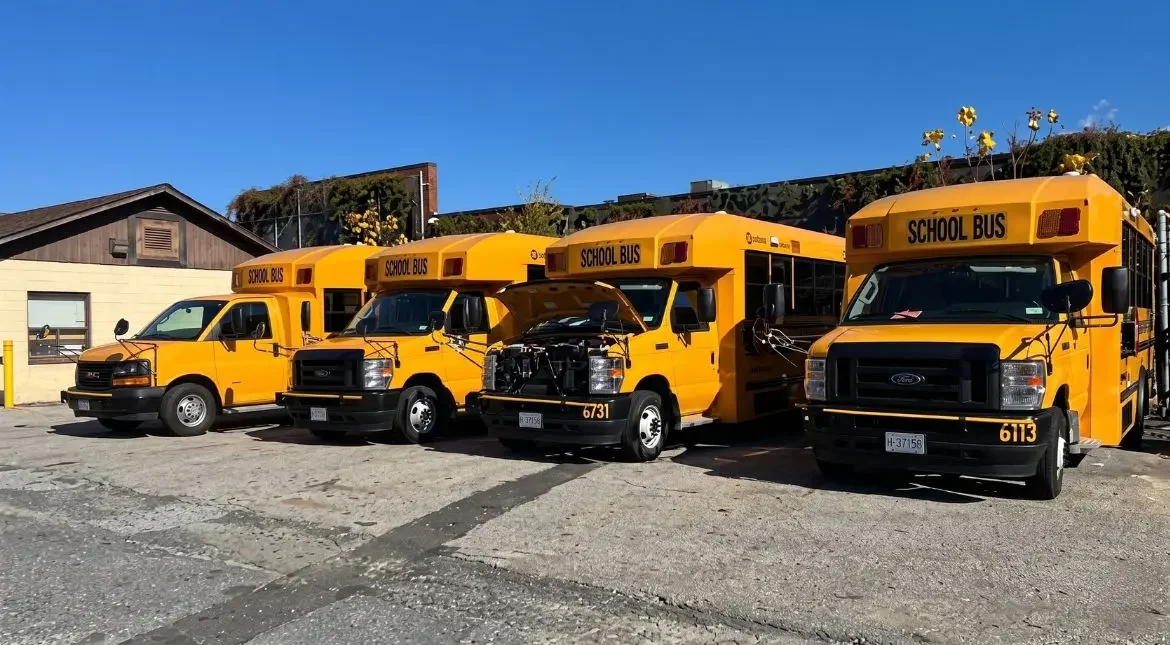
Alaska's school transportation environment has no equivalent in the lower 48. Temperatures that drop below -40°F, routes that cover gravel and unimproved roads for miles before reaching a student, and service infrastructure that simply doesn't exist in remote regions — these are the operational realities that determine what a school bus purchase decision actually means for an Alaska district.
Endera manufactures Type A school buses in ICE, propane, CNG, and full-electric configurations on Ford E450 and Chevrolet Express cutaway chassis. For Alaska districts managing dispersed rural routes, special education transport, and the operational demands of extreme weather, the vehicle decision starts with whether the platform is built to last under real conditions.
Alaska doesn't forgive the wrong spec — contact Endera's sales team today to find a configuration that holds up where your district actually operates.
What Type A School Buses Are — and Why Alaska Uses Them
Under Alaska Administrative Code definitions, school buses in Alaska are classified by function and equipment standards rather than strictly by size. The National Congress on School Transportation provides the national framework that Alaska's standards build from — defining Type A buses as vehicles built on van or cutaway chassis designed for smaller passenger loads and route flexibility.
For Alaska, that flexibility is the point. Districts serving remote communities don't need 48-passenger capacity — they need reliable, maneuverable vehicles that fit the road conditions and student populations they actually serve. A Type A bus handles narrow roads, limited turnaround space, and multi-stop rural routes more efficiently than a full-size Type C bus running half-empty.
Type A vs. Type C in Alaska's Context
| Feature | Type A | Type C |
|---|---|---|
| GVWR | Up to 14,500 lbs | 19,501–26,000 lbs |
| Typical seating | 10–24 passengers | 24–48 passengers |
| CDL required | Generally not | Yes |
| Best fit | Rural, special ed, low-density | High-volume urban routes |
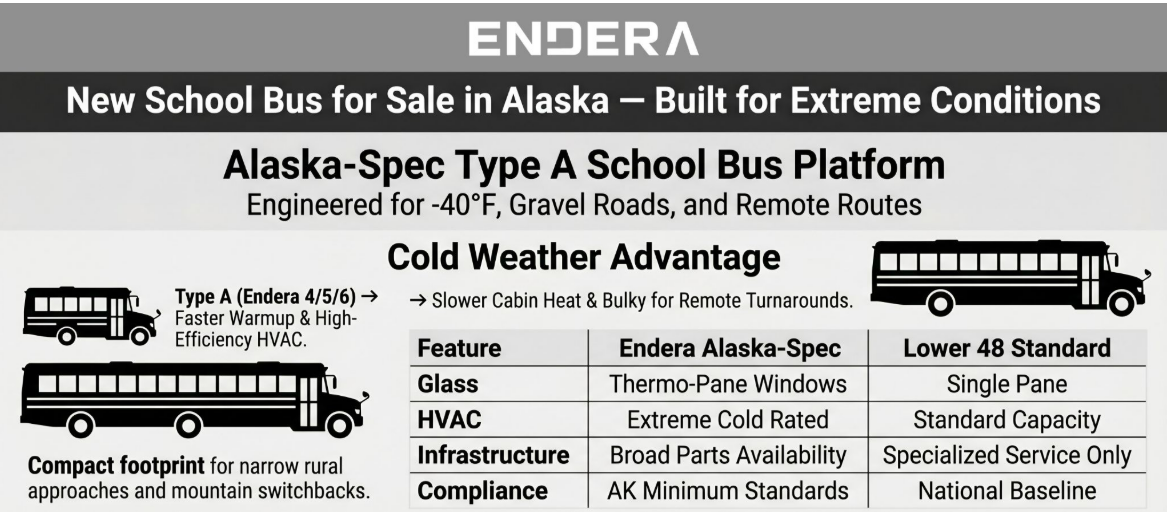
| Cold-weather advantage | Faster warmup, easier block heating | Larger engine compartment, slower cabin heat |
Type A buses warm up faster in cold conditions — a practical advantage in Alaska where vehicle warmup time before student pickup is an operational variable, not a minor inconvenience.
Alaska's Compliance and Equipment Standards
Alaska imposes specifications beyond the national baseline for school buses operating in its climate. The Alaska Minimum Standards for School Buses include requirements for thermo-pane windows, communication systems, and cold-weather-ready equipment that reflect the state's operational environment rather than lower-48 norms.
Alaska Administrative Code 4.27.110 adopts statewide school bus standards applicable to all districts, and Alaska Statute 14.09.030 governs inspection requirements and equipment mandates for school transportation vehicles. Non-compliant buses can be removed from service — making compliance documentation a procurement requirement from day one, not an afterthought.
Fuel Options for Alaska: The Cold-Weather Calculus
Fuel selection in Alaska carries operational stakes that warmer-climate buyers don't face. Cold-weather startup reliability, fuel availability in remote areas, and energy density in extreme temperatures all factor into the decision in ways the lower 48 largely don't consider.
Diesel and Gasoline ICE
Gasoline ICE on Ford E450 and Chevrolet Express platforms offers the widest parts and service availability in Alaska's road-accessible communities. Engine block heaters — standard practice in Alaska — address cold-start concerns. Diesel remains common in larger fleets but carries particulate emission concerns that Alaska's clean bus programs are designed to reduce.
Propane
Propane burns cleaner than diesel and gasoline and typically reduces fuel costs 30–40% according to DOE Alternative Fuels Data Center fleet data. Cold-weather propane performance is well-documented — propane buses operate effectively in sub-zero temperatures with appropriate equipment. For Alaska districts where fueling infrastructure exists along the route corridor, propane is the strongest near-term alternative to diesel.
Electric
Electric Type A buses perform best on fixed, predictable routes with overnight depot charging. Alaska's cold climate reduces battery range — typically 15–25% in sub-freezing conditions — and charging infrastructure outside Anchorage and a handful of larger communities is limited. For Alaska districts in or near larger population centers with depot facilities, electric is viable and federal funding covers both vehicles and charging equipment. For remote village routes, electric isn't the current-cycle answer.
ADA Accessibility for Alaska School Districts
Special education transport represents a significant share of Type A bus demand across Alaska, particularly in districts serving students with complex needs across long, infrequent routes. ADA transportation guidelines and FTA accessible vehicle specifications define the compliance requirements for accessible student transport — requirements that apply in Alaska's most remote districts as much as in urban ones.
Endera's flat-floor Type A configurations are available with 800 lb Braun ADA lifts installed at the manufacturing stage. For Alaska districts where service calls to a body upfitter aren't practical, having ADA equipment installed as part of the original build matters — both for compliance standing and for warranty coverage that doesn't fragment across vendors.
Winter Operations: What Alaska Districts Need to Know Before Buying
The Anchorage School District's winter routing policies reflect the operational planning that Alaska's largest district applies to cold-weather service — route suspension thresholds, road condition monitoring, and driver protocols that exist nowhere in the lower 48.
For Type A bus operators, the practical winter checklist includes engine block heaters, battery warmers on electric units, adequate HVAC capacity for extended idling in extreme cold, and chassis components rated for low-temperature operation. CVSA inspection standards govern fleet compliance checks — Alaska districts should confirm that any new vehicle meets CVSA standards for the climate conditions under which it will be inspected and operated.
New vs. Used in Alaska's Market
New Type A school buses typically start around $80,000 and range to $150,000 depending on powertrain and configuration. Used alternatives are available at lower upfront cost, but Alaska's conditions accelerate corrosion, wear, and mechanical fatigue on vehicles that have already accumulated years of service.
Used buses purchased without thorough inspection in a climate like Alaska's carry compounding risk — deferred maintenance in extreme-cold environments tends to show up in expensive and inconvenient ways. Federal and state clean bus funding programs, which used buses typically cannot access, further shift the economics toward new for districts with any available grant pathway. Endera's grant navigation and financing services help Alaska districts identify applicable programs and structure purchases accordingly.
Spec a Bus Built for Alaska
New 2026 Type A models are available for immediate delivery through Endera Stock for districts with pressing timelines. For districts working through Alaska's formal procurement process, Endera provides full specification sheets, Alaska compliance documentation, and grant application support.
Alaska's conditions are unforgiving — your bus spec shouldn't be an afterthought. Contact Endera's sales team today to discuss cold-weather specifications, fleet configuration, and powertrain options for your Alaska district.
Frequently Asked Questions
What Alaska-specific equipment standards apply to new Type A school buses?
Alaska's Minimum Standards for School Buses require thermo-pane windows, communication systems, and cold-weather equipment beyond the national baseline. Alaska Administrative Code 4.27.110 adopts these standards statewide, and Alaska Statute 14.09.030 governs inspection and equipment compliance. New buses purchased for Alaska service should meet these specifications as delivered — Endera provides compliance documentation for review during procurement.
Is electric school bus operation practical in Alaska?
Electric Type A buses are viable for Alaska districts near Anchorage and larger communities with depot charging infrastructure. Battery range drops 15–25% in sub-freezing temperatures, which narrows the operational window for remote or long routes. Pre-conditioning the battery while still plugged in mitigates range loss. For remote village routes without charging infrastructure, propane or ICE configurations are the current-cycle answer.
Why are Type A buses better suited to rural Alaska routes than full-size buses?
Type A buses warm up faster, maneuver more easily on narrow roads, and are more practical to maintain in areas with limited service infrastructure. Full-size Type C buses carry seating capacity that most Alaska rural routes don't need — running a 48-passenger bus for 8 students compounds operating costs and maintenance overhead without operational benefit.
What ADA accessibility options are available for Alaska school districts?
Endera's flat-floor Type A configurations include 800 lb Braun ADA lifts installed at the manufacturing stage, configurable seating across 4-to-6 section layouts, and wheelchair securement positions. For Alaska special education programs where third-party retrofits aren't practical, OEM-installed accessibility equipment provides better compliance standing and unified warranty coverage.
Are there funding programs available for Alaska school bus purchases?
Yes. The EPA Clean School Bus Program provides federal funding for electric and clean-fuel bus replacements — Alaska districts are eligible to apply. Alaska state programs and alternative fuel incentives may also apply depending on vehicle type and district profile. Used buses are typically ineligible for these programs. Endera's grant navigation services help Alaska districts identify applicable funding and manage applications alongside procurement.
How does propane perform in Alaska's extreme cold?
Propane operates reliably in sub-zero temperatures with appropriate cold-weather equipment — engine block heaters and fuel system components rated for low-temperature operation. DOE fleet data shows propane reduces fuel costs 30–40% versus gasoline equivalents. For Alaska districts where propane fueling is accessible along route corridors, it's the most practical cleaner-fuel option that doesn't require the charging infrastructure of a full EV transition.
What makes Endera's Type A school bus different from other manufacturers?
Endera is the only American vertically integrated OEM for Type A school buses — body assembly and powertrain installation happen at the same Ottawa, Ohio facility under a single quality control process. Buyers receive one warranty covering body and powertrain, one compliance certification, and one service contact. The Endera 4, 5, and 6 models are configurable across 4-to-6 section layouts in all four powertrain types, giving Alaska districts flexibility across procurement cycles without switching manufacturers.