
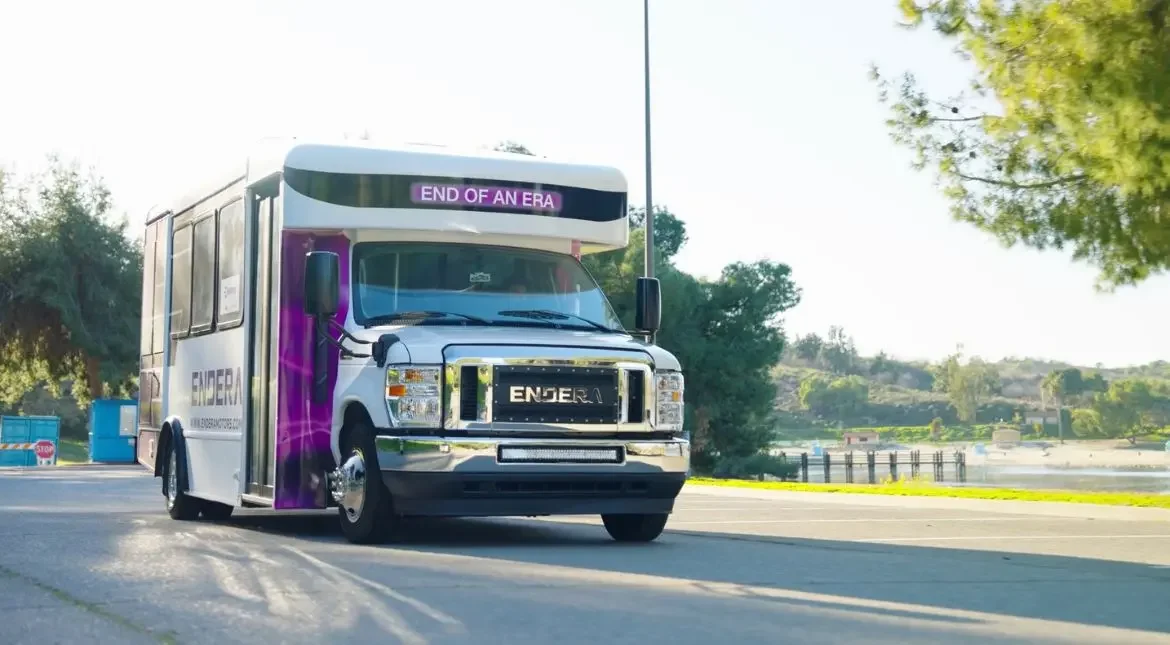
If you're searching for a shuttle bus for sale, you already know the landscape can feel overwhelming. Dozens of manufacturers, confusing spec sheets, and the constant question of whether to go electric or stick with what you know — it's a lot to sort through before you even get to price. What most buyers actually want is simple: a reliable vehicle, built well, backed by a company that won't disappear after the sale. That's exactly what Endera's B-Series commercial shuttle line was designed to deliver.
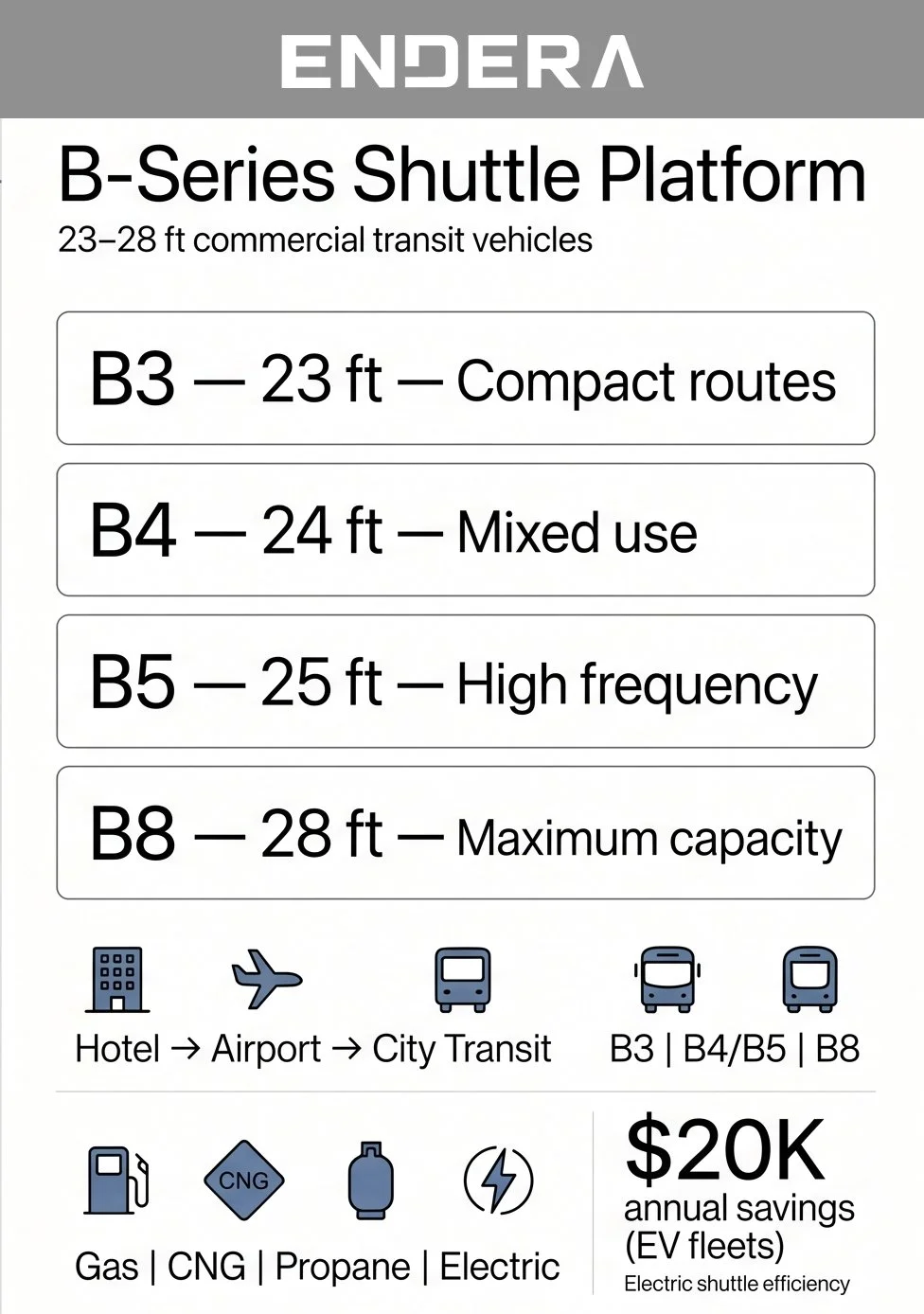
The B-Series spans four models — the B3, B4, B5, and B8 — ranging from 23 to 28 feet, covering everything from compact hotel loops to high-demand municipal transit routes. Every one is manufactured under one roof in Ottawa, Ohio, by a company that controls the entire process from powertrain engineering to final body assembly.
Skip the spec-sheet guesswork and cut straight to the solution. Contact Endera’s specialists today to check real-time availability and secure a custom quote for your fleet.
Fleet Decision Framework: Matching the Shuttle to the Mission
Don't Start With the Spec Sheet — Start With Your Route
Most shuttle bus pages lead with specs. But research on demand-responsive shuttle systems shows that the best fleet decisions are driven by demand patterns, route characteristics, and cost efficiency — not vehicle size alone. Vehicle capacity, demand density, and operational patterns directly determine total system cost and optimal fleet configuration. Similarly, transit electrification research highlights that route length, stop frequency, and utilization levels are the key variables when selecting vehicle type and technology.
A Simple Framework for Smarter Buying
That insight translates into a practical decision matrix. Instead of asking "What shuttle bus should I buy?", leading transit research suggests reframing it as: "What vehicle best fits my demand, route, and utilization profile?" That shift turns a complex purchase into a structured, data-driven decision — and prevents costly mismatches between vehicle capability and real-world operation.
| Use Case | Recommended Model | Fuel Type | Why |
|---|---|---|---|
| Hotel loop | B3 | Gas / Propane | Lower demand, tighter routes, cost-efficient operation |
| Airport shuttle | B4 / B5 | Electric | High utilization maximizes fuel & maintenance savings |
| Municipal transit | B8 | Diesel / CNG | High capacity + long routes require range and durability |
Low-demand, short routes benefit from smaller vehicles and flexible fuels, avoiding unnecessary capital and operating costs.
High-frequency routes (like airports) are ideal for electrification, since consistent utilization improves total cost of ownership and reduces emissions.
High-demand corridors require larger vehicles to maintain service levels while minimizing fleet size and wait times — a key driver of system efficiency.
The B-Series Lineup: Four Models, One Platform
From Compact to High-Capacity
The B3 is the entry point of the lineup — a 23-foot shuttle built on an ICE platform, purpose-designed for smaller-scale urban transit, hotel pickups, and tight campus loops where maneuverability matters as much as capacity. It's compact without feeling cramped, and it's the right tool for operators who need reliability in a nimble package.
The Workhorses and the Heavy Hitter
Step up to the B4 (24 ft) and B5 (25 ft) and you unlock both ICE and full electric variants — the models you'll find running airport parking routes, corporate employee shuttles, and university transportation networks. At the top of the range sits the B8, a 28-foot ICE shuttle built for high-demand routes where passenger volume is the priority, from large group transport to busy municipal transit corridors.
One Platform, Endless Flexibility
A Shared Architecture That Makes Fleet Management Easier
What ties all four models together is a common platform architecture. Components are shared across the lineup, which means parts availability is straightforward and your maintenance team isn't learning four different systems from scratch. Fleet operators running mixed B-Series configurations benefit from a unified service experience across every vehicle in the garage.
Mix, Match, and Scale on Your Terms
Every fleet moves forward at a different pace, and Endera's lineup is built to reflect that. Whether you're running three vehicles today or planning a 50-unit expansion next year, the B-Series scales with you — and the shared platform means adding models or fuel types doesn't mean starting over from a maintenance and operations standpoint.
ICE, CNG, Propane, or Electric — You Choose the Fuel
Meet Your Fleet Where It Is Today
Endera doesn't force you into a technology decision you're not ready to make. The lineup supports gasoline (ICE), compressed natural gas (CNG), propane, and full electric powertrains — and you can mix and match across your fleet depending on your infrastructure, routes, and budget. Operators interested in going electric but not yet set up for charging can start with propane or CNG today and add EVs as their depot infrastructure catches up.
The Electric Case Is Getting Hard to Ignore
For those ready to go fully electric, the EV variants of the B4 and B5 come with a 150 kWh battery pack and Cascadia iM225 electric motor, installed in-house with the battery pack housed within the structural frame rails for better crash protection and a lower center of gravity. Operators running EV shuttles at San Diego International Airport have forecasted nearly $20,000 in annual savings per vehicle compared to LPG or CNG models — over a fleet of ten vehicles, that's $200,000 a year back in the budget.
Built in Ohio, Built to Last
A Manufacturing Model That Actually Holds Together
Every B-Series shuttle is produced at Endera's 250,000-square-foot facility in Ottawa, Ohio, sourcing roughly 65% of its components from within the state. That domestic supply chain translates into faster lead times, more predictable parts availability, and compliance with Buy America standards that many federally funded transit contracts require.
Why Vertical Integration Produces a Better Vehicle
Unlike the traditional model — where a chassis might pass through multiple separate facilities before becoming a finished vehicle — Endera handles EV system integration and body construction in the same building. Engineers who designed the powertrain are steps away from the team building the body around it, which means every system is optimized for the specific vehicle it lives in, not adapted from a generic spec.
Software, Financing, and Support That Come With the Vehicle
An Ecosystem, Not Just a Transaction
Every commercial shuttle comes available with Endera's proprietary fleet management software suite. Endera Dispatch gives fleet managers real-time visibility into vehicle performance and state-of-charge monitoring, while Endera Go — the passenger-facing app — provides riders with live shuttle location, ETA updates, and occupancy data. For airport and university operators, that kind of transparency meaningfully improves the rider experience without adding operational complexity.
Getting to Yes on the Financial Side
The upfront cost of a commercial shuttle is a real consideration, and Endera's team knows it. Whether you need direct financing, capital leasing, or help navigating the more than $20 billion in available federal and state EV incentives — including EPA programs, HVIP, and other state-level grants — Endera's financing advisory team has worked through these programs before and can help you access the funding your fleet qualifies for.
The Right Shuttle, Built the Right Way
Finding a shuttle bus for sale is easy. Finding one backed by genuine manufacturing depth, multi-fuel flexibility, integrated software, and a team that stays engaged after delivery — that's the harder part. The B-Series delivers on all of it, whether you're running a three-vehicle airport operation or scaling a full corporate campus fleet.
If you're ready to find the right fit for your operation, contact Endera's team to chat with a specialist directly.
FAQs
What shuttle bus sizes does Endera offer?
The B-Series lineup covers four sizes: the B3 (23 ft), B4 (24 ft), B5 (25 ft), and B8 (28 ft). Each model is designed for different capacity needs and route types, from compact hotel shuttles to high-volume municipal transit.
Are Endera shuttles available in electric?
Yes. The B4 and B5 are available in full electric variants, powered by a 150 kWh battery pack and Cascadia iM225 motor. The B3 and B8 are currently ICE-only. CNG and propane options are also available across the lineup.
What chassis do Endera shuttles use?
B-Series shuttles are built on Ford E450 and Chevrolet Express cutaway chassis — two of the most proven and widely supported platforms in commercial transportation.
How long do Endera electric shuttles take to charge?
DC fast charging comes standard on all EV variants, enabling rapid turnaround times suited for high-frequency operations. Specific charge times vary by power source and configuration — Endera's team can walk you through the details for your setup.
Does Endera help with EV grant funding?
Yes. Endera provides grant advisory services to help operators access federal, state, and local EV incentives, including EPA grants, California's HVIP, and other programs. They assist with identifying eligible funding and managing the application process.
Can I run a mixed fleet of EV and ICE B-Series shuttles?
Absolutely. The shared platform architecture across the B-Series means parts, maintenance procedures, and service networks are consistent whether you're running gas, propane, CNG, or electric — making mixed-fleet management significantly simpler.
Where are Endera shuttles manufactured?
All B-Series vehicles are built at Endera's Ottawa, Ohio facility — a 250,000-square-foot plant with approximately 65% Ohio-sourced components, supporting Buy America compliance for federally funded contracts.