
The Number You See First Isn't the Number That Matters Most
Sticker Price vs. What You Actually Pay
When transportation directors and district administrators start researching school bus costs, the first number they find is the sticker price — and it can stop a conversation before it starts. A new Type A school bus with an ICE powertrain typically lands in the $40,000–$80,000 range. Propane models are similar, often in the $50,000–$90,000 range depending on configuration. An electric Type A is a different category entirely, with base prices generally running higher before any incentives are applied. But procurement decisions built around sticker price alone usually miss the actual cost picture — and in many cases, leave significant grant funding on the table.
Why the Final Number Varies So Much
The range in school bus pricing isn't random. Fuel type, seating configuration, ADA accessibility options, and the number of sections in the build all affect the final price. A base ICE model and a fully spec'd electric bus with an ADA lift, additional seating sections, and an integrated charging solution are genuinely different products — and their pricing reflects that. Understanding what drives the number is more useful than a single average figure.
Pricing depends on configuration, fuel type, and accessibility options — talk to Endera's team to get current numbers on the spec that matches your district's routes.

Type A vs. Other School Bus Types: Why Size Changes the Equation
What Makes a Type A Different
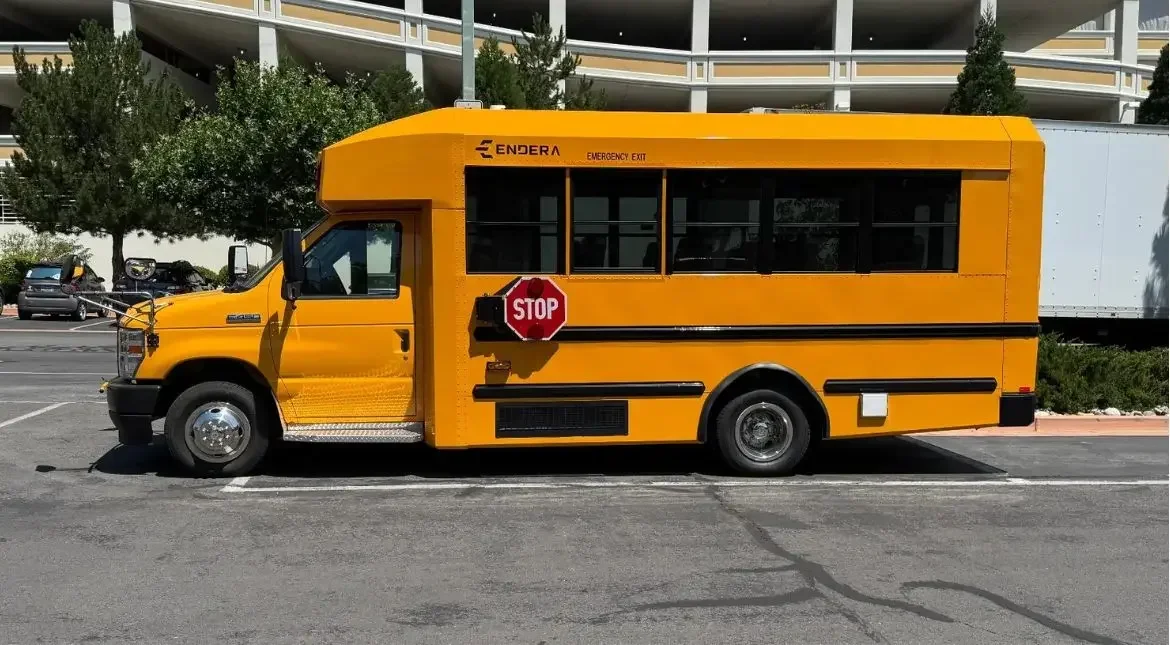
A Type A school bus is built on a cutaway van chassis — typically the Ford E450 — and is the smallest classification in the federal school bus system. It's designed for specialized routes, smaller student populations, ADA transport, rural pickups, and districts that need a reliable, maneuverable vehicle that doesn't require the operational overhead of a full-size Type C or D bus. Endera builds its school bus line — the Endera 4, 5, and 6 — entirely within the Type A segment, with configurations ranging from 4 to 6 sections to fit different district needs.
Where Type A Sits Relative to Larger Buses
Type C and Type D buses, the 35–40-foot conventional school buses most people picture, typically start closer to $100,000–$150,000 for ICE models and climb considerably from there. The Type A's lower base cost is part of its appeal for smaller districts and specialized programs — but it's also smaller, which means districts needing to carry 50+ students per route need a different answer. For districts whose routes are built around special education, rural pickups, or tight urban corridors, the Type A is purpose-built for the job.
What Drives the Final Price on a Type A School Bus
Fuel Type Is the Single Biggest Variable
The choice between ICE, propane, CNG, and electric has the largest impact on purchase price of any single decision. ICE gasoline models carry the lowest upfront cost, though fuel costs at 9 MPG average roughly $4,600–$11,900 per year depending on gas prices — a figure that's moved significantly with diesel and gas price swings.
Propane models cost more upfront but offer real operational savings; districts running propane fleets have reported fuel costs running 50% lower than diesel equivalents, with lower per-oil-change costs as well. Electric is the highest sticker-price option but comes with the deepest grant support and the lowest per-mile fuel cost over the vehicle's life.
Configuration, Sections, and Accessibility Options
The Endera school bus lineup — the Endera 4, 5, and 6 — uses a section-based configuration system that lets districts set seating capacity, ADA lift integration, and floor plan layout. Each additional section changes the footprint and the price. An ADA-compliant lift is not a minor add-on; it affects floor plan design, structural configuration, and securement positioning in ways that have to be built into the vehicle from the beginning, not bolted on afterward. Endera's vertically integrated manufacturing process handles this at the Ottawa production facility, where the floor plan is designed to the district's spec rather than adapted from a template.
Chassis and Manufacturing Method
Not all Type A buses use the same manufacturing model. Traditional “upfitter” systems separate chassis and body production, creating added complexity in quality control, warranties, and lead times. Endera builds both the EV powertrain and body in-house at its Ohio facility, allowing the bus to be engineered as a fully integrated system—an approach that can improve long-term serviceability and total cost of ownership over a 10–12 year lifecycle.
Electric Type A School Buses: The Price vs. Cost Reality
What the Sticker Price Doesn't Show
Electric school bus pricing often draws an immediate reaction based on the upfront number, but the purchase price is only one piece of the calculation. Annual fuel costs for an electric school bus averaged around $4,042 nationally in 2026, compared to over $11,900 for a diesel equivalent over the same period — a gap that compounds over years of operation. Maintenance costs are also structurally lower on an EV platform; fewer moving parts mean fewer service events, lower oil change costs, and reduced drivetrain maintenance. The total cost of ownership calculation often looks very different from the sticker price comparison.
Grant Funding That Changes the Math
The federal and state grant landscape for electric school buses is substantial, though it has shifted in recent years. The EPA's Clean School Bus Program has distributed hundreds of millions in rebates and continues to accept applications in periodic windows.
State-level programs like California's HVIP, the Texas TERP/TCSB program, and various state air quality incentives can reduce the effective purchase price significantly. Endera's platform page outlines the grant navigation support the company provides, including access to over $20 billion in available federal, state, and local EV subsidies — with a team that manages the application process directly rather than handing districts a list of programs and a good luck.
The Endera School Bus Lineup: Models and What They Cover
Endera 4, 5, and 6
Endera’s three Type A school bus models differ by section count—4, 5, or 6—which affects seating capacity and vehicle length. Each is available in ICE, propane, CNG, and electric versions, allowing districts to choose the best fit without changing manufacturers. The electric models use an integrated battery design within the frame rails, improving stability and battery protection.
Who Each Model Is Built For
The Endera 4 is the right answer for smaller routes, tight turnaround schedules, and ADA-specialized transport where passenger count is limited but access requirements are high. The Endera 5 covers the mid-range — the workhorse configuration for rural routes, district-to-district transfers, and mixed-use programs.
The Endera 6 serves districts that need maximum capacity in a Type A footprint without stepping up to a full-size Type C. All three are built with the same vertical manufacturing process, the same safety engineering standards, and the same software ecosystem — Endera Dispatch for fleet management, routing, and vehicle health analytics, integrated directly into the hardware rather than added through a third-party telematics system.
The Price Is One Number. The Total Cost Is the Real Decision.
Buying a school bus on sticker price alone is one of the more expensive ways to do it. The districts that make the best procurement decisions are the ones that account for fuel costs over a multi-year horizon, factor in available grant funding before finalizing a budget, and work with a manufacturer that can support the vehicle for its full service life — not just hand it off at the delivery point.
Endera builds Type A school buses as complete systems — vehicle, powertrain, software, and charging infrastructure — from a single manufacturing facility with a team that supports districts through procurement, grant applications, and ongoing operations. Get in touch with Endera's sales team to get current pricing on specific configurations and find out what funding your district may already qualify for.
FAQs
1. What does a Type A school bus cost in 2025–2026?
A new Type A school bus with an ICE or propane powertrain typically falls in the $40,000–$90,000 range depending on configuration, sections, and accessibility options. Electric Type A models carry a higher sticker price but are eligible for significant grant funding that can reduce the effective purchase price substantially. Contact the Endera sales team for current pricing on specific configurations.
2. How much does an electric school bus cost compared to a propane or gas model?
Electric school buses carry a meaningfully higher upfront cost than ICE or propane equivalents, but lower annual fuel and maintenance costs often close that gap over the vehicle's service life. Federal and state grants — including the EPA Clean School Bus Program and state-level incentives — can further offset the purchase price. Propane buses cost roughly a third of an electric bus at purchase, making them a practical bridge option for districts not yet ready for a full EV transition.
3. What is included in Endera's school bus price?
Endera builds the vehicle, powertrain, and body as an integrated system at its Ohio manufacturing facility. Software — including Endera Dispatch for fleet management — is available with every bus. Turnkey charging infrastructure is also available for EV buyers, covering site assessment, charger procurement, and installation, rather than leaving districts to coordinate separately with a charging vendor.
4. Does Endera help with school bus grant applications?
Yes. Endera's team assists clients in identifying applicable federal, state, and local funding and manages the grant application process directly. This includes programs like the EPA Clean School Bus Program, California HVIP, and various state-level clean fleet incentives. Districts that engage early in the planning cycle get the most out of this support.
5. Can I get an ADA-accessible Type A school bus from Endera?
Yes. The Endera 4, 5, and 6 are all configurable with ADA-compliant lifts and securement systems. Accessibility options are built into the floor plan design from the beginning, not added afterward — which is important for maintaining proper aisle width, securement positioning, and structural integrity throughout the vehicle.
6. What powertrain options are available on Endera school buses?
All three Endera school bus models — the 4, 5, and 6 — are available in ICE, propane, CNG, and electric powertrains. This lets districts choose based on their current infrastructure, budget, and route profile, and transition to electric in future procurement cycles without switching manufacturers or rebuilding a service relationship from scratch.
7. How long does a Type A school bus last, and how does that affect the cost calculation?
Type A school buses typically have a service lifecycle of 10–12 years. Over that span, fuel costs, maintenance frequency, and resale value all factor into total cost of ownership. ICE models have the lowest upfront cost but higher ongoing fuel exposure. Electric models carry higher purchase prices but lower per-mile operating costs that compound meaningfully over a full service cycle — a calculation that becomes more favorable as fuel prices rise.