
Managing an Electric Fleet Isn't the Same as Managing a Diesel Fleet
The Operational Gap That Catches Most Fleets Off Guard
Many fleet operators assume electrification is mainly about buying buses and charging them. In reality, EV fleets introduce new operational demands like charge management, battery health tracking, energy cost monitoring, and route-range planning. Traditional fleet systems built for diesel vehicles often can’t handle these requirements effectively.
Why the Software Layer Matters as Much as the Vehicle
The management platform isn't a nice-to-have addition to an EV fleet — it's part of the infrastructure. Knowing a vehicle's state of charge in real time, scheduling charging sessions around off-peak energy rates, flagging battery health anomalies before they become service events, and optimizing routes based on actual range data all require software that's integrated with the vehicle's hardware, not running as a separate telematics layer on top of it.
Endera builds that integration into every commercial vehicle it produces, through an in-house software stack — Endera Go and Endera Dispatch — developed alongside the vehicle platform rather than sourced from a third-party vendor after the fact.
Managing a transition to electric — or running a mixed fleet while you get there? Endera's team can walk you through how the full system works, from vehicle and software to charging infrastructure and applicable funding.
What EV Fleet Management Software Actually Needs to Do
Real-Time State of Charge and Range Visibility
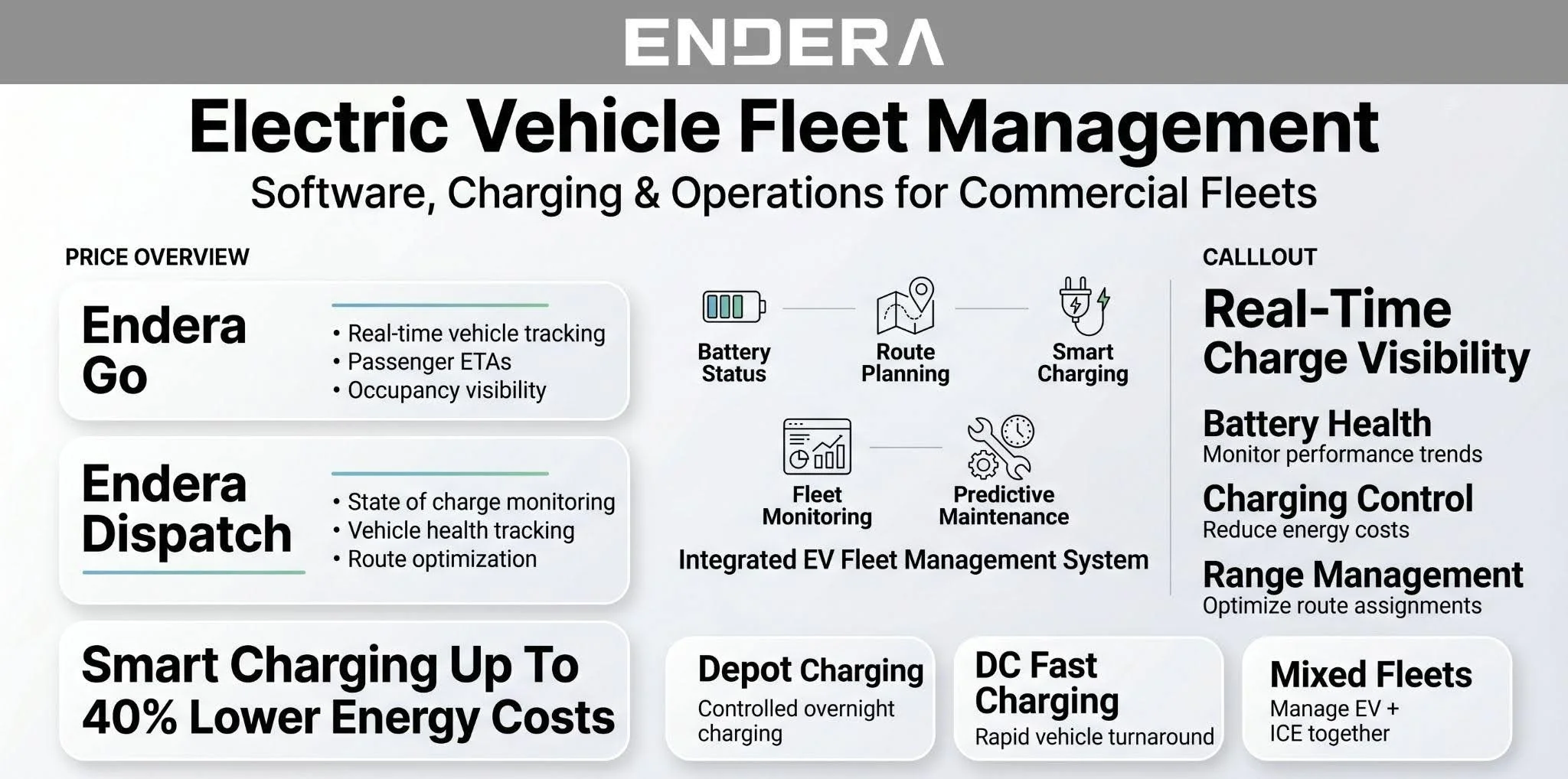
The most critical operational need in an EV fleet is real-time state-of-charge (SoC) visibility. SoC data drives route assignment, charging priority, and dispatch readiness. Without it, fleet managers risk inefficient charging and vehicles unable to complete routes. Endera Dispatch pulls this data directly from the vehicle hardware, eliminating reliance on third-party telematics devices.
Route Optimization Built Around Battery Reality
EV range planning is dynamic, affected by passenger load, weather, terrain, and battery age. A route that works under ideal conditions may fail in winter or later in the battery lifecycle. Effective EV fleet software must use live vehicle data—not static manufacturer estimates—to make accurate route assignments.
Charging Infrastructure: The Part Most Fleets Underplan
Depot Charging as the Operational Foundation
For commercial shuttle and school bus fleets that return to a central location at the end of each route cycle, depot charging is the right model — and the most controllable one. Vehicles arrive on predictable schedules, charging can be coordinated centrally, and energy costs can be managed by scheduling sessions during off-peak utility rate windows.
The problem most operators run into isn't the concept; it's the execution. Unmanaged depot charging — every vehicle plugging in at full draw at the same time — creates demand charge spikes that can significantly increase electricity costs. Smart charging management can reduce electricity costs by up to 40% compared to unmanaged depot charging, which is a meaningful operational difference at fleet scale.
DC Fast Charging and Turnaround Schedules
For airport shuttles, high-frequency campus loops, and any route profile that doesn't allow for long overnight charging windows, DC fast charging is the practical answer. Endera builds DC fast charging capability as a standard feature across its electric vehicle lineup — not an optional upgrade — because high-frequency routes require rapid turnaround times that Level 2 charging alone can't support.
The company also provides turnkey charging infrastructure as part of its EV offering, covering site assessment, charger procurement, and installation. Operators aren't coordinating a vehicle purchase from one vendor and a charging setup from another; it comes from the same team, designed to work together from the start.
Endera's Integrated Software Stack: Go and Dispatch
Endera Go: The Passenger-Facing Side
Endera Go is the rider-facing platform that provides real-time vehicle tracking, ETAs, and occupancy data for shuttles. This improves passenger visibility and reduces status inquiries to dispatch. At San Diego International Airport, SP+ uses Endera’s electric fleet and Endera Go together, improving ground transportation efficiency through real-time tracking.
Endera Dispatch: The Fleet Operations Layer
Endera Dispatch is built for the operator side — fleet managers who need to see vehicle health, manage charging state, optimize routing, and respond to service issues without switching between multiple platforms. The depth of integration matters here. Because Dispatch is developed in-house alongside the vehicle hardware, it has direct access to the powertrain data that third-party telematics systems often can't read accurately. Battery health monitoring, charging cycle tracking, and predictive maintenance flags all come from the same data source as the vehicle's operating systems — not from a sensor added to a platform that wasn't designed to receive it.
Mixed-Fleet Operations: Managing ICE and EV Together
Why Most Fleets Won't Go All-Electric Overnight
The practical reality for most commercial fleet operators is that full electrification happens in stages. Budget cycles, charging infrastructure buildout timelines, route profiles that don't yet support EV range, and ongoing federal incentive uncertainty all mean that mixed ICE-and-EV operations will be the norm for most fleets over the next several years. A fleet management approach that handles only one powertrain type creates an operational split — separate tracking, separate reporting, separate maintenance workflows — that costs time and creates gaps in visibility.
Endera's Dual-Track Advantage
Endera builds and supports vehicles across ICE, propane, CNG, and electric powertrains on the same platform. This isn't a legacy ICE business being wound down in favor of an EV line — it's a deliberate product strategy that lets operators manage their transition at their own pace, with the same manufacturer, the same software infrastructure, and the same service relationship throughout. For fleet managers who need to run propane buses on long rural routes today while deploying electric vehicles on urban loops, that operational continuity matters more than it sounds.
The Total Cost of Operating an Electric Commercial Fleet
Where the Savings Actually Show Up
EVs have significantly lower per-mile fuel costs than diesel or gasoline, along with reduced maintenance needs due to fewer moving parts and regenerative braking. While these savings may not be immediate, they compound over a 10–12 year lifecycle, making total cost of ownership more favorable than upfront pricing suggests when all factors and incentives are included.
What Integrated Management Does for That Number
A significant portion of EV operating costs are controllable through smart management — and a significant portion of potential savings are lost through poor charging coordination, unoptimized routing, and reactive rather than predictive maintenance. The software platform isn't separate from the cost structure; it's how the cost structure is managed. Fleets that run integrated management tools, where the charging schedule, the route assignment, and the vehicle health data all feed into the same platform, consistently operate more efficiently than those managing those functions separately. That integration is the core premise of how Endera builds its vehicles and its software — as one system, not two products sold together.
Electric Commercial Fleet Management Is a Good Investment
Fleet electrification decisions made without a clear operations and management strategy tend to underperform against expectations — not because the vehicles don't work, but because the surrounding infrastructure wasn't built to support them. The vehicle is one part of a larger system that includes charging, software, route planning, and ongoing maintenance. When those elements are designed together, from the same manufacturer, the operational picture changes.
Endera builds commercial electric shuttles and school buses as complete systems — vehicle, powertrain, software stack, and charging infrastructure — supported by a team that works with operators through procurement, grant applications, and the full service lifecycle. Reach out to the Endera team at enderamotors.com to discuss fleet configurations, software capabilities, and what funding your operation may qualify for.
Frequently Asked Questions
1. What makes EV fleet management software different from traditional fleet management tools?
Traditional fleet platforms were designed for diesel vehicles, focusing on mileage, maintenance, and fuel tracking. EV fleets require additional capabilities like state-of-charge monitoring, charging coordination, battery health tracking, and range-based routing. Many legacy systems lack the integration to handle this data accurately. Endera Dispatch is built in-house with the vehicle platform, enabling direct data flow between the bus and the management system.
2. How does Endera handle charging infrastructure for fleet operators?
Endera provides turnkey charging infrastructure as part of its EV offering — site assessment, charger procurement, and installation — so operators aren't coordinating the vehicle purchase and the charging setup through separate vendors. DC fast charging is standard across Endera's electric lineup, supporting the rapid turnaround schedules that high-frequency commercial routes require.
3. Can Endera's software manage a mixed ICE and EV fleet?
Yes. Endera builds vehicles across ICE, propane, CNG, and electric powertrains on the same platform, and the software infrastructure is designed to support operators managing more than one fuel type. This is practical for fleets in transition, where not every route or vehicle has moved to electric yet.
4. What federal and state incentives are currently available for EV fleet electrification?
The federal incentive picture shifted after July 2025, with several IRA credits discontinued. However, state-level programs — California HVIP, New York, Colorado, Oregon, and Washington fleet electrification programs — remain active. The Section 30C charging infrastructure credit also remains available in eligible areas. Endera's team assists operators in identifying applicable programs and managing applications directly.
5. What is Endera Go and who is it designed for?
Endera Go is the passenger-facing side of Endera's software platform. It provides real-time vehicle location, arrival time estimates, and occupancy data to riders — improving the experience for airport passengers, university shuttle users, and corporate campus employees. It's designed to run alongside Endera Dispatch, which handles the operator and fleet manager side of operations.
6. How does smart charging management reduce fleet operating costs?
Unmanaged depot charging — all vehicles drawing full power simultaneously — creates demand charge spikes that inflate electricity costs. Smart charging schedules sessions based on route cycles and off-peak utility rates, distributing the load across the available window. Research from fleet operations indicates this approach can reduce electricity costs by up to 40% compared to unmanaged charging at similar fleet scales.
7. Does Endera provide ongoing software and fleet support after delivery?
Yes. Endera's integrated model means the software, charging infrastructure, and vehicle support all come from the same organization. Fleet managers have a single point of contact for vehicle issues, software updates, and operational questions — rather than managing separate relationships with a vehicle manufacturer, a telematics vendor, and a charging infrastructure provider.