
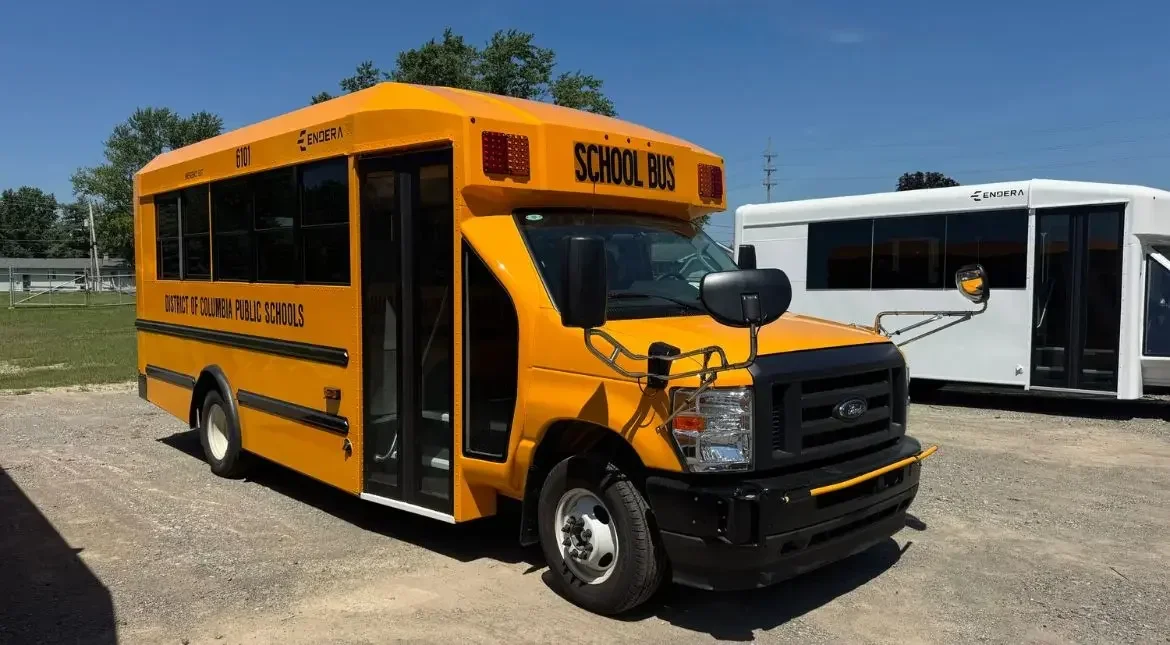
Electric school buses are no longer limited to a few urban districts — as of July 2025, they are deployed or committed in 360 congressional districts, including many rural areas. However, districts still face common barriers: upfront cost, charging infrastructure, grid capacity, cold-weather performance, and procurement complexity.
Endera builds its Type A school bus and B-Series shuttle as a single-vendor platform designed to address these challenges in an integrated way. The Endera lineup — the Endera 4, 5, and 6 school bus models — is available in ICE, propane, CNG, and full-electric configurations, with 4–6 section floor plans, ADA-compliant lift options, and turnkey charging infrastructure included as part of the same procurement relationship.
Thinking through your district's transition? Endera's team is available to work through your routes, funding situation, and the right configuration for where you are in the process.
Why Not All School Bus Routes Are Electrification Candidates
Route Geometry Determines EV Feasibility More Than Fleet Size Does
A common misconception in electric school bus planning is that most routes can be electrified with sufficient range and funding. In practice, feasibility depends on route design, duty cycles, depot capacity, utility rates, and local climate and terrain. The U.S. Department of Transportation’s EV planning guidance emphasizes evaluating these factors as an interconnected system before investing in buses and charging infrastructure.
The Four Route Archetypes Districts Should Know
School bus routes fall into distinct operational types that respond differently to electrification.
Tier 1 — short in-town loops are the best fit for EVs due to predictable mileage, frequent stops, and easy overnight charging. Tier 2 — mixed suburban routes can work with careful energy planning but are more sensitive to range variation. Tier 3 — rural long-haul routes are often better suited to ICE due to distance and limited charging access. Tier 4 — special education micro-routes are short in miles but energy-intensive because of frequent stops and high HVAC use.
Why Routing and Charging Must Be Planned Together
Research on electric bus operations consistently shows that scheduling constraints, charging access, and route structure are as important as battery capacity in determining feasibility. Electrification is not a uniform transition across a district — it is a route-by-route engineering decision where the same fleet may simultaneously support highly efficient EV corridors and routes that remain better suited to diesel operation. Endera's sales team works through this route-by-route assessment with districts before recommending an EV or ICE configuration, which is why the starting conversation is always about the routes, not the vehicle.
Barrier 1: Upfront Cost
The Price Gap Is Real — and Fundable
Electric school buses cost significantly more than diesel equivalents at acquisition. Current market pricing for electric school buses ranges from roughly $200,000 to $440,000 or more depending on size and range — often two to three times the cost of a comparable diesel model. For districts operating on tight capital budgets, that gap is the first and most visible obstacle. The WRI Electric School Bus Initiative's Roadmap to 100 identifies upfront cost as the primary barrier to electric school bus adoption, particularly for underserved districts with limited staff capacity to navigate funding programs.
What Closes the Gap
The EPA Clean School Bus Program has provided the most direct federal cost offset — up to $345,000 per electric school bus plus associated charging infrastructure in past funding rounds. The program has directed over $5 billion in total funding toward school bus electrification, with priority for low-income and historically underserved communities.
Beyond EPA funding, state-level funding for electric school buses has grown from $268 million in 2020 to $2.47 billion in 2025 — a tenfold increase that reflects states filling gaps when federal programs have been disrupted. Endera's team assists districts with identifying applicable programs and managing grant applications directly, which removes the administrative burden from transportation administrators managing procurement alongside daily operations.
Barrier 2: Charging Infrastructure Complexity
Why Infrastructure Is Often Harder Than the Vehicle
For many districts, the charging infrastructure is a bigger operational challenge than the bus itself. A school bus yard that has never supported EV charging needs an electrical service assessment, potentially a utility service upgrade, new panel capacity, conduit runs, and EVSE installation — a multi-vendor, multi-timeline process that can add months to a procurement project and significant cost beyond the vehicle price. The WRI Roadmap to 100 identifies complex and costly charging infrastructure deployment — particularly utility coordination and grid capacity — as the second major barrier to electric school bus transition.
The Turnkey Difference
The practical solution is a turnkey approach — one vendor that handles site assessment, charger procurement, and installation as part of the same engagement as the vehicle purchase. Endera provides turnkey charging infrastructure as a standard part of its EV offering, which means districts aren't managing a vehicle procurement from one vendor and a charging infrastructure project from another. For districts in states where utility programs provide infrastructure rebates — such as Dominion Energy's commercial Level 2 program in Virginia, which covers up to 50% of installation costs — Endera coordinates with applicable utility programs so operators manage one process rather than two. The result is a depot charging setup engineered for the specific vehicles and route patterns of each district, not installed from a generic commercial template.
Barrier 3: Grid Capacity and Utility Coordination
When the Substation Is the Bottleneck
Grid capacity is often the most unexpected barrier for districts. A fleet of electric school buses charging overnight can exceed local distribution limits, and in some cases requires substation upgrades that may take 18 months or more. This can delay deployment even after vehicles are ready. The challenge is not the buses or chargers, but early coordination with the local utility on grid interconnection.
Solving It Early Enough
The key is engaging the utility before the purchase order, not after. Endera’s site assessment process evaluates grid capacity early so any needed upgrades can be aligned with procurement instead of delaying deployment.
Smart charging strategies also reduce peak load by staggering charge times across the fleet, as recommended in DOE guidance. Endera’s Dispatch software supports this with state-of-charge monitoring and scheduling, enabling coordinated overnight charging without requiring a dedicated EV specialist on staff.
Barrier 4: Cold Weather Performance Concerns
What the Data Shows — and What It Doesn't Justify
Cold weather range reduction in electric school buses is real. Research consistently shows that EV range can drop significantly in cold conditions, with cabin heating consuming a large share of the additional energy. For school bus routes that operate in the early morning during the coldest part of winter days, the concern is legitimate — and transportation directors should plan for it rather than dismiss it.
Where It Matters and Where It Doesn't
The key factor is route length versus available range after cold-weather reduction. Most Type A school bus routes are shorter and more predictable, making them a strong fit for Endera’s electric lineup, even in colder conditions. Pre-conditioning at the depot helps recover range by heating the battery and cabin while plugged in. Districts that focus on predictable routes with overnight charging and pre-conditioning typically find cold-weather impacts manageable rather than limiting.
Barrier 5: Procurement Complexity and Grant Administration
Why Smaller Districts Get Left Behind
The electric school bus transition has disproportionately benefited larger, better-resourced districts — not because the technology doesn't work for smaller districts, but because the procurement and grant administration process is more complex than most small district transportation offices can manage alongside their regular responsibilities.
Applying for EPA Clean School Bus funding, coordinating with a utility for infrastructure rebates, navigating state-level programs, and managing the vehicle procurement simultaneously is genuinely difficult without dedicated staff. The WRI Needs Assessment for Equitable School Bus Electrification found that limited staff capacity is one of the primary barriers for underserved districts, even when funding is available.
What Single-Vendor Procurement Actually Solves
The practical approach is working with a manufacturer that manages more of the procurement process. Endera helps districts identify available funding and handles grant applications directly, reducing the administrative burden on transportation staff.
As a vertically integrated manufacturer, Endera provides the vehicle, powertrain, charging infrastructure, and fleet software as a single point of contact, simplifying coordination and making electrification more feasible for districts without dedicated procurement teams.
Barrier 6: Split-Vendor Accountability and Maintenance Concerns
The Warranty Gap Problem
A key risk in electric school bus procurement is split-vendor accountability. In converted or multi-supplier builds, the chassis, body, and EV system often come from different manufacturers, making it unclear who is responsible when issues arise. This can delay repairs and increase downtime for districts that need vehicles back in service quickly.
What Vertical Integration Solves
Endera's vertically integrated manufacturing model — where the EV powertrain and the vehicle body are both engineered and assembled at the same facility in Ottawa, Ohio — means there is one manufacturer accountable for the whole vehicle. When the bus needs attention, there is one call, one warranty claim, and one service relationship. For districts with small fleets where every bus matters, that accountability structure is worth more than a marginally lower acquisition cost from a multi-vendor configuration that creates escalation complexity when reliability matters most.
The Barriers Are Real. Most of Them Are Solvable With the Right Manufacturer Relationship.
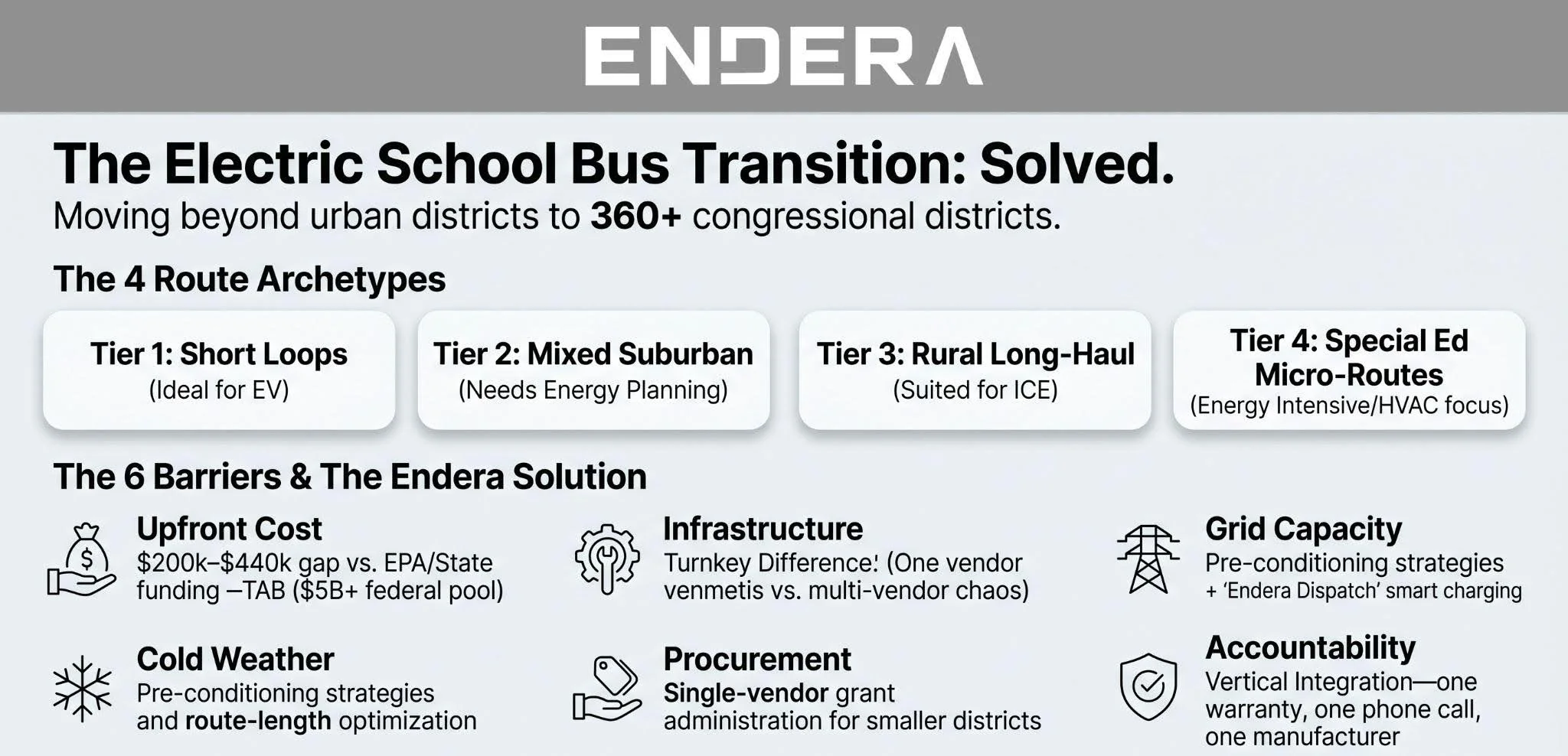
The electric school bus transition is not blocked by technology. The buses work. The barriers are cost, infrastructure, grid capacity, procurement complexity, and accountability — and most of them are more manageable when a district works with a manufacturer that handles the full stack rather than sourcing each component separately. Endera's Type A school bus and B-Series shuttle are built as complete systems by one manufacturer — vehicle, powertrain, software, and charging infrastructure — specifically so that the procurement and operational complexity lands on the manufacturer rather than the district.
Start the conversation with Endera's team to discuss your district's routes, funding situation, and the right configuration for where you are in the transition.
FAQs
1. Is the EPA Clean School Bus Program still available?
The EPA Clean School Bus Program has experienced funding uncertainty due to federal budget changes. Endera's team stays current on available funding rounds and helps districts identify both federal and state-level alternatives as the funding landscape evolves.
2. How does Endera's electric school bus handle cold weather routes?
Endera's electric Type A is built for the shorter, predictable routes that characterize most Type A applications — routes where daily mileage falls within available range even after cold-weather reduction. Pre-conditioning at depot and overnight charging strategy are the primary operational tools for managing winter performance.
3. Does Endera provide charging infrastructure for schools?
Yes. Endera provides turnkey charging infrastructure — site assessment, charger sourcing, and installation — as part of its EV offering. Districts work with one vendor for both the vehicle and the charging setup.
4. Is Endera's electric school bus Altoona certified?
Endera's electric B4 commercial shuttle passed Altoona testing with a score of 90.1 — the highest in its class. Altoona certification is required for vehicles purchased with FTA funding. Contact Endera's team for current school bus certification status.
5. Does Endera help with grant applications for districts?
Yes. Endera assists with identifying applicable funding and managing the application process directly — removing the administrative burden from district staff managing procurement alongside daily operations.
6. What fleet management software comes with an Endera electric school bus?
Every Endera vehicle comes available with Endera Dispatch — fleet management, routing, vehicle health analytics, and state-of-charge monitoring — integrated directly with the vehicle's hardware.
7. Does Endera offer financing for school districts?
Yes. Endera offers direct financing and capital leasing through its financing platform. Capital leasing preserves operating funds and aligns vehicle costs with revenue cycles — a practical structure for districts that want to avoid large upfront capital commitments.