

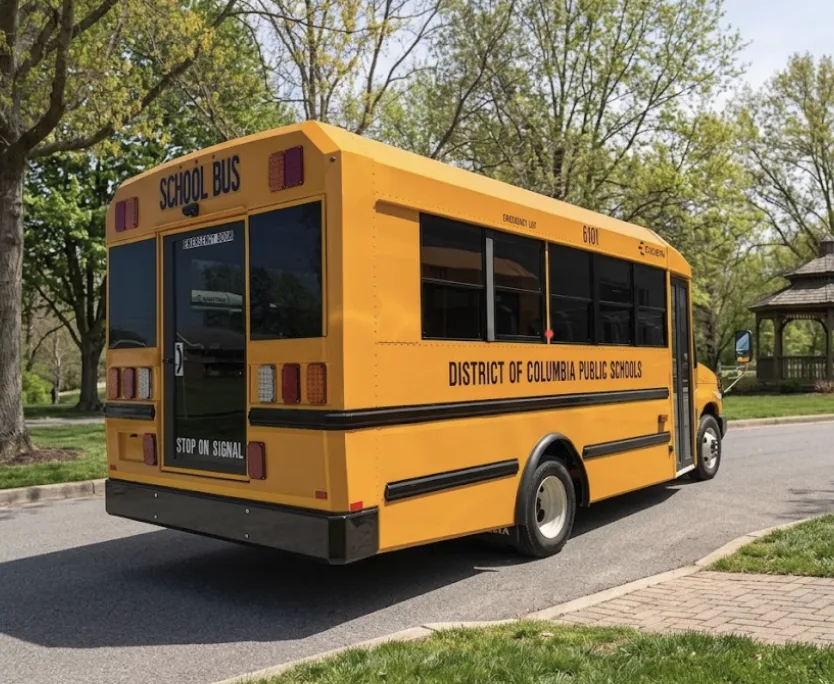
Size Is a Procurement Decision, Not Just a Technical Detail
Why Dimensions Drive More Than Just Fit
When choosing a school bus, size matters beyond passenger count and route fit. A bus that’s too large or too small can create operational inefficiencies, from route constraints to added staffing costs. Getting the right fit requires understanding how federal classifications translate to real-world use before purchase decisions are made.
The NHTSA Classification Framework
The National Highway Traffic Safety Administration classifies school buses into four types — A, B, C, and D — based on chassis architecture and body configuration, not on length or passenger count alone. Each type occupies a different part of the size spectrum, and each comes with distinct operational trade-offs. Understanding what separates them is the starting point for any serious size comparison.
Trying to match bus size to your routes? Endera’s team can help you work through which configuration fits your operational reality — capacity, clearance, ADA requirements, and all.
Type A School Buses: Dimensions and Where They Operate
Length, Width, and Height
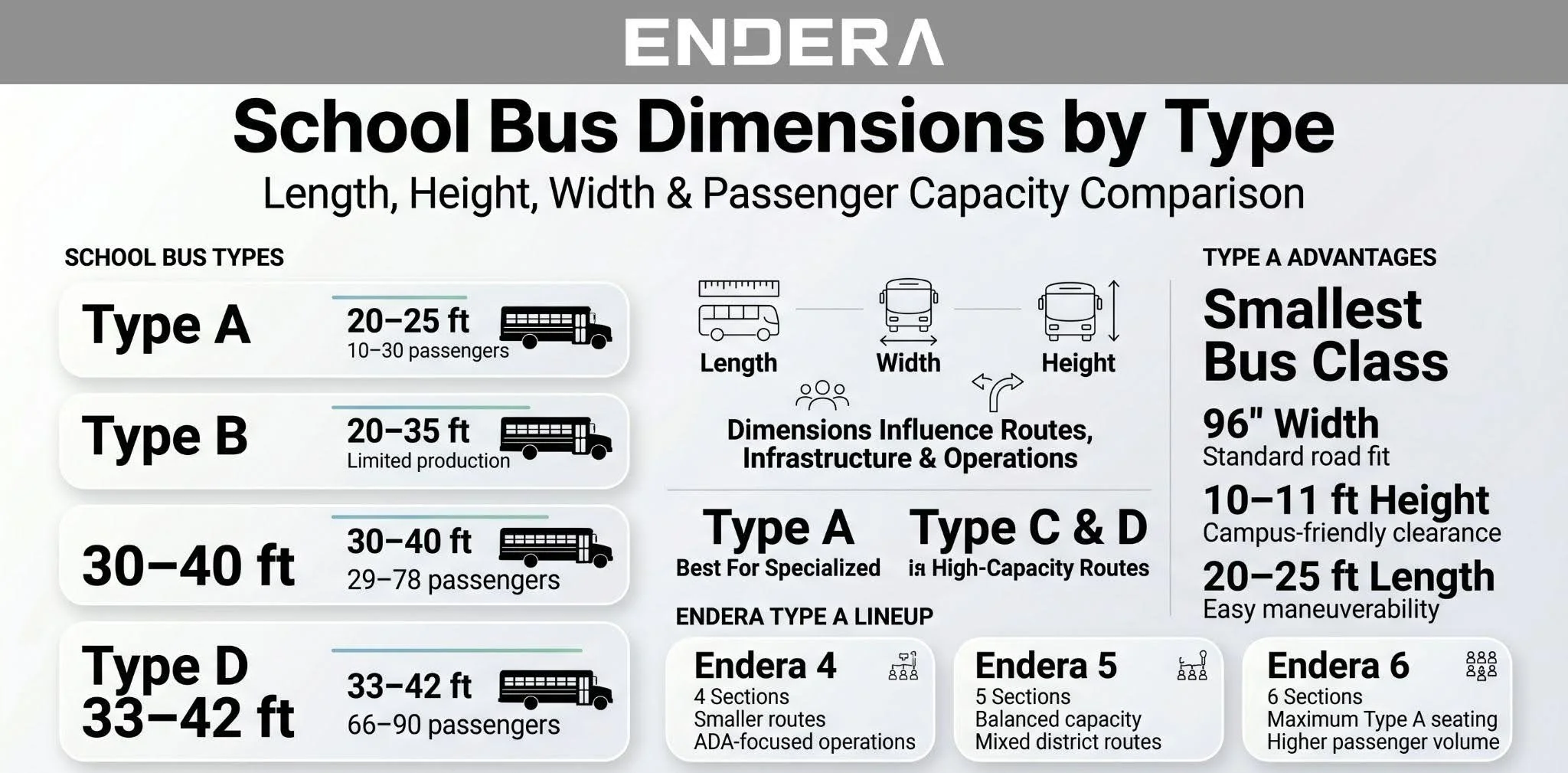
Type A school buses are built on a cutaway van chassis — most commonly the Ford E450 — with a left-side driver’s door and an entrance positioned behind the front wheels. They are the smallest classification in the federal system, and their dimensions reflect that. Overall exterior length typically runs from 20 to 25 feet depending on the number of body sections.
Exterior width is generally around 96 inches (8 feet), consistent with lane-width standards. Exterior height runs approximately 10 to 11 feet. Interior dimensions matter too for day-to-day operations: the Endera school bus lineup features a 92-inch interior width — the widest aisle available in the Type A class — and a 78-inch center aisle ceiling height, giving students and staff meaningful headroom throughout the passenger cabin.
Passenger Capacity and Use Cases
Type A buses typically seat about 10–30 students depending on configuration and ADA accommodations. An Endera 4 can carry up to 30 in standard layout, with capacity dropping as ADA space increases. They’re best for special education routes, rural or tight suburban roads, and low-volume pickups, but not for high-capacity routes needing 50+ seats.
Type B School Buses: A Classification Largely Without Active Production
What the Classification Covers
Type B buses are defined by a cowled chassis with part of the engine positioned beneath or beside the driver’s seat, with the entrance door behind the front wheels. They sit between Type A and Type C in length, typically ranging from about 20 to 35 feet, and were historically used as a middle-capacity option for districts that needed more room than a cutaway van chassis could offer but didn’t want to commit to a full-size conventional bus.
Why Type B Is Rarely the Answer Today
Type B buses have largely become obsolete because key chassis platforms were discontinued—Ford in 1998 and GM in 2003. As a result, production and parts availability have declined over a 10–12 year lifecycle. Most districts now opt for modern Type A buses instead, which cover similar use cases with better serviceability and broader manufacturer support.
Type C School Buses: The Conventional Full-Size
Exterior Dimensions
Type C is the classic “dog nose” school bus design with the engine in front and the door behind the front axle. It typically measures 30–40 feet long, 96 inches wide, and 10–12 feet high depending on configuration. Interior height is usually around 6–6’3″, with some high-headroom options available.
Passenger Capacity and Operational Profile
Type C capacity ranges from around 29 to 78 students depending on seat spacing, grade level, and whether ADA positions are included. A 35-foot Type C in a standard configuration typically seats 48 to 54 students; a 40-foot model can push into the 65–78 range. These buses are built for high-volume routes where maximizing students per vehicle run is the primary goal. The trade-off is maneuverability — a 40-foot bus needs more room to turn than a 25-foot Type A, which matters on residential roads, older school campuses with tight drop-off configurations, and routes that include low-clearance structures.
Type D School Buses: Flat-Front, Maximum Capacity
Dimensions at the Largest End of the Classification
Type D buses are transit-style, flat-front designs with the door ahead of the front wheels and engines mounted front or rear. They are the highest-capacity school bus type, typically 33–42 feet long, 96 inches wide, and 10–12 feet high. Their design allows more usable interior space than Type C buses of the same length due to reduced engine intrusion.
Passenger Capacity and Where Type D Makes Sense
Type D capacity ranges from around 66 to 90 students, making it the right answer for large urban and suburban districts running high-density routes where moving the maximum number of students per trip is the operational priority. The IC Bus RE Series, as one example, runs from 33 to 42 feet in length with a capacity range of 66 to 84 passengers. Type D buses are not appropriate for rural routes with limited road width, tight turning environments, or specialized programs where student count per run is low — those use cases belong to Type A.
How Sections Affect Dimensions on Type A Buses
What a Section Actually Changes
On a Type A school bus, “sections” refer to the structural body modules that make up the passenger cabin behind the driver’s compartment. Adding sections increases overall length and passenger capacity proportionally. An Endera 4 (4-section configuration) is shorter and carries fewer passengers than an Endera 6 (6-section configuration), and both are built on the same Ford E450 chassis platform. The section count also affects where ADA lift integration fits within the floor plan — a larger section count provides more flexibility in positioning securement stations relative to standard seating rows.
Matching Section Count to Route Requirements
Choosing the right section count is a route-planning decision as much as a capacity decision. A district running special education routes with 8 to 12 students per run and two wheelchair positions doesn’t need a 6-section bus — and running one adds weight, reduces fuel efficiency, and may limit where the bus can operate. A district running a general route with 28 to 30 students and no ADA requirements is better served by a larger configuration. Endera’s school bus lineup — the Endera 4, 5, and 6 — gives districts exactly this flexibility, with section count selected at the time of order rather than adapted from a fixed template after the fact.
Dimensions and the Infrastructure That Surrounds Them
Clearance, Turning Radius, and Campus Design
A bus must fit not just the route but also site constraints like garage clearance, canopy heights, and turning radius. Type A buses offer a much tighter turning radius than Type C or D, making them better suited for tight campuses, older facilities, and residential routes not designed for large buses.
Charging Infrastructure and Bus Dimensions
For fleets moving toward electric Type A buses, physical dimensions also affect the depot charging layout. A Type A bus takes up considerably less space per charging position than a Type C or D, which means more vehicles can be charged per linear foot of depot space — a meaningful consideration for smaller facilities that are planning charging infrastructure buildouts alongside fleet replacement. Endera handles charging infrastructure through a turnkey service that includes site assessment before any equipment is specified, ensuring the physical footprint of the bus fleet is accounted for in the infrastructure design.
School Bus Dimensions Matched to the Right Use Are What Matters
The dimension tables matter — but only in the context of the routes, the infrastructure, and the students they’re designed to serve. A 40-foot Type D that’s too long for its roads doesn’t perform better because it has a higher listed capacity. A Type A configured correctly for an ADA route with 12 students does its job more efficiently than a larger bus running mostly empty. The right size is the one that fits the actual operational requirement, built by a manufacturer that gives districts the configuration flexibility to match that requirement precisely.
Endera builds Type A school buses in 4, 5, and 6 section configurations across ICE, propane, CNG, and electric powertrains — sized and spec’d to the district, not to a production default. Talk to Endera’s sales team to discuss which configuration fits your routes, your infrastructure, and your procurement timeline.
FAQs
1. How long is a Type A school bus?
Type A school buses typically range from 20 to 25 feet in exterior length depending on section configuration. Endera’s Type A lineup — the Endera 4, 5, and 6 — spans that range with section count selected to match each district’s specific route and passenger requirements.
2. How wide is a school bus?
Most school buses have a standardized exterior width of 96 inches (8 feet) across all four types, consistent with lane-width regulations. Interior width varies by manufacturer and body design. The Endera school bus features a 92-inch interior width — the widest available in the Type A category.
3. How tall is a school bus?
Exterior height for most school bus types runs from 10 to 12 feet, depending on body configuration and roof-mounted equipment. Interior ceiling height is typically 6 to 6 feet 6 inches depending on the model. The Endera Type A has a 78-inch (6.5-foot) center aisle ceiling height.
4. How many passengers does a Type A school bus hold?
Type A capacity generally ranges from 10 to 30 students depending on section count, seating layout, and ADA configuration. A fully configured Endera 4 in standard seating holds up to 30 passengers. ADA positions reduce that number proportionally based on securement placement.
5. What is the difference between Type C and Type D school buses?
Type C is the conventional “dog nose” design with the engine in front and the entrance door behind the front axle. Type D is a flat-front transit-style design with the entrance door ahead of the front wheels. Both cover similar length ranges (roughly 30 to 42 feet), but the flat-front Type D typically offers more usable passenger space per foot of exterior length because less room is lost to the front engine compartment.
6. Are Type B school buses still manufactured?
Active production of Type B school buses is very limited. The Ford and GM cowled chassis platforms that defined Type B production were both discontinued in the late 1990s and early 2000s, significantly narrowing the parts supply chain. Districts with use cases that would have historically fit a Type B are generally better served today by a correctly configured Type A.
7. Does section count on a Type A affect more than just length?
Yes. Section count affects overall length, passenger capacity, ADA positioning options, weight distribution, and fuel consumption. It also affects where the bus can operate — a 6-section Type A is longer and heavier than a 4-section model and may have a wider turning arc. Endera’s section-based configuration lets districts select the right balance at the time of order rather than modifying a fixed production template.