
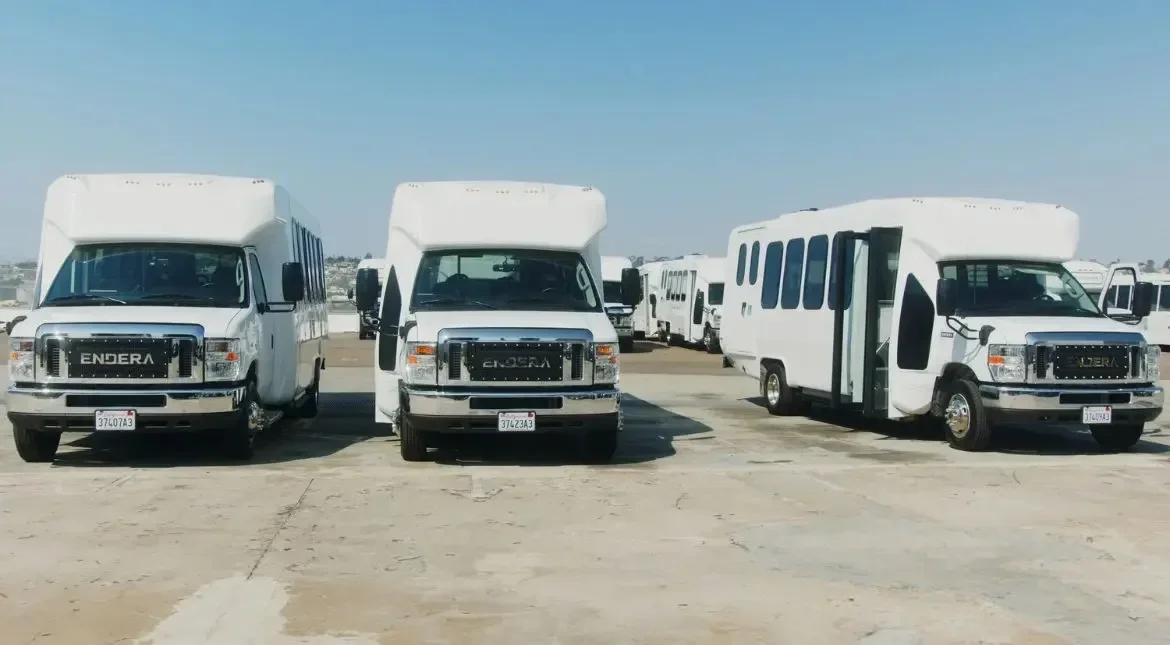
Most Electric Shuttles on the Market Are Conversions. The B-Series Isn't.
What That Distinction Actually Means for Fleet Operators
Most electric shuttle buses available today start with a gasoline or diesel cutaway chassis and work backward — a third-party installer removes the drivetrain, retrofits battery packs and an electric motor into a frame designed for a different propulsion system, and delivers a vehicle where high-voltage components sit wherever they fit. The manufacturer of the chassis, the body, and the powertrain are three different companies. When something goes wrong, accountability is split accordingly.
Endera is the only American vertically integrated EV shuttle OEM — the powertrain, the 150 kWh battery architecture, and the vehicle body are all engineered and assembled under one roof in Ottawa, Ohio. For fleet operators evaluating a new electric shuttle or fleet refresh, Endera's electric B-Series lineup includes the B4 (24 ft) and B5 (25 ft) in Standard Range and Extended Range configurations, with DC fast charging standard, turnkey charging infrastructure, and the highest Altoona score in its class at 90.1.
Ready to spec your fleet? Contact Endera's fleet specialists today to design a custom configuration blueprint for your operation.
Built Together, Not Assembled From Parts
Endera is the only American vertically integrated EV shuttle OEM — the powertrain, the 150 kWh battery architecture, and the vehicle body are all engineered and assembled under one roof in Ottawa, Ohio. The electric system and the vehicle structure were designed together, not retrofitted into a frame that was never intended for them. For fleet operators evaluating total cost of ownership over 10–12 years, that difference accumulates in ways that don't show up on a spec sheet.
Why Battery Placement Changes the Vehicle
The most consequential engineering difference between a purpose-built EV platform and a conversion is where the battery lives. Endera integrates the battery pack within the vehicle's frame rails — lowering the center of gravity, protecting the battery within the structural frame in a collision, and distributing weight tuned for the shuttle body sitting on top of it. Conversion platforms typically mount batteries externally or in secondary locations, which affects durability, thermal management, and maintenance access over the vehicle's service life.
What Split-Vendor Accountability Looks Like in Practice
In conversion-based models, responsibility for drivetrain, body, and integration sits across multiple vendors — which complicates warranty claims and slows repairs when no single manufacturer owns the full system. For operators navigating federal funding, independent validation through the FTA Altoona Bus Testing Program is the third-party benchmark that conversion-based suppliers often can't provide, because the test is designed for purpose-built vehicles, not retrofits.
B-Series Electric Shuttle Specifications
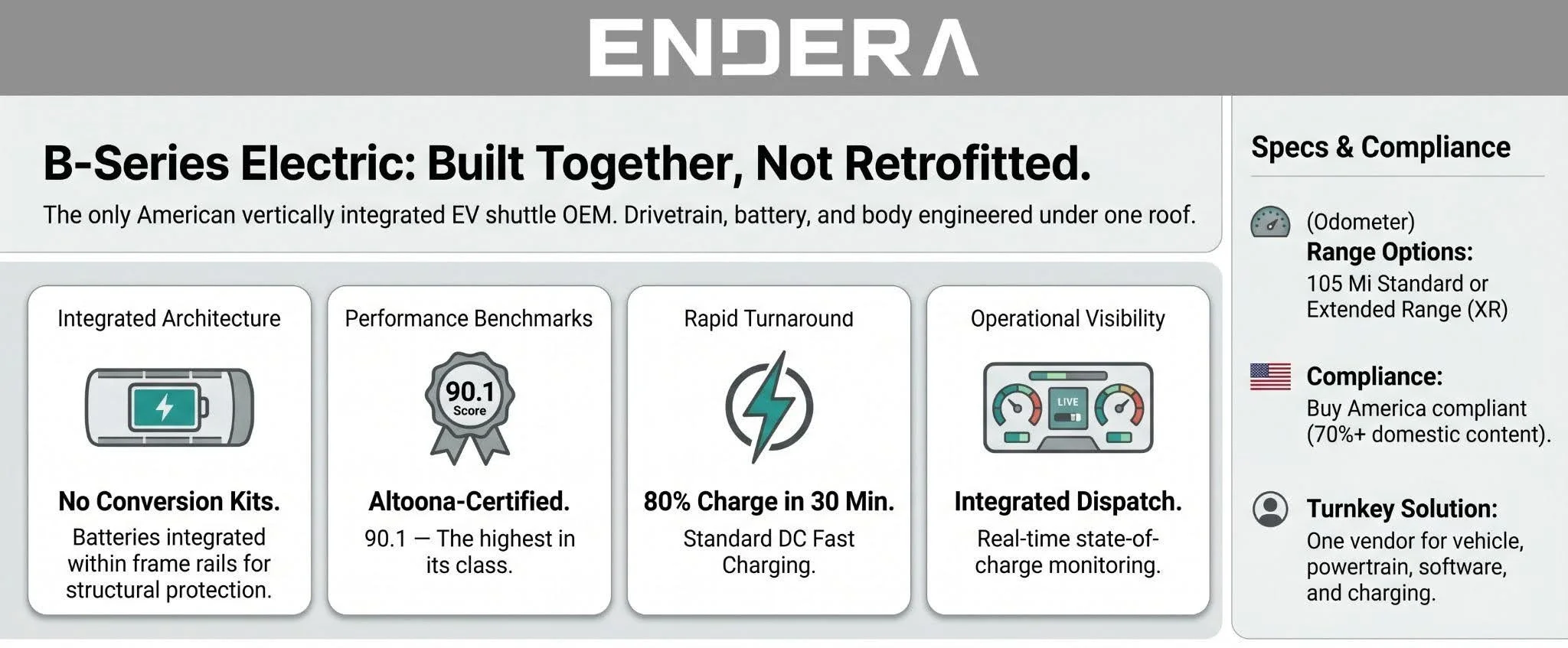
B4 and B5: Standard Range and Extended Range Options
The electric B-Series is available in the B4 (24 feet) and B5 (25 feet) in both Standard Range (SR) and Extended Range (XR) configurations. The SR variants deliver up to 105 miles of range — enough to cover the vast majority of airport loop, hotel shuttle, university campus, and corporate campus routes in active operation. The XR variants extend that range further using the same 150 kWh platform architecture, tuned for operators whose routes or operational patterns require more buffer before returning to depot charging.
Charging: 80% in 30 Minutes
DC fast charging comes standard on every Endera electric shuttle. The 150 kWh platform reaches 80% charge in approximately 30 minutes — a spec that matters operationally for high-frequency routes where vehicles need to turn around quickly between service periods. A 30-minute charge window fits naturally into a shift break or scheduled layover, which means fast charging isn't just a technical specification — it's what makes continuous-duty electric operation practical without expanding the fleet size to compensate for charging downtime.
Turnkey Charging Infrastructure
Endera also provides turnkey charging infrastructure — site assessment, charger procurement, and installation — so fleet operators aren't sourcing the vehicle from one vendor and the charging equipment from another. The depot setup is engineered for the specific vehicles and route patterns of each operation, not installed from a generic template.
The Altoona Test Score: What 90.1 Actually Means for Fleet Operators
The Test and Why It Matters for Procurement
The FTA Altoona Bus Testing Program at the Larson Transportation Institute in Pennsylvania is the federal benchmark for transit bus durability, safety, reliability, and performance. Altoona certification is required for all buses purchased with FTA funding — which means it's not an optional validation exercise. It's a procurement requirement for any fleet operator planning to use federal transit grants to fund electric shuttle acquisition. Without it, the vehicle is ineligible for FTA-funded purchases regardless of its other specifications.
What the B4's Score Means in Practice
In March 2025, Endera's electric B4 completed Altoona testing with an aggregate score of 90.1 — the highest in its class. That score is a third-party verification of the vehicle's durability under the intense demands of continuous transit service. For operators pursuing FTA Low or No Emission Program funding, the B4's Altoona certification removes one of the most common hurdles in the procurement process and is the kind of independent data point that carries weight when a transportation director has to justify the purchase to a board, a procurement committee, or a grant administrator.
What Electric Shuttle Operation Looks Like Day to Day
Route Planning and State-of-Charge Management
The most common concern fleet managers raise about electric shuttle operation is range anxiety — specifically, the risk of a vehicle running low on charge mid-route. Endera's Dispatch software addresses this directly. Dispatch provides real-time state-of-charge monitoring for every vehicle in the fleet, which lets operators plan routes and scheduling around actual battery availability rather than discovering range constraints during service. For fleets running multiple vehicles across simultaneous routes, that visibility is what makes continuous-duty electric operation manageable without a dedicated EV specialist on staff.
Depot Charging Strategy
For most electric shuttle operations, the highest-value charging window is overnight at the depot. A vehicle returning from a full day of service with 20–30% remaining charge can return to 100% by morning without fast charging — preserving battery chemistry over the long term and reducing energy cost compared to mid-shift DC fast charging. Most fleet operators running airport loops, corporate campus routes, or university transit can cover their daily mileage needs with overnight Level 2 charging, reserving DC fast charging for extended-shift operations or vehicles that need a mid-day top-up.
Federal Funding for Electric Shuttle Acquisition
FTA Low or No Emission Vehicle Program
The FTA Low or No Emission Vehicle Program is the primary federal funding pathway for public transit agencies and eligible operators purchasing zero-emission buses. The program has awarded more than $4.5 billion in competitive grants to support investments in American-made transit buses, and Endera's Altoona-certified B4 is directly eligible for purchases made through this program. For state and local transit agencies, metropolitan planning organizations, and eligible private operators, this is the most significant funding lever available for electric shuttle acquisition.
Buy America Compliance
Every Endera electric shuttle is Buy America compliant — a requirement for any vehicle purchased with federal transit funding under FTA's Buy America standards, which now mandate over 70% domestic content and U.S. final assembly. Endera's Ohio manufacturing facility, where both the EV powertrain and the vehicle body are assembled, is the basis for that compliance. For procurement officers at transit agencies navigating pre-award compliance reviews, Buy America certification from a vertically integrated domestic manufacturer is a cleaner documentation path than one involving multiple domestic and international vendors.
Endera's Grant Navigation Support
Endera assists fleet operators in identifying and pursuing applicable federal, state, and local funding — and manages the application process directly. The company has relationships providing access to over $20 billion in available EV subsidies nationally. For fleet managers at smaller transit agencies or private operators without dedicated grant staff, that support removes a real administrative burden from what can be a complex multi-program funding landscape.
How the B-Series Electric Compares to Other Electric Shuttle Options
What the Market Currently Offers
The Class 4 electric shuttle segment — the market Endera occupies — is meaningfully different from the large transit bus segment where manufacturers like Proterra and New Flyer operate. Most Class 4 electric shuttle options come from body builders who install third-party EV conversion kits on Ford E450 or GM cutaway chassis, then source telematics from a separate vendor. Lion Electric and GreenPower Motor offer purpose-built electric bus options but focus primarily on larger Type C and D configurations rather than the mid-size Class 4 shuttle segment.
Where Endera's Integration Shows Up in a Comparison
For fleet operators doing a head-to-head evaluation, the meaningful comparison points are Altoona certification status, Buy America compliance documentation, charging integration, and total cost of ownership over the vehicle's service life. Endera's B4 carries the only Altoona score in its class, and the vertically integrated manufacturing model means service and warranty accountability sit with one manufacturer rather than being split between a chassis supplier, an EV conversion vendor, and a telematics provider. For fleet procurement processes that require quantitative third-party validation and clean compliance documentation, that structure is a practical advantage.
Built as a Complete System, Not Assembled From Parts
The B-Series electric shuttle isn't a converted ICE vehicle or an upfitted chassis — it's a purpose-built EV where the powertrain, the battery architecture, the vehicle body, and the fleet management software were designed and assembled together by one manufacturer. Endera's electric B-Series carries the highest Altoona score in its class, runs on a 150 kWh platform with DC fast charging standard, and comes with the turnkey charging infrastructure and integrated software that fleet operators need to run electric service without managing multiple vendor relationships.
Contact Endera's fleet specialists to review configurations, confirm current in-stock availability, and find out what funding your operation may qualify for.
FAQs
1. What is the range of the Endera electric B-Series shuttle?
The B4 and B5 Standard Range variants deliver up to 105 miles. Extended Range variants provide additional buffers for operators whose routes or duty cycles require more range before returning to depot charging. Endera's sales team can confirm current SR and XR specifications for your specific route profile.
2. How long does it take to charge an Endera electric shuttle?
The 150 kWh platform reaches 80% charge in approximately 30 minutes with DC fast charging. Full charge times vary by charger type. Endera provides turnkey charging infrastructure — site assessment, charger sourcing, and installation — as part of its EV platform.
3. Is the Endera B-Series Altoona certified?
Yes. The electric B4 passed Altoona testing in March 2025 with an aggregate score of 90.1 — the highest in its class. Altoona certification is required for buses purchased with FTA funding.
4. Is the Endera electric shuttle Buy America compliant?
Yes. Every Endera electric shuttle is Buy America compliant, manufactured at Endera's Ottawa, Ohio facility where both the EV powertrain and the vehicle body are assembled. This compliance is required for purchases using FTA transit funding.
5. What federal funding is available for electric shuttle purchases?
The FTA Low or No Emission Vehicle Program is the primary pathway for eligible transit operators. State-level programs vary. Endera assists operators with identifying applicable funding and managing applications as part of the sales process.
6. What software comes with the Endera electric shuttle?
Every B-Series electric shuttle comes available with Endera Go (real-time passenger tracking and ETA) and Endera Dispatch (fleet management, routing, and state-of-charge monitoring), both integrated directly with the vehicle's hardware.
7. Does Endera offer financing for electric shuttle purchases?
Yes. Endera offers direct vehicle financing and capital leasing through its financing platform. Capital leasing aligns vehicle costs with revenue cycles and preserves working capital. Endera also assists with grant identification and application for buyers pursuing public funding.