
Type B School Buses: Where the Category Stands Today
A Classification That Exists on Paper More Than in Production
Transportation directors searching for a Type B school bus are often trying to solve a specific problem — something smaller than a full-size conventional, configurable for special education or rural routes, and appropriate for lower student counts. The issue is that the Type B category, while still part of the federal classification system, has largely disappeared from active production.
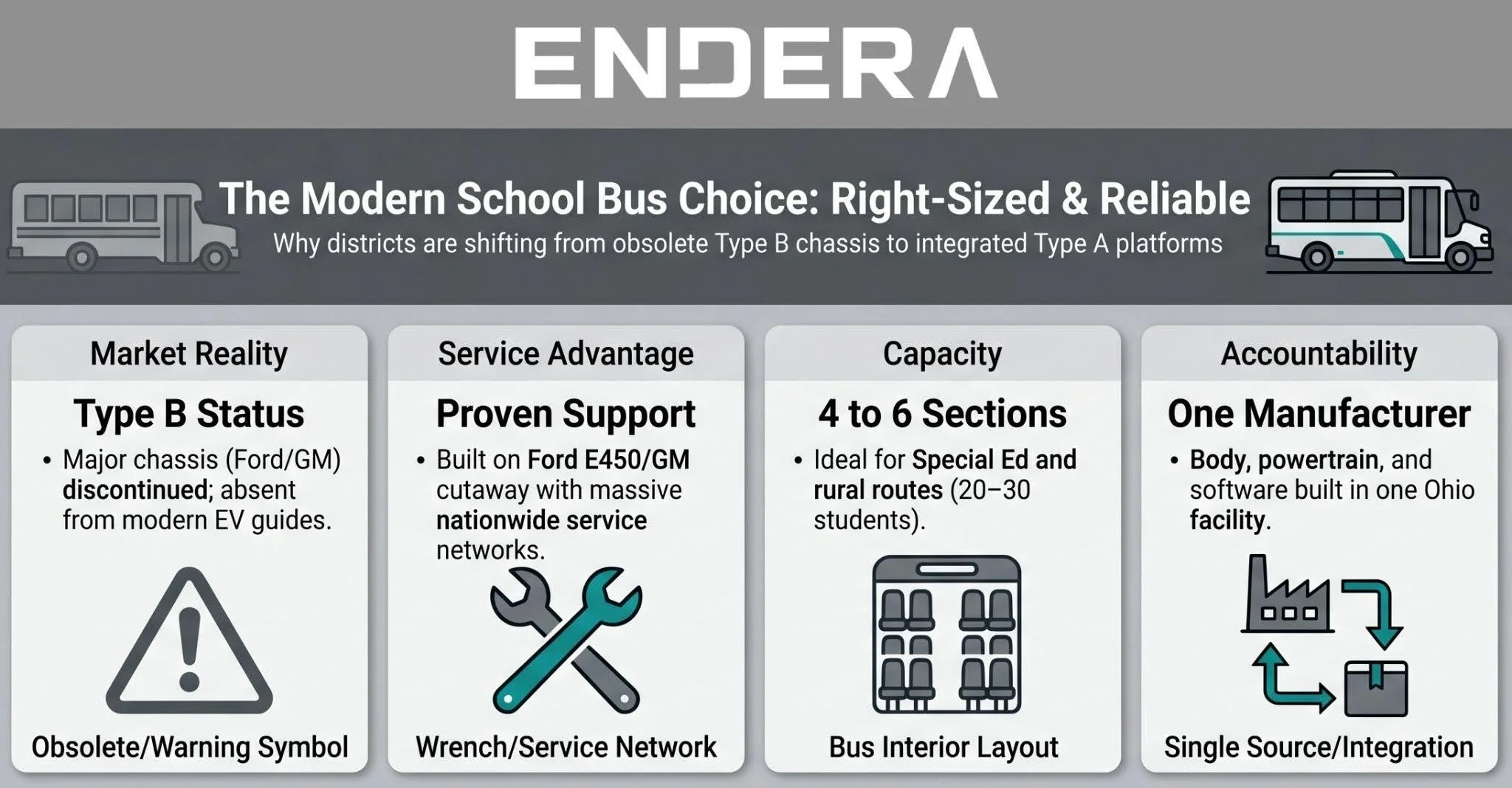
The chassis platforms that made Type B buses possible were discontinued decades ago — Ford ended its B-Series cowled bus chassis in 1998 after a 50-year run, and General Motors ended its B-Series cowled chassis after 2003. With those chassis gone, the supply chain and parts availability that districts would need over a 10–12 year vehicle lifecycle effectively went with them.
Ready to find the right configuration for your district? Contact Endera's fleet specialists today to design a custom configuration blueprint for your routes.
Where the Market Has Moved — and What That Means for Districts
Most major OEMs now produce Type A, C, and D configurations. The shift is visible in the electric school bus market as well — as of June 2025, the Electric School Bus Initiative's buyer's guide lists more than 20 electric models across Types A, C, and D, with no Type B represented. That's not because the federal classification was removed — it's because the manufacturing reality no longer supports it. For districts asking who still makes a Type B school bus, the honest answer is very few, and fewer each year.
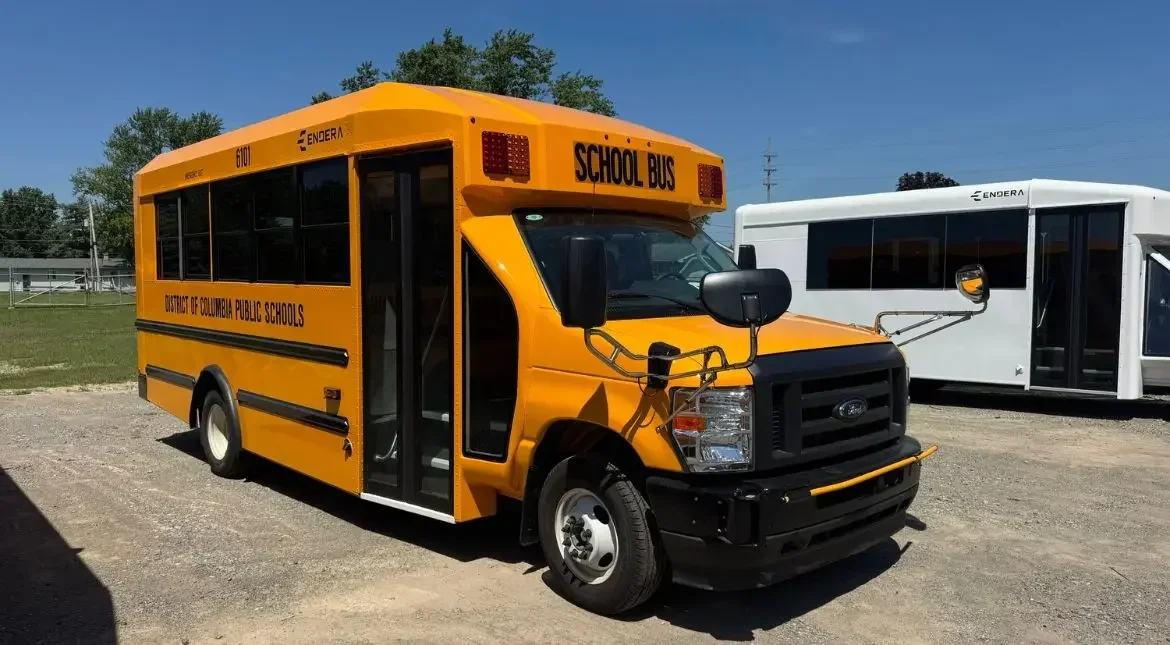
The more useful question is whether the operational need driving that search can be met by a well-configured Type A — and for most districts, it can. Endera builds the Type A school bus specifically for the districts that once would have bought a Type B: special education routes, rural pickups, small enrollment schools, and districts that need a configurable, right-sized vehicle without the serviceability concerns of a near-obsolete chassis type.
What the Federal Classification Actually Means
Type A vs. Type B: The Structural Difference
The federal classification system defines a Type B school bus as a bus body built and installed on a front-section vehicle chassis or stripped chassis with a GVWR of more than 10,000 pounds, where part of the engine is positioned beneath or beside the driver's seat. The entrance door sits behind the front wheels. A Type A, by contrast, is built on a cutaway front-section vehicle with a left-side driver's door — the van-derived platform that underpins most smaller school buses today. Both are federally recognized and meet all Federal Motor Vehicle Safety Standards. The difference is in chassis architecture, not safety standard or intended use — and for the routes where districts have historically considered Type B, that architectural difference rarely changes the operational outcome.
Type A vs. Type B: A Practical Comparison for Districts
Capacity and Configuration
The capacity gap between Type A and Type B is smaller than most districts assume. Modern Type A buses, including Endera's models, accommodate configurations ranging from 4 to 6 seating sections — covering the full range from small special education routes to general student transport for smaller enrollment schools.
The Endera 4, 5, and 6 school buses offer customizable seating, ADA-compliant lift options, and storage configurations that let districts tailor the floor plan to their actual route needs. A Type B's larger chassis provides incrementally more interior volume, but for most districts whose primary use case is special education transport or rural routes under 30 students, a well-configured Type A covers the same operational ground.
Chassis and Drivetrain Flexibility
Type A buses built on Ford E450 and Chevrolet Express cutaway platforms have an established dealer service network across the country — meaning maintenance support is broadly available wherever a district operates.
Type B buses, built on stripped chassis, are less common in active production today, which creates real serviceability considerations for districts that need parts availability and technician familiarity over a 10–12 year vehicle lifecycle. Endera's Type A school bus is built on proven platforms with ICE, propane, CNG, and electric powertrain options, giving districts the fuel flexibility to meet where their state funding and infrastructure currently sit — without committing to a single fuel path before they're ready.
Maneuverability and Route Fit
One of the practical reasons districts have historically considered Type B buses is the combination of more passenger capacity with a vehicle that's still smaller than a conventional Type C. In reality, modern Type A buses on extended wheelbases cover most of that middle ground — they're maneuverable enough for tight rural roads, neighborhood pickups, and school parking situations where a full-size conventional bus creates operational friction. For districts serving students across mixed terrain or making multiple short stops on rural routes, the Type A's tighter turning radius and driver sight lines are often the more functional choice.
Who Actually Needs a Type B — and Who Doesn't
Special Education and Small-Group Transport
The majority of districts searching for a Type B school bus are trying to solve a special education transport problem. They need a vehicle that's smaller than a conventional bus, ADA-compliant, and able to serve routes with low student counts — often five to fifteen students on a given run.
For this use case, a Type A configured with an ADA-compliant wheelchair lift, flexible seating sections, and the appropriate securement systems does the job fully. Endera's school bus lineup is specifically designed for this segment — districts can select from 4 to 6 section configurations to dial in seating, accessibility, and storage for the specific needs of their special education program.
Rural Districts and Small Enrollment Schools
Rural districts and small private schools often look at Type B classifications because they need more capacity than a small van but less than a 50-seat conventional bus. Again, a modern
Type A covers this range. Districts running routes with 20 to 30 students across rural roads with variable conditions will find that a properly configured Type A handles the capacity and route demands without the serviceability concerns that come with a less-common chassis type. Endera's multi-section floor plan options give rural districts the ability to configure a vehicle that matches their actual rider count rather than paying for capacity they don't use.
Districts Where Type B Genuinely Makes More Sense
There are situations where a true Type B is the right answer. Districts that have existing contracts or state bid approvals for Type B configurations, states where procurement frameworks specify Type B vehicles for certain funding categories, or specific route profiles where the chassis architecture of a Type B aligns better with the physical demands of the route — these are all legitimate cases. If your district has a specific Type B requirement written into a state bid or IEP-based transportation plan, Endera's sales team can help you evaluate whether a Type A configuration meets the same specification or whether the Type B designation is a genuine constraint.
Why Endera's Type A Is the Right Starting Point for Most Districts
Vertically Integrated Manufacturing
Endera is the only American vertically integrated OEM building Type A school buses — meaning the EV powertrain, the vehicle body, and the software stack are all engineered and assembled at the same 250,000-square-foot facility in Ottawa, Ohio. That matters for districts because it eliminates the accountability gaps that come from multi-vendor assembly. When something needs attention, there's one manufacturer responsible for the whole vehicle — not a chassis supplier, a body builder, and a separate powertrain integrator pointing at each other.
Fuel Options That Match Where Districts Are Today
Most districts aren't ready to commit fully to electric school buses, and Endera doesn't require them to. The Type A school bus lineup is available in ICE, propane, CNG, and electric variants — all on the same platform. Districts can start with what their current budget and infrastructure support and transition toward electric as EPA Clean School Bus Program funding or state-level EV grants make the economics work. Endera's team assists with identifying and applying for available funding, which matters particularly for smaller districts that don't have dedicated grant staff.
Configurable for What Your Routes Actually Require
The 4 to 6 section floor plan options aren't just about seating count — they determine where the ADA lift goes, how storage is allocated, and how the seating arrangement accommodates the mix of ambulatory and wheelchair-using students on a given route. That level of configurability is a direct result of the vertically integrated manufacturing process: Endera controls the floor plan rather than working within the constraints of a body builder's standard template. For districts serving students with complex transportation needs, that flexibility has real operational value.
The Right Bus for Your District Starts With the Right Conversation
For most districts searching for a Type B school bus, the actual need is a smaller, configurable, safety-compliant vehicle for special education transport, rural routes, or small enrollment programs. Endera's Type A school bus lineup covers that need — with fuel flexibility, ADA configuration options, and a vertically integrated manufacturer accountable for the whole vehicle.
Contact Endera's team to discuss your district's routes, student needs, and available funding — and find out which configuration fits what you're actually trying to solve.
FAQs
1. Does Endera sell a Type B school bus?
Endera's current school bus lineup focuses on the Type A classification — the Endera 4, 5, and 6 models, available in ICE, propane, CNG, and electric variants. For most districts searching for a Type B, a properly configured Endera Type A covers the same operational ground. Talk to the Endera team to discuss whether a Type A configuration meets your district's specific requirements.
2. What's the practical difference between Type A and Type B for a special education route?
For most special education applications — small student counts, ADA lift requirements, flexible seating — a Type A configured with the right section layout and accessibility options serves the route as well as a Type B. The Type A's cutaway chassis also provides broader serviceability across the dealer network than a Type B's stripped chassis.
3. What fuel options are available on Endera's school buses?
Endera's Type A school bus lineup is available in ICE, propane, CNG, and electric variants. Districts can choose the fuel type that matches their current infrastructure and budget, with the option to transition to electric as funding and charging infrastructure develop.
4. Can smaller districts access EPA Clean School Bus Program funding for a Type A bus?
Yes. The EPA Clean School Bus Program is open to school districts regardless of size, and Type A buses are eligible for funding. Endera assists districts with identifying applicable funding and managing the application process.
5. How configurable is the Endera Type A school bus interior?
Districts can select from 4 to 6 section configurations, customizing seating count, ADA lift placement, and storage layout. This level of configuration is possible because Endera controls the floor plan as the manufacturer — not a body builder working from a standard template.
6. What is Endera's warranty and service support structure?
As a vertically integrated manufacturer, Endera is the single point of contact for the vehicle, powertrain, and software. Endera's dealer network and service team provide support without the split accountability that comes from multi-vendor configurations. Contact Endera's team for specific warranty details.
7. Does Endera help with procurement paperwork and cooperative purchasing?
Yes. Endera's sales team works with districts through cooperative purchasing frameworks and state bid processes, and assists with grant documentation for federally funded purchases. For smaller districts without dedicated procurement staff, that support is a meaningful part of what Endera provides.