
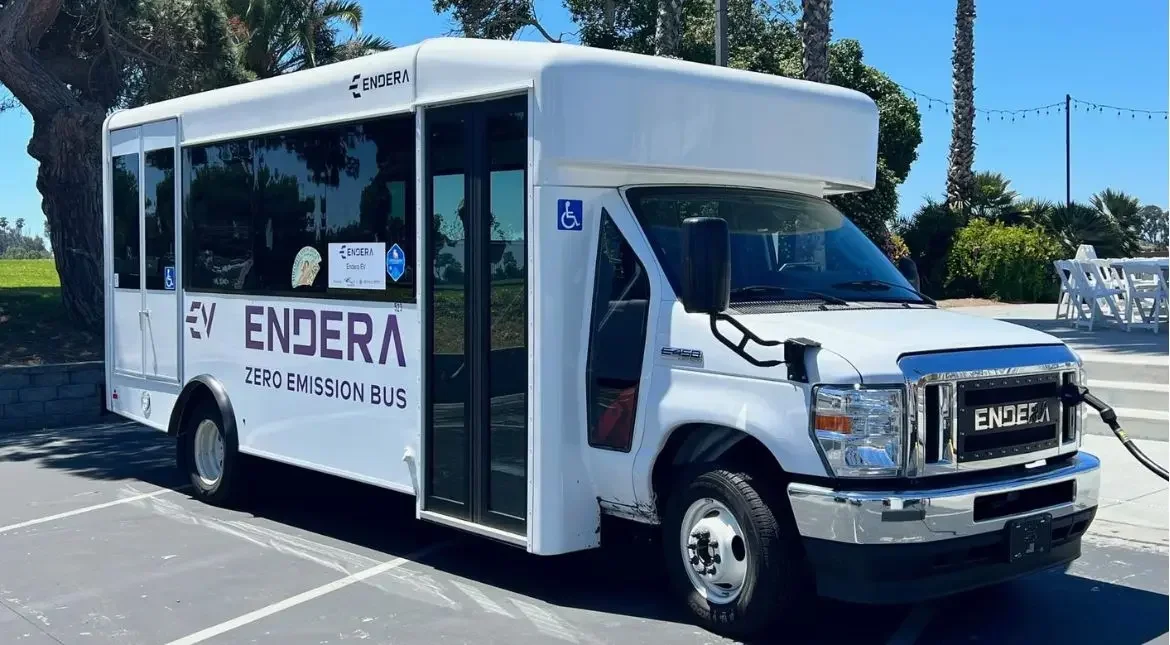
Paratransit buses serve a buyer pool that most shuttle sales pages never directly address — transit agencies fulfilling ADA complementary service obligations, healthcare systems moving patients between facilities, NEMT operators running dialysis and rehabilitation transport, and senior living communities providing resident mobility. What these buyers share is that ADA compliance isn't a feature they're shopping for. It's a baseline requirement, and the vehicle has to meet it as delivered.
Endera manufactures Class 4 B-Series commercial shuttles with ADA-compliant flat-floor configurations as a standard offering — 800 lb Braun ADA lifts, wheelchair securement systems, and accessible seating layouts installed at the Ottawa, Ohio manufacturing facility as part of the original build. For transit agencies, healthcare operators, and NEMT fleets, that OEM installation matters for compliance documentation, warranty accountability, and service lifecycle.
Ready to spec your fleet? Contact Endera's fleet specialists today to design a custom configuration blueprint for your operation.
What ADA Paratransit Compliance Actually Requires
Most pages describe paratransit buses as "ADA compliant" without explaining what that means operationally. FTA Part 37 transportation service regulations define the technical requirements — lift platform dimensions, securement specifications, aisle clearances, and driver assistance obligations. ADA accessible transportation requirements establish the service-level standards: complementary paratransit must operate within three-quarters of a mile of fixed routes, at comparable fares and hours.
For transit agencies running demand-response service, compliance extends beyond vehicle specifications to operational protocols. ADA guidance on bus operator assistance obligations defines what drivers must do during boarding and alighting — requirements that affect vehicle layout decisions as much as equipment specifications. Agencies that don't account for driver workflow in vehicle configuration create compliance gaps that equipment alone can't close.
Wheelchair Securement: Beyond the Lift
A wheelchair that boards the vehicle must be secured before transit. DOT wheelchair securement requirements mandate four-point tie-down systems with separate occupant shoulder and lap restraints — a standard that ADA securement interpretation guidance clarifies in detail for transit operators.
NHTSA wheelchair occupant safety research and RESNA wheelchair transportation safety standards document the engineering basis for these requirements — crashworthiness testing, tie-down geometry, and occupant restraint load paths that purpose-built commercial vehicles satisfy and that modified alternatives often don't. PMC wheelchair transportation safety research reinforces the gap between compliant and non-compliant securement outcomes in real-world transit conditions.
The Demand Behind Paratransit Fleet Purchases
The procurement volume for accessible transit vehicles is driven by demographics as much as regulation. NADTC data on aging and disability transportation documents consistent growth in transit demand from seniors and people with disabilities — a population that research on public transportation use among older adults shows is increasingly dependent on accessible transit as driving becomes less viable.
A national poll on transportation challenges found that inability to drive and lack of transportation options rank among the top concerns for older adults, people with disabilities, and caregivers. The West Health mobility crisis analysis frames this as a structural gap that transit agencies and healthcare operators are actively investing in closing — not a niche market but a growing core of accessible fleet demand.
Healthcare and NEMT Applications
Research on transportation barriers to healthcare access documents the direct clinical impact of inadequate medical transport — missed dialysis appointments, delayed discharge, and reduced medication adherence are measurable outcomes of unreliable NEMT fleets. NEMT integration research addresses how healthcare systems are increasingly investing in purpose-built accessible vehicles to reduce transportation friction in care pathways.
For healthcare operators, the vehicle requirements overlap with transit ADA standards but carry additional operational considerations. Dialysis transport requires predictable scheduling and vehicles that accommodate power wheelchairs reliably. Hospital discharge programs need accessible vehicles that can move patients with varying mobility limitations efficiently. Rehab center transport often requires lift systems rated for heavier mobility equipment — the reason Endera's standard 800 lb Braun lift capacity matters operationally rather than just on paper.
What Transit Agencies Look for in a Paratransit Bus
GAO analysis of increasing ADA paratransit demand identifies fleet modernization as a consistent response to ridership growth — agencies replacing aging paratransit vehicles with more capable, lower-maintenance accessible platforms. NFTA paratransit study data provides operational statistics on ridership trends and service planning that inform procurement decisions.
Access Board ADA vehicle accessibility guidance and demand-response vehicle accessibility rules define the design standards that paratransit procurement specifications draw from. Demand-responsive paratransit optimization research documents how dispatch efficiency, vehicle configuration, and fleet composition interact to reduce wait times and operational costs — factors procurement teams increasingly evaluate alongside vehicle price.
Rural Paratransit: A Different Operational Profile
Urban paratransit and rural paratransit serve the same population but operate very differently. The NADTC rural ADA demand-response guide outlines how rural providers configure flexible fleet operations — longer routes, lower trip density, and vehicles that must serve multiple functions across a service day.
For rural operators, ICE and propane B-Series configurations with ADA lifts serve demand-response routes well — broad parts availability, no charging infrastructure dependency, and the operational flexibility that variable rural routing requires. Urban operators with depot charging and fixed daily routes are stronger candidates for electric configurations.
The B-Series Paratransit Lineup
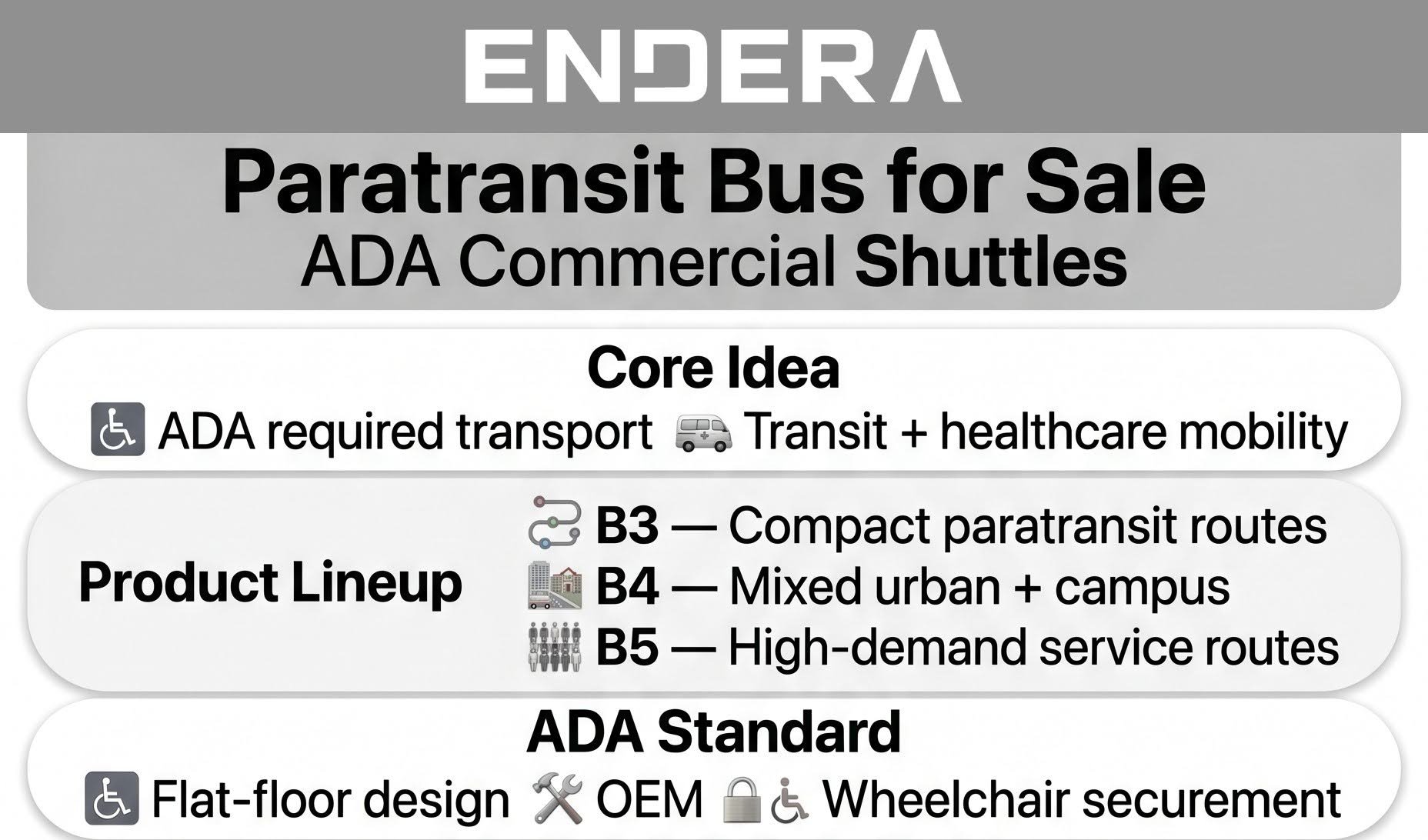
Endera's flat-floor B-Series configurations are available across the B3, B4, and B5 models with 800 lb Braun ADA lifts installed at the manufacturing stage. Common configurations include:
2 wheelchair + 6 ambulatory — standard mixed paratransit configuration for most NEMT and demand-response routes
4 wheelchair + 2 ambulatory — for routes serving primarily wheelchair users
Fold-away seating — allows the same vehicle to serve mixed loads across a service day
All configurations meet FTA Part 37 accessibility requirements and ADA accessible transportation standards as delivered. Seating and securement arrangements are specified at the order stage to match actual route and passenger population requirements.
Funding for Paratransit Fleet Purchases
FTA Section 5310 Enhanced Mobility of Seniors and Individuals with Disabilities program funds accessible vehicle purchases for qualifying transit and community transportation operators. Endera's B-Series shuttles are FTA-eligible and Buy America compliant — meeting the federal procurement requirements attached to Section 5310 and related accessible transit funding. Endera's grant navigation services help operators identify applicable programs and manage application submissions.
Ready to Spec a Paratransit Shuttle for Your Fleet?
Several 2026 ADA-configured B-Series units are available for immediate delivery through Endera Stock. For transit agencies and healthcare operators working within formal procurement cycles, Endera provides full specification documentation, ADA compliance materials, and Buy America certification.
Contact Endera's fleet specialists to discuss accessible fleet configuration, securement options, or financing.
Frequently Asked Questions
What is the difference between paratransit and NEMT?
Paratransit is a federally mandated accessible transit service that complements fixed-route public transportation — transit agencies must provide it under ADA Title II for eligible riders within three-quarters of a mile of fixed routes. NEMT (non-emergency medical transportation) is a healthcare-funded service that moves Medicaid-eligible patients to medical appointments — it's typically funded through state Medicaid programs rather than transit grants. Both use similar accessible vehicle formats, but operate under different regulatory and funding frameworks.
How many wheelchair positions should a paratransit bus have?
Standard configurations support two to four wheelchair securement positions depending on layout and service profile. NEMT and demand-response operations typically use 2-wheelchair/6-ambulatory mixed configurations. Routes serving primarily wheelchair users specify 4-wheelchair/2-ambulatory with fold-away seating. Endera's Type A and B-Series configurations are specified at the order stage to match actual passenger population needs — not defaulted to a single layout.
What wheelchair securement systems are required by federal law?
FTA and ADA regulations require four-point tie-down securement with occupant shoulder and lap restraints — two straps at the front of the wheelchair frame, two at the rear, anchored to floor-mounted tracks. Occupant restraint belts are separate from wheelchair tie-downs and must be provided regardless of whether the passenger uses their own seatbelt. Endera's OEM-installed securement systems meet these specifications as delivered.
Are electric paratransit buses practical for healthcare and transit fleets?
Yes, for fixed-route and scheduled operations with overnight depot charging. Dialysis transport, hospital campus shuttles, and senior living circuits typically have predictable daily mileage that suits electric operation well. Electric drivetrains reduce maintenance spend 30–40% versus diesel, and the quieter cabin benefits passengers with sensory sensitivities or medical conditions affected by noise and vibration.
What is Section 5310 funding and does it cover paratransit bus purchases?
FTA Section 5310 funds accessible vehicle purchases for operators serving seniors and people with disabilities — including transit agencies, nonprofits, and community transportation providers. Endera's B-Series shuttles are FTA-eligible and Buy America compliant, satisfying the federal procurement requirements attached to Section 5310 awards. Endera's grant navigation services help operators confirm eligibility and manage the application process.
Can paratransit buses serve rural communities effectively?
Yes, though rural paratransit requires different vehicle configurations than urban demand-response. Rural operators need flexible, multi-purpose accessible vehicles capable of longer routes with lower trip density. ICE and propane B-Series models with ADA lifts serve rural demand-response well — broad parts availability, no charging infrastructure dependency, and configurable seating that handles the varied passenger loads typical of rural paratransit service days.
How does Endera's vertical integration benefit paratransit fleet buyers?
Endera installs ADA lifts and securement systems at the manufacturing stage — not as post-sale upfitter additions. That produces a single warranty document covering body and accessibility equipment, one compliance certification, and one service contact for any post-sale issue. For transit agencies and healthcare operators whose accessible vehicles are subject to ADA compliance inspections, OEM-installed equipment carries stronger documentation standing than retrofits sourced through a separate vendor.