
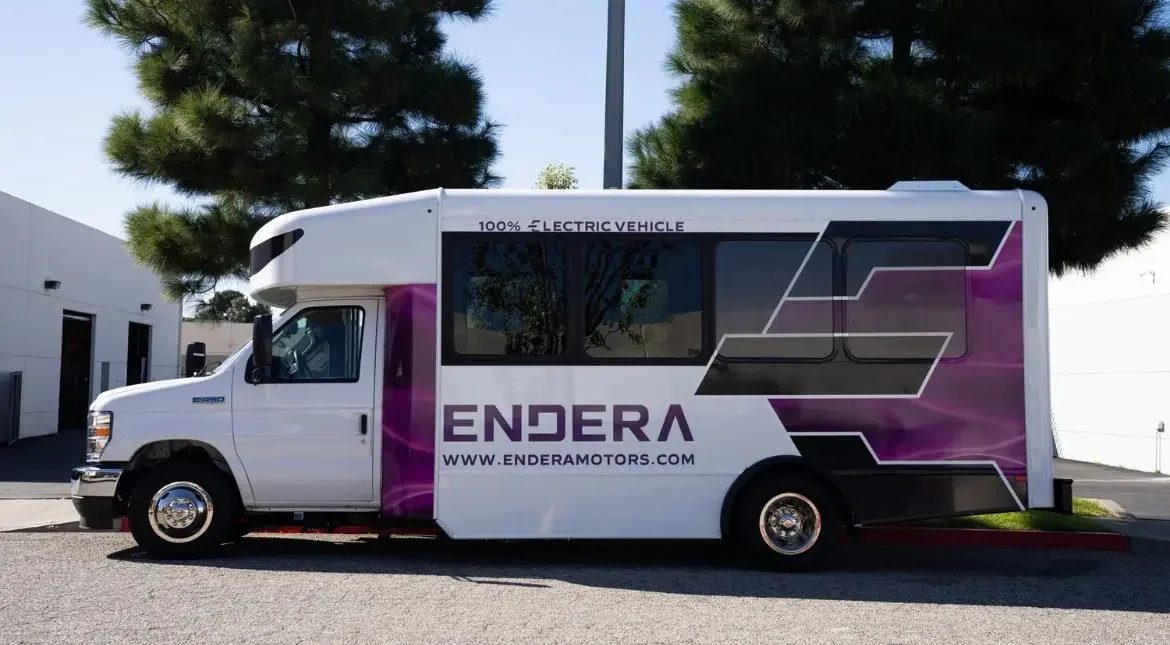
Not every route needs a 28-foot bus. Hotel loops, small campus circuits, and urban pickup operations have a different set of demands — tighter turns, lower passenger volumes, and a premium on maneuverability over raw capacity. Buying more vehicle than the route requires adds cost without adding value, and that gap shows up in the budget every single month.
The Endera B3 is a 23-foot commercial shuttle built specifically for this operating profile. It's the most compact model in Endera's B-Series lineup, built on a proven cutaway chassis and manufactured entirely at Endera's Ottawa, Ohio facility alongside the rest of the B-Series family. Stop paying for capacity you'll never use — talk to an Endera specialist today to see if the B3 is the right fit for your operation.
Who the B3 Is Actually Built For
Compact Routes With Real Operational Demands
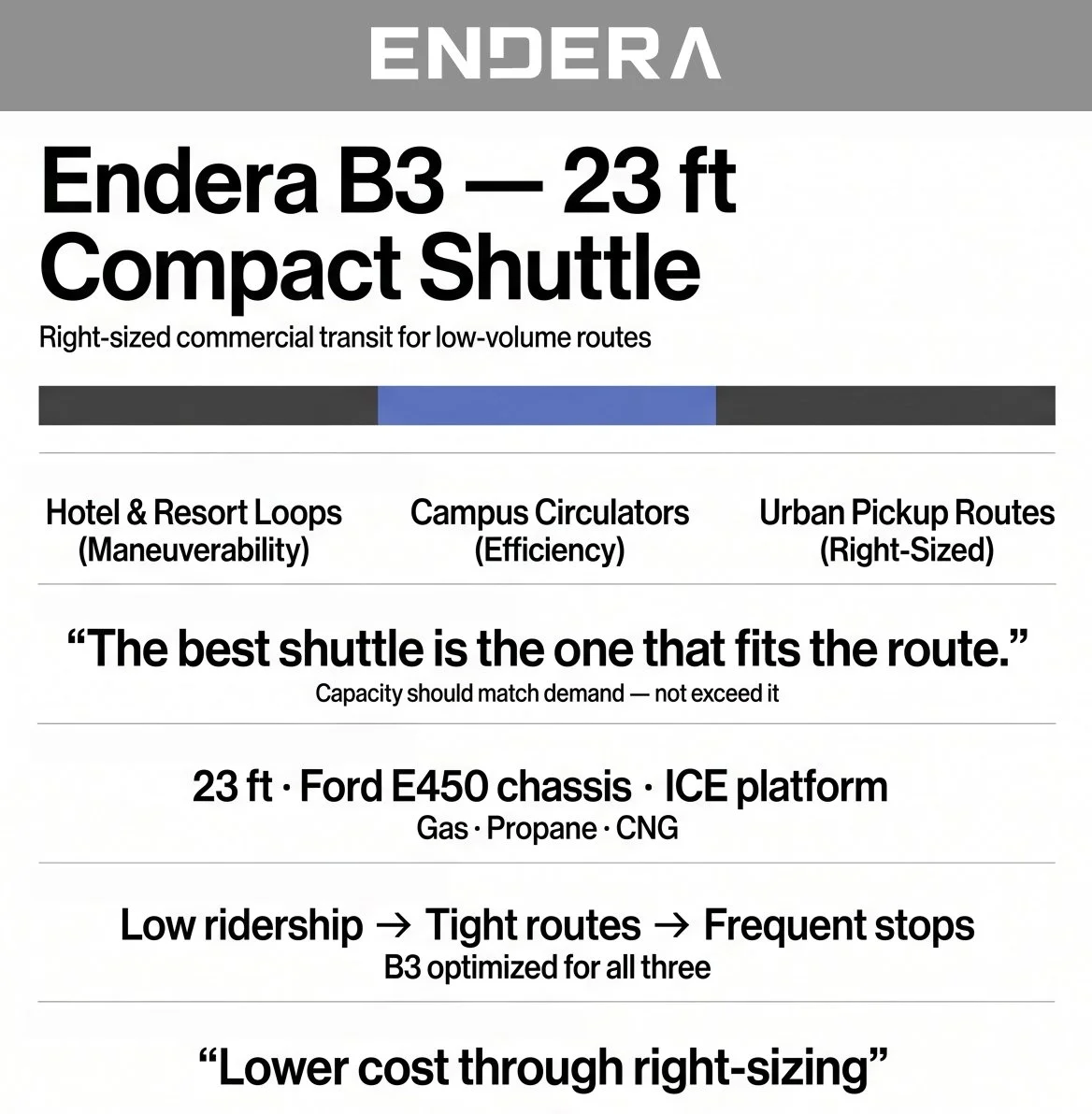
The B3 fits a specific set of use cases particularly well. Hotel and resort shuttles running tight loops between a property and a nearby airport or convention center. Small campus circulators covering a handful of stops on a predictable schedule. Urban pickup operations where street width and turning radius matter as much as passenger count. In each of these environments, a larger vehicle creates more problems than it solves — harder to park, harder to maneuver, more expensive to fuel and maintain per passenger served.
When Smaller Is the Smarter Fleet Decision
Research on transit vehicle sizing consistently shows that matching vehicle capacity to actual ridership demand — rather than buying to a theoretical peak — reduces operating costs and improves service efficiency. Running a 28-foot shuttle at 30% capacity isn't a safety net; it's an ongoing expense. The B3 gives operators a purpose-built option for routes where a 23-foot vehicle is the right answer, not a compromise.
The B3 at a Glance
Built on a Proven Platform
The B3 is an ICE-only model available in gasoline, propane, and CNG configurations, built on the Ford E450 cutaway chassis — one of the most widely serviced commercial platforms in North America. That chassis choice matters for operators outside major metro areas, where service availability and parts access are practical day-to-day concerns. You're not dependent on a specialized service network; any Ford commercial dealer can support the underlying platform.
Manufactured Under One Roof
Like every vehicle in the B-Series lineup, the B3 is assembled at Endera's 250,000-square-foot Ottawa facility, where body construction happens alongside powertrain integration under the same roof. That vertical integration means the finished vehicle is engineered as a cohesive unit — not a chassis that passed through three separate shops before reaching the customer. With approximately 65% of components sourced from within Ohio, lead times are more predictable and parts availability more reliable than vehicles built from international supply chains.
What "Passenger Capacity" Actually Means in Real Operations
The Gap Between the Spec Sheet and the Route
Most shuttle listings quote a capacity number — often something like "14–24 passengers" — but that figure reflects theoretical maximum seating, not how vehicles actually operate. According to the Transit Capacity and Quality of Service Manual (National Academies), transit agencies intentionally design for lower-than-maximum passenger loads to maintain service quality, reduce dwell times, and accommodate ridership variability. The number on the spec sheet is a ceiling, not a target.
How Usable Capacity Actually Breaks Down
For a 23-foot shuttle like the B3, that distinction matters practically. While a high-density layout may seat 20–24 passengers, that assumes minimal luggage, tight seating, and no accessibility needs—rare in hotel, airport, or campus settings. Standard configurations typically run 14–18 passengers, and with ADA features or luggage storage, usable capacity often drops to 8–14. This isn’t a flaw in the B3, but a category-wide design reality that reframes it as a right-sized vehicle built around real route conditions.
Total Cost of Ownership: Right-Sizing Saves More Than You Think
The Hidden Cost of Oversized Vehicles
Sticker price is only one part of the cost equation. Fuel consumption, maintenance frequency, insurance premiums, and depreciation all scale with vehicle size — meaning an oversized shuttle carries a compounding cost penalty across its entire service life. Fleet cost research consistently shows that right-sizing vehicles to actual route demand is one of the most effective levers for reducing total cost of ownership, often more impactful than fuel type alone.
Where the B3 Delivers Ongoing Savings
| Cost Factor | Oversized Shuttle | B3 (Right-Sized) |
|---|---|---|
| Fuel per mile | Higher | Lower |
| Maintenance cost | Higher | Lower |
| Insurance premium | Higher | Lower |
| Parking & maneuverability | Harder | Easier |
| Passenger cost per seat | Higher if underutilized | Optimized |
For hotel operators, small campus transit programs, and urban shuttle services running defined low-volume routes, the B3's operating economics make a compounding difference over a 5–10 year ownership cycle. The savings aren't dramatic on day one — they accumulate quietly and consistently across every tank of fuel and every service interval.
Fleet Decision Framework: Is the B3 the Right Model?
Matching the Vehicle to the Route
The B-Series spans four models from 23 to 28 feet, and the right choice depends on ridership volume, route length, and operational context — not brand preference or price alone. The B3 fits best where passenger loads are consistently low-to-moderate and where the operating environment rewards compactness over capacity.
| Use Case | B3 Fit | Notes |
|---|---|---|
| Hotel / resort loop | Strong | Low volume, tight routes, frequent stops |
| Small campus circulator | Strong | Predictable ridership, short distances |
| Urban pickup / dropoff | Strong | Maneuverability a priority |
| Airport parking shuttle | Consider B4 | Higher volume benefits from added capacity |
| High-frequency transit | Consider B4/B5 | Sustained demand warrants larger model |
The B4 and B5 are the right step up when ridership volumes are higher or routes cover more varied terrain — both are available in ICE and full electric configurations. For operators building a mixed fleet, the shared platform architecture across the B-Series means the B3 integrates cleanly alongside larger models, with consistent parts availability and maintenance procedures across the lineup.
Software and Support Included
Fleet Visibility From Day One
Every Endera commercial shuttle comes available with access to Endera's fleet management platform. Endera Dispatch gives operators real-time vehicle tracking, route performance data, and maintenance monitoring — useful even for small fleets where a single vehicle going offline disrupts the entire operation. For hotel and campus operators without dedicated fleet staff, that kind of visibility removes a lot of guesswork from day-to-day management.
One Contact for the Whole Package
Because Endera handles manufacturing, software, and fleet support under one organizational umbrella, B3 buyers aren't managing relationships across multiple vendors after the sale. Charging infrastructure support, financing options, and grant advisory services are all available through the same team — whether you're buying one vehicle or building out a larger mixed fleet over time.
The Right-Sized Shuttle for the Right Route
The best shuttle bus isn't the biggest one available — it's the one that fits the route. For operators running compact, predictable loops where maneuverability and operating efficiency matter more than maximum capacity, the B3 delivers exactly what's needed without the overhead of a larger vehicle.
Don't overspec your fleet. Talk to an Endera specialist today to get a spec sheet, discuss configuration options, or confirm whether the B3 is the right fit for your operation.
FAQs
What is the Endera B3?
The B3 is Endera's 23-foot compact commercial shuttle — the smallest model in the B-Series lineup. It's an ICE-only vehicle available in gasoline, propane, and CNG configurations, built on the Ford E450 cutaway chassis and manufactured in Ottawa, Ohio.
Is the B3 available in electric?
The B3 is currently an ICE-only model. Electric variants are available in the B4 (24 ft) and B5 (25 ft) for operators ready to electrify. Propane and CNG options on the B3 offer a cleaner-burning alternative for fleets not yet set up for EV charging.
What is the B3 best used for?
The B3 is well suited for hotel and resort loops, small campus circulators, and urban pickup operations where maneuverability and lower passenger capacity are priorities. It's designed for routes where a larger shuttle would be underutilized and operationally cumbersome.
Where is the B3 manufactured?
All B-Series vehicles, including the B3, are built at Endera's Ottawa, Ohio facility — a 250,000-square-foot plant with approximately 65% Ohio-sourced components, supporting Buy America compliance for federally funded contracts.
Can the B3 be part of a mixed B-Series fleet?
Yes. The shared platform architecture across the B-Series means parts, maintenance procedures, and service networks are consistent whether you're running B3, B4, B5, or B8 models — making mixed-fleet management straightforward.
Does Endera offer financing for the B3?
Yes. Endera's financing team offers direct financing and capital leasing options. For operators exploring propane or CNG configurations, state and local alternative fuel incentives may also apply — Endera's team can help identify relevant programs.
How do I get a spec sheet or floor plans for the B3?
Spec sheets and floor plans for the B3 are available directly on Endera's shuttle bus page. For a custom quote or to discuss configuration options, contact Endera at hello@enderacorp.com or call +1 (419) 523-3593.