
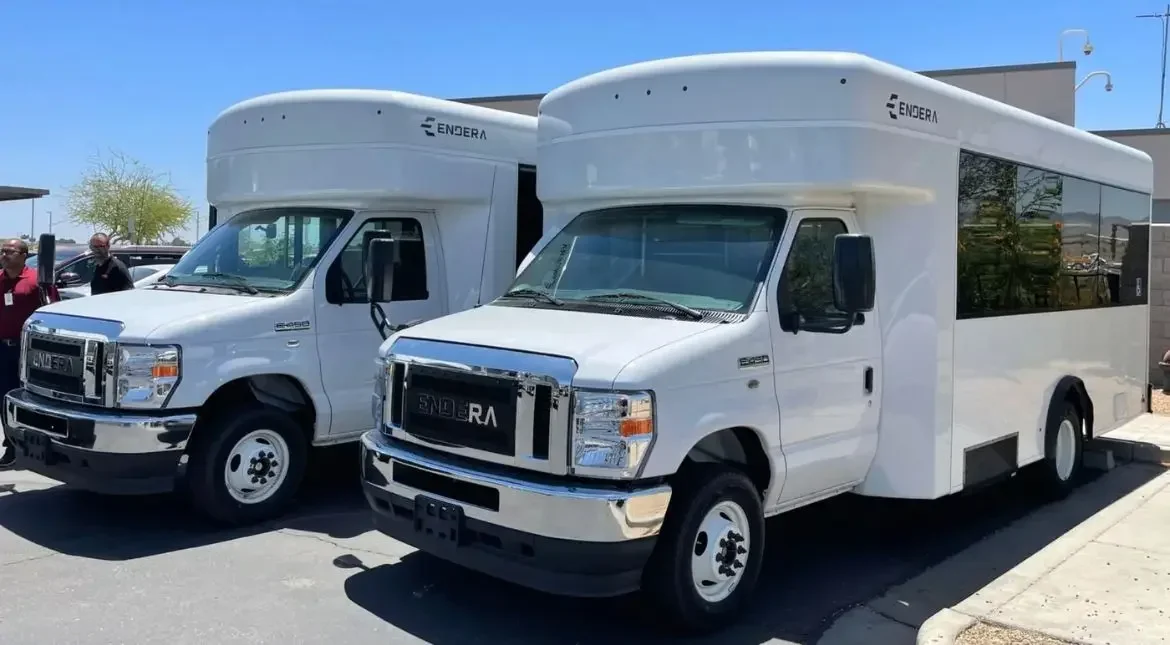
Campus Transportation Has Become a Sustainability Commitment, Not Just a Logistics Function
Why Universities Are Accelerating Fleet Electrification
University transportation departments are under increasing pressure — from institutional climate commitments, student expectations, and state emissions targets — to transition campus fleets away from diesel. Columbia University's shift to electric shuttles reduced campus shuttle greenhouse gas emissions by over 70 percent. The University of Maryland is deploying 27 battery-electric buses through a $40 million FTA grant.
A Sector-Wide Shift
UConn introduced its first zero-emission buses in 2025 after nearly a century of fossil-fuel operations. These aren't isolated experiments — they reflect a sector-wide shift in how universities think about campus mobility and what they owe their communities in terms of air quality and emissions accountability.
Scope 1 Emissions and Why Campus Buses Are in the Frame
Campus shuttle fleets typically contribute to a university's Scope 1 emissions — direct emissions from sources the institution owns or controls. As universities set net-zero targets with defined timelines, transportation departments are being asked to show measurable progress in fleet decarbonization. A shuttle fleet running diesel is a visible, quantifiable emissions source that sustainability offices can point to — and replacing it is one of the more straightforward ways to move the number.
Where Endera Fits
Endera builds the B-Series commercial shuttle line with electric and alternative fuel powertrain options suited to campus loop and commuter route profiles. Every B-Series model comes available with Endera Dispatch and Endera Go — the fleet management and passenger-facing platform that gives university transportation departments real-time fleet visibility and students the live ETAs they expect.
Planning a campus fleet transition or adding to an existing program? Endera's team can help you think through configurations, charging infrastructure, and applicable grant funding for your institution.
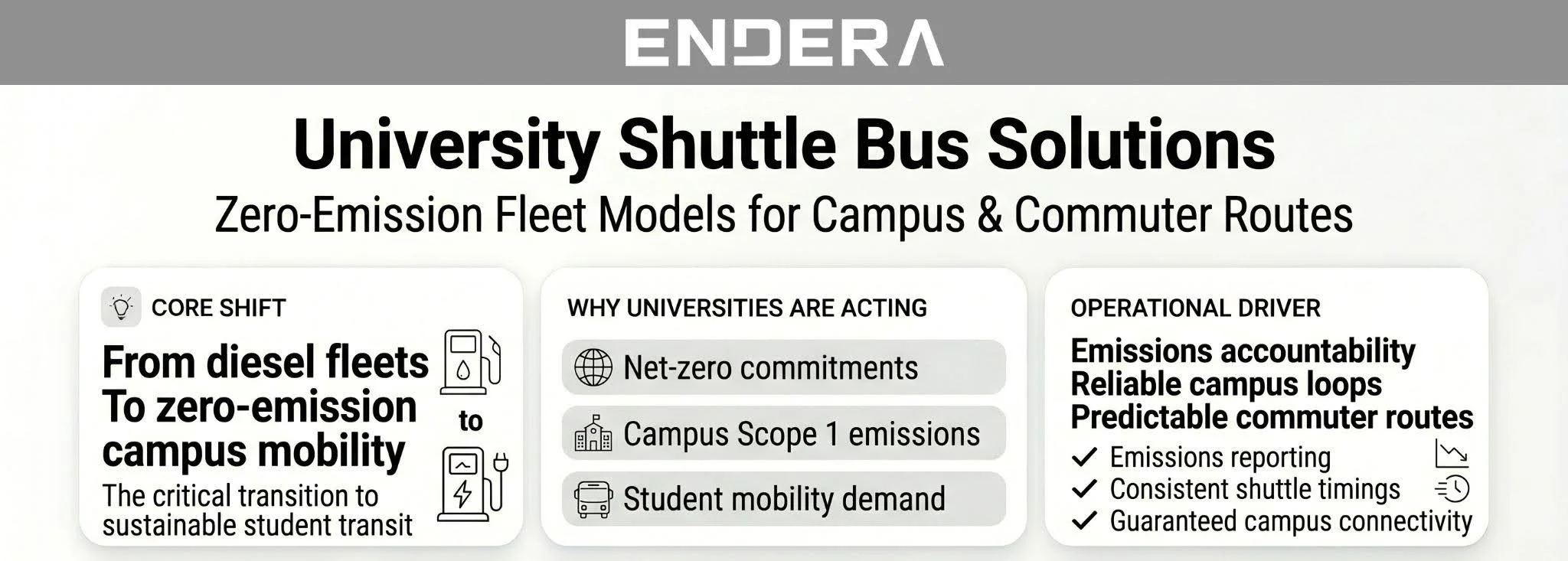
Campus Transit Is a Micro-Transit Grid Problem, Not a Vehicle Problem
Why Fleet Replacement Is the Wrong Frame
Most discussions of university shuttle electrification treat the problem as a straightforward replacement exercise: retire diesel buses, purchase electric ones, and align with institutional emissions targets. This framing misses the underlying reality — campus transportation systems behave less like fleet operations and more like closed-loop micro-transit grids with highly deterministic demand patterns.
Three Distinct Network Behaviors
Campus loop routes function as high-frequency circulators — effectively a municipal microtransit network compressed into a single geography. Commuter shuttles behave more like peak-synchronized feeder services into a central hub, with sharp demand spikes tied to class start and end times. Inter-campus and medical system routes resemble distributed logistics networks where reliability and timing between nodes matter more than route distance.
Why System Design Variables Determine EV Feasibility
Electric vehicle feasibility on a campus is not primarily a function of vehicle type, but of system design variables: network topology, depot dwell time, and synchronization with academic "bell waves" that structure demand across the day. U.S. DOE Vehicle Technologies Office research highlights that electrification outcomes depend heavily on duty-cycle alignment and operational modeling rather than vehicle substitution alone.
What the Research Confirms
The FTA's research and innovation work emphasizes system-level planning and infrastructure coordination as prerequisites for successful zero-emission transit deployment. NREL transportation analysis further reinforces that route structure and charging behavior are primary determinants of feasibility — not simply fleet composition. Universities, in effect, operate as small cities with highly predictable mobility rhythms, making them uniquely suited for network-optimized electrification strategies rather than simple fleet replacement programs.
The Endera B-Series for University Campus Operations
B4: The Standard for Campus Loop and Commuter Routes
The B4 at 24 feet covers the broadest range of university use cases — campus loops, commuter runs, transit connections, and event transport. It is available in both ICE and electric powertrains. In most states, the B4 can be operated without a CDL depending on configuration — a staffing flexibility advantage for transportation departments covering routes across variable operating windows.
Altoona Validation
The electric B4 earned a score of 90.1 on the Altoona Bus Testing Program, the highest in its class — a third-party durability certification that matters when university procurement offices are justifying a multi-unit fleet commitment to institutional leadership.
B5: High-Frequency Routes and Larger Campus Programs
The B5 at 25 feet handles higher passenger loads for larger campus programs running frequent routes during peak class and shift windows. It is available in both ICE and electric variants. Six B5 models operate at the Illumina corporate campus, demonstrating the vehicle's ability to handle high-frequency, high-visibility routes over extended daily operating windows — a profile directly comparable to a university campus loop.
ADA Configuration for Campus Accessibility
Both the B4 and B5 are configurable with ADA-compliant lifts and wheelchair securement systems. For university transportation departments operating under 49 CFR Part 37 and institutional accessibility commitments, having accessible configurations built into the floor plan at the production stage — not added through aftermarket modification — is a meaningful compliance and durability advantage.
Charging Infrastructure for University Fleet Operations
Depot Charging as the Operational Foundation
University shuttle fleets that return to a central garage overnight are well-positioned for depot charging — the most controllable and cost-effective model for electric campus buses. Vehicles arrive on predictable schedules, charging can be coordinated centrally, and sessions can be scheduled during off-peak utility rate windows to manage energy costs.
The Cost of Unmanaged Charging
Unmanaged depot charging — all vehicles drawing full load simultaneously — creates demand charge spikes that inflate electricity costs and stress campus electrical infrastructure. Smart charging, managed through Endera Dispatch, schedules sessions to distribute load across the available overnight window rather than stacking demand at plug-in time.
Turnkey Infrastructure Through Endera
Endera provides turnkey charging infrastructure alongside its electric vehicles — site assessment, charger procurement, and installation. For university facilities teams managing complex campus electrical systems alongside dozens of other capital projects, handling vehicle procurement and charging infrastructure through one vendor simplifies coordination significantly. DC fast charging is standard across Endera's electric lineup.
Mixed-Fleet Operations During the Transition Period
Most university fleet transitions happen over multiple procurement cycles rather than all at once. Endera's dual-track model — building ICE, propane, CNG, and electric variants on the same platform — lets university transportation departments configure each vehicle to its actual operating environment. Endera Dispatch manages all powertrain types within a single fleet view, eliminating separate management systems for different vehicle types.
Software for University Transportation Departments
Endera Dispatch for Transportation Managers
Endera Dispatch provides real-time GPS tracking, geofence alerts, route performance data, and state-of-charge visibility for electric vehicles from a single dashboard. For university transportation managers overseeing multiple routes and vehicle types simultaneously, centralized fleet visibility reduces coordination overhead across a system that students, faculty, and staff depend on daily.
Reporting for Sustainability and Institutional Review
Custom reporting tools available at no additional cost support the ridership documentation, emissions reporting, and service performance data that university sustainability offices and transportation directors regularly produce. For institutions with Scope 1 reduction targets, having that data accessible directly from the fleet management platform removes a significant administrative burden from the reporting cycle.
Endera Go for Students and Campus Users
Endera Go provides students, faculty, and staff with real-time shuttle location and precise ETAs through a mobile app powered by onboard vehicle technology and Google API. For a student deciding between walking to class and waiting for the next loop bus, a live ETA is the difference between a useful tool and an unreliable guess. Rider feedback collected through Go feeds into the Dispatch dashboard.
University Fleet Electrification Is a Procurement Decision With a Long Tail
The buses a university transportation department orders today will be on campus for 10 to 15 years. The charging infrastructure installed alongside them will shape electrical capacity planning for longer than that. Getting the vehicle specification, powertrain choice, and infrastructure design right at the procurement stage — rather than correcting it mid-cycle — is the real value of working with a manufacturer that builds across powertrain types and supports the fleet through its full service life.
Endera builds the B-Series as a complete system — vehicle, software, and charging infrastructure — for university transportation programs at every stage of the electrification transition. Reach out to Endera's sales team to discuss which configuration fits your campus routes, fleet size, and procurement timeline.
FAQs
Which Endera B-Series model is best for a university campus shuttle?
The B4 at 24 feet covers the broadest range of university use cases — campus loops, commuter routes, transit connections, and event transport. It is available in ICE and electric powertrains and is configurable with ADA lift and securement systems. Larger programs with high-frequency peak demand may prefer the B5. Configuration details should be discussed with the Endera sales team based on the specific route profile and daily ridership of the program.
Can universities access FTA Low-No program funding for Endera vehicles?
Public transit agencies operated by or for public universities are eligible applicants under the FTA Low or No Emission Grant Program. The program funds the purchase of zero-emission and low-emission transit buses and associated infrastructure. Endera's grant navigation support can help university transportation departments identify applicable programs and assist with application documentation. State-level incentives and utility make-ready programs may also apply depending on the institution's location.
How does depot charging work for a university electric shuttle fleet?
University shuttle fleets that return to a central garage overnight are well-positioned for managed depot charging. Endera provides turnkey charging infrastructure — site assessment, charger procurement, and installation — alongside its electric vehicles. Smart charging schedules sessions during off-peak utility rate windows and manages demand to avoid peak charge spikes. DC fast charging is standard across Endera's electric lineup for routes requiring mid-day turnaround capability.
Does Endera Dispatch support mixed ICE and electric university fleets?
Yes. Endera Dispatch manages all powertrain types within a single fleet view. Universities transitioning incrementally — with electric vehicles on some routes and ICE or CNG on others — don't need separate management systems for different vehicle types. Real-time GPS, route performance data, and state-of-charge visibility for EVs are all accessible from the same dashboard.
What does Endera Go provide for university students and staff?
Endera Go is the passenger-facing app in Endera's software platform. It provides real-time shuttle location, precise ETAs based on live traffic conditions, and occupancy data — accessible through a mobile app powered by onboard vehicle technology and Google API. Rider feedback collected through Go feeds into the Dispatch dashboard, giving transportation departments a continuous signal on service quality from the student perspective.
Are Endera campus shuttles ADA accessible?
Yes. The B4 and B5 are both configurable with ADA-compliant lifts and wheelchair securement systems built into the floor plan at the production stage. Universities operating under 49 CFR Part 37 accessibility requirements should confirm lift weight ratings, securement area dimensions, and interior circulation specifications with the Endera sales team during the configuration process.
What is the service lifecycle of an Endera B-Series shuttle for university fleet planning?
The B-Series is built for a 10-to-12-year service lifecycle in high-frequency commercial shuttle operations. The vehicles ordered today will shape route capability, charging infrastructure requirements, and emissions reporting through the early 2030s. Endera supports the vehicle through its full service lifecycle, not just at the point of delivery.