
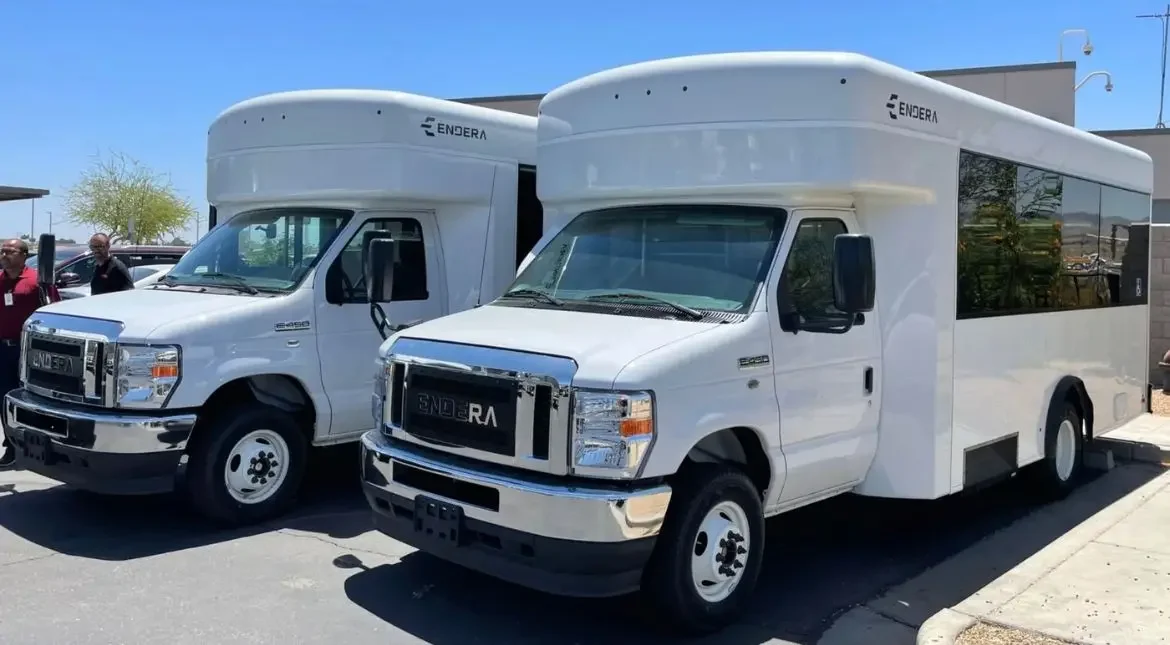
Oklahoma fleet operators shopping for a commercial shuttle face a set of conditions that aren't always reflected in national product marketing. Routes here tend to cover more ground, extreme heat in the summer months places real demands on vehicles and passengers alike, and the infrastructure picture — particularly for EV charging — varies considerably between urban centers like Oklahoma City and Tulsa and the more rural stretches in between. Finding a shuttle that actually fits those operating conditions takes more than reading a spec sheet.
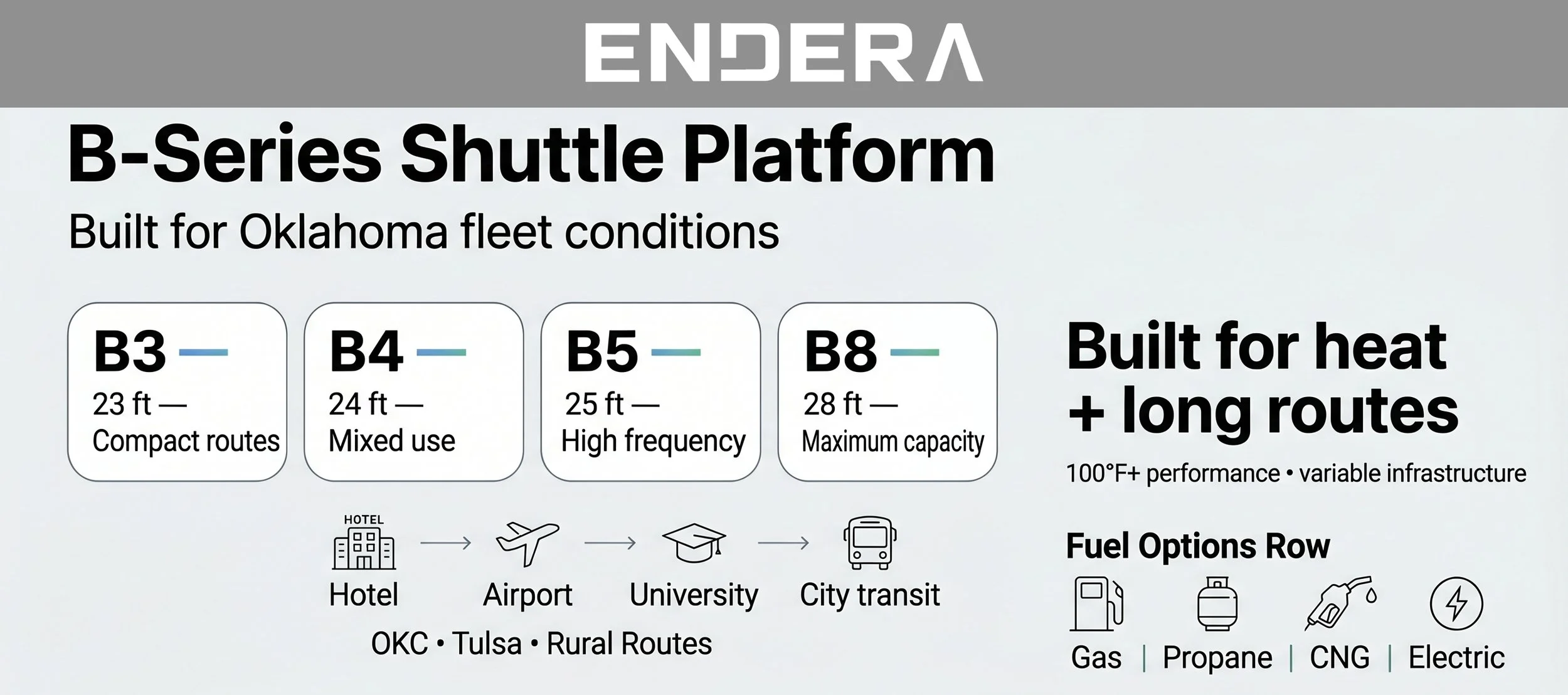
Endera's B-Series — the B3, B4, B5, and B8, ranging from 23 to 28 feet — is available in ICE, propane, CNG, and full electric configurations, built to serve the full range of Oklahoma fleet environments. Whether you're running a hotel loop in downtown OKC, a university shuttle at OU or OSU, or a corporate operation in Tulsa, there's a B-Series model and fuel configuration that fits the route.
Stop guessing which spec holds up in Oklahoma conditions — connect with an Endera fleet specialist today to match the right model to your operation.
Oklahoma Fleet Conditions: What Actually Shapes the Decision
Heat, Distance, and Infrastructure Variability
Oklahoma's climate and geography create specific operating demands. Summer temperatures regularly exceed 100°F, which affects both vehicle cooling systems and passenger comfort — a shuttle that runs hot in those conditions isn't just uncomfortable, it's a maintenance liability. Route distances also tend to be longer than in dense urban markets, which matters for fuel efficiency calculations and, for EV operators, range planning. These aren't reasons to avoid electrification — they're factors to build into the vehicle and configuration selection from the start.
Urban vs. Rural Operating Profiles
Oklahoma City and Tulsa support reasonably developed commercial infrastructure, including growing EV charging networks and established fleet service centers. Outside those metros, the picture changes. Operators in smaller markets need to think carefully about parts availability, service access, and charging infrastructure before committing to an EV-first strategy. Endera's multi-fuel lineup exists precisely for this reason — operators can choose propane or CNG as a cleaner alternative to gasoline while EV infrastructure matures in their area, and transition to electric when the conditions support it.
The B-Series Lineup for Oklahoma Operations
Four Models Covering the Full Range of Oklahoma Routes
The B3 (23 ft) is the most compact model — ICE-only, built for hotel loops, small campus circulators, and tight urban pickup operations where maneuverability matters more than capacity. The B4 (24 ft) and B5 (25 ft) step up in capacity and unlock both ICE and full electric configurations, making them the right fit for airport operations, university transit, and higher-frequency corporate shuttles. At the top of the range, the B8 (28 ft) is an ICE model built for high-volume routes where passenger capacity is the priority.
Built on Ford and Chevrolet Chassis
All B-Series models are built on Ford E450 or Chevrolet Express cutaway chassis — two of the most widely serviced commercial platforms in the country, with dealer networks that extend well into Oklahoma's smaller markets. For operators outside OKC and Tulsa, that matters practically: you're not dependent on a specialized bus service network that may not exist in your area. Any Ford or GM commercial dealer can support the underlying platform, which reduces service downtime risk considerably.
Fleet Decision Framework: Matching the Shuttle to the Oklahoma Mission
Route Type Determines the Right Model and Fuel
The right B-Series configuration for an Oklahoma operator depends on what the route actually demands — not on which model looks best in a brochure. Research on demand-responsive transit systems consistently shows that vehicle capacity and fuel type should be matched to ridership volume, route length, and utilization patterns to minimize total system cost. An oversized shuttle running at half capacity on a short hotel loop wastes fuel and budget every day it operates.
| Use Case | Recommended Model | Fuel Type | Why |
|---|---|---|---|
| Hotel / casino loop (OKC, Tulsa) |
B3 | ICE / Propane | Low volume, tight routes, cost-efficient |
| Airport shuttle (TUL, OKC) |
B4 / B5 | EV or ICE | High utilization, defined route cycles |
| University transit (OU, OSU) |
B4 / B5 | EV or CNG | Predictable schedules, campus infrastructure |
| Corporate / industrial campus | B5 | EV or ICE | Higher capacity, employee volume |
| High-volume municipal transit | B8 | ICE / CNG | Maximum capacity, longer routes |
For Oklahoma operators in markets where EV charging infrastructure is already established — particularly on university campuses and at major airports — the electric B4 and B5 offer the strongest long-term operating economics. For operators in smaller markets or running longer routes, CNG and propane configurations provide a meaningful step toward lower emissions without requiring charging infrastructure that may not yet exist locally.
Heat + Range Reality: What Oklahoma Summer Actually Does to EV Performance
The Numbers Most Manufacturers Don't Publish
Oklahoma's summer heat doesn't just affect passenger comfort — it directly changes how electric shuttles perform. Research published in Applied Energy shows that as temperatures rise into extreme ranges (115–122°F), EV energy consumption increases by roughly 25–28%, driven largely by cooling demands and thermal management systems. That increase doesn't appear on a spec sheet, but it shows up immediately in operations: reduced effective range, more frequent charging needs, and tighter route margins on days when temperatures peak.
HVAC Load Is the Hidden Variable
The primary driver is HVAC demand. Studies on EV thermal systems confirm that heating and cooling are among the largest contributors to energy use outside propulsion — often the single biggest impact on range under extreme conditions. In a 100°F+ Oklahoma summer, keeping passengers comfortable can draw as much energy as moving the vehicle itself over shorter distances.
Operationally, this shifts how fleets should think about EV deployment: short, predictable routes like airport parking loops and university circulators remain well suited for EVs even in high heat, because charging cycles can be tightly controlled. Longer rural routes require buffer planning to account for heat-driven range loss — or may be better served by CNG or propane configurations until range management tools and infrastructure are in place. For Oklahoma operators, factoring HVAC load into route planning isn't optional — it's essential to keeping vehicles on schedule and avoiding mid-day charging disruptions.
ICE, Propane, CNG, or Electric — Oklahoma's Fuel Options
No Single Path Fits Every Oklahoma Fleet
Oklahoma's energy landscape is worth acknowledging directly. The state has historically been a major natural gas producer, which means CNG infrastructure is more developed here than in many other markets — a practical advantage for fleets considering CNG as a bridge fuel. Propane is similarly accessible across the state. For operators not yet ready to commit to electrification, both CNG and propane offer lower emissions than straight gasoline, reduced fuel costs, and a cleaner operational profile without requiring charging infrastructure.
The Electric Case for Oklahoma Operators
For Oklahoma operators on defined short-to-medium routes with access to depot charging, the economics of electric are compelling. Fuel costs are lower and more stable than gasoline or diesel, maintenance costs drop with fewer moving parts and no oil or exhaust system, and federal incentive programs are available to offset the higher upfront cost. The EPA's Diesel Emissions Reduction Act (DERA) and Inflation Reduction Act commercial vehicle credits both apply to eligible Oklahoma fleet operators, and Endera's financing and grant advisory team can identify which programs apply to your specific operation.
Manufactured in Ohio, Delivered to Oklahoma
A Domestic Supply Chain That Holds Up
Every B-Series shuttle is built at Endera's 250,000-square-foot Ottawa, Ohio facility, with approximately 65% of components sourced from within Ohio. That domestic manufacturing base translates into more predictable lead times than vehicles assembled from international supply chains — a practical advantage for Oklahoma operators working within budget cycles or replacing vehicles on a defined timeline. It also supports compliance with Buy America standards for operators accessing federal transit funding.
Software and Support That Travel With the Vehicle
Every Endera commercial shuttle comes available with access to Endera Dispatch — real-time vehicle tracking, route performance data, and state-of-charge monitoring for EV fleets — and Endera Go, the passenger-facing app that provides live shuttle location and ETA updates. For Oklahoma operators managing vehicles across multiple sites or routes, that fleet visibility reduces operational guesswork and supports more responsive service management without adding administrative overhead.
The Right Shuttle for Oklahoma, Built to Last
Oklahoma fleet operators need vehicles that handle heat, cover ground reliably, and are supported by a manufacturer that doesn't disappear after the sale. The B-Series delivers that across four models, four fuel types, and two chassis options — with the fleet software, financing support, and grant advisory capacity to back it up.
Ready to start your next procurement cycle? Contact Endera's Sales Team to lock in your Type A configuration, review Alabama specification compliance documentation, and secure your build timeline.
FAQs
Which B-Series models are available for Oklahoma fleet operators?
All four B-Series models — the B3 (23 ft), B4 (24 ft), B5 (25 ft), and B8 (28 ft) — are available for Oklahoma operators. Configuration options, fuel types, and chassis preferences can be discussed directly with Endera's sales team.
Are electric shuttles practical for Oklahoma routes?
For operators running defined short-to-medium routes with access to depot charging — including university campuses, airport parking operations, and corporate facilities in OKC and Tulsa — electric configurations are fully viable. For longer or more variable routes in smaller markets, CNG and propane offer a practical alternative while EV infrastructure continues to develop statewide.
What chassis options are available in Oklahoma?
All B-Series models are available on Ford E450 and Chevrolet Express cutaway chassis — both widely serviced through dealer networks across Oklahoma, including in markets outside the major metro areas.
Does Endera help Oklahoma operators access EV incentives?
Yes. Endera's financing and grant advisory team assists operators in identifying and applying for federal programs including the EPA DERA program, IRS commercial clean vehicle credits, and other available incentives relevant to Oklahoma fleet operators.
How long does it take to receive a B-Series shuttle after ordering?
Lead times vary by configuration and time of year. Operators with urgent needs can explore Endera's in-stock vehicles for faster deployment. Contact Endera's team for current availability and production timelines.
Is CNG a good option for Oklahoma shuttle operators?
CNG is a practical choice for Oklahoma operators given the state's well-developed natural gas infrastructure. It offers lower emissions than gasoline, stable fuel costs, and doesn't require the electrical infrastructure investment that EV charging demands — making it a strong bridge fuel for fleets not yet ready to fully electrify.
How do I get pricing or a spec sheet for Oklahoma fleet purchases?
Spec sheets and floor plans are available on Endera's shuttle bus page. For pricing and configuration discussions specific to your Oklahoma operation, contact Endera at hello@enderacorp.com or call +1 (419) 523-3593.