
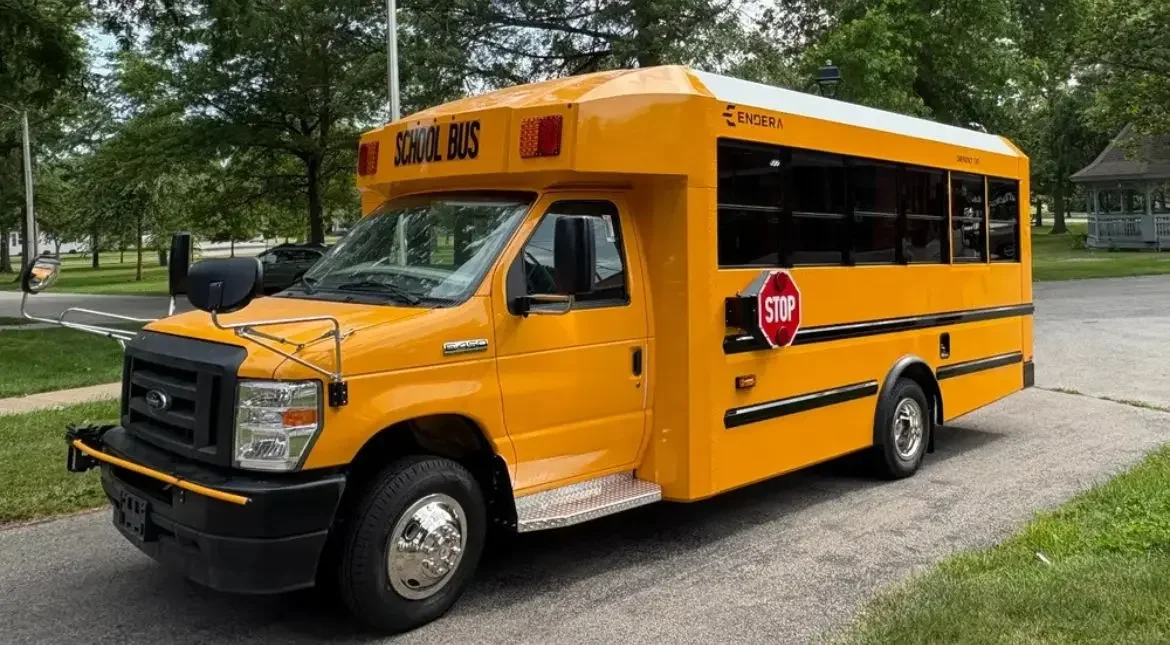
Alabama school districts aren't facing a regulatory mandate to electrify their fleets — but they are leaving significant federal money on the table if they're not evaluating electric options. Seven Alabama school systems already secured $7.865 million in EPA Clean School Bus awards for 24 electric buses through the 2023 funding round alone, and more federal funding remains available for districts that haven't yet applied. For procurement teams weighing ICE versus electric, the cost equation looks different once grant eligibility is factored in.
Endera manufactures Type A school buses in gasoline, propane, CNG, and electric configurations from its Buy America compliant facility in Ottawa, Ohio. All models are engineered to meet both federal FMVSS standards and Alabama's state minimum specifications, with ADA-compliant lift options and 4–6 section configurations available across all powertrain types.
Don't let the next funding round close without your district in it — talk to an Endera specialist today to review grant eligibility alongside your configuration options.
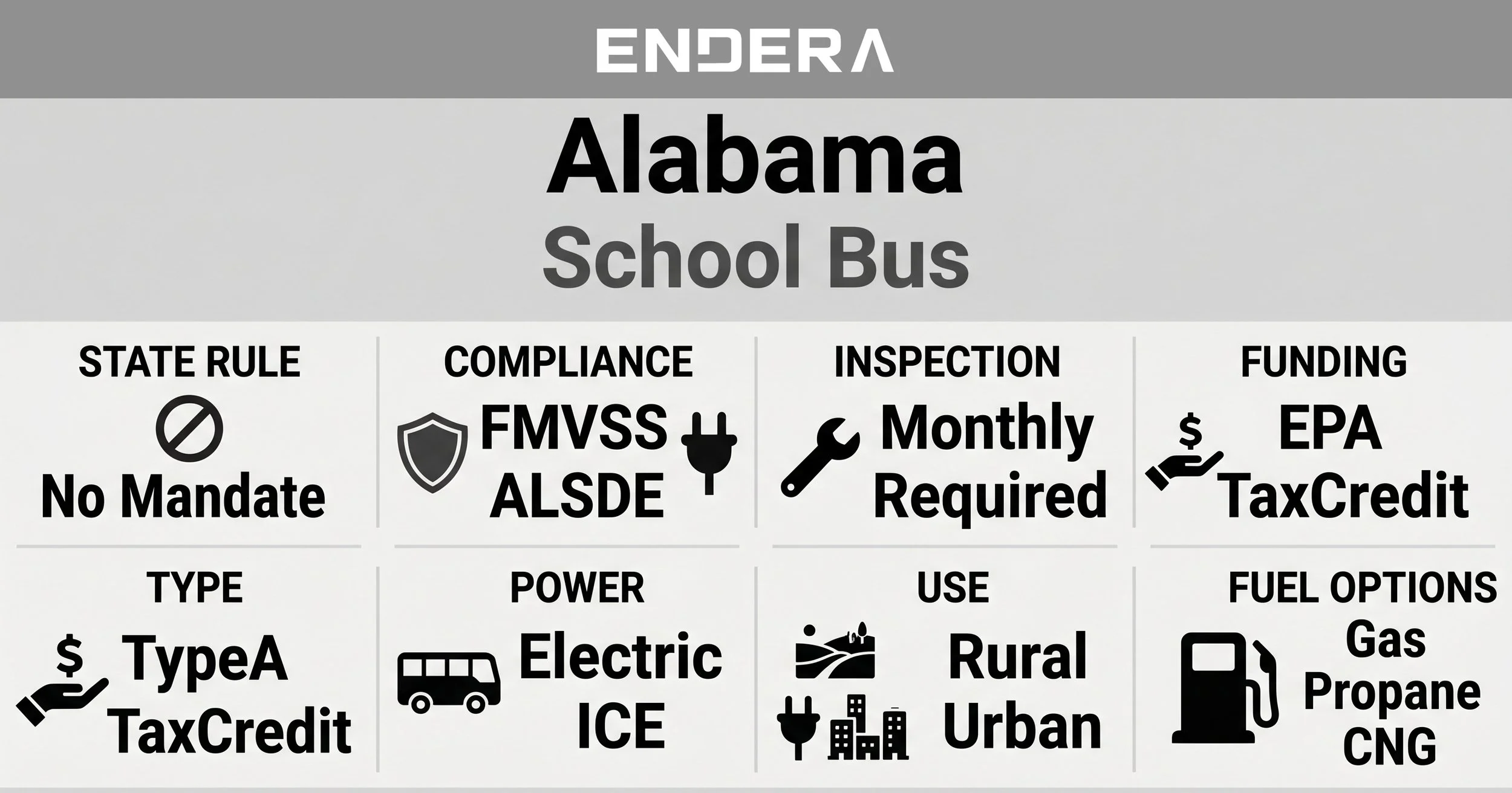
Alabama's School Bus Specifications: What Every Bus Must Meet
The Alabama State Department of Education (ALSDE) publishes annual minimum specifications that govern every school bus purchased by a county or city board of education. The 2026 Alabama Minimum Specifications are the current governing document, covering chassis and body construction standards, safety equipment requirements, lighting systems, emergency exits, and mechanical specifications.
A key rule embedded in the Alabama specs: in any conflict between the Alabama minimum specifications and applicable federal FMVSS requirements, the federal standard controls. This means buses must meet both simultaneously — Alabama's minimums serve as a floor, not a ceiling, and manufacturers must certify compliance before any sale to a public school system in the state. Buses not meeting Alabama's specifications will not be certified by the ALSDE and cannot be used to transport students.
Inspections and Compliance: What Alabama Requires After Purchase
Alabama law requires monthly safety inspections for all school buses operating in the state, conducted according to ALSDE inspection standards. The inspection manual published by the Pupil Transportation Section covers brakes, tires, lighting, structural integrity, and emergency equipment — and identifies which deficiencies remove a bus from service immediately versus which allow continued operation pending repair.
The monthly inspection requirement has a direct implication for procurement decisions. A new bus built to current specifications starts its service life compliant; a used bus may carry deferred maintenance, out-of-spec equipment, or components that predate current Alabama standards — creating inspection liability from day one. For districts managing tight operational schedules where an out-of-service bus disrupts routes, the compliance certainty of a new purchase reduces that operational risk.
Federal Funding Available to Alabama Districts
The EPA's Clean School Bus Program has funded electric and clean bus replacements for districts across nearly all 50 states, including Alabama. In the 2023 program round, seven Alabama school systems — including Clay County, Fort Payne City, Gulf Shores City, Lanett City, and Jasper City — received a combined $7.865 million for 24 electric buses. The federal program covered the complete cost of those buses.
Beyond the EPA program, the 45W Qualified Commercial Clean Vehicle tax credit applies to electric school buses and can save districts up to $40,000 per vehicle. The 30C tax credit for alternative fuel refueling property covers up to $100,000 in charging infrastructure costs in low-income and non-urban areas. Endera's grant navigation services identify which programs apply to a specific district's classification, location, and fleet profile — and assist with application preparation.
Electric vs. ICE for Alabama Districts: A Practical Assessment
Alabama's mix of rural counties and suburban corridors creates different use-case profiles that favor different powertrain choices. The table below maps the key decision factors:
| Powertrain | Best Fit for Alabama | Key Consideration |
|---|---|---|
| Gasoline | Rural districts, variable routes, limited capital budgets | Lowest upfront cost, universal service access |
| Propane | Consistent daily routes; suburban districts | 30–40% lower fuel cost vs. gasoline; mature AL fueling network |
| CNG | High-mileage urban fleets with depot fueling | Lowest per-mile ICE fuel cost; infrastructure investment required |
| Electric | Districts with EPA funding eligibility; urban/suburban routes | Highest long-term savings; federal funding can cover full acquisition cost |
Alabama has no state mandate requiring zero-emission bus purchases, which means districts have genuine flexibility. The practical argument for evaluating electric isn't regulatory — it's financial. When EPA grant funding covers the full purchase price, as it did for the seven Alabama districts in 2023, the total cost of ownership comparison shifts decisively in electric's favor.
Alabama Driver Certification Requirements
Alabama school bus drivers must hold a valid Commercial Driver's License with Passenger (P) and School Bus (S) endorsements. The ALSDE requires prospective drivers to pass four written CDL tests — General Knowledge, Air Brakes, Transporting Passengers, and School Buses — before attending the 12-hour ALSDE New School Bus Driver Certification Class over three days.
These certification requirements apply regardless of vehicle size or powertrain type. Transitioning to electric buses does not change driver qualification standards — an ALSDE-certified driver qualified to operate a gasoline Type A is qualified to operate an electric Type A on the same routes.
Type A Buses in Alabama's District Fleet Structure
Type A buses serve the portions of Alabama's district transportation network where full-size buses are operationally inefficient. Special education routes, small-enrollment school placements, rural runs with low daily ridership, and program-specific transport needs all align with the Type A's capacity range and per-mile operating cost.
Alabama's geographic spread — from the densely routed suburban districts around Birmingham and Huntsville to the low-density rural counties in the Black Belt region — creates consistent demand for the flexibility that Type A buses provide. A district that runs full-size buses on low-ridership routes is paying for capacity it doesn't use; a Type A right-sized to the route reduces that inefficiency without sacrificing the safety engineering of a federally certified school bus.
Starting Your Procurement
Alabama districts purchasing new buses for the upcoming school year or a fleet replacement cycle benefit from starting the procurement process early — both to meet ALSDE bid and certification timelines and to position for any federal funding rounds that open during the procurement window.
Don't let procurement timelines catch your district unprepared. Contact Endera's sales team today to discuss Type A configurations, review Alabama specification compliance documentation, assess EPA and tax credit eligibility for electric models, and confirm current build timelines for both in-stock and custom-built units.
Frequently Asked Questions
Does Alabama require school buses to meet both state and federal standards?
Yes. Alabama's Minimum Specifications require all school buses purchased by county or city boards of education to meet the state's construction and safety standards. In any conflict between Alabama specifications and federal FMVSS requirements, the federal standard controls. Buses not certified by the ALSDE as meeting these standards cannot be used to transport students in Alabama public school systems.
How often are school buses inspected in Alabama?
Alabama law requires monthly safety inspections for all school buses in service. Inspections are conducted according to ALSDE standards and cover brakes, tires, lighting, emergency equipment, and structural integrity. Deficiencies that meet the ALSDE's "out of service" threshold require the bus to be removed from routes immediately until repaired — making upfront compliance a direct operational priority for fleet managers.
Which Alabama school districts have already received EPA electric bus funding?
In the 2023 EPA Clean School Bus Program round, seven Alabama school systems received a combined $7.865 million: Clay County, Fort Payne City, Gulf Shores City, Lanett City, Jasper City, and two others. Each award covered the complete purchase cost of the buses. Additional federal funding rounds have since been opened, and Alabama districts that haven't yet applied remain eligible for future program cycles.
Does Alabama have a state mandate to purchase electric school buses?
No. Unlike Maryland, which requires zero-emission bus purchases beginning in FY2025, Alabama has not enacted a state-level electric school bus mandate. Districts have full flexibility to purchase ICE or electric models based on operational fit and budget. Federal funding availability — not regulatory pressure — is the primary driver for Alabama districts evaluating electric.
Can Endera's Type A school buses meet Alabama's 2026 minimum specifications?
Endera engineers its Type A school buses to meet or exceed applicable FMVSS requirements and builds to state procurement specification standards. Buyers should request Alabama specification compliance documentation from Endera's sales team as part of the RFP or bid process. The ALSDE requires manufacturer certification of compliance before any bus can be used to transport students in Alabama.
What is the 45W tax credit and how does it apply to Alabama school bus purchases?
The 45W Qualified Commercial Clean Vehicle tax credit applies to electric school buses purchased by eligible entities and can reduce acquisition cost by up to $40,000 per vehicle. Note that this credit was set to be eliminated for vehicles acquired after September 30, 2025 under legislation passed in 2025 — districts evaluating electric purchases should confirm current credit availability with their tax advisor or Endera's grant navigation team before building it into procurement projections.
How does propane compare to gasoline for Alabama's rural district routes?
Propane delivers roughly 30–40% lower per-mile fuel cost than gasoline and has a mature fueling infrastructure in rural Alabama markets. For districts running consistent daily routes — even in lower-density areas — propane provides meaningful operating cost savings without requiring new fueling infrastructure from scratch. It's the most practical ICE alternative for rural districts that aren't yet positioned for electric but want to reduce ongoing fuel spend.