
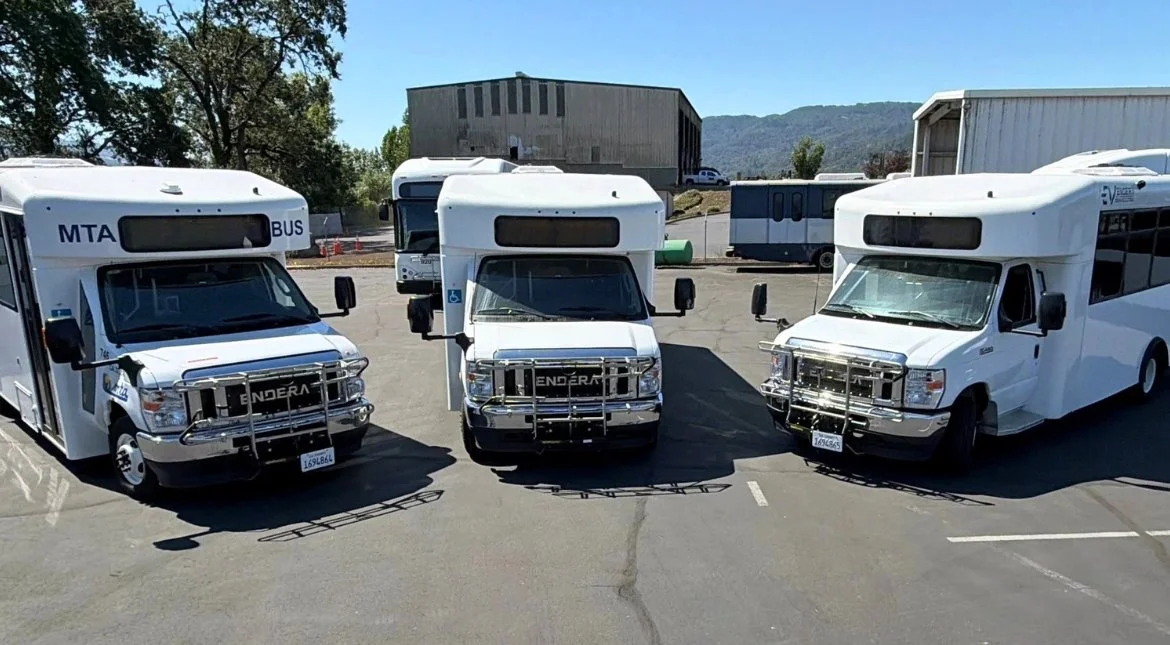
Mississippi’s shuttle market is shaped by several regional hubs rather than a single metro, including Gulf Coast casino and resort demand from Biloxi to Gulfport, the Tunica gaming corridor, Jackson’s airport and healthcare network, and university transit across schools like Ole Miss, Mississippi State, Southern Miss, and Jackson State. Endera builds the B-Series commercial shuttle as a complete system — vehicle, powertrain, software, and charging infrastructure — offering both ICE and electric variants so operators can match fuel type to route and depot conditions.
Mississippi's warm year-round climate removes the cold-weather range concern that complicates EV deployment in northern markets. For Gulf Coast resort loops, casino hotel circuits, university campus routes, and airport parking shuttles with predictable duty cycles and overnight depot access, the electric B4 and B5 are operationally viable. For longer inter-city routes between Mississippi's spread-out markets, the ICE variants provide the range reliability the state's geography demands. Endera builds both on the same platform.
Ready to spec your fleet? Contact Endera's fleet specialists today to design a custom configuration blueprint for your operation.
The B-Series Lineup and What Each Model Is Built For
From 23 to 28 Feet, on Proven Platforms
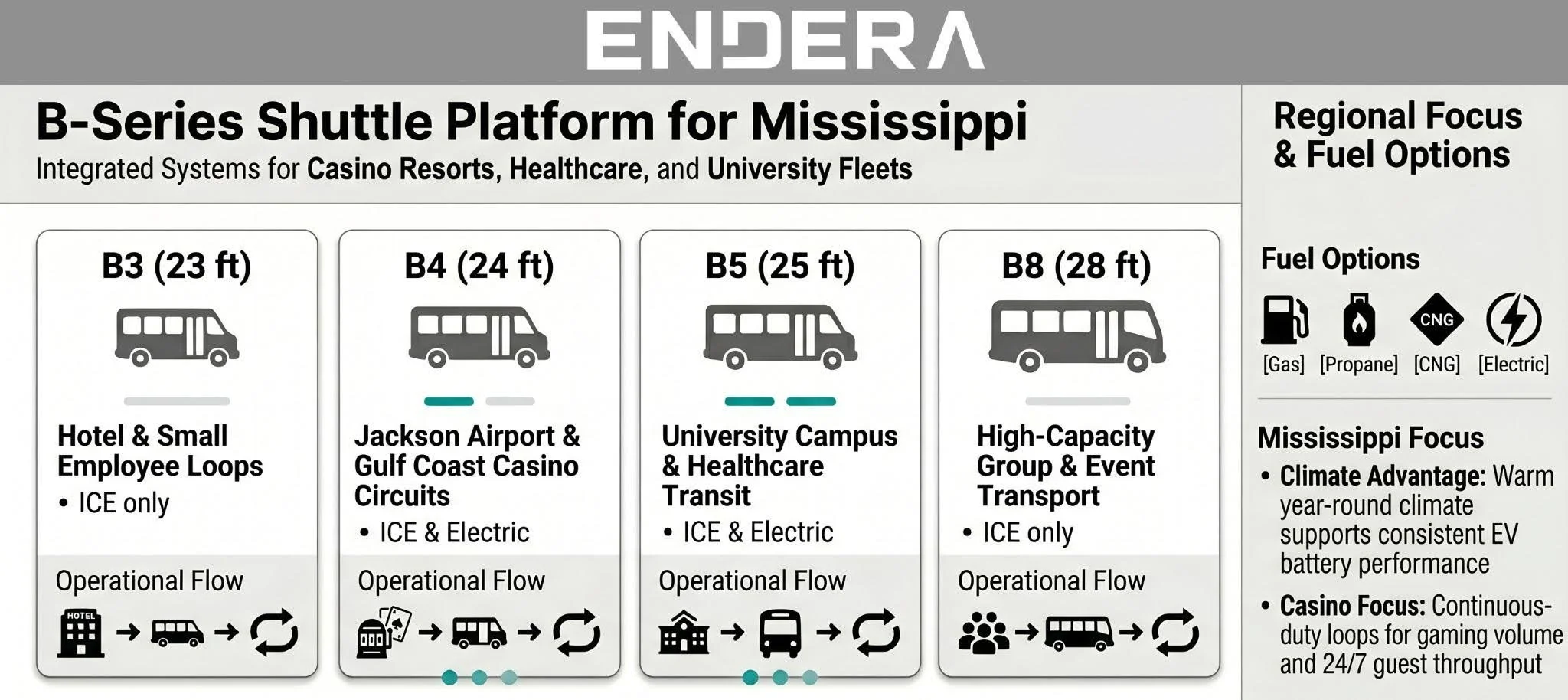
Endera's B-Series runs from 23 to 28 feet, built on the Ford E450 and Chevrolet Express cutaway chassis — platforms with dealer and service coverage across Mississippi's major markets. The B3 at 23 feet handles smaller hotel loops and employee shuttles. The B4 and B5 — available in both ICE and electric — cover the mid-size range most used by resort properties, casinos, universities, and healthcare systems. The B8 at 28 feet handles higher-volume group and event transport where capacity is the constraint.
ICE or Electric: Mississippi's Honest Assessment
For resort hotel loops in Biloxi, casino shuttle circuits in Tunica, and campus routes with overnight depot access, the electric B4 and B5 deliver reliable service year-round in Mississippi's climate. For operators running longer routes between Jackson and the Gulf Coast, between Tunica and Memphis, or across rural corridors between the state's university towns, the ICE variants provide the range and operational simplicity those routes require. Endera's sales team works through route and depot conditions with operators before recommending a configuration.
What Makes Casino Shuttle Fleets Different From Standard Hotel Shuttles
A Demand Pattern Driven by Gaming Volume, Not Check-In Windows
Casino shuttle operations in Mississippi operate under a fundamentally different demand pattern than typical hotel or airport transport. Properties along the Gulf Coast in Biloxi and Gulfport, as well as the Tunica gaming corridor, function as near-continuous mobility environments where passenger flow is driven by gaming volume, entertainment events, and 24/7 facility operations. Unlike hotel shuttles that peak around morning and evening check-in windows, casino fleets experience sustained demand spikes tied to concerts, tournaments, and holiday weekends — creating irregular but intense passenger surges that require rapid boarding, frequent dispatch cycles, and minimal dwell time at loading zones.
Downtime, Idling, and ADA Requirements in Casino Environments
Operational downtime carries a direct revenue impact in casino environments. When shuttles are unavailable during peak gaming hours, properties lose guest throughput to parking friction or delayed transfers between hotel towers, casinos, and off-site parking facilities — making fleet reliability a core financial consideration, not just a transportation metric.
Extended idling in covered pickup lanes adds unnecessary fuel burn and localized emissions, an issue EPA's SmartWay program specifically addresses through idle reduction strategies for commercial fleets. ADA compliance requirements are also amplified by frequency — frequent wheelchair loading and unloading cycles must be supported without disrupting dispatch cadence, consistent with federal ADA transportation guidance. Because these fleets operate continuously, system reliability standards align with FTA fleet performance expectations where uptime and service continuity are central operational requirements — not secondary considerations.
The Gulf Coast: Biloxi, Gulfport, and the Casino-Resort Corridor
The Mississippi Gulf Coast is the state's most active shuttle market. Biloxi's casino resort properties — Beau Rivage, Hard Rock, IP Casino, and Scarlet Pearl — run hotel loops, airport transfers to Gulfport-Biloxi International, and guest transport between parking facilities and casino floors continuously. Gulfport's Port of Gulfport adds cruise passenger transport demand during active cruise seasons. The warm climate makes this corridor one of the stronger candidates for electric shuttle deployment in Mississippi where depot charging can be established at fleet yards or hotel facilities.
Tunica and the Memphis Airport Corridor
The Tunica casino corridor generates consistent shuttle demand between casino properties, hotels, and Memphis International Airport. The transfer route runs roughly 40–50 miles each way — beyond the EV sweet spot for operators without en-route charging access. ICE variants are the more practical powertrain for the airport transfer routes, while shorter on-property loops between hotels, parking, and casino floors are reasonable EV candidates with depot charging in place.
Jackson: Airport, Healthcare, and State Government
Jackson-Medgar Wiley Evers International Airport generates consistent hotel and parking shuttle demand. The University of Mississippi Medical Center operates a large employee and patient transportation program across a sprawling campus. Baptist Medical Center, St. Dominic's, and Merit Health Central add healthcare campus demand. The state government campus, Nissan's Canton Vehicle Assembly Plant, and Entergy's regional headquarters generate institutional employee shuttle demand the B4 and B5 handle comfortably.
University Campuses and Manufacturing
Ole Miss, Mississippi State, Southern Miss, and Jackson State each run campus transit with predictable duty cycles suited to mid-size shuttles — and Mississippi's climate makes EV deployment on these routes straightforward where depot charging is available. On the manufacturing side, Ingalls Shipbuilding in Pascagoula runs workforce transport across a large facility footprint where reliability has a direct operational impact. Multi-shift manufacturing operations like Ingalls favor ICE for continuous-duty service, while Endera's Dispatch software gives fleet managers real-time visibility across multiple vehicles.
Who Makes the Shuttle Purchase Decision in Mississippi Organizations
The Operational Side of the Table
In Mississippi shuttle operations — whether a casino resort group, a university transportation department, or a hospital system — the transportation director or fleet manager defines what the vehicle needs to do. They know the routes, the seasonal demand cycles, and where the current fleet falls short. That knowledge drives the specifications. But approval authority typically sits elsewhere.
The Approval Side of the Table
For public-sector buyers, procurement follows the Mississippi DFA Office of Purchasing, Travel and Fleet Management framework, with statewide contracts and competitive bid processes managed through OPTFM. DFA also administers a Master Lease Purchase Program that allows state agencies and school districts to acquire vehicles at favorable financing rates. When federal transit funding is involved, FTA procurement standards apply. For private operators in hospitality or manufacturing, the approval chain runs through a general manager or CFO weighing total cost of ownership alongside capital availability.
How B-Series Compares to Other Mississippi-Available Shuttle Buses
The Shared Platform Reality
In Mississippi, most shuttle buses share the Ford E450 or GM cutaway chassis, and the differences come down to integration depth, configuration flexibility, and single-vendor accountability. Any shuttle purchased with federal dollars must meet FTA Buy America requirements, including domestic content thresholds and U.S. final assembly standards — which narrows the field to manufacturers that can certify compliance and support pre-award and post-delivery documentation.
Where Endera Differs — and Where It Doesn't
Competing manufacturers like Starcraft, Turtle Top, and ElDorado operate as body builders on shared chassis — a legitimate fit for operators who prioritize low upfront cost or an existing regional dealer relationship. Where Endera's B-Series differs is in being a fully integrated platform — vehicle, powertrain, software, and charging infrastructure — from a single manufacturer. For Gulf Coast resort and casino operators where downtime during peak season directly affects revenue, single-vendor accountability reduces service friction that a multi-vendor configuration doesn't.
Funding and Incentives for Mississippi Shuttle Buyers
FTA Programs and Mississippi Power Charging Rebates
For transit agencies and eligible operators pursuing the electric B4, the FTA Low or No Emission Vehicle Program is the primary federal funding pathway. The B4's Altoona certification and Buy America compliance make it directly eligible for FTA-funded procurement. Mississippi Power offers commercial customers rebates for EV charging infrastructure in its southern Mississippi service territory — including the Gulf Coast — which can offset depot charging installation costs. Endera's turnkey charging infrastructure offering coordinates with these utility programs so operators aren't managing two separate procurement projects.
MDOT NEVI Infrastructure
Mississippi's NEVI program, administered by MDOT, is expanding DC fast charging along the state's designated alternative fuel corridors — including I-10 along the Gulf Coast, I-55 from Jackson north toward Memphis, and I-20 through the Jackson metro. For shuttle operators whose routes align with these corridors, the developing charging network improves the long-term operational feasibility of electric deployment on routes that didn't previously support EV operation. Endera assists operators with identifying applicable funding and managing applications directly.
Endera's Software Stack: What It Does for Mississippi Fleet Managers
Real-Time Visibility for Passengers and Operators
Every Endera B-Series shuttle comes available with two integrated software tools built in-house. Endera Go gives passengers real-time vehicle location, ETA updates, and occupancy data — useful for casino resort programs and airport ground transport where wait time affects the guest experience. Endera Dispatch handles fleet management: routing optimization, vehicle health analytics, and state-of-charge monitoring for EV operators.
No Third-Party Integration Required
Both tools are integrated directly with the vehicle's hardware — no separate telematics license, no integration project, no data gap between what the vehicle is doing and what the software reports. For Mississippi operators managing small fleets across spread-out routes, that visibility means problems can be identified before they become breakdowns. The cost-per-mile and utilization data Dispatch generates is also what a general manager or CFO needs to evaluate the business case for electrification.
Mississippi's Shuttle Markets Are Spread Out. The Vehicle Needs to Match That.
From Gulf Coast casino resort circuits and Biloxi airport transfers to UMMC campus shuttles in Jackson and manufacturing employee transport in Pascagoula, Mississippi shuttle operations cover a wide range of environments and demand patterns. Endera's B-Series is built as a complete system by one manufacturer accountable for the whole thing, in ICE and electric variants that fit operators wherever they are in the transition to cleaner transportation.
Contact Endera's fleet specialists to explore configurations, check current availability, and find out what funding your Mississippi operation may qualify for.
FAQs
1. What B-Series models are available for Mississippi buyers?
The B-Series runs from the B3 (23 feet) through the B8 (28 feet). The B4 and B5 are available in both ICE and electric. The B3 and B8 are currently ICE only. Endera's sales team can confirm availability and lead times for Mississippi delivery.
2. Does Mississippi's climate support electric shuttle operation?
Yes. Mississippi's warm year-round climate is favorable for EV battery performance. Gulf Coast resort loops, casino hotel circuits, and university campus routes are strong candidates for the electric B4 and B5 where depot charging is available.
3. What utility EV charging incentives are available in Mississippi?
Mississippi Power offers commercial EV charging infrastructure rebates for customers in its southern Mississippi service territory. Endera coordinates turnkey charging infrastructure alongside applicable utility rebates.
4. Does Endera provide charging infrastructure for Mississippi EV buyers?
Yes. Endera provides full turnkey charging — site assessment, charger sourcing, and installation — as part of its EV offering.
5. How does Mississippi public procurement work for shuttle buses?
State agencies and IHL universities procure through Mississippi DFA OPTFM. DFA also administers a Master Lease Purchase Program. Federal transit funding purchases are subject to FTA requirements.
6. What software comes with a B-Series shuttle?
Every B-Series shuttle comes available with Endera Go and Endera Dispatch — real-time tracking, fleet management, routing, and vehicle health analytics — integrated directly with the vehicle's hardware.
7. Does Endera offer financing for Mississippi buyers?
Yes. Endera offers direct financing and capital leasing through its financing platform. Endera also assists with grant identification and application for buyers pursuing public funding.