
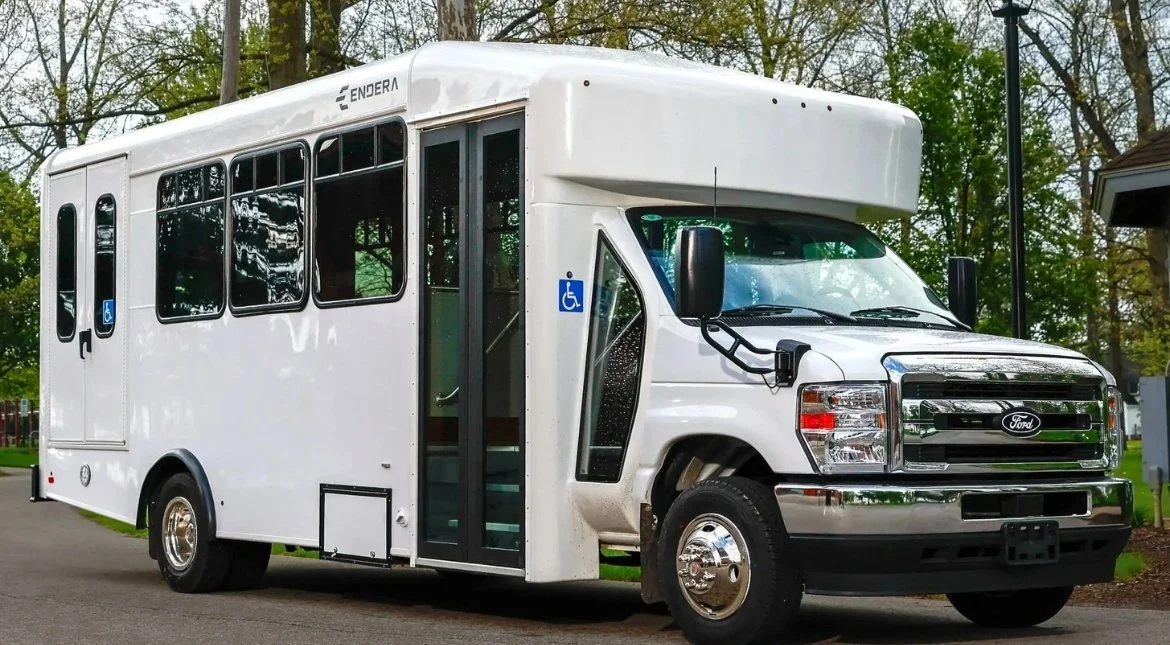
Kansas's commercial shuttle market is defined by its geography more than any other factor. Long distances between population centers, sparse rural county networks, significant workforce transportation demand tied to agriculture and aviation manufacturing, and university systems in Lawrence, Manhattan, and Wichita all generate fleet purchasing activity that generic shuttle sales pages never address directly. For Kansas operators, the vehicle decision is inseparable from the route.
Endera manufactures Class 4 B-Series commercial shuttles in ICE, propane, CNG, and full-electric configurations on Ford E450 and Chevrolet Express cutaway chassis. For Kansas municipalities, universities, healthcare systems, rural transit agencies, and workforce transportation providers, the B-Series is purpose-built for the operational demands that define commercial fleet use across the state.
Ready to spec your fleet? Contact Endera's fleet specialists today to design a custom configuration blueprint for your operation.
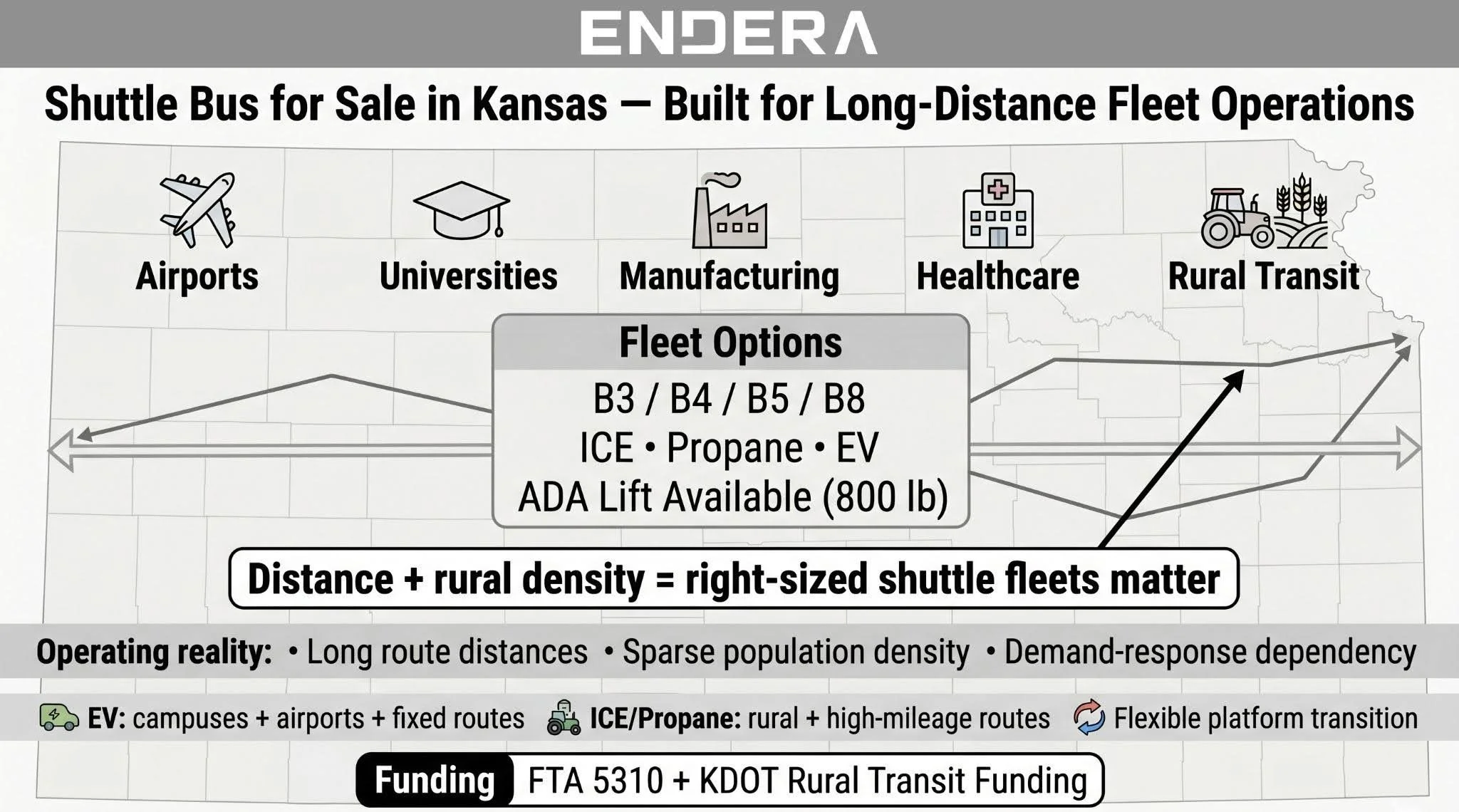
Kansas Transit Funding and Fleet Modernization
Kansas transit operators access fleet funding through a combination of federal and state programs that most shuttle sales pages never explain. KDOT's rural and non-urban transit funding programs — structured around FTA Section 5311 rural and 5310 elderly/disabled programs — provide the capital and operating support that Kansas county transit agencies use to purchase ADA-accessible cutaway buses and commercial shuttle vehicles.
KDOT transit grant allocations document millions in annual federal and state investment flowing into Kansas transportation operations — capital funding that covers fleet replacement alongside operating support. The broader federal $15 billion bus fleet modernization program provides additional procurement pathways for Kansas operators pursuing clean or low-emission fleet replacement.
FTA Project Funding in Kansas
FTA bus and bus facility project documentation includes Kansas fleet facility expansion and maintenance infrastructure investment — proof that Kansas transit agencies are actively scaling operations, not just maintaining status quo fleets. Endera's B-Series is FTA-eligible and Buy America compliant, meeting the federal procurement requirements attached to these funding programs.
Endera's grant navigation services help Kansas operators identify applicable programs and manage applications alongside procurement.
Kansas Shuttle Use Cases: Where the B-Series Fits
Kansas's shuttle demand spans several distinct operational profiles that vary significantly by region.
Workforce and Industrial Transportation
Kansas's aviation manufacturing corridor — Spirit AeroSystems in Wichita, Textron Aviation, and their supplier networks — generates consistent shift-based workforce transportation demand. Agricultural processing operations across central and western Kansas add further employee shuttle requirements. These routes run on tight schedules with high passenger turnover, requiring vehicles built for commercial cycle intensity rather than light-duty daily use.
Universities and Campus Transportation
University of Kansas, Kansas State, and Wichita State all operate campus and off-campus transportation programs requiring ADA configurations and real-time dispatch. The Kansas Rural Transit Assistance Program documentation from the KU Transportation Center outlines the technical assistance framework that supports transit operators across the state — including university-adjacent community transportation systems.
Endera's Endera Dispatch software provides AI-powered routing and GPS tracking suited to multi-stop campus and community operations.
Healthcare and Senior Transportation
U.S. Census data on aging population growth documents the structural demographic shift driving healthcare and senior shuttle demand across the country — a trend that is pronounced in Kansas's rural counties where driving cessation leaves residents without alternatives. Kansas transit accessibility investment — including $13.2 million awarded for public transit projects focused on accessibility improvements — reflects the state's active investment in ADA-capable fleet expansion.
Airports, Hotels, and Municipal Transportation
Wichita Dwight D. Eisenhower National Airport and the municipal transportation programs in Wichita, Topeka, and Lawrence generate airport and community shuttle demand. KDOT's public transportation operational policies outline the emergency transportation readiness and safety-sensitive operational standards that Kansas transit operators follow — a compliance framework that purpose-built commercial vehicles satisfy more reliably than van conversions.
Rural Transportation: Kansas's Distinct Challenge
Kansas's rural transportation gap is one of the most significant in the Midwest. Sparse population density across western Kansas counties, long distances between towns, and limited fixed-route options mean that demand-response and community shuttle services are often the only mobility option for residents accessing healthcare, employment, and essential services.
The National Transit Database tracks ridership trends and fleet conditions across transit operators nationally — data that documents growing demand-response utilization in states like Kansas where rural mobility needs are most acute. ICE and propane B-Series configurations serve these routes well: broad parts availability across Kansas's rural service areas, no charging infrastructure dependency, and ADA-configured models for accessible transport in communities where paratransit is often the only option.
ADA Compliance for Rural Kansas Operators
Official ADA transportation guidance and FTA Part 37 regulations apply to Kansas rural transit operators as much as to urban agencies — requirements that ADA accessible transportation standards define in terms of lift dimensions, securement specifications, and service obligations.
Endera's flat-floor B-Series configurations include 800 lb Braun ADA lifts installed at the manufacturing stage. For Kansas rural transit agencies, NEMT operators, and senior living communities, OEM-installed equipment provides unified warranty coverage and cleaner compliance documentation than post-sale retrofits.
The B-Series Lineup for Kansas Fleets
| Model | Length | Fuel Options | Best Fit |
|---|---|---|---|
| B3 | 23 ft | ICE | Rural transit, church transport, community programs |
| B4 | 24 ft | ICE & EV | Airport shuttles, campus loops, healthcare transport |
| B5 | 25 ft | ICE & EV | Workforce transport, university routes, municipal service |
| B8 | 28 ft | ICE | High-volume industrial, group, event transport |
Electric vs. ICE for Kansas Fleets
Kansas's flat terrain and moderate climate make it a practical EV operating environment for urban and suburban routes. Fixed-route campus, airport, and healthcare operations with overnight depot charging are the strongest EV candidates. The state's generally lower electricity rates relative to coastal markets improve the per-mile cost advantage of electric operation — a factor worth modeling against actual route mileage before finalizing powertrain specifications.
When ICE or Propane Makes More Sense
For rural operators with long irregular routes or no existing charging infrastructure, ICE or propane remains the current-cycle solution. Propane reduces fuel costs 30–40% versus gasoline per DOE Alternative Fuels Data Center data and qualifies for clean fuel programs that diesel replacements typically cannot access. Kansas's agricultural and industrial operators running high-mileage regional routes benefit from propane's lower per-mile cost without the depot infrastructure requirement of full electrification.
All B-Series configurations share the same platform — standardizing on Endera now doesn't foreclose an EV transition on the next procurement cycle as Kansas infrastructure develops.
Ready to Spec a Shuttle for Your Kansas Fleet?
Several 2026 B-Series units are available for immediate delivery through Endera Stock, including ADA-configured flat-floor models and standard passenger layouts. For operators working within formal procurement or grant-aligned purchasing cycles, Endera provides full specification documentation, Buy America compliance materials, and grant application support.
Contact Endera's fleet specialists to discuss fleet configuration, powertrain options, or financing for your Kansas operation.
Frequently Asked Questions
What funding programs are available for Kansas shuttle fleet purchases?
KDOT administers FTA Section 5311 rural transit and Section 5310 elderly/disabled transportation funding for Kansas operators. Kansas has received millions in annual federal transit allocations covering fleet replacement and operations. The federal $15 billion bus modernization program provides additional procurement pathways for clean fleet replacement. Endera's B-Series is FTA-eligible and Buy America compliant — Endera's grant navigation services help identify applicable programs.
How does the B-Series serve Kansas's rural transit operators?
ICE and propane B-Series configurations are well-suited to Kansas rural demand-response routes — broad parts availability across the state, no charging infrastructure dependency, and ADA-configured models for accessible transport. The B3 and B4's compact footprint handles county road approaches and tight rural facility turnarounds more efficiently than full-size transit buses.
What ADA accessibility options are available for Kansas fleet operators?
Flat-floor B-Series configurations include 800 lb Braun ADA lifts installed at the manufacturing stage, meeting FTA Part 37 requirements. For Kansas NEMT operators, rural transit agencies, and senior living communities, OEM-installed equipment provides unified warranty coverage and stronger compliance standing than aftermarket modifications.
Are electric shuttle buses practical for Kansas operations?
Yes, for urban and suburban fixed-route applications. Kansas's flat terrain and moderate climate support predictable EV range. Campus, airport, and healthcare operations with overnight depot charging are the strongest candidates. Rural operators with long irregular routes or no charging infrastructure should consider ICE or propane as the current-cycle solution.
What industries drive shuttle bus demand in Kansas?
Aviation manufacturing workforce transportation in the Wichita corridor, university campus transit, healthcare and senior transport in rural counties, agricultural processing employee shuttles, airport ground transportation, and municipal transit programs all represent active fleet purchasing markets in Kansas. Each has different operational requirements and procurement structures.
Does Endera's fleet management software support rural Kansas transit operations?
Yes. Endera Dispatch provides AI-powered routing, real-time GPS tracking, geofence management, and state-of-charge monitoring from a single platform. For rural Kansas operators managing demand-response and flexible routing, the routing optimization and real-time visibility tools reduce dispatcher workload while maintaining service reliability across dispersed route networks.
Do B-Series shuttle buses require a CDL in Kansas?
Most B-Series configurations fall below the federal CDL threshold — under 26,001 lbs GVWR and fewer than 16 passengers including the driver. Kansas operators running for-hire commercial transport should confirm state-specific licensing requirements, as for-hire passenger carrier rules may add licensing layers beyond the standard federal CDL threshold.