
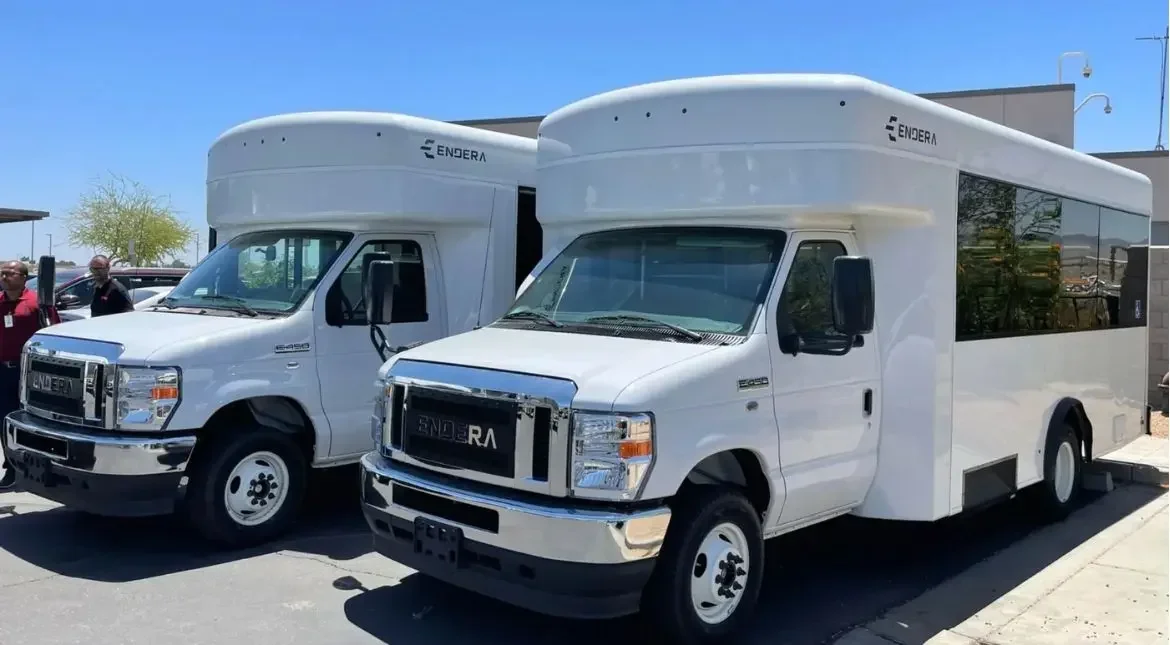
Iowa’s shuttle market may be smaller than Florida or Texas, but it still serves demanding operations across airports, universities, healthcare systems, and industrial corridors. Operators need vehicles that can handle cold winters, varying route lengths, and limited rural service infrastructure. Endera builds the B-Series commercial shuttle as a complete system — including the vehicle, powertrain, software, and charging infrastructure — assembled in nearby Ottawa, Ohio for practical delivery and service support across Iowa.
Iowa’s climate makes electric vs. ICE an important operational decision. Cold winters can reduce EV range, which matters for longer rural or inter-city routes. For predictable short-loop operations like airport, university, or healthcare shuttles, Endera’s electric B4 and B5 can perform well with proper charging strategy. For longer-distance or rural operations, ICE variants provide greater range certainty. Endera builds both on the same platform, allowing operators to choose based on route needs rather than fuel type limitations.
Ready to spec your fleet? Contact Endera's fleet specialists today to design a custom configuration blueprint for your operation.
Winter Operations Reality in Iowa: What Fleet Operators Actually Plan For
EV Range in Cold Weather — What the Data Shows
Winter performance in Iowa is not just about whether a shuttle can start in cold weather — it affects range planning, maintenance schedules, passenger comfort, and overall fleet reliability. According to the U.S. Department of Energy's fueleconomy.gov, EV driving range can drop by roughly 41% in cold-weather operation when cabin heat is in heavy use, with about two-thirds of the extra energy consumed going toward heating the passenger cabin rather than propulsion.
That figure makes route predictability more important than raw mileage — airport parking loops, campus circulators, and healthcare campus routes with scheduled charging windows remain viable EV applications in Iowa winters, provided fleets use battery pre-conditioning before morning dispatch and store vehicles indoors or in heated depots overnight.
ICE Winter Risks — and What Iowa's Roads Add
ICE fleets face their own cold-weather operational realities. Diesel fuel can begin forming wax crystals at low temperatures, restricting fuel flow and creating hard-start or no-start conditions if winterized fuel and additives are not used — the U.S. EPA recommends winterized No. 1 diesel blends and cold-flow additives for cold-weather operation. Iowa operators also contend with snow, road salt, and freeze-thaw cycles that accelerate underbody corrosion and increase maintenance frequency for suspension, brake, and electrical systems. For fleets running year-round across rural Iowa, winter durability and serviceability are as important as passenger capacity or upfront vehicle cost — which is why Endera's single-vendor accountability matters particularly in markets where getting a service response in February needs to be as straightforward as it is in July.
The B-Series Lineup and What Each Model Is Built For
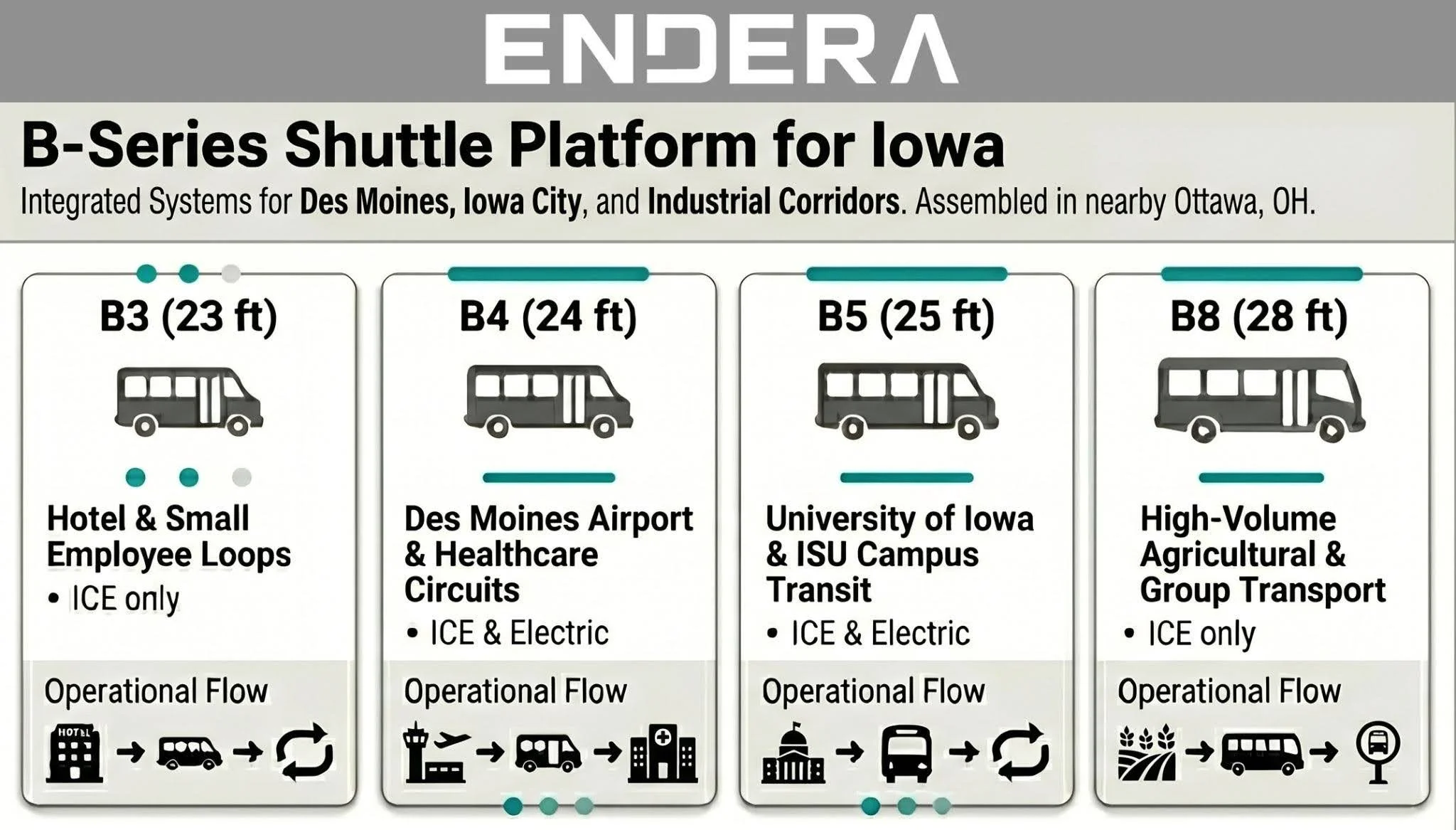
From 23 to 28 Feet, on Proven Platforms
Endera's B-Series runs from 23 to 28 feet, built on the Ford E450 and Chevrolet Express cutaway chassis — platforms with dealer and service coverage across Iowa's major metros and many smaller markets. The B3 at 23 feet handles smaller hotel loops and employee shuttles. The B4 and B5 — available in both ICE and electric — cover the mid-size range used most often by airports, university campuses, and healthcare systems. The B8 at 28 feet handles higher-volume group transport where passenger capacity is the primary constraint.
ICE or Electric: Iowa's Honest Calculus
For Iowa operators, the EV conversation starts with winter. Battery range drops measurably in cold conditions — real-world EV fleets in the upper Midwest typically plan for 20–30% range reduction during winter months, and vehicles that aren't pre-conditioned at depot lose additional efficiency on cold starts. For campus loops and airport parking shuttles with overnight depot access, the electric variants are workable with intentional charging strategy. For longer routes and rural operations, the ICE models are the more operationally reliable choice until Iowa's charging infrastructure matures further. Endera's sales team works through route and depot conditions with operators before recommending a configuration.
Where Iowa Operators Are Actually Running Shuttles
Des Moines: Airport, Corporate, and State Government
Des Moines International Airport generates consistent shuttle demand from off-site parking operators, hotel ground transport, and business travel programs serving Iowa's largest metro. The state government campus, corporate campuses along the Northwest Side and Jordan Creek corridor, and healthcare systems at UnityPoint Health and MercyOne Des Moines all represent institutional shuttle demand that runs on a predictable schedule. The B4 and B5 handle most of these routes comfortably, and for state agency fleets, procurement runs through the Iowa Department of Administrative Services via the IMPACS eProcurement system.
Iowa City and the University of Iowa Health Care Corridor
The University of Iowa and UI Health Care together anchor one of the most active shuttle markets in the state. Campus transit between the main campus and the sprawling Health Science campus, employee shuttles serving the hospitals and research facilities, and accessible transport for patients and students all generate continuous mid-size shuttle demand. For public procurement at the University of Iowa, purchases follow the Iowa Board of Regents procurement framework. For healthcare shuttle programs specifically, the combination of ADA-accessible configuration options and integrated fleet visibility through Endera's Dispatch software makes the B4 a practical fit for the duty cycle and compliance documentation that healthcare campus transport requires.
Ames, Cedar Rapids, and Secondary Markets
Iowa State University in Ames operates campus transit with a predictable duty cycle well-suited to electric shuttle operation when depot charging is in place. Cedar Rapids — home to the Eastern Iowa Airport, Quaker Oats, and a significant healthcare and manufacturing employer base — generates employee and airport ground transport demand that the B4 and B5 cover well. Waterloo's manufacturing corridor, including John Deere Waterloo Works, and the Quad Cities logistics and industrial operations along the Iowa-Illinois border represent employee shuttle demand where the ICE variants' range and operational simplicity serve multi-shift operations effectively.
Agricultural and Rural Iowa
Iowa's rural interior presents a different operational picture. Agricultural employer shuttles, grain cooperative transport, and logistics operations covering long distances between small towns and processing facilities need vehicles that can handle cold starts and variable road conditions without depending on charging infrastructure that doesn't yet exist in much of rural Iowa. For these operators, the ICE B4 and B5 are the practical choice — and Endera's dual-fuel manufacturing capability means operators aren't being sold an EV platform that doesn't fit their operating environment.
Endera's Software Stack: What It Does for Iowa Fleet Managers
Real-Time Visibility for Passengers and Operators
Every Endera B-Series shuttle comes available with two integrated software tools built in-house. Endera Go gives passengers real-time vehicle location, ETA updates, and occupancy data — useful for university campus transit, hospital shuttles, and airport ground transport where wait time affects the passenger experience. Endera Dispatch handles the fleet management side: routing optimization, vehicle health analytics, and for EV operators, state-of-charge monitoring that lets managers plan routes around battery availability.
No Third-Party Integration Required
Both tools are integrated directly with the vehicle's hardware — no separate telematics license, no integration project, no data gap between what the vehicle is doing and what the software reports. For Iowa operators managing small fleets across spread-out geography, that visibility is operationally useful when a problem needs to be caught before it becomes a breakdown. For operators building the internal case for electrification, the cost-per-mile and utilization data Dispatch generates is what a CFO or board needs to evaluate the business case.
Iowa Shuttle Operations Are Spread Out. The Vehicle Has to Be Ready for That.
From Des Moines airport loops and UI Health Care campus shuttles in Iowa City to Ames university transit and manufacturing employee routes across the Quad Cities and Waterloo corridors, Iowa shuttle operations span a wide range of environments and operational demands. Endera's B-Series is built as a complete system — vehicle, powertrain, software, and charging infrastructure — by one manufacturer in Ohio, close enough to Iowa that support is practical, with ICE and electric variants that fit operators wherever they are in the transition to cleaner transportation.
Contact Endera's fleet specialists to explore configurations, check current availability, and find out what funding your Iowa operation may qualify for.
FAQs
1. What B-Series models are available for Iowa buyers?
The B-Series runs from the B3 (23 feet) through the B8 (28 feet). The B4 and B5 are available in both ICE and electric configurations. The B3 and B8 are currently ICE only. Endera's sales team can confirm current in-stock availability and lead times for Iowa delivery.
2. How does Iowa's cold climate affect EV shuttle performance?
Cold temperatures reduce battery range — Iowa operators should plan for 20–30% range reduction during winter months. For campus loops and airport shuttles with overnight depot charging, the electric variants are workable with proper pre-conditioning. For longer rural routes or extended shifts without depot access, ICE models are the more reliable choice. Endera's team works through route conditions before recommending a configuration.
3. Can Iowa operators access diesel emission reduction grant funding?
Yes. The Iowa DOT DERA program provides grants for replacing diesel medium and heavy-duty vehicles, including transit buses, for government, nonprofit, and private fleet operators. Endera assists with identifying eligibility and managing applications.
4. Does Endera provide charging infrastructure for Iowa EV buyers?
Yes. Endera provides full turnkey charging infrastructure — site assessment, charger sourcing, and installation — as part of its EV offering. Iowa operators work with one vendor for both the vehicle and the charging setup.
5. How does Iowa public procurement work for shuttle buses?
Public agencies in Iowa procure through the Iowa DAS procurement framework and the Iowa Cooperative Purchasing Program. Federal transit funding purchases are subject to FTA requirements. Endera's team supports documentation across procurement pathways.
6. What software comes with a B-Series shuttle?
Every B-Series shuttle comes available with Endera Go and Endera Dispatch — real-time passenger tracking, fleet management, routing, and vehicle health analytics — both built in-house and integrated directly with the vehicle's hardware.
7. Does Endera offer financing for Iowa buyers?
Yes. Endera offers direct vehicle financing and capital leasing through its financing platform. Capital leasing preserves working capital and aligns vehicle costs with revenue cycles. Endera also assists with grant identification and application for buyers pursuing public funding.