
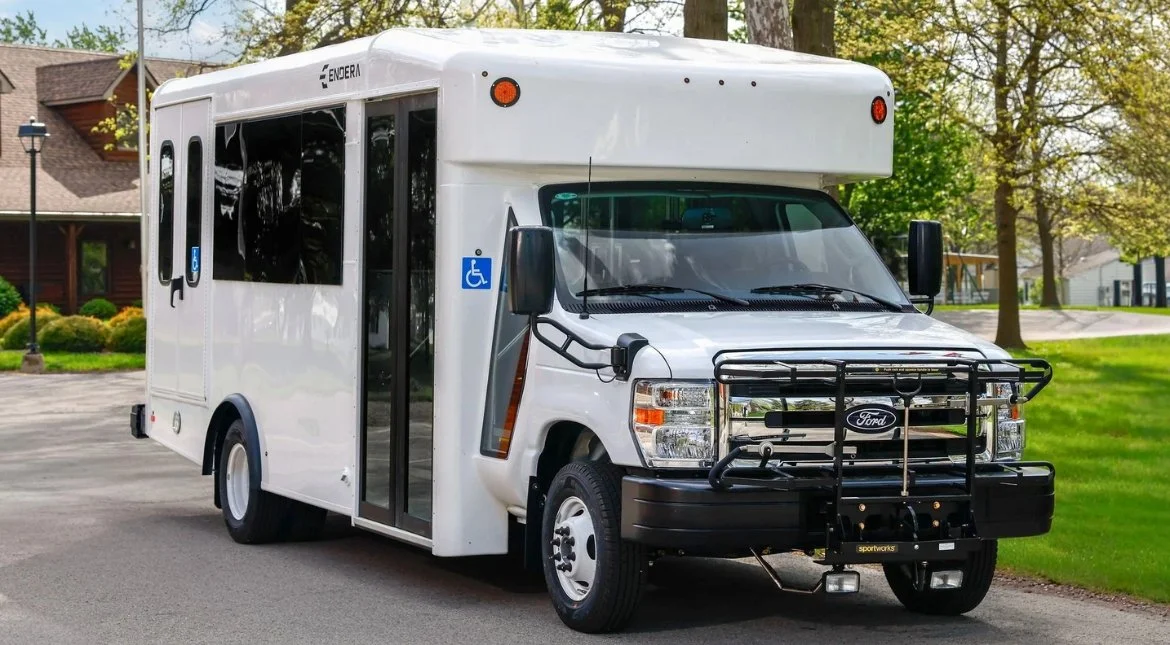
Idaho’s shuttle market is shaped by geography and seasonality, with demand spanning Boise airport and corporate routes, ski resort corridors in Sun Valley and Bogus Basin, university transit across multiple regions, and agricultural logistics from Twin Falls to Nampa. Endera builds the B-Series commercial shuttle as a complete system — vehicle, powertrain, software, and charging infrastructure — assembled in Ottawa, Ohio, with the flexibility to serve these varied operating environments without a one-size-fits-all approach.
Idaho’s winters and elevation changes create real operational challenges for shuttle fleets, impacting both EV range and ICE maintenance. For short, predictable routes with depot charging — like Boise airport shuttles and campus circulators — Endera’s electric B4 and B5 can work with proper charging and pre-conditioning. For mountain resort routes, rural employee transport, and longer inter-city runs with limited infrastructure, ICE variants provide the necessary range reliability. Endera builds both on the same platform so operators choose based on route needs, not fuel type limitations.
Ready to spec your fleet? Contact Endera's fleet specialists today to design a custom configuration blueprint for your operation.
The B-Series Lineup and What Each Model Is Built For
From 23 to 28 Feet, on Proven Platforms
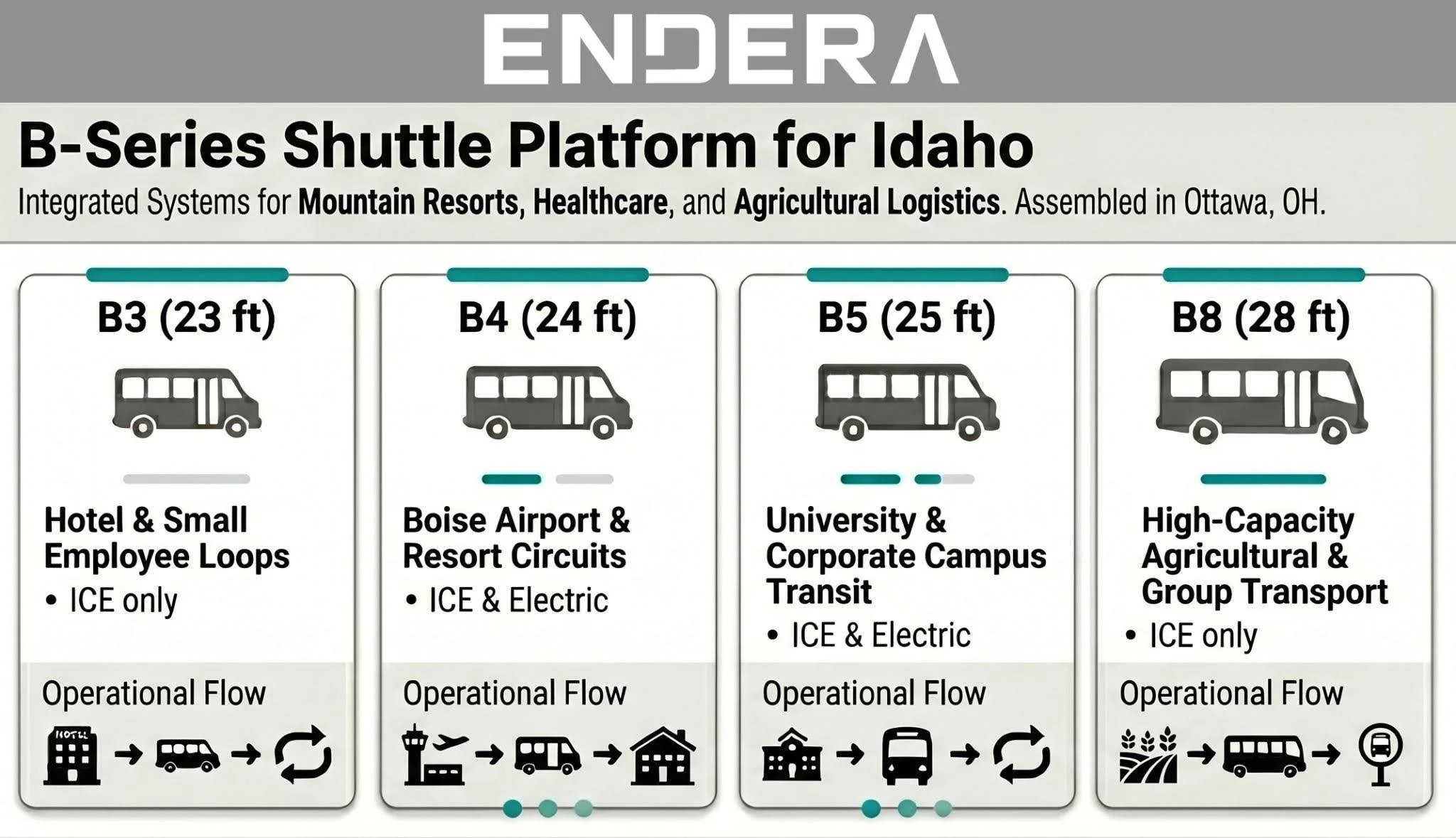
Endera's B-Series runs from 23 to 28 feet, built on the Ford E450 and Chevrolet Express cutaway chassis — platforms with dealer and service coverage in Boise, Twin Falls, Pocatello, and across Idaho's regional markets. The B3 at 23 feet handles smaller hotel loops and employee shuttles. The B4 and B5 — available in both ICE and electric — cover the mid-size range most used by airports, resorts, university campuses, and corporate programs. The B8 at 28 feet handles higher-volume group transport where capacity is the constraint.
ICE or Electric: Idaho's Honest Assessment
Idaho's combination of cold winters and geographic spread puts EV range planning at the center of the fuel decision. According to the hU.S. Department of Energy, EV range can drop by roughly 41% in cold weather when cabin heat is in heavy use — a figure that changes the operational math significantly for routes that don't have predictable charging windows. For Boise-area hotel loops and airport parking circuits with overnight depot access, the electric B4 and B5 are workable with pre-conditioning protocols. For Sun Valley resort shuttles running mountain terrain, Twin Falls agricultural corridors, and any route where depot charging isn't established, the ICE variants are the more reliable choice until Idaho's charging infrastructure catches up.
Mountain Grade and Elevation Performance in Idaho Shuttle Operations
Why Distance Is the Wrong Way to Plan Idaho Routes
Idaho shuttle routes are defined less by distance and more by elevation change, where performance is shaped by steep grades, sustained climbs, and long downhill descents. Unlike flat urban shuttle environments, mountain and canyon routes require vehicles to operate under continuous load variation — a factor that directly affects energy consumption, braking systems, and thermal management. For both EV and ICE operators, elevation is a more important planning variable than mileage alone.
EV Energy on Ascent — and the Regenerative Advantage on Descent
For electric shuttles, climbing steep grades can dramatically increase energy use compared to flat-road operation because the drivetrain must continuously overcome gravity in addition to rolling resistance. Industry research shows that steep uphill segments can multiply energy demand several times over baseline conditions. However, Idaho's terrain also introduces one of EV's key advantages: regenerative braking on descent. On long downhill sections common in routes like Sun Valley–Hailey or mountain passes near Boise, electric drivetrains can recover a meaningful portion of the energy used during ascent by converting kinetic energy back into stored battery energy — partially offsetting the energy cost of the climb.
What Mountain Terrain Means for ICE Shuttles
For ICE shuttles, elevation introduces a different constraint: sustained climbs increase engine strain and fuel consumption, while repeated braking on descents accelerates brake wear and heat buildup — particularly on resort shuttle routes with frequent elevation drops. These are manageable with proper maintenance scheduling, but they make service interval planning more important in Idaho's mountain corridors than in flat-road markets.
Route-Specific Energy Planning Is the Practical Answer
Across both powertrains, Idaho's mountain environment requires route-specific energy planning rather than flat-mile assumptions. Operators need to account for vertical gain, descent recovery potential, and seasonal temperature swings, which together have a larger impact on usable range than total route distance. In practice, this makes predictable shuttle loops and well-mapped elevation profiles critical to fleet reliability in Idaho's resort and mountain corridors — and it's why Endera's sales team works through route conditions with operators before recommending a powertrain configuration.
Where Idaho Operators Are Actually Running Shuttles
Boise: Airport, Corporate, and the Treasure Valley
Boise Airport (BOI) generates consistent shuttle demand from off-site parking operators, hotel ground transport along the airport corridor, and corporate travel programs serving the Treasure Valley's growing tech and healthcare sector.
St. Luke's Health System and Saint Alphonsus Regional Medical Center both operate campus shuttle programs across Boise's medical district. Corporate campuses in Meridian and the Boise Spectrum corridor add employee shuttle demand that runs on predictable schedules well-suited to mid-size B4 and B5 configurations. For public-sector buyers in Boise or state agencies, procurement runs through the Idaho Division of Purchasing via statewide contracts.
Sun Valley and the Mountain Resort Corridor
Sun Valley Resort is one of the most active resort shuttle markets in the Northwest. Guests moving between the Sun Valley Lodge, Ketchum properties, and Hailey — as well as the daily express shuttle service connecting Boise Airport to the Wood River Valley — generate consistent mid-size shuttle demand year-round, with sharp peaks in ski season. The mountain terrain, elevation, and cold temperatures make ICE the more practical powertrain for most Sun Valley corridor operations. The B4 and B5 ICE variants handle the passenger capacity and range requirements of these routes without the cold-weather range planning that EV operation requires on mountain terrain.
Bogus Basin and Boise-Area Ski Transport
Bogus Basin Mountain Recreation Area operates shuttle services for skiers from Boise — a shorter, more urban route than Sun Valley that's a stronger candidate for EV shuttle consideration. The round trip from Boise to Bogus Basin is under 50 miles, which falls well within the electric B4 and B5's Standard Range even accounting for winter battery reduction. For resort properties and shuttle operators running this corridor with a depot charging strategy, the electric variants are worth evaluating alongside the ICE option.
University Campuses and Institutional Transit
Boise State University, University of Idaho in Moscow, and Idaho State University in Pocatello all operate campus transit programs with duty cycles well-suited to mid-size shuttles. Campus loops are short, route patterns are predictable, and overnight depot charging is generally available at institutional facilities — the operational profile where the electric B4 and B5 work well even in Idaho winters. For Board of Education system procurement, Idaho State Board of Education institutions typically coordinate through the Idaho Division of Purchasing statewide contract framework.
Twin Falls, Nampa, and the Agricultural Corridor
The Snake River Plain's agricultural and food processing sector — spanning Twin Falls, Nampa, Caldwell, and the surrounding rural corridor — generates employee shuttle demand from major employers including Chobani, Lamb Weston, and a significant dairy processing industry. These operations typically run multi-shift schedules across facilities that are spread across rural roads where charging infrastructure is limited. The ICE variants of the B4 and B5 are the practical answer for this market, with the range and cold-start reliability that rural Idaho operations require.
How B-Series Compares to Other Idaho-Available Shuttle Buses
The Shared Platform Reality
In Idaho, most shuttle buses share the Ford E450 or GM cutaway chassis, and the differences between manufacturers come down to integration depth, configuration flexibility, and who's accountable when something needs attention in a market where service infrastructure outside Boise can be limited. For public-sector buyers using federal transit funding, compliance is a real constraint. Any shuttle purchased with federal dollars must meet FTA Buy America requirements, including domestic content thresholds and U.S. final assembly standards.
Where Endera Differs — and Where It Doesn't
Competing manufacturers like Starcraft, Turtle Top, and ElDorado operate as body builders on shared chassis — a legitimate fit for operators who prioritize low upfront cost, rapid delivery, or an existing dealer relationship. Where Endera's B-Series differs is in being a fully integrated platform — vehicle, powertrain, software, and charging infrastructure — from a single manufacturer. For Idaho operators managing small fleets across spread-out geography, single-vendor accountability means fewer handoffs when something needs attention.
What the Procurement Difference Looks Like in Practice
Body-builder configurations often require third-party telematics, separate charging vendors for EV units, and more coordination across procurement and service. Under federal procurement rules, public agencies must verify compliance certifications before contract award — a process that becomes more complex when multiple vendors are involved. In practice: integrated software and single-vendor accountability favor the B-Series; lowest initial cost or an existing dealer relationship may favor traditional manufacturers. Idaho operators should evaluate both against their actual operational priorities.
Idaho's Shuttle Market Spans More Terrain Than Most. The Vehicle Has to Match It.
From Boise airport loops and Sun Valley resort corridors to Boise State campus transit and Snake River Plain agricultural employee routes, Idaho shuttle operations cover a wide range of environments, elevations, and seasonal demands. Endera's B-Series is built as a complete system — vehicle, powertrain, software, and charging infrastructure — by one manufacturer accountable for the whole thing, with ICE and electric variants that let operators match the fuel type to the route rather than the other way around.
Contact Endera's fleet specialists to explore configurations, check current availability, and find out what funding your Idaho operation may qualify for.
FAQs
1. What B-Series models are available for Idaho buyers?
The B-Series runs from the B3 (23 feet) through the B8 (28 feet). The B4 and B5 are available in both ICE and electric configurations. The B3 and B8 are currently ICE only. Endera's sales team can confirm current in-stock availability and lead times for Idaho delivery.
2. How does Idaho's cold climate and mountain terrain affect EV shuttle performance?
EV range can drop roughly 41% in cold weather with heavy cabin heat use, per DOE data. For Boise-area loops and campus routes with depot charging, the electric variants work well with pre-conditioning. For Sun Valley mountain terrain, rural corridors, and routes without charging access, ICE models are the more reliable choice. Endera's team works through route and depot conditions before recommending a configuration.
3. Can Idaho operators access IDEQ VW Settlement rebates for shuttle replacement?
Yes. The IDEQ program explicitly covers shuttle and transit bus replacement with diesel or alternative fuel vehicles. Endera assists operators with eligibility assessment and application management.
4. Does Idaho Power offer commercial incentives for EV charging infrastructure?
Yes. Idaho Power's program provides up to $20,000 per site for EVSE supporting buses and DC fast charging. Endera's turnkey charging service coordinates with this program so operators manage one procurement process rather than two.
5. How does Idaho public procurement work for shuttle buses?
Public agencies in Idaho procure through the Idaho Division of Purchasing under the State Procurement Act, with statewide contracts available for vehicle purchases. Federal transit funding purchases are subject to FTA requirements. Endera's team supports documentation across procurement pathways.
6. What software comes with a B-Series shuttle?
Every B-Series shuttle comes available with Endera Go and Endera Dispatch — real-time passenger tracking, fleet management, routing, and vehicle health analytics — both built in-house and integrated directly with the vehicle's hardware.
7. Does Endera offer financing for Idaho buyers?
Yes. Endera offers direct vehicle financing and capital leasing through its financing platform. Capital leasing preserves working capital and aligns vehicle costs with revenue cycles. Endera also assists with grant identification and application for buyers pursuing public funding.