
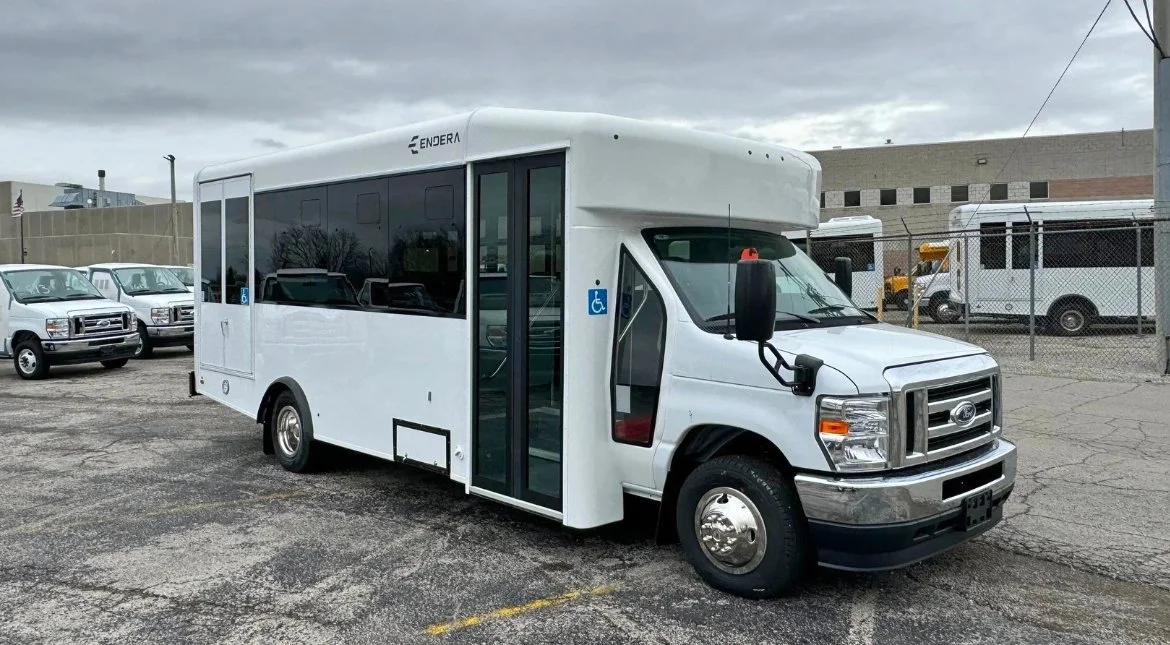
Alaska's transportation conditions eliminate most commercial vehicles from consideration before procurement starts. Sub-zero temperatures, remote routes with limited service access, and seasonal demand cycles demand a shuttle built for commercial durability — not optimized for easy operating environments. For fleet managers across airports, tourism operations, healthcare networks, and municipal transit, the wrong vehicle means grounded units in conditions where there's no convenient backup.
Endera manufactures the B-Series commercial shuttle lineup in ICE, propane, CNG, and full-electric configurations across 23- to 28-foot body lengths, built on Ford E450 and Chevrolet Express cutaway chassis. For Alaska operators evaluating a new shuttle or fleet refresh, Endera's B-Series lineup spans the B3, B4, B5, and B8, with ADA-accessible flat-floor models and route-specific customization handled at the factory level.
Alaska's operating conditions are unlike anywhere else — walk Endera's team through your routes and we'll help you find the right vehicle, fuel type, and funding pathway for your fleet.
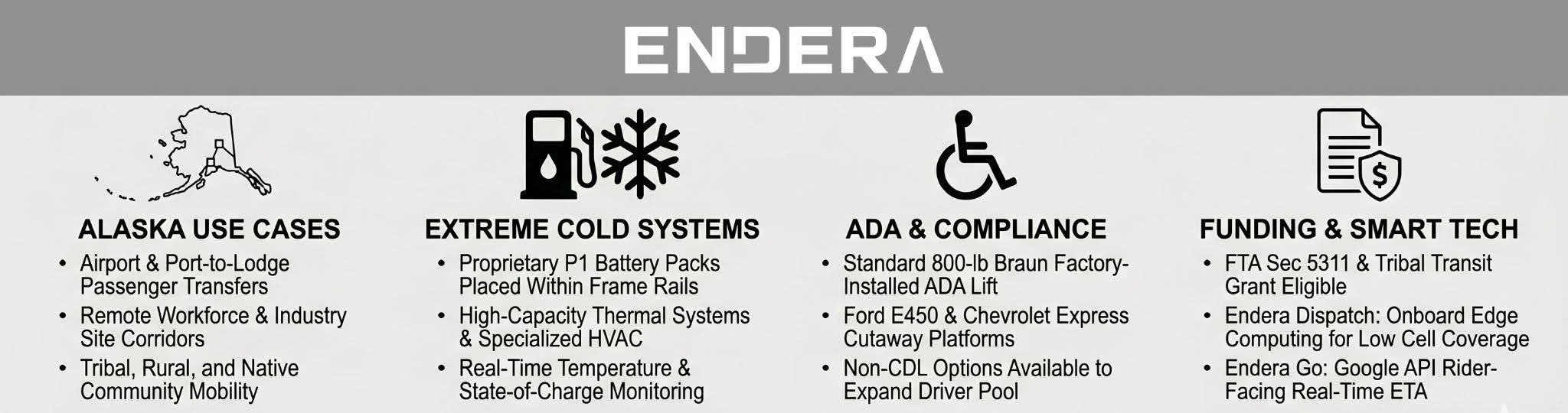
Built for Extreme Cold: What Alaska Fleet Conditions Actually Require
Cold-weather fleet performance is where most generic shuttle spec sheets go silent. The U.S. Department of Energy's alternative fuel fleet guidance identifies vehicle reliability in extreme cold as a function of powertrain design, fluid management, and thermal systems. Alaska operators running routes through interior regions, the Kenai Peninsula, or the North Slope face sustained temperatures that test HVAC output, battery management on electric units, and cold-start reliability on ICE models.
Endera's proprietary P1 all-electric powertrain places batteries within the frame rails rather than under the floor, providing structural protection and thermal management advantages in cold-weather scenarios. For Alaska fleets evaluating EV variants, state-of-charge management through Endera Dispatch allows operators to monitor battery performance in real time and adjust charging schedules based on temperature and route demands.
ICE and Alternative Fuel Options for Remote Operations
Not every Alaska route is a viable electric application. For fleet operators running long regional corridors, remote workforce sites, or routes through areas without charging infrastructure, ICE, propane, and CNG configurations remain the practical choice. Endera's dual-track production maintains full manufacturing capability across all fuel types on the same platform — meaning an Alaska buyer can spec a propane B4 for one route and an electric B5 for a depot-based airport loop without managing two separate vehicle families or service networks.
Alaska Tourism Transportation: Seasonal Scale and Fleet Planning
Alaska's tourism industry creates shuttle demand that is both large in volume and operationally specific. Cruise passengers arriving at Juneau, Ketchikan, or Skagway need rapid ground transfers to excursion departure points. Lodge and resort operators in Denali, Wrangell-St. Elias, and Kenai Fjords run daily guest transportation on unpaved and remote access roads. The Alaska Travel Industry Association documents seasonal visitor patterns that inform fleet sizing and rotation planning for operators managing peak-season surge without over-committing capital to year-round inventory.
For tourism operators, B-Series configurations with luggage storage, high-capacity HVAC, and ADA lift options cover the core requirements of multi-stop excursion loops. Airport-to-hotel and port-to-lodge transfer routes place a premium on passenger turnover efficiency — boarding speed, luggage handling, and climate control during loading windows in cold weather.
Tribal, Rural, and Community Transit in Alaska
Alaska's rural and tribal transportation needs represent one of the most underserved fleet markets in the country. Many Alaska Native communities depend on scheduled shuttle services for healthcare appointments, elder transportation, and community mobility. The FTA's Tribal Transit Program provides dedicated federal funding to support transportation systems serving tribal lands, and Alaska has more eligible tribal communities than any other state.
The Alaska Community Transit Needs Assessment documents persistent gaps in transportation access across rural regions, translating directly into demand for reliable, ADA-compliant passenger vehicles capable of operating on low-frequency routes without urban-level maintenance infrastructure. The Denali Commission funds transportation projects in remote Alaska communities, and its investment history reflects how deeply the state's rural mobility depends on federal partnership.
Healthcare and Senior Transportation
The Rural Health Information Hub's Alaska profile identifies transportation as one of the primary barriers to healthcare access across the state's rural communities. Non-emergency medical transport, senior shuttle services, and clinic-to-hospital transfer routes operate in conditions that require dependable vehicles with ADA-compliant boarding — not modified vans on light-duty platforms.
The Braun 800-lb ADA lift available on B-Series in-stock configurations, combined with federal ADA transportation compliance standards, establishes the baseline for operators serving mobility-dependent passengers in isolated communities.
Funding Pathways for Alaska Fleet Buyers
Federal funding is not peripheral to Alaska shuttle procurement — it is central to it. The FTA's Section 5311 Rural Formula Grants direct capital funding to rural transportation systems, and Alaska's rural transit footprint is among the largest in the country by geographic coverage. Eligible operators can apply Section 5311 funds toward shuttle bus purchases, replacing aging vehicles that no longer meet safety or emissions standards.
The FTA Bus and Bus Facilities Program provides additional capital funding for public agencies investing in fleet replacement and facility improvements. Alaska DOT's public transportation programs administer state-level transit funding that complements federal sources, and buyers working across multiple funding streams benefit from a manufacturer experienced in the documentation requirements those programs impose. Endera's financing and grant navigation services support buyers through the full funding process, with access to over $20 billion in federal, state, and local EV subsidies identified across its client base.
Fleet Management Software for Remote Alaska Routes
Alaska's geographic scale creates data management challenges that standard telematics platforms aren't built for. Endera Dispatch includes onboard edge computing hardware that processes routing, GPS, and vehicle performance data locally without requiring consistent cellular connectivity — directly relevant for routes operating through rural interior Alaska, the Mat-Su Valley, or coastal communities where network coverage is intermittent. AI-powered routing, geofence management, and state-of-charge monitoring for EV units are included without additional licensing costs.
The rider-facing Endera Go app provides real-time vehicle location and ETA tracking for passengers, which tourism operators and airport shuttle providers use to reduce boarding delays and improve passenger flow at high-turnover stops. For healthcare and community transit operators, the occupancy and feedback tools give dispatchers visibility into route utilization — useful for documenting ridership data required by federal funding program reporting.
Choosing the Right Configuration for Alaska Applications
Fleet buyers selecting a B-Series model for Alaska operations are typically making a decision that spans several use-case variables: route length, depot infrastructure, seasonal utilization, and passenger profile. The table below maps common Alaska applications to relevant B-Series configurations.
| Application | Recommended Model | Key Spec Consideration |
|---|---|---|
| Airport loops / hotel transfer | B4 ICE or EV | ADA lift, luggage storage, rapid boarding |
| Tourism excursion routes | B5 ICE or Propane | HVAC capacity, durability on remote roads |
| Rural community transit | B3 or B4 ICE | Non-CDL GVWR, ADA compliance, cold-start reliability |
| Workforce / remote site transport | B5 or B8 ICE | Passenger capacity, long-range fuel range |
| Healthcare / senior transport | B3 or B4 ICE | ADA lift, flat-floor layout, low boarding height |
Endera's in-stock vehicles are available for immediate delivery on 2026 Ford E450 chassis at 14,500 lb GVWR, with factory order options available for customized configurations across all B-Series models and fuel types.
Ready to Equip Your Alaska Fleet
Alaska shuttle buyers are operating in conditions that reward vehicles built to commercial-grade specifications rather than optimized for easy deployment markets. Endera builds to that standard across fuel types, body lengths, and ADA configurations — with software, charging infrastructure, and grant navigation services available as part of the same procurement relationship.
Reach out to Endera's team to review configurations, confirm available inventory, and discuss applicable Alaska and federal funding programs..
Frequently Asked Questions
How do Endera B-Series shuttles perform in extreme cold weather?
The B-Series lineup is built on medium-duty commercial platforms rated for continuous high-cycle operation, with powertrain and HVAC systems designed for demanding climates. The P1 electric powertrain places batteries within the structural frame rails rather than under the floor, which supports thermal management and reduces cold-weather exposure to battery packs. ICE and propane configurations provide proven cold-start reliability for operators in remote areas without charging infrastructure.
What federal funding programs are available for Alaska shuttle bus purchases?
Alaska transit operators can access FTA Section 5311 Rural Formula Grants for capital vehicle purchases, the FTA Bus and Bus Facilities Program for fleet replacement and facility investment, and the Tribal Transit Program for eligible Alaska Native community transportation systems. Alaska DOT administers complementary state-level transit funding. Endera's grant navigation team helps buyers identify applicable programs and manage documentation requirements across funding sources.
Are Endera shuttles suitable for Alaska tourism and cruise transportation?
Yes. B-Series models are available with luggage storage, high-capacity HVAC, and ADA lift options that support multi-stop excursion loops, port-to-lodge transfers, and airport-to-hotel routes common in Alaska's tourism sector. The B4 and B5 are the most commonly specified models for tourism applications, with ICE and propane configurations favored for remote road access where depot charging isn't available.
Do Endera shuttle buses meet ADA compliance requirements for Alaska public transit operators?
All B-Series models support ADA-compliant configurations, including 800-lb Braun lift systems, wheelchair securement, and accessible seating layouts. Federal ADA transportation standards require public entities and certain commercial operators to provide accessible vehicles, and Endera's factory-built ADA options meet those requirements without requiring post-sale modifications.
Can Endera Dispatch maintain connectivity on remote Alaska routes?
Endera Dispatch uses onboard edge computing hardware that processes GPS, routing, and vehicle data locally without relying on a continuous cellular connection. This makes it functional on routes through rural interior Alaska and coastal communities where network coverage is unreliable or unavailable, unlike cloud-dependent telematics platforms that lose functionality in low-signal environments.
What is the CDL requirement for operating B-Series shuttles in Alaska?
B-Series models built on the Ford E450 chassis carry a 14,500 lb GVWR, which falls below the 26,001 lb federal CDL threshold for most commercial applications. Alaska CDL requirements follow federal standards for vehicle weight and passenger count, so many B3 and B4 configurations can be operated without a commercial license — a practical consideration for rural operators and tourism providers managing seasonal driver staffing.
Are propane and CNG shuttles a viable option for Alaska fleets where EV charging isn't available?
Propane and CNG configurations are a well-established alternative for Alaska operators whose depot locations or route lengths make electric charging impractical. Both fuel types offer lower emissions than gasoline and are eligible for certain federal alternative fuel incentive programs. Endera manufactures propane and CNG variants across the B-Series lineup on the same platform as the EV models, allowing fleet operators to maintain a unified parts and service structure regardless of fuel type.