
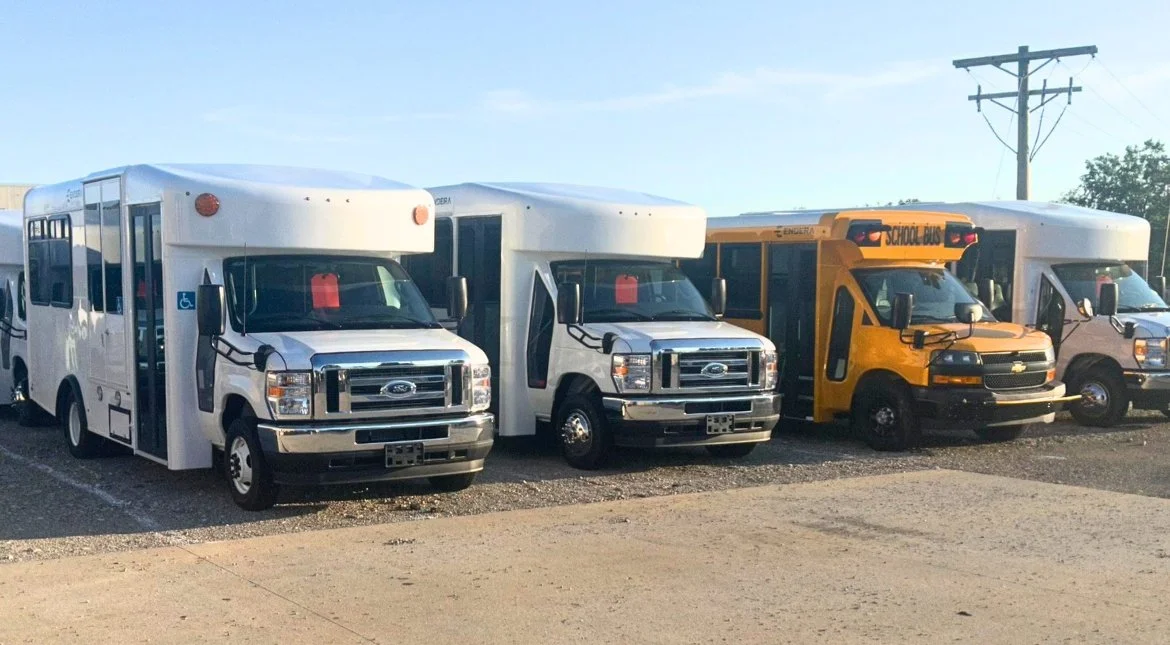
Alabama’s shuttle market is driven by three major sectors: Birmingham’s healthcare and university corridor, Huntsville’s aerospace and technology industry, and Mobile’s port, manufacturing, and Gulf Coast tourism economy. These varied operations create demand for everything from campus and employee transit to hospitality shuttles. Endera builds the B-Series commercial shuttle as a complete system — vehicle, powertrain, software, and charging infrastructure — with both ICE and electric variants to match different route and operational needs.
Alabama’s warm climate supports consistent EV shuttle performance year-round, making electric models practical for campus loops, corporate circuits, and Gulf Coast hotel shuttles with predictable routes and depot charging access. For longer inter-city routes and extended manufacturing or port employee transport operations, ICE variants provide greater range certainty. Endera builds both on the same platform to support different operational needs.
Not sure whether ICE or electric is right for your Alabama routes? Endera's team can work through the specifics with you — configurations, funding, and depot infrastructure included.
The B-Series Lineup and What Each Model Is Built For
From 23 to 28 Feet, on Proven Platforms
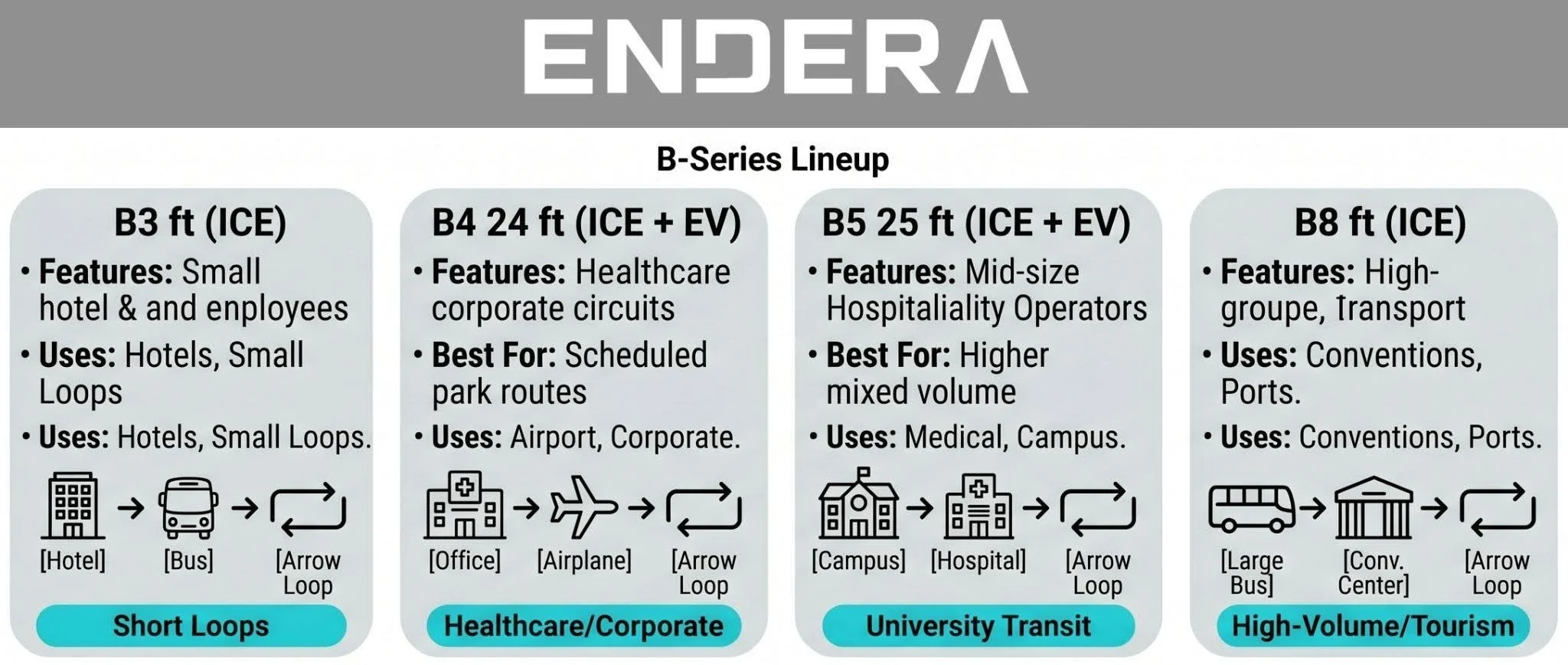
Endera's B-Series runs from 23 to 28 feet, built on the Ford E450 and Chevrolet Express cutaway chassis — platforms with dealer and service coverage across Alabama's major markets. The B3 at 23 feet handles smaller hotel loops and employee shuttles. The B4 and B5 — available in both ICE and electric — cover the mid-size range most used by healthcare campuses, corporate programs, universities, and hospitality operators. The B8 at 28 feet handles higher-volume group and event transport.
ICE or Electric: Alabama's Honest Assessment
Alabama's hot, humid climate supports consistent EV battery performance year-round — the cold-weather range reduction concern that affects northern markets doesn't apply here.
For Birmingham healthcare campus loops, Huntsville corporate circuits, and Gulf Coast resort shuttles with overnight depot access, the electric B4 and B5 are practical. For longer routes between Birmingham, Huntsville, Mobile, and Montgomery, and for port and manufacturing employee transit running multi-shift schedules without depot charging infrastructure, the ICE models are the more operationally reliable choice. Endera's sales team works through route and depot conditions before recommending a configuration.
What Summer EV Shuttle Operations Actually Require in Alabama
Heat and Humidity Replace Cold as the Primary EV Planning Variable
Alabama's climate removes the winter battery range loss that affects northern EV fleets — but high heat and humidity create a different operational reality that shuttle operators still need to plan for.
The U.S. Department of Energy notes that cabin cooling and battery thermal management are among the largest non-driving energy demands on EVs during periods of extreme heat — the same dynamic that affects cold weather operation, just in the opposite direction. For Gulf Coast shuttle fleets running in Gulf Shores, Orange Beach, and Mobile, high humidity forces air-conditioning systems to run continuously during service, and battery cooling systems must work harder when ambient temperatures exceed 95°F.
What NREL Research Shows on Thermal Management and Fleet Charging
NREL's thermal management research found that climate-control demands can reduce EV range by as much as 68% in extreme conditions — a figure that underscores why hot-climate EV planning is as operationally important as cold-climate planning.
NREL identifies thermal management and charging coordination as critical planning factors for fleet electrification, particularly when multiple vehicles must charge while maintaining daily uptime. Overnight depot charging becomes especially valuable in Alabama because charging during cooler nighttime hours reduces battery heat stress and aligns with Alabama Power's time-of-use rate structure, which reduces energy costs for commercial customers charging fleet EVs during off-peak windows.
Where Summer Heat Affects the EV Decision — and Where It Doesn't
For Birmingham healthcare campus loops, Huntsville corporate circuits, and Gulf Coast resort shuttles running short, predictable routes with overnight depot return, the heat-and-humidity factor is manageable with proper HVAC pre-conditioning and charging strategy — these remain strong EV applications in Alabama.
For longer-distance employee transport, port logistics shuttles running 24-hour operations, and multi-shift routes without extended charging windows, the additional HVAC energy load that Alabama's summers impose makes the ICE variants the more operationally reliable choice. Endera's sales team works through route profiles and depot conditions before recommending a powertrain configuration for Alabama operators.
Who Makes the Shuttle Purchase Decision in Alabama Organizations
The Operational Side of the Table
In Alabama shuttle operations — whether a hospital system, a university transportation department, or a defense contractor running employee transit — the transportation director or fleet manager defines what the vehicle needs to do. They know the routes, shift schedules, seasonal patterns, and where the current fleet falls short. That operational knowledge drives specifications. But approval authority typically sits elsewhere.
The Approval Side of the Table
For public-sector buyers — state agencies, University of Alabama System campuses, or transit authorities — procurement follows the Alabama Department of Finance Division of Purchasing framework via the Alabama Buys system, with statewide contracts available for vehicle acquisitions.
Alabama's Green Fleets Policy requires state fleet managers to submit annual plans reflecting increasing fuel economy across their fleets — a mandate that signals procurement direction toward more efficient and alternative fuel options. When federal transit funding is involved, FTA procurement standards apply. For private operators in aerospace, healthcare, or hospitality, the approval chain runs through a CFO or operations director weighing total cost of ownership alongside capital availability.
How B-Series Compares to Other Alabama-Available Shuttle Buses
The Shared Platform Reality
In Alabama, most shuttle buses share the Ford E450 or GM cutaway chassis, and the differences come down to integration depth, configuration flexibility, and single-vendor accountability. Any shuttle purchased with federal transit funding must meet FTA Buy America requirements, including domestic content thresholds and U.S. final assembly standards — narrowing the field to manufacturers that can certify compliance and support pre-award and post-delivery documentation.
Where Endera Differs — and Where It Doesn't
Competing manufacturers like Starcraft, Turtle Top, and ElDorado operate as body builders on shared chassis — a legitimate fit for operators who prioritize low upfront cost or an existing dealer relationship in the region.
Where Endera's B-Series differs is in being a fully integrated platform — vehicle, powertrain, software, and charging infrastructure — from a single manufacturer. For UAB healthcare campus operations and Huntsville government contractor shuttles where fleet visibility and service accountability matter alongside acquisition cost, that integration reduces friction in ways that multi-vendor configurations don't.
Funding and Incentives for Alabama Shuttle Buyers
ADECA VW Settlement Grants for Shuttle and Transit Buses
The Alabama Department of Economic and Community Affairs administers VW Environmental Mitigation Trust grants that explicitly cover the replacement of qualified medium- and heavy-duty diesel vehicles — including school, shuttle, and transit buses — with new diesel or alternative fuel vehicles.
This is Alabama's most directly applicable state-level funding program for fleet operators replacing aging diesel shuttles, covering both electric and cleaner diesel replacements. Funding amounts vary by vehicle type, fuel type, and applicant type. Endera's team assists operators with identifying current eligibility and managing the application process directly.
Alabama Power Make Ready Rebates and Rate BEV
Alabama Power's Make Ready program offers commercial customers rebates for Level 2 and DC fast charging station installation — $2,000 per Level 2 port with a minimum of six ports per site. The program is directly applicable to depot charging installation for commercial shuttle fleets in Alabama Power's service territory.
Alabama Power also offers Rate BEV — a time-of-use rate for commercial and industrial customers charging fleet EVs — which reduces overnight charging costs when vehicles return to depot between service periods. Endera's turnkey charging infrastructure offering coordinates with Alabama Power's programs so operators manage one procurement process rather than two.
FTA Programs for Transit Agencies
For transit agencies and eligible operators pursuing the electric B4, the FTA Low or No Emission Vehicle Program remains the primary federal funding pathway. The B4's Altoona certification and Buy America compliance make it directly eligible for FTA-funded procurement. Endera assists operators with identifying applicable funding and managing applications directly.
Endera's Software Stack: What It Does for Alabama Fleet Managers
Real-Time Visibility for Passengers and Operators
Every Endera B-Series shuttle comes available with two integrated software tools built in-house. Endera Go gives passengers real-time vehicle location, ETA updates, and occupancy data — useful for healthcare campus shuttles, corporate employee transit, and Gulf Coast resort programs where wait time affects the passenger experience. Endera Dispatch handles fleet management: routing optimization, vehicle health analytics, and state-of-charge monitoring for EV operators.
No Third-Party Integration Required
Both tools are integrated directly with the vehicle's hardware — no separate telematics license, no integration project, no data gap between what the vehicle is doing and what the software reports. For Alabama operators managing fleets across multiple facilities or shift schedules, that real-time visibility is operationally useful every shift. The cost-per-mile and utilization data Dispatch generates also supports the fuel economy reporting that Alabama's Green Fleets Policy requires of state fleet managers.
Alabama's Shuttle Markets Span Healthcare Campuses, Defense Contractors, and Gulf Coast Resorts
From UAB's medical complex and Birmingham airport ground transport to Redstone Arsenal employee transit in Huntsville and resort shuttles along Alabama's Gulf Coast, the state's shuttle operations cover a wider range of industries and operating environments than most states in the South. Endera's B-Series is built as a complete system — vehicle, powertrain, software, and charging infrastructure — by one manufacturer accountable for the whole thing, in ICE and electric variants that fit operators wherever they are in the transition to cleaner transportation.
Have a look at what's available — current configurations, in-stock units, and funding programs for Alabama buyers.
FAQs
1. What B-Series models are available for Alabama buyers?
The B-Series runs from the B3 (23 feet) through the B8 (28 feet). The B4 and B5 are available in both ICE and electric. The B3 and B8 are currently ICE only. Endera's sales team can confirm availability and lead times for Alabama delivery.
2. Is the electric B-Series a good fit for Alabama's climate?
Yes. Alabama's warm year-round climate supports consistent EV battery performance, removing the cold-weather range concern that affects northern markets. Healthcare campus loops, Huntsville corporate circuits, and Gulf Coast resort shuttles with overnight depot access are all practical EV applications.
3. What are the ADECA VW Settlement grants and do they cover Endera shuttles?
The ADECA program explicitly covers replacement of qualifying diesel shuttle and transit buses with new alternative fuel or diesel vehicles. Endera assists operators with eligibility assessment and application management as part of the sales process.
4. Does Alabama Power offer commercial EV charging rebates?
Yes. Alabama Power's Make Ready program provides $2,000 per Level 2 port for commercial customers. The Rate BEV time-of-use program reduces overnight fleet charging costs. Endera's turnkey charging service coordinates with Alabama Power programs for operators in its service territory.
5. How does Alabama public procurement work for shuttle buses?
State agencies and eligible entities procure through the Alabama Division of Purchasing via the Alabama Buys system. Alabama's Green Fleets Policy requires annual fuel economy improvements for state fleet acquisitions. Federal transit funding purchases are subject to FTA requirements.
6. What software comes with a B-Series shuttle?
Every B-Series shuttle comes available with Endera Go and Endera Dispatch — real-time tracking, fleet management, routing, and vehicle health analytics — integrated directly with the vehicle's hardware.
7. Does Endera offer financing for Alabama buyers?
Yes. Endera offers direct financing and capital leasing through its financing platform. Capital leasing preserves working capital and aligns vehicle costs with revenue cycles. Endera also assists with grant identification and application management.