
The Gap Between a Scheduled Bus and a Visible One
What Transportation Directors Actually Need
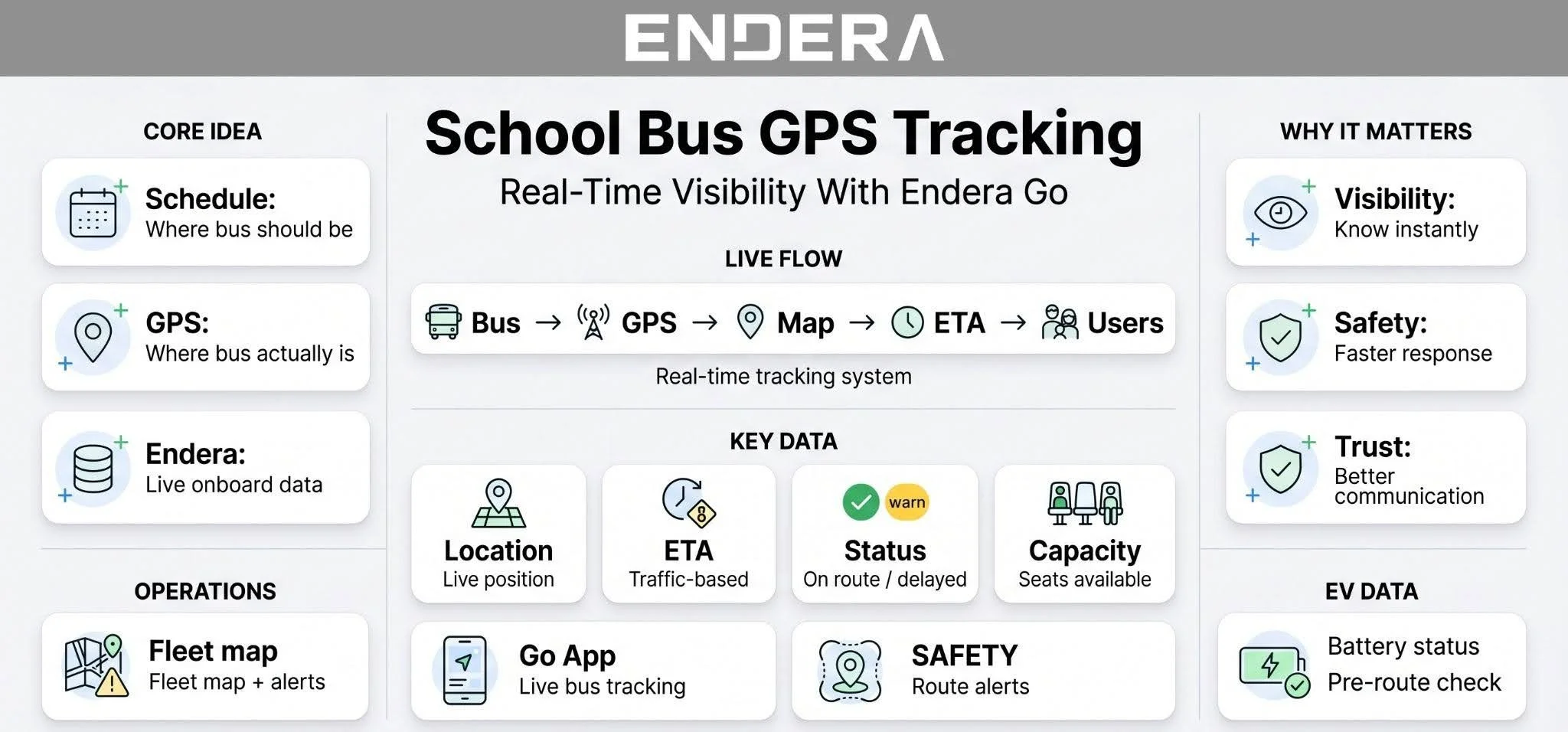
A bus schedule shows where a vehicle should be, but GPS tracking shows where it actually is. For transportation directors, real-time visibility enables proactive oversight instead of reacting to issues like delays or route deviations after parent complaints. Endera integrates GPS and fleet tracking directly into its vehicles, providing native data rather than relying on external devices.
Why "A Dot on a Map" Isn't Enough
Real-time location is the baseline, not the full picture. Transportation directors need to know not just where each bus is, but whether it's on route, running on schedule, operating within designated zones, and — for electric vehicles — what charge it has remaining before its next run. A GPS system that shows position without context doesn't reduce the management burden; it just replaces one kind of guesswork with another. The software layer that surrounds location data is what determines whether a tracking system is operationally useful or just a map.
Evaluating GPS tracking options for your district or fleet? Endera's team can show you how the platform works in practice and how it compares to what you're running today.
How Endera Go Works
Onboard Technology, Not an Add-On Device
Endera Go is the passenger- and operator-facing component of Endera's integrated software platform. It is powered by onboard technology and Google API, meaning the location data it displays comes from hardware built into the vehicle — not a third-party telematics device plugged into a port after delivery. When a vehicle appears in the Go app, it is on the road. The position is live, continuously updated, and pulled from the same system that powers Endera Dispatch on the fleet management side.
Precise ETAs, Not Schedule Estimates
Endera Go provides precise estimated arrival times based on actual vehicle position and current traffic conditions. For transportation coordinators and parents tracking a bus approaching a school or a stop, the distinction between a live ETA and a scheduled time matters — especially when traffic, weather, or an earlier stop has shifted the timing. The system updates continuously, so the ETA a rider sees when they open the app reflects what is actually happening on the road at that moment.
Available Seats and Vehicle Details
Beyond location and ETA, Endera Go surfaces occupancy data — the number of available seats on nearby or upcoming vehicles — along with stop count and time to the next stop on the route. For school and campus shuttle operations running multiple vehicles on overlapping routes, this level of detail lets passengers and coordinators make informed decisions about which vehicle to board rather than waiting on a bus that may already be at capacity.
What Fleet Managers See on the Dispatch Side
Real-Time Route Mapping and Traffic Adaptation
Endera Dispatch is the operator-facing platform that runs alongside Go. It maps every active route in real time using GPS-powered tracking, adapting to traffic patterns and route changes as they occur. A bus that has deviated from its planned route shows up immediately — not after the run is completed and a log is reviewed. This live mapping feeds into the route performance data that transportation directors use to evaluate whether existing routes are working or need adjustment.
Geofence Management and Compliance
Dispatch includes geofence management that provides perimeter tracking and speed monitoring across the fleet. For school bus operations, geofencing serves both safety and compliance functions — confirming that buses are operating within designated zones, flagging when a vehicle exits a defined area, and providing the documented location history that some state and district compliance requirements call for. These alerts are configurable, so transportation directors receive notifications on the events that matter to their specific operation rather than constant system noise.
State of Charge Visibility for Electric Fleets
For districts running electric school buses, Dispatch adds a layer of visibility that ICE-only fleet management platforms don't address: real-time state of charge across every electric vehicle in the fleet. Knowing what charge each bus has before a route begins — and monitoring that charge during the run — lets transportation directors assign routes to vehicles with adequate range rather than discovering a range problem at dispatch. This is not a feature that can be retrofitted through a third-party telematics device; it requires native access to the vehicle's powertrain data, which Endera's in-house software has by design.
GPS Tracking Across Different School Transportation Contexts
School Districts: Route Oversight and Parent Communication
For school district transportation departments, GPS tracking serves two distinct audiences simultaneously. Transportation coordinators need fleet-wide visibility — where every bus is, whether routes are running on time, and whether any vehicle needs attention. Parents need stop-level information — when their child's bus will arrive and confirmation that the bus is actually on the road.
Endera Go addresses both in a single platform: the coordinator sees the full fleet view through Dispatch while parents and students access real-time location and ETA through the Go app without requiring access to the operational dashboard.
Special Education and ADA Routes
Special education transportation operates under tighter accountability requirements than general education routes. Families of students with disabilities rely on precise pickup and drop-off timing, and transportation coordinators managing these routes need a higher degree of visibility into individual bus positions and schedule adherence.
Real-time GPS tracking on these routes reduces the volume of status calls that transportation staff handle daily and gives families a direct way to see where a bus is rather than waiting on a callback. Endera's Type A school buses — the Endera 4, 5, and 6 — are configurable with ADA-compliant lifts and securement systems, and the GPS platform applies to these vehicles exactly as it does to standard routes.
Campus Shuttle and Last-Mile Operations
For universities, hospitals, and corporate campuses operating shuttle programs that include school-age passengers or connect to school transit networks, the same tracking infrastructure applies. Endera Go was built for multi-agency and multi-route environments — it supports navigation across local and nationwide transportation agencies, allowing organizations that operate shuttle programs alongside or in coordination with public transit to provide riders with consistent, accurate location data across the full route picture.
The Integration Advantage: Software Built With the Vehicle
Why Third-Party Telematics Creates Gaps
Most school bus fleets that add GPS tracking after vehicle purchase do so by installing a third-party hardware device and subscribing to a separate software platform. That model works at the location level — the device reports a position — but it creates gaps everywhere the tracking system needs to interact with the vehicle's own data.
Speed data comes from the device's own sensors, not the vehicle's drivetrain. Battery status for electric buses isn't accessible. Maintenance signals require a separate integration that may or may not be current. Each gap is a place where the platform shows something less accurate than what the vehicle actually knows.
Endera's Approach: One System, One Data Source
Because Endera Dispatch and Endera Go are developed in-house alongside the vehicles they run on, the data they surface is native. The GPS position, the route performance data, the state-of-charge information, and the maintenance signals all come from the same source — the vehicle's onboard hardware — without translation through a third-party layer. For transportation directors evaluating GPS tracking options, this integration is what makes Endera's platform different from a telematics subscription added to a bus it was never designed to work with.
Custom Reporting at No Additional Cost
Dispatch includes custom reporting tools available without an additional subscription fee. Transportation directors can configure reports around route performance, on-time metrics, vehicle health, and charge cycle data — the operational outputs that district administrators, school boards, and state compliance offices regularly ask for. The data is already in the system; the reporting layer makes it accessible in the format each user needs.
GPS Tracking Is Only as Useful as the Data Behind It
A GPS tracking system that shows a position is better than one that doesn't. But for school transportation operations — where route adherence, student safety, parent communication, and fleet readiness all depend on accurate, real-time information — the quality of the underlying data determines how much the system actually changes daily operations. Endera builds tracking into the vehicle from the start, not as a subscription layered on afterward, so the data transportation directors and families rely on reflects what the bus actually knows.
Reach out to Endera's team to discuss how Endera Go and Dispatch fit your district's or organization's fleet.
FAQs
1. What is Endera Go and how does it work for school bus tracking?
Endera Go is the passenger- and operator-facing app in Endera's integrated software platform. Powered by onboard vehicle technology and Google API, it provides real-time bus location, precise ETAs based on live traffic conditions, available seat counts, and stop-by-stop timing. Because it runs on hardware built into the vehicle rather than a third-party add-on device, the data it displays is live and accurate — if a vehicle appears in the app, it is on the road.
2. Can parents track their child's school bus in real time with Endera Go?
Yes. Endera Go is available on iOS and Android and provides real-time vehicle location and ETA information accessible to riders and parents. The app updates continuously based on actual vehicle position and current traffic conditions, giving families accurate timing data rather than scheduled estimates that may not reflect what's happening on the road.
3. How does Endera Dispatch differ from Endera Go?
Endera Go is the rider- and parent-facing app. Endera Dispatch is the fleet management platform for transportation directors and operations staff — providing full fleet-wide visibility, geofence management, route performance data, speed monitoring, and state-of-charge tracking for electric vehicles. Both run on the same integrated platform and share the same data source.
4. Does Endera's GPS tracking work for electric school buses specifically?
Yes — and it goes further than standard GPS tracking for EV fleets. Endera Dispatch provides real-time state-of-charge visibility for electric buses, drawing directly from the vehicle's powertrain data. This allows transportation directors to assign routes based on actual available range, not estimated range, before a run begins.
5. What geofencing capabilities does Endera Dispatch include?
Dispatch includes geofence management with configurable perimeter tracking, speed monitoring, and zone-entry alerts. Transportation directors can define operational zones for each vehicle or route and receive notifications when a bus exits a designated area. Historical location data supports compliance documentation where state or district requirements call for it.
6. Is Endera Go available for campus shuttle and non-school transportation programs?
Yes. Endera Go supports multi-agency and multi-route environments and is used across airport, corporate campus, university, and hospitality shuttle operations — not only school district fleets. The platform is built to work wherever Endera vehicles are deployed.
7. Does Endera charge extra for GPS tracking and software features?
Endera Go and Dispatch come available with every Endera commercial vehicle. Custom reporting tools within Dispatch are available at no additional cost. The software relationship is maintained through Endera regardless of whether the vehicle was purchased directly or through a dealer partner.