
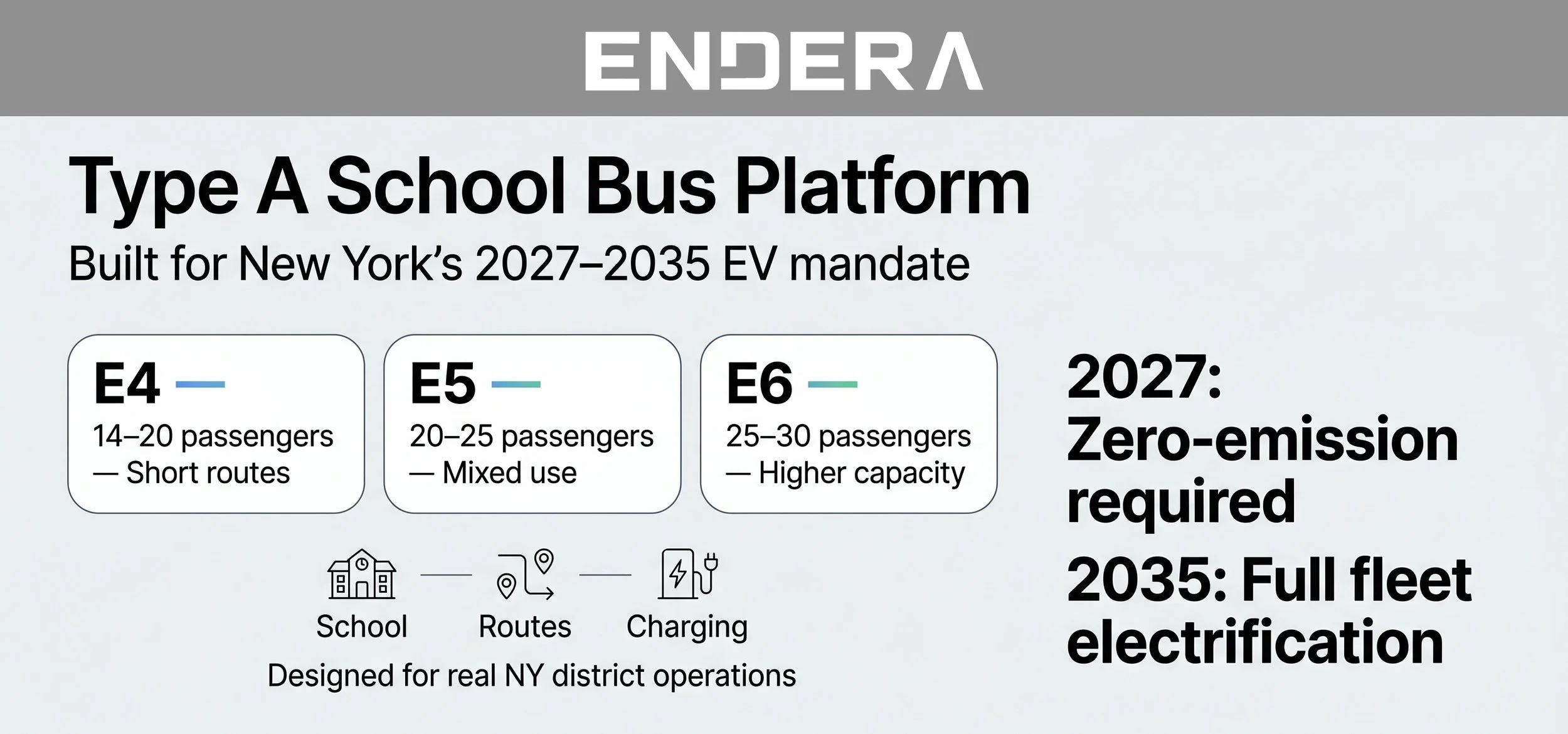
New York has set some of the most aggressive school bus electrification targets in the country. The state's mandate requires all new school bus purchases to be zero-emission by 2027, with full fleet electrification required by 2035. For districts across the state — from Long Island suburbs to upstate rural routes — that timeline is no longer a distant planning horizon. It's an active procurement decision with funding cycles, infrastructure requirements, and vendor relationships that need to be in place well before the deadlines arrive.
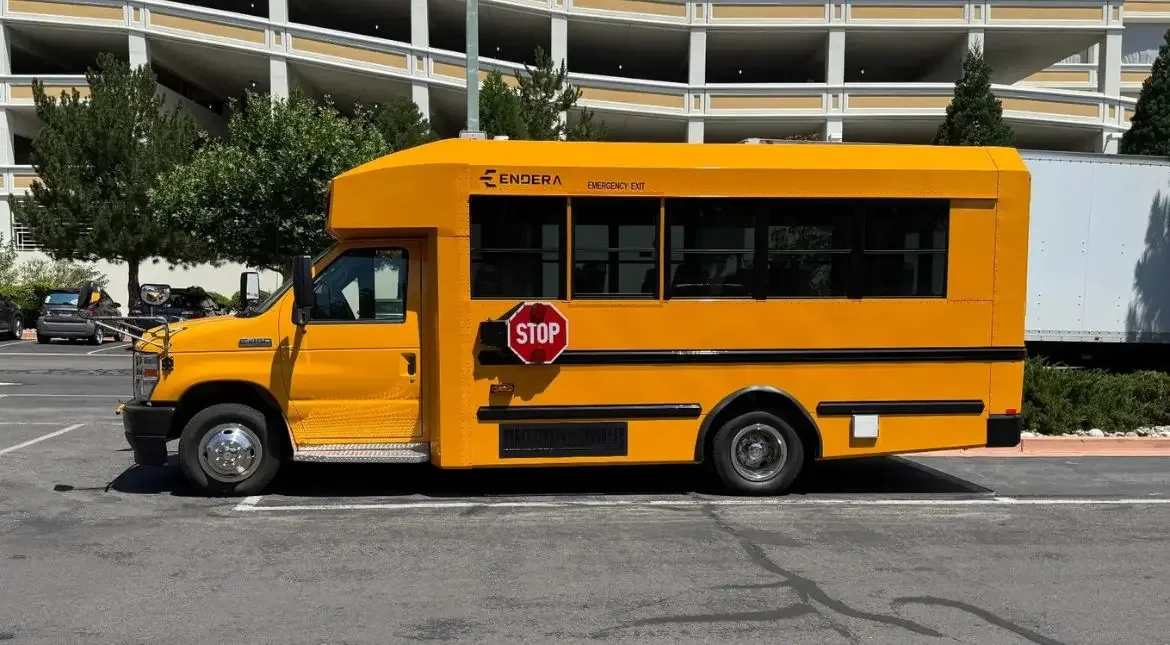
Endera's Type A school buses — the Endera 4, 5, and 6 — are available in full electric configurations and built to support exactly this kind of transition. They're manufactured at a domestic facility with the supply chain credentials needed for federally funded contracts, backed by a grant advisory team that knows how to navigate the funding landscape, and configurable enough to serve the full range of routes New York districts actually run.
New York's School Bus Mandate: What Districts Need to Know
The 2027 and 2035 Deadlines Are Real
New York's Advanced Clean School Bus regulation sets a clear trajectory: zero-emission buses only for new purchases starting in model year 2027, full fleet conversion by 2035. The New York State Energy Research and Development Authority (NYSERDA) administers several programs specifically designed to help districts make that transition — including rebates and funding for both vehicles and charging infrastructure. Districts that engage with these programs early tend to access more funding and face fewer logistical constraints than those that wait until the deadline pressure builds.
Type A Buses Are Central to NY's Transition
Type A buses — the smaller, cutaway-based models used for special education routes, rural low-ridership runs, and smaller districts — are often overlooked in statewide electrification conversations that tend to focus on full-size yellow buses. But they represent a meaningful share of fleet purchases across New York, particularly in districts where specialized transport is the primary use case. Electrifying the Type A segment first often makes practical sense: shorter routes, lighter vehicles, and smaller battery requirements mean lower upfront cost and faster return on investment compared to larger bus categories.
The Endera Type A Lineup for New York Districts
Three Models, Configured for NY Route Realities
The Endera 4, 5, and 6 cover 14 to 30 passengers across 4 to 6 section configurations, with options for standard seating, ADA-compliant wheelchair lifts, and storage layouts suited to specialized transport needs. That configurability matters in New York, where special education transportation is a significant portion of Type A bus use and accessibility requirements are non-negotiable. Both Ford and Chevrolet cutaway chassis are available, giving districts flexibility in their procurement and ongoing service relationships.
Manufactured to Support Buy America Compliance
New York districts accessing federal funding — through the EPA Clean School Bus Program, FTA grants, or other sources — need vehicles that meet Buy America requirements. Endera's Ottawa, Ohio facility sources approximately 65% of its components domestically, supporting compliance with these standards. That's a practical procurement advantage that narrows the field of eligible manufacturers considerably for federally funded New York purchases.
Mandate vs. Operational Reality: What It Actually Means for Your Routes
Most Districts Are Better Positioned Than They Think
New York’s 2027 and 2035 deadlines depend on route-level feasibility, not just policy. NYSERDA reports the average school bus travels about 80 miles per day—well within typical EV range—making many routes viable for electrification. With buses returning to depots, 6–11 hours of overnight charging is also standard and practical.
Where It Gets More Complex
Districts with rural or dispersed routes face tighter constraints due to longer distances, route variability, and fewer backup vehicles, which increase planning complexity. Infrastructure is also a hurdle, requiring utility coordination and potential grid upgrades that can delay deployment. Workforce readiness adds another layer, as maintenance teams must transition to high-voltage systems and drivers learn range and charging management. While mandates set the destination, route design, infrastructure, and operations determine how smoothly districts can get there.
Real-World Charging and Route Compatibility for NY Operations
Matching the Vehicle to the Route, Not the Spec Sheet
New York’s school bus routes vary widely, from dense urban pickups in NYC to 40-mile rural routes in the North Country. U.S. Department of Energy guidance emphasizes matching EV buses to real route profiles, especially during early adoption as infrastructure develops. Most New York routes average under 100 miles per day—within Endera’s electric Type A range—but charging windows are just as important. Mid-day dwell times of 2–4 hours enable meaningful recharge, supported by Endera’s DC fast charging standard even in multi-cycle operations.
Cold Weather and Infrastructure Realities
New York's winters create real range considerations that districts in warmer climates don't face to the same degree. Cabin heating draws battery power, and cold temperatures affect overall battery performance — factors that need to be built into route planning and charge scheduling, not discovered after delivery. Endera's fleet management platform, including state-of-charge monitoring through Endera Dispatch, gives transportation directors the visibility to manage these variables in real time rather than responding to them after a bus runs short on a route. The EPA notes that federal funding programs explicitly include charging infrastructure because deployment success depends on it — districts pursuing NY state funding should factor infrastructure readiness into their timelines from the start.
Funding the Transition in New York
What's Available and How to Access It
New York districts can stack multiple incentives for electric school buses. The EPA Clean School Bus Program provides major federal grants, NYSERDA adds state rebates, and the NY Truck Voucher Incentive Program (NYTV) offers additional point-of-sale support. Together, these programs can significantly reduce the upfront cost gap versus diesel Type A buses.
Endera's Grant Advisory Team Navigates the Paperwork
Stacking multiple funding sources requires coordination across application timelines, eligibility criteria, and compliance documentation — work that most district transportation offices aren't staffed to absorb. Endera's financing and grant advisory team manages that process on behalf of districts, identifying every program they qualify for and handling the application paperwork. With more than $20 billion in available federal, state, and local EV subsidies in play nationally, getting the funding right before procurement closes is as important as choosing the right vehicle.
Total Cost of Ownership: The NY District Perspective
Upfront Cost vs. Long-Term Operating Reality
Electric buses have a higher upfront cost than ICE alternatives, but the long-term operating savings shift the equation. The Electric School Bus Initiative notes lower and more stable energy costs, reduced maintenance due to fewer moving parts, and less brake wear from regenerative braking. For New York districts facing the 2027 mandate, the focus is less on whether to transition and more on how to do it cost-effectively over the fleet’s full lifecycle.
Type A Routes Accelerate the Return on Investment
| Cost Factor | ICE | Propane | CNG | Electric |
|---|---|---|---|---|
| Upfront cost | Low | Medium | Medium | High |
| Fuel cost | High | Lower | Lower | Lowest |
| Maintenance | Medium | Lower | Medium | Lowest |
| 10-year TCO | — | — | — | Often lowest |
Type A routes are particularly well suited to electrification from a financial standpoint. Shorter distances and lighter vehicle weight mean smaller battery packs are needed, which reduces upfront cost relative to full-size electric buses and accelerates payback on the initial investment. For New York districts running specialized transport routes — often the shortest and most predictable in the fleet — the Type A EV is often the most financially defensible first step in a broader electrification plan.
Built for the Transition New York Is Already In
New York's electrification mandate isn't coming — it's here. Districts that start procurement conversations now have access to more funding, more configuration flexibility, and more time to get infrastructure right before the 2027 deadline tightens the field. Endera's Type A lineup is built to support that transition, with the domestic manufacturing credentials, grant advisory capacity, and vehicle configurability that New York routes actually require.
Visit enderamotors.com, call +1 (419) 523-3593, or email hello@enderacorp.com to talk with an Endera expert about procurement options for your New York district.
FAQs
What is New York's school bus electrification mandate?
New York requires all new school bus purchases to be zero-emission starting in model year 2027, with full fleet electrification required by 2035. The NY Department of Environmental Conservation and NYSERDA administer related programs and incentives for districts making the transition.
Which Endera models are available for New York districts?
The Endera 4, 5, and 6 are all available in full electric configurations, as well as ICE, propane, and CNG variants for districts not yet ready to fully electrify. All three models support ADA-accessible configurations for special education transport.
Do Endera buses qualify for New York state funding programs?
Endera's electric Type A buses are eligible for programs including the EPA Clean School Bus Program, NYSERDA's Electric School Bus Initiative, and the NY Truck Voucher Incentive Program. Endera's financing team can help identify and apply for all applicable programs.
Do Endera buses meet Buy America requirements for federally funded contracts?
Yes. With approximately 65% of components sourced domestically, Endera's manufacturing model supports Buy America compliance for federally funded school bus procurement.
How does Endera support districts planning charging infrastructure?
Endera provides turnkey charging infrastructure services including site assessments, charger procurement, and installation — as well as state-of-charge monitoring through Endera Dispatch to support operational management of EV fleets once deployed.
How does cold weather affect Endera's electric Type A buses?
Cold temperatures and cabin heating draw additional battery power, which affects effective range. Endera's fleet management software provides real-time state-of-charge visibility to help transportation directors account for these variables in route planning and charge scheduling.
How do I start the procurement process for a New York school district?
Contact Endera's sales team directly to discuss model configuration, funding eligibility, and timeline. Early engagement — ideally before an RFP is issued — gives districts the most flexibility in aligning vehicle specs, infrastructure planning, and grant applications.