

Fleet buyers searching for a diesel shuttle bus are asking a performance question before they're asking a fuel question. What they want is a commercial vehicle that handles sustained daily use
without performance degradation — the kind of durability that's made diesel the default in heavy-duty transport for decades. The fuel type is a means to that end, and in 2026, it's no longer the only way to get there.
Endera builds heavy-duty B-Series commercial shuttles in gasoline, propane, CNG, and electric configurations — the full spectrum of ICE and zero-emission options for operators prioritizing commercial-grade reliability. Each powertrain is built on the same Ford E450 cutaway platform, engineered for the load cycles, daily mileage, and operational demands that define commercial shuttle use.
Why Diesel Has Dominated Commercial Shuttle Fleets
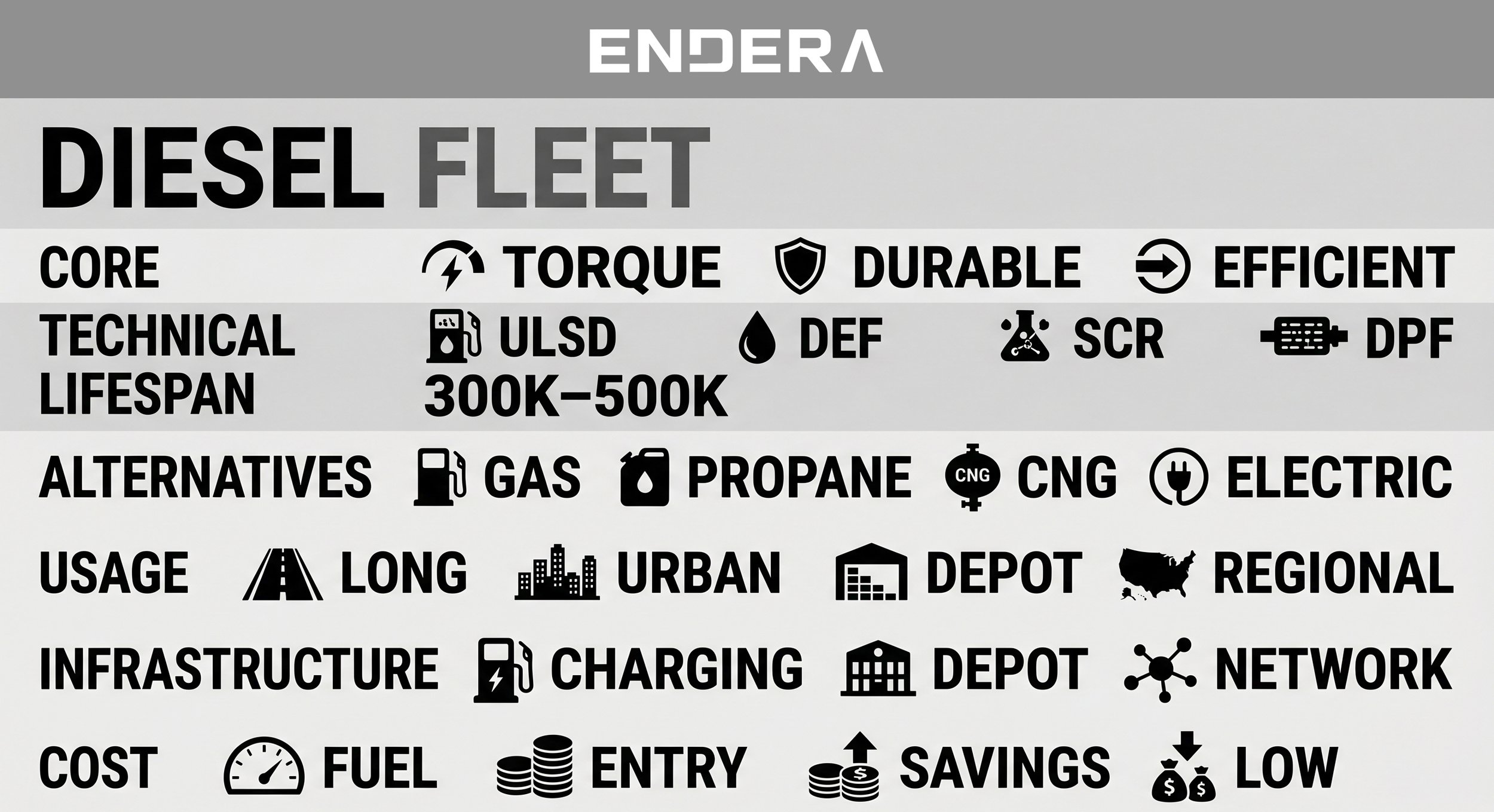
Diesel engines generate torque through compression ignition rather than spark ignition — a process that produces more rotational force at lower RPMs compared to gasoline engines. For a shuttle bus carrying 12–16 passengers through stop-and-go urban routes, airport loops, or sustained highway segments, that low-end torque means the drivetrain isn't working against itself under load. Diesel engines are also 30–35% more fuel-efficient than comparable gasoline engines in heavy-duty applications, which compounds across a fleet running multiple shifts per day.
The durability case is equally well-documented. Diesel engines have thicker cylinder walls, larger pistons, and fewer electrical components than gasoline equivalents — characteristics that extend service intervals and reduce failure points under sustained commercial duty. A well-maintained diesel commercial vehicle regularly reaches 300,000–500,000 miles before major drivetrain work, which is why high-mileage diesel fleets are the norm rather than the exception in airport and hospitality transport.
Modern Diesel Is Not the Diesel of 20 Years Ago
The emissions objection to diesel — the black smoke, the particulate concerns — reflects an older technology baseline. Since 2010, EPA diesel standards have required all highway diesel vehicles to use ultra-low sulfur diesel (ULSD), a fuel with a maximum sulfur content of 15 parts per million, down from 500 ppm under prior standards. Combined with diesel particulate filters (DPF) and selective catalytic reduction (SCR) systems now standard on modern engines, EPA standards have collectively reduced harmful emissions from onroad diesel sources by more than 90%.
Diesel exhaust fluid (DEF) is part of this system — a urea-based solution injected into the exhaust stream that converts nitrogen oxides into harmless nitrogen and water vapor. Modern diesel shuttle buses running ULSD with DPF, SCR, and DEF systems are operating at emission levels that would have been unrecognizable to operators from the pre-2007 era. For fleet buyers citing environmental concerns as a reason to avoid diesel, the technology has largely addressed the problem that prompted those concerns.
Where Diesel Still Has the Advantage
For buyers genuinely evaluating diesel against alternatives in 2026, the operational case holds in specific scenarios. Routes exceeding 150 miles per shift, operations in areas without charging infrastructure, and fleets requiring immediate fueling turnaround rather than overnight charging windows all favor diesel's energy density and refueling speed. Diesel also carries the most mature parts and service ecosystem of any commercial vehicle fuel type — any commercial fleet mechanic knows the platform.
The total cost of ownership picture is where the comparison gets more nuanced. Diesel's upfront cost advantage over electric narrows when grant funding is available, and its per-mile fuel cost advantage over propane and CNG has narrowed as those fuels have matured. For operators on fixed urban routes under 100 miles per shift, propane and CNG deliver diesel-level reliability at lower per-mile fuel cost, and electric delivers the lowest operating cost of all for fleets with charging access.
Endera's Heavy-Duty ICE Options: What Buyers Are Actually Choosing
Endera's B-Series lineup covers the ICE powertrain range that heavy-duty shuttle buyers are evaluating. Gasoline on the Ford E450 platform delivers the familiar reliability of the most serviced commercial chassis in the country — universal parts availability, Ford dealer network coverage, and a drivetrain that operators and mechanics know. For buyers accustomed to diesel's durability but open to alternatives, propane and CNG on the same platform deliver comparable heavy-duty performance with lower fuel costs per mile and cleaner emissions profiles.
| Powertrain | Best For | Key Advantage |
|---|---|---|
| Gasoline | Variable routes, smaller fleets, universal service needs | Lowest barrier to entry; widest service network |
| Propane | Consistent daily routes, suburban/rural operations | 30–40% lower fuel cost vs gasoline; mature infrastructure |
| CNG | High-mileage urban fleets, operators with depot fueling | Lowest per-mile fuel cost of ICE options |
| Electric | Fixed urban/suburban routes under 100 miles/shift | Lowest total operating cost; eligible for federal incentives |
Endera's financing options cover all powertrain types, and the grant navigation team can identify whether federal or state incentive programs apply to a specific purchase — particularly relevant for electric models where acquisition cost offsets are available.
Choosing the Right Heavy-Duty Configuration
The right powertrain for a heavy-duty shuttle operation depends on three factors: route length, fueling infrastructure, and procurement budget. Diesel buyers who arrive at Endera's lineup typically end up in one of two places — gasoline for its familiarity and service accessibility, or propane/CNG for its fuel cost advantage on high-mileage routes. Electric is the right answer for operators with the infrastructure and the procurement timeline to capture the long-term savings.
What doesn't change across any of these configurations is the chassis and body engineering. Every B-Series shuttle is built on the Ford E450 cutaway platform with the same structural specifications, ADA lift options, and commercial-grade interior build — the durability case that diesel buyers were making is built into the platform, not the fuel type.
Built for the Work
Endera builds commercial shuttles for operators who can't afford downtime — hotels running 18-hour airport loops, corporate campuses on four-shift daily schedules, municipal demand-response routes that run regardless of weather. The B-Series platform was engineered for that operating environment, and the powertrain options are matched to the different fueling realities those operators work within.
For buyers ready to discuss configurations, compare powertrain options for their specific route profile, or review in-stock vehicles available for immediate delivery, contact Endera's sales team at (419) 796-6080 or sales@enderacorp.com.
Frequently Asked Questions
Why don't commercial shuttle buses use diesel as commonly as large transit buses?
Large transit buses use diesel because their size and sustained mileage demands favor its energy density and long engine life. Class 4 shuttles in the 23–28 foot range operate at lower GVWRs and shorter duty cycles where gasoline, propane, and CNG deliver comparable reliability without diesel's added maintenance complexity. The fuel economics shift in diesel's favor primarily at higher vehicle weights and sustained highway mileage profiles.
What is ultra-low sulfur diesel (ULSD) and why does it matter?
ULSD is highway diesel with a maximum sulfur content of 15 ppm — down from 500 ppm before 2006. The EPA required all highway diesel vehicles to run ULSD beginning in 2010. Combined with diesel particulate filters and selective catalytic reduction systems, EPA standards have collectively reduced harmful onroad diesel emissions by more than 90% compared to pre-2007 baselines.
How does propane compare to diesel for a commercial shuttle operation?
Propane delivers 30–40% lower fuel costs than gasoline with a significantly cleaner emissions profile than diesel. For Class 4 shuttle operations, propane's power output is sufficient for full passenger loads on standard commercial routes. The fueling infrastructure is mature across suburban and rural markets, and propane on commercial cutaway chassis has a long track record in hotel and airport shuttle applications.
What maintenance differences should operators expect with CNG vs. diesel?
CNG engines generally have longer service intervals because natural gas burns cleaner and produces less combustion byproduct — reducing carbon buildup and extending oil life. The tradeoff is infrastructure: CNG requires on-site fueling or proximity to a public CNG network. For fleets already running CNG, the maintenance profile is an advantage; for fleets starting fresh, the infrastructure investment is the primary evaluation factor.
Is there federal funding available for non-diesel commercial shuttle purchases?
Yes. Electric models may qualify for direct federal incentive programs depending on the buyer's classification and location. The EPA's DERA program funds diesel fleet upgrades and replacements, while HVIP in California and other state programs support CNG, propane, and electric transitions. Endera's grant navigation team can assess program eligibility as part of the purchase process.
How does Endera's gasoline B-Series compare to a diesel shuttle in terms of durability?
Shuttle durability is driven mCan Endera's ICE shuttles handle the same duty cycles as a diesel commercial shuttle?ore by chassis engineering than fuel type. Endera's B-Series runs on the Ford E450 DRW — a commercial-grade chassis with heavy-duty suspension, four-wheel disc brakes with ABS, and dual rear wheels rated for 14,500 lbs GVWR. That structural baseline is identical across gasoline, propane, CNG, and electric variants, with the E450 platform known for reaching 200,000–300,000 miles under regular fleet maintenance.
Can Endera's ICE shuttles handle the same duty cycles as a diesel commercial shuttle?
Yes, for Class 4 shuttle applications. Endera's B-Series ICE models are built for the load cycles, daily mileage, and passenger configurations typical of hotel, airport, campus, and corporate operations. The performance difference between gasoline/propane/CNG and diesel becomes significant primarily in heavier Class 6–8 vehicles on sustained freight routes — not in Class 4 passenger shuttle use.