

Most school bus fleet management software is sold separately from the vehicle — a third-party telematics platform that has to be installed, configured, and integrated with hardware it wasn't designed for. The data gap between what the vehicle is doing and what the software reports is a known limitation of that model, and it's where operational visibility breaks down. Endera builds its fleet management software in-house and integrates it directly with the vehicle's hardware at the manufacturing stage — which means the software and the vehicle are a single product, not two products that have to be made to work together.
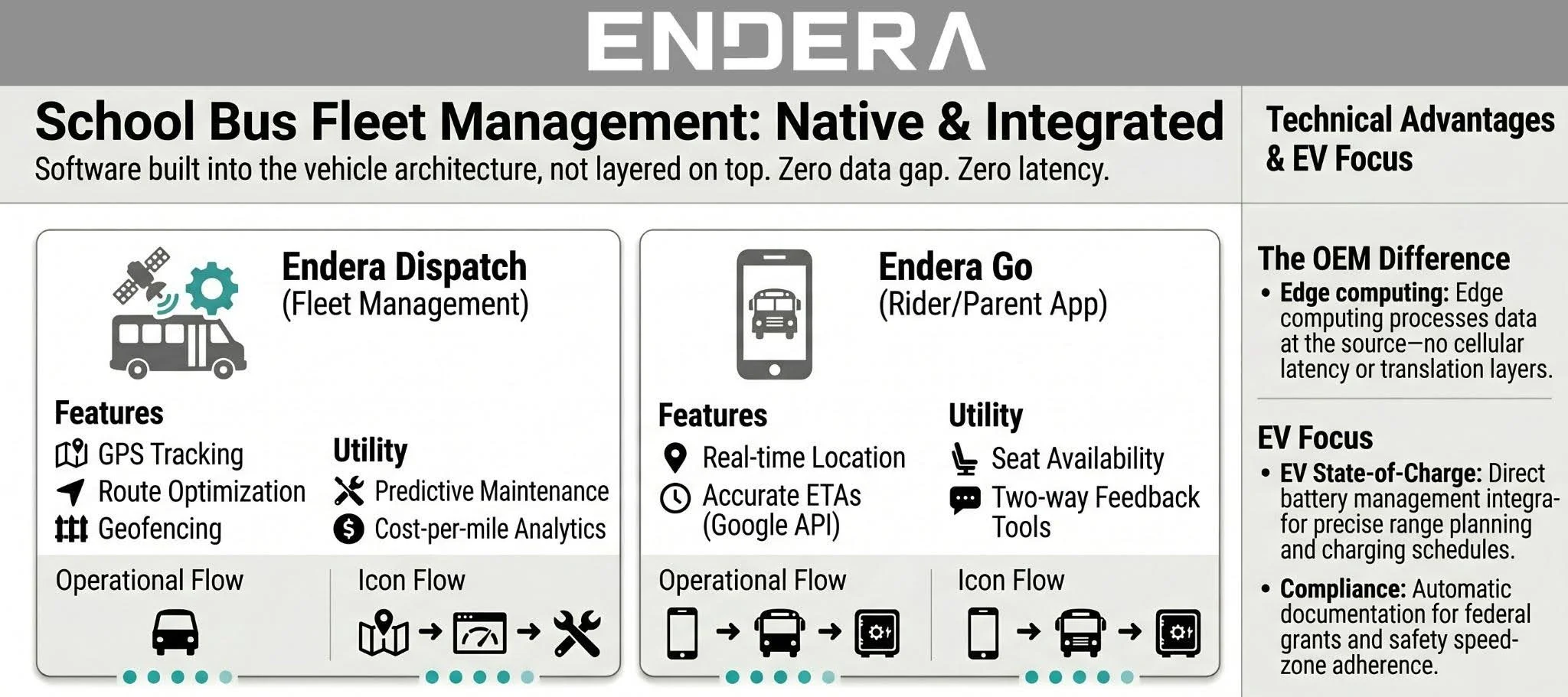
Endera's software stack has two components built for two different users. Endera Dispatch is the fleet management side — GPS tracking, route optimization, vehicle health analytics, geofence management, and state-of-charge monitoring for electric vehicles. Endera Go is the rider-facing side — real-time bus location, accurate ETAs powered by Google API, seat availability, and rider feedback tools. Both sit on the same integrated platform and draw from the same real-time vehicle data.
Ready to see what integrated fleet software looks like in practice? Contact Endera's fleet specialists today to discuss your fleet's specific data needs and how Dispatch and Go work alongside Endera's vehicle lineup.
What Transportation Directors Actually Need From Fleet Software
The Gap Between Knowing and Acting
Transportation directors managing school bus fleets spend a significant portion of their day responding to information they should have had before the problem developed — a bus running late on a route, a maintenance issue that wasn't flagged, a driver deviation that went unnoticed. Generic fleet software installed on top of a third-party telematics device can show location, but it rarely provides the vehicle-level operational data that lets a transportation director get ahead of problems rather than respond to them. The question isn't whether the bus is on the map — it's whether the software is telling you anything useful about what the bus is doing and how it's performing.
What Changes When the Software Is Built Into the Vehicle
Endera Dispatch is built on AI and edge computing, with onboard hardware processing real-time vehicle data before it reaches the dispatch interface. That architecture means the system isn't dependent on a cellular connection to process and report vehicle health — data is processed at the source. For fleet managers running school bus routes in areas with variable connectivity, that distinction matters. Route performance, vehicle health, and driver behavior data flows into the dispatch dashboard without the latency and data quality issues that come from a third-party telematics overlay.
Endera Dispatch: What It Does for Fleet Managers
Real-Time GPS Tracking and Route Optimization
Endera Dispatch maps every route in real-time using GPS, adapting to traffic patterns, route changes, and operational needs as they develop. Dispatchers see where every vehicle is, whether it's on schedule, and how the route is performing against historical benchmarks — not a snapshot from two minutes ago, but live vehicle position integrated with route data. For transportation directors managing multiple school bus routes simultaneously, that visibility is what makes proactive dispatch decisions possible rather than reactive ones.
Geofence Management and Compliance Monitoring
Geofence tools within Dispatch provide perimeter tracking and speed monitoring across defined zones — school campuses, pickup corridors, restricted areas. Alerts trigger when a vehicle crosses a geofence boundary or exceeds a speed threshold, giving transportation administrators real-time awareness of compliance without manually reviewing trip logs after the fact. For districts with safety policies around school zone speed limits or authorized route deviations, geofencing provides automatic documentation of adherence rather than relying on driver self-reporting.
Vehicle Health Analytics and Predictive Maintenance
Dispatch aggregates vehicle health data from onboard hardware and surfaces it through the fleet management dashboard — engine performance, component diagnostics, and maintenance indicators that allow transportation departments to schedule service proactively rather than responding to breakdowns. For electric school bus fleets, state-of-charge monitoring is integrated into the same dashboard, allowing route planners to assign vehicles based on actual battery availability rather than estimated range. A bus flagged for service or showing low charge doesn't get assigned to a route it can't complete.
Reporting and Cost-Per-Mile Analytics
Dispatch generates custom reports on vehicle utilization, cost-per-mile, fuel or energy consumption, and route efficiency — the data that transportation directors need when presenting fleet performance to school boards, justifying capital requests, or building the operational case for electrification. For districts using federal grants for vehicle purchases, the utilization and performance documentation Dispatch generates supports the reporting requirements that come with federally funded procurement.
Why Integrated Software Matters More for Electric Fleets
State-of-Charge Is an Operational Variable, Not Just a Battery Metric
For school districts transitioning to electric buses, the most common operational concern isn't range per se — it's whether the transportation department has the visibility to manage range across a fleet without it becoming a daily crisis. Endera Dispatch's state-of-charge monitoring addresses this directly: every electric vehicle's battery status is visible in the same dashboard as route assignments, vehicle health, and GPS position. Route planners assign vehicles based on what the data shows rather than what the driver estimates.
Charging Schedule Integration
For EV fleets operating on school schedules — predictable daily departure times, overnight depot charging windows — Dispatch provides the data needed to optimize charging schedules against route requirements. A vehicle returning from afternoon routes with 35% remaining charge doesn't need to be fast-charged for the next morning if it can fully charge overnight on Level 2. That visibility reduces energy costs and preserves battery chemistry over the vehicle's service life. For districts managing both ICE and electric vehicles on the same platform, Dispatch provides a unified fleet view rather than requiring separate systems for different powertrain types.
OEM-Integrated vs. Telematics Overlay: The Technical Distinction That Matters
How Traditional Telematics Actually Work
Most school bus fleet management platforms describe themselves as "integrated," but the word covers two meaningfully different architectures. In the traditional telematics model, fleet software is installed after vehicle production using external hardware modules that read signals from the vehicle's CAN bus and transmit them to cloud platforms.
The U.S. Department of Energy's FEMP telematics guide describes this architecture directly — telematics systems collect and transmit vehicle data via cellular networks to remote servers and a user interface, with the data originating from vehicle onboard diagnostics. That relay introduces a translation layer between the vehicle and the software, which can create latency, inconsistent signal interpretation across different chassis manufacturers, and partial visibility into real mechanical state data.
What OEM Integration Changes at the Architecture Level
An OEM-integrated system is designed as part of the vehicle's native architecture, where vehicle diagnostics, dispatch logic, and routing data all originate from the same embedded data environment. Instead of aggregating and interpreting external signals after the fact, the system processes operational data at the source.
Endera Dispatch uses AI and edge computing with onboard hardware that processes real-time data before it reaches the fleet management interface — the software and the vehicle share the same data pipeline because they were designed together. For school transportation departments managing EV fleets, this matters specifically for state-of-charge data, which a manufacturer-integrated system reports directly from battery management rather than approximating through an aftermarket module.
Why Fragmentation Matters for School Districts
In mixed-vehicle environments — where a district operates buses from multiple manufacturers — third-party telematics platforms must normalize data from different OEM protocols into a single dashboard view, which can produce inconsistent operational data and delayed maintenance visibility. For districts purchasing Endera vehicles, the software is not a separate licensing decision or an integration project. Vehicle health diagnostics, dispatch and routing logic, and real-time location tracking are unified in a single native data pipeline — the result is more reliable operational intelligence across the fleet lifecycle, from daily routing to long-term maintenance planning.
How Endera's Software Compares to Third-Party Fleet Management Platforms
What Generic Telematics Platforms Offer
Third-party fleet management platforms like Samsara, Verizon Connect, and GPS Insight are legitimate tools used across school transportation. They offer GPS tracking, route analytics, maintenance scheduling, and — through integrations with parent communication platforms like Transfinder — some rider-facing functionality. For districts with mixed fleets from multiple manufacturers, these platforms provide the standardization benefit of one system across different vehicle types.
Where Endera's Integrated Approach Is Distinct
The meaningful difference is integration depth. Third-party platforms pull data from telematics hardware installed on the vehicle, which introduces a layer of translation between what the vehicle is doing and what the software reports. Endera's Dispatch and Go are built on onboard hardware that processes vehicle data at the source — the software and the vehicle share the same data architecture because they were designed together. For Endera's electric fleet operators specifically, state-of-charge monitoring through Dispatch is a manufacturer-level integration, not a third-party approximation. For districts purchasing Endera vehicles, the software is not a separate licensing decision — it's part of the vehicle.
Software That Was Built for the Vehicle, Not Installed on Top of It
Most fleet management software is a third-party system layered onto a vehicle it wasn't designed for. Endera's Dispatch and Go platform is built into the vehicle at the manufacturing stage — the same data architecture powers both the onboard hardware and the fleet management interface. For school districts managing bus routes, EV fleets, or specialized transportation programs, that integration is the difference between a software tool and operational visibility.
Contact Endera's fleet specialists to learn more about Dispatch and Go, discuss your fleet's specific data needs, and find out how the software platform works alongside Endera's school bus and shuttle lineup.
FAQs
1. Does Endera Dispatch work for both ICE and electric school buses?
Yes. Dispatch provides fleet management across both ICE and electric Endera vehicles on a unified platform. For electric vehicles, state-of-charge monitoring is integrated alongside GPS tracking, vehicle health analytics, and route performance data. See the full software overview.
2. Is Endera Go available for parents as well as riders?
Yes. Endera Go is available as a consumer-facing app that provides real-time bus location, ETAs, and seat availability. For school transportation programs, it gives parents direct visibility into bus positions without requiring calls to the transportation office.
3. Does the software require a separate subscription or licensing fee?
Every Endera vehicle comes available with the Dispatch and Go platform integrated into the vehicle hardware. Contact Endera's sales team for current software terms and any applicable licensing details.
4. Can Endera Dispatch integrate with existing routing or student information systems?
Endera Dispatch is designed as an integrated platform with custom reporting and API capabilities. Contact Endera's team to discuss integration requirements for your district's specific systems.
5. How does Dispatch handle vehicle health monitoring for school buses?
Dispatch aggregates onboard vehicle health data and surfaces it in the fleet dashboard — maintenance indicators, component diagnostics, and for electric vehicles, battery health monitoring. Transportation directors can schedule service proactively based on what the data shows rather than waiting for a breakdown.
6. Does Endera Go support two-way communication with parents or riders?
Yes. Endera Go supports integrated rider feedback with operator-configurable engagement levels — from one-way service updates to two-way communication depending on the program's needs.
7. Is Endera's software available on vehicles purchased with federal transit funding?
Yes. Endera's vehicles — including the integrated software platform — are Buy America compliant and, for the electric B4, Altoona-certified. Both are required for vehicles purchased with FTA transit funding.