

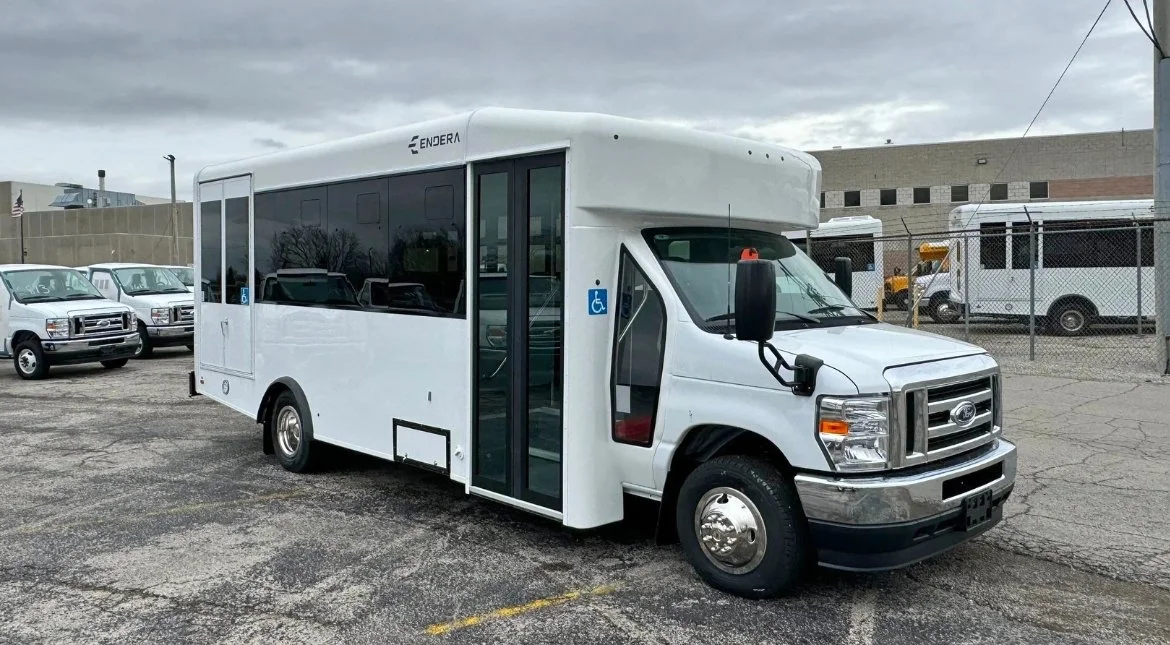
The difference between a GPS tracker and a fleet management platform is the difference between knowing where your vehicles are and knowing what to do about it. Basic tracking shows location. Intelligent fleet software predicts delays, dynamically optimizes routes, automates dispatch decisions, and surfaces the operational data that lets transportation managers make better decisions — in real time and across an entire fleet.
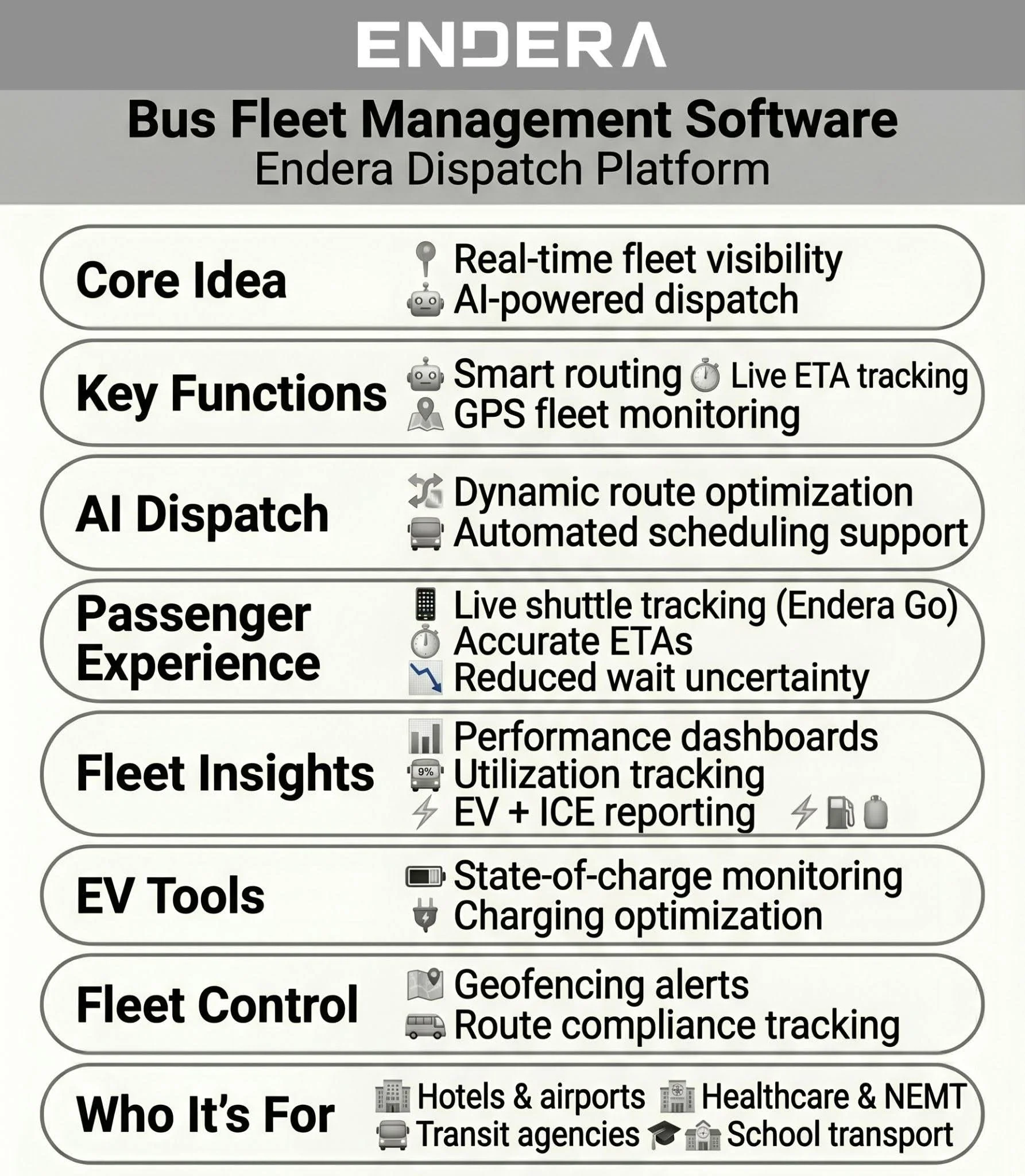
Endera Dispatch is Endera’s AI-powered fleet management platform built specifically for commercial shuttle and transit operations. It combines live GPS tracking, AI-powered routing, geofence management, state-of-charge monitoring for EV fleets, and custom reporting dashboards — all in a single platform developed in-house and supported directly by Endera.
Ready to deploy intelligent fleet management for your operation? Contact Endera’s fleet specialists today to discuss Dispatch configuration and onboarding for your fleet.
AI-Powered Dispatching: What It Actually Does
Most fleet software pages mention “AI” without explaining what it changes operationally. Research on AI-powered dispatch transformation in bus operations documents how automated dispatching reduces manual scheduling workload, improves route coordination, and surfaces conflicts before they become service failures. AI dispatching doesn’t replace the dispatcher — it reduces the cognitive load of managing multiple simultaneous route variables.
Endera Dispatch uses AI-powered routing that accounts for real-time traffic conditions, vehicle availability, and route load balancing across the fleet. Studies on demand-responsive transit optimization show that AI-assisted dispatching reduces wait times and operational costs in demand-response environments — the same environments that hotel shuttle, paratransit, and campus fleet operators run daily.
Dynamic Route Optimization
Static routes assigned at the start of a shift don’t account for what actually happens during the day — traffic incidents, passenger no-shows, vehicle delays, or demand spikes. Dynamic route optimization adjusts assignments in real time, redistributing load across the fleet as conditions change. For airport shuttle and healthcare transport operators running tight schedules, that adaptive capability reduces the cascading delays that fixed-route systems can’t absorb.
Real-Time ETA Tracking and Passenger Notifications
Passenger wait-time uncertainty is consistently the top driver of negative satisfaction scores in commercial shuttle and transit operations. An accurate ETA communicated proactively eliminates most of that friction — guests who know their shuttle is four minutes away behave differently than guests who don’t know if it’s coming at all.
Research on AI bus ETA prediction frameworks demonstrates how machine learning improves arrival time accuracy by incorporating historical route data, real-time traffic feeds, and vehicle-specific performance characteristics. Studies on traffic-based bus travel time prediction and surveys of public transit ETA systems establish that prediction accuracy improves significantly when systems account for traffic conditions at the route segment level rather than applying average travel times.
Endera Go: The Rider-Facing App
Endera Dispatch connects to the rider-facing Endera Go app, which provides passengers with live vehicle location and ETA powered by Google API. Only vehicles confirmed active on a route appear in the app — preventing passenger confusion from inactive or off-route vehicles showing on the map. For hotel, airport, and campus operators, that real-time visibility directly reduces front desk calls and lobby wait-time complaints.
Fleet Reporting and Analytics
Operational data that doesn’t surface as actionable insight doesn’t improve fleet performance. Analysis of bus fleet analytics and maintenance monitoring outlines what modern transit operators track — route performance, vehicle utilization, driver behavior, and maintenance signals — and how centralized dashboards make those metrics actionable rather than buried in raw data.
Endera Dispatch includes custom reporting dashboards at no additional cost. Fleet managers can track on-time performance, route efficiency, state-of-charge trends for EV units, and utilization metrics across the entire fleet from a single interface. Research on public transport fleet management dashboards documents how centralized reporting reduces administrative overhead and improves operational decision-making speed for transit operators managing multiple routes simultaneously.
What Transit Operators Should Be Tracking
The most operationally valuable reporting categories for shuttle and transit fleets include route on-time performance by driver and vehicle, idle time per vehicle per shift, state-of-charge trends for electric units across the service day, and trip completion rates against scheduled service. These metrics identify underperforming routes, inefficient vehicles, and charging patterns that need adjustment — before they compound into service failures.
Geofencing and Perimeter Management
Geofencing creates virtual perimeters that trigger automatic alerts when vehicles enter or exit defined zones — useful for monitoring depot departures, verifying route compliance, and managing secure facility access. Endera Dispatch includes geofence management as a standard feature.
For healthcare campuses, university facilities, and airport ground transportation operators, geofencing provides compliance verification without manual supervision. When a vehicle departs a designated zone outside scheduled windows or enters a restricted area, the system flags the event automatically — reducing the monitoring burden on dispatch staff while maintaining operational oversight.
EV Fleet Monitoring and Charging Optimization
For fleet operators running electric vehicles, state-of-charge visibility is as operationally important as GPS location. Knowing that a vehicle is at 23% charge and 45 minutes from completing its current route is information that shapes dispatching decisions — whether to reassign that vehicle, reorder the charge queue, or adjust the schedule before a range event occurs.
Endera Dispatch includes state-of-charge monitoring and demand-based charging schedule optimization for EV fleets. Research on urban transit bus idling and emissions documents the operational cost of unoptimized fleet scheduling — inefficiencies that compound in electric fleets where energy management directly affects route viability. Charging schedule optimization reduces peak-rate energy costs by keeping vehicles off high-cost charging windows while maintaining service readiness.
Unified Visibility for Mixed ICE and EV Fleets
Operators transitioning gradually from ICE to electric often manage both vehicle types simultaneously — and the data needs of each are different. Endera Dispatch provides a single dashboard that surfaces GPS tracking and route data for ICE vehicles alongside state-of-charge monitoring and charging optimization for EVs. No separate telematics system required for each fleet type.
Who Uses Bus Fleet Management Software
Fleet management software serves a wider range of operators than the trucking-focused platforms most people picture. Federal transit operational guidance and transportation and tourism infrastructure research both reflect the scope of operational environments where centralized fleet visibility creates measurable improvement.
Common Endera Dispatch user profiles include:
-
Transit agencies — demand-response, fixed-route, and paratransit operations requiring route monitoring and passenger ETA visibility
-
Hotel and resort shuttle fleets — airport loops and property circuits where guest satisfaction depends on ETA accuracy
-
Healthcare and NEMT operators — scheduled patient transport where dispatch efficiency directly affects appointment compliance
-
University and campus systems — multi-stop campus routes with student-facing ETA expectations
-
School transportation — route monitoring, driver accountability, and parent-facing visibility
-
Airport ground transportation — high-cycle fixed routes where scheduling precision affects terminal flow
Predictive Maintenance and Fleet Uptime
Transit maintenance standards from the National Academies establish that planned maintenance consistently outperforms reactive maintenance on fleet uptime metrics. Analysis of AI fleet maintenance and predictive analytics documents how modern fleet platforms surface fault signals before they become breakdowns — reducing unplanned downtime that disrupts service delivery.
Endera Dispatch’s vehicle health monitoring integrates with the B-Series and Type A powertrain data to surface maintenance signals in the dispatch dashboard. For fleet operators whose vehicles run multi-shift daily schedules, that early warning capability is operationally significant — a flagged fault caught during a mid-shift check prevents the full vehicle-out-of-service event that affects route coverage.
Ready to Deploy Endera Dispatch for Your Fleet?
Endera Dispatch is available for Endera’s B-Series shuttle and Type A school bus fleets. For operators evaluating the platform alongside a vehicle purchase or as a standalone fleet management solution, Endera’s team provides configuration consultation and onboarding support.
Contact Endera’s fleet specialists to discuss Endera Dispatch for your fleet. .
Frequently Asked Questions
What is Endera Dispatch and how does it differ from basic GPS tracking?
Endera Dispatch is an AI-powered fleet management platform that combines real-time GPS tracking with dynamic route optimization, automated dispatching, state-of-charge monitoring for EV fleets, geofence management, and custom reporting dashboards. Basic GPS tracking shows vehicle location — Endera Dispatch uses that location data alongside AI to optimize routes, predict delays, and surface actionable operational intelligence.
How accurate is AI-powered ETA prediction for transit operations?
Research on AI bus ETA prediction frameworks shows that machine learning models incorporating real-time traffic data and historical route performance significantly outperform average-speed estimates. Accuracy varies by route complexity and traffic data quality, but AI-powered ETA systems consistently reduce the prediction error that creates passenger dissatisfaction in high-frequency shuttle operations.
Can passengers track shuttles in real time through Endera?
Yes. The rider-facing Endera Go app provides passengers with live vehicle location and ETA powered by Google API. Only vehicles confirmed active on a route appear — preventing confusion from off-route vehicles. For hotel, airport, and campus operators, this real-time visibility reduces front desk calls and lobby wait complaints.
Does Endera Dispatch support both ICE and electric vehicle fleets?
Yes. Endera Dispatch provides unified fleet visibility across both powertrain types from a single dashboard — GPS tracking and route data for ICE vehicles, plus state-of-charge monitoring and charging optimization for electric units. Operators transitioning from ICE to electric don’t need separate telematics systems for each fleet type.
What fleet reporting does Endera Dispatch provide?
Endera Dispatch includes custom reporting dashboards at no additional cost, covering on-time performance, route efficiency, vehicle utilization, idle time, state-of-charge trends for EV units, and driver behavior metrics. Reports are accessible from the central dispatch interface and can be configured for the operational metrics most relevant to each fleet operator.
Can Endera Dispatch support paratransit and demand-response operations?
Yes. AI-powered routing and dynamic dispatch are particularly valuable in demand-response environments where fixed schedules don’t apply and route assignments change throughout the service day. Endera Dispatch’s geofence management and real-time passenger ETA visibility support the operational requirements of paratransit and NEMT fleets alongside standard shuttle operations.
How does geofencing work in Endera Dispatch?
Geofencing creates virtual perimeters that trigger automatic alerts when vehicles enter or exit defined zones. Common applications include depot departure monitoring, route compliance verification, and secure facility access management. Alerts appear in the dispatch dashboard automatically — reducing the supervision burden on dispatch staff while maintaining real-time operational awareness.