
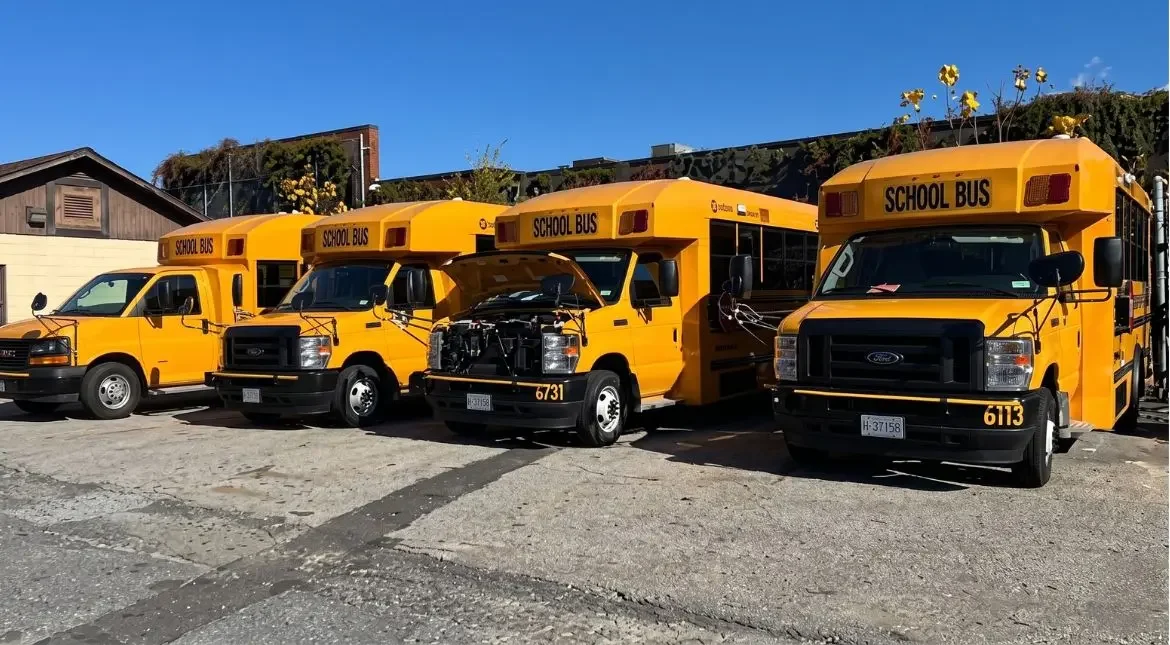
Missouri school districts operate across one of the more geographically diverse states in the Midwest — dense urban routes in St. Louis and Kansas City on one end, and rural districts in the Ozarks and agricultural flatlands where a single route covers 40 miles on the other. That range makes fleet decisions more consequential than in states with uniform transportation environments, and it makes the ICE-versus-electric question genuinely district-specific rather than a blanket recommendation.
Endera manufactures Type A school buses in ICE, propane, CNG, and full-electric configurations on Ford E450 and Chevrolet Express cutaway chassis. Missouri districts can choose the powertrain that fits their current infrastructure and transition to the next configuration on the same platform — without switching manufacturers or retraining staff on a new vehicle.
Ready to optimize your routes? Contact Endera's fleet specialists today to design a custom configuration blueprint for your district.
What Is a Type A School Bus?
Missouri's school bus standards, administered by the Department of Elementary and Secondary Education, define the construction, safety equipment, and operational requirements for all school buses in the state. The 2020 Missouri Minimum Standards for School Buses classify Type A buses as cutaway chassis vehicles built for smaller passenger loads — designed for routes where a full-size Type C bus creates more overhead than the student population justifies.
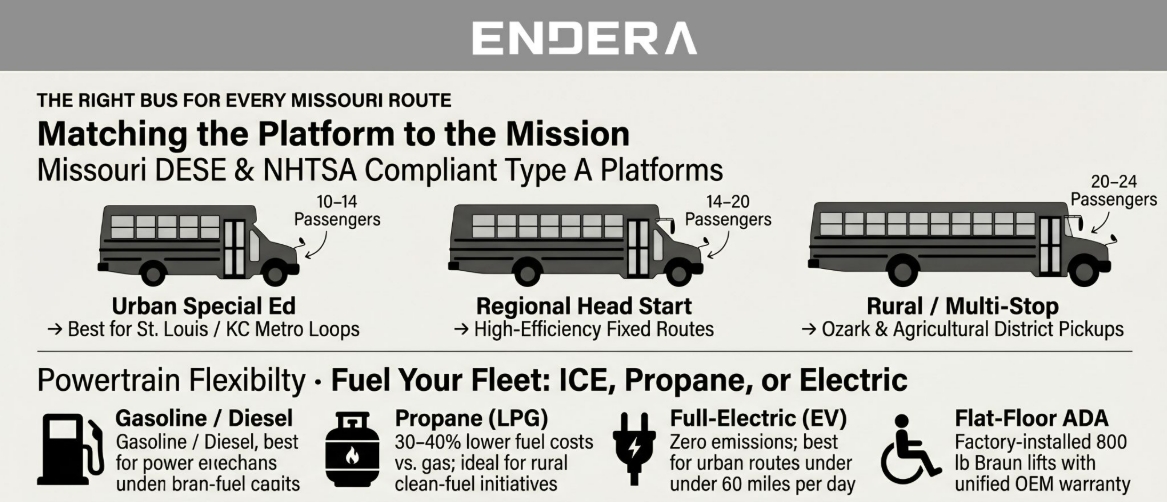
Missouri's regulations on student seating capacity establish the parameters that determine which bus size fits a given route. For districts managing special education circuits, Head Start runs, or rural pickups where 10 to 24 students per route is the norm, Type A is the operationally correct and cost-efficient format. The National Congress on School Transportation sets the national specifications that Missouri's standards draw from — ensuring Type A buses across manufacturers meet a consistent safety baseline.
Type A vs. Type C: Matching the Bus to Missouri Routes
| Feature | Type A | Type C |
|---|---|---|
| GVWR | Up to 14,500 lbs | 19,501–26,000 lbs |
| Typical seating | 10–24 passengers | 24–48 passengers |
| CDL required | Generally not | Yes |
| Best fit | Special ed, rural, low-density | High-enrollment primary routes |
| Operating cost | Lower fuel and maintenance per route | Higher overhead on underloaded runs |
Missouri districts commonly operate both types — Type C for primary enrollment routes and Type A for specialized, lower-volume, and accessibility-focused applications.
ICE vs. Electric: The Core Decision for Missouri Districts
ICE stands for internal combustion engine — the gasoline, diesel, propane, or CNG-powered buses that have been the fleet standard for decades. Electric buses replace the combustion drivetrain with a battery pack and electric motor. The practical difference for Missouri districts isn't just fuel; it's route structure, infrastructure readiness, and where the district sits in its budget and planning cycle.
Neither powertrain is universally correct. The FTA Electric Bus Initiative documents EV bus performance data across a range of operating environments — including cold-weather and rural conditions — that Missouri districts should review before specifying electric for routes with unusual demands.
When Electric Makes Sense for Missouri Districts
Fixed routes with predictable daily mileage and overnight depot charging are where electric Type A buses perform best. Urban and suburban Missouri districts running special education circuits or Head Start routes under 60 miles per day are strong candidates.
The EPA Clean School Bus Program provides federal funding covering both vehicles and charging infrastructure — and Missouri districts are eligible to apply. Electric drivetrains typically reduce maintenance spend 30–40% versus diesel according to DOE Vehicle Technologies Office fleet data, with fuel savings compounding further over a 10-to-12-year service life.
When ICE or Propane Is the Right Call
Rural Missouri districts managing long routes, irregular mileage, or facilities without charging infrastructure should consider ICE, propane, or CNG as a current-cycle solution. Propane reduces fuel costs 30–40% versus gasoline per DOE Alternative Fuels Data Center data while qualifying for clean fuel incentive programs that diesel purchases typically cannot access.
For districts in the Ozarks or agricultural regions where charging infrastructure doesn't yet exist along route corridors, propane is the most practical cleaner-fuel alternative to diesel without the depot investment of full electrification.
Why Missouri Districts Use Type A Buses
The Missouri Association for Pupil Transportation identifies purpose-built Type A buses as safer and more compliant than modified passenger vans — a distinction that matters for districts where used van conversions are sometimes considered as a lower-cost alternative.
Rural Missouri transportation creates specific operational demands. Long distances between student pickup points, unpaved county roads in agricultural districts, and seasonal weather variability require vehicles built for sustained daily use — not repurposed commercial vans. According to Bureau of Transportation Statistics data, rural student transportation demand stays consistent regardless of metro enrollment trends. The U.S. DOT rural transportation program tracks rural mobility as a persistent national challenge — one that Type A buses on commercial platforms address more reliably than light-duty alternatives.
ADA Accessibility for Missouri School Districts
Special education and accessible student transport drive a significant share of Type A bus procurement across Missouri's districts. ADA accessible transportation requirements and FTA Part 37 transportation service regulations define the compliance standards that districts must meet for accessible student transport — requirements that apply in rural Missouri as much as in urban districts.
Endera's flat-floor Type A configurations are available with 800 lb Braun ADA lifts installed at the manufacturing stage, with seating configurable across 4-to-6 section layouts. For Missouri special education programs, OEM-installed accessibility equipment provides unified warranty coverage and cleaner compliance documentation than post-sale retrofits from separate vendors.
Missouri Compliance and Fleet Standards
Missouri school buses must meet the minimum standards for school buses published by DESE and pass regular inspections before entering district service. NHTSA's school bus safety standards establish the federal baseline — school buses remain among the safest vehicles on the road as a result of those combined requirements.
CVSA inspection standards govern fleet compliance checks that Missouri operators face annually. Endera provides full specification sheets and compliance documentation to support Missouri's formal procurement and inspection review process, including Buy America certification for districts pursuing federally funded purchases.
Fleet Transition Strategy: Mixed ICE and EV Fleets
Missouri districts don't need to commit their entire fleet to electric in a single procurement cycle. Endera's platform allows districts to run ICE and electric Type A buses side by side — standardized on the same manufacturer, same service network, and the same Endera Dispatch software platform for unified fleet visibility.
A phased approach lets districts deploy electric on their most route-appropriate circuits first — urban special education loops and Head Start runs — while maintaining ICE or propane on rural routes where charging infrastructure isn't yet in place. Grant funding through the EPA Clean School Bus Program can be applied to electric units in each procurement round, progressively reducing the net cost of fleet electrification without requiring a single-cycle total transition.
Get Your Fleet Spec'd
New 2026 Type A models are available for immediate delivery through Endera Stock for districts with pressing replacement timelines. For districts working within Missouri's formal procurement process, Endera provides full specification documentation, compliance materials, and grant navigation support.
To discuss fleet configuration, powertrain options, or Missouri procurement requirements, contact Endera's sales team.
FAQs
What are Missouri's minimum standards for Type A school buses?
Missouri's 2020 Minimum Standards for School Buses, administered by DESE, define body construction requirements, safety equipment specifications, seating capacity rules, and accessibility standards for all school buses operating in the state. Type A buses must meet these standards as delivered. Endera provides full compliance documentation for Missouri's procurement and inspection review process.
When should a Missouri district choose electric over ICE?
Electric Type A buses are best suited to fixed routes under 60 miles per day with overnight depot charging available — typically urban and suburban special education or Head Start circuits. ICE and propane configurations better serve rural districts with long routes, irregular mileage, or no existing charging infrastructure. Endera's platform supports both in the same fleet, allowing districts to phase in electric units as infrastructure allows.
Are there federal funding programs available for Missouri school districts?
Yes. The EPA Clean School Bus Program provides funding for electric and clean-fuel bus replacements — Missouri districts are eligible to apply. Propane buses may also qualify for alternative fuel incentives. Used buses are typically ineligible regardless of condition. Endera's grant navigation services help districts identify applicable programs and manage applications alongside procurement.
What ADA accessibility options are available on Endera's Type A buses?
Endera's flat-floor configurations include 800 lb Braun ADA lifts installed at the manufacturing stage, with seating configurable across 4-to-6 section layouts for wheelchair securement and ambulatory positions. All configurations meet FTA Part 37 requirements. For Missouri special education programs, OEM-installed equipment provides unified warranty coverage and stronger compliance standing than post-sale retrofits.
How does propane compare to diesel for rural Missouri school bus routes?
Propane reduces fuel costs 30–40% compared to diesel equivalents per DOE Alternative Fuels Data Center data while producing significantly lower particulate and NOx emissions. Propane buses qualify for clean fuel incentive programs that diesel replacements typically cannot access. For rural Missouri districts not yet ready to commit to full electrification, propane is the most practical cleaner-fuel option available without requiring charging infrastructure.
Can Missouri districts run a mixed ICE and electric fleet from the same manufacturer?
Yes. Endera builds all four powertrain configurations on the same Type A platform, and all models are compatible with Endera Dispatch — the company's fleet management software. Districts running mixed fleets get unified GPS tracking, routing, and state-of-charge monitoring across both ICE and EV units from a single dashboard, eliminating the need to manage separate telematics systems for different vehicle types.
How long does a new Type A school bus last under Missouri operating conditions?
Purpose-built Type A school buses on medium-duty cutaway chassis typically operate 10 to 12 years under daily use with proper maintenance. Missouri's variable climate — humid summers and cold winters — creates moderate wear compared to extreme northern states. Annual inspection compliance per DESE standards and CVSA maintenance benchmarks are the primary factors in reaching full service life.