
The Airport Run Is the Most Operationally Demanding Shuttle Route a Hotel Operates
Why Airport Shuttle Operations Are Different From Other Hotel Transport
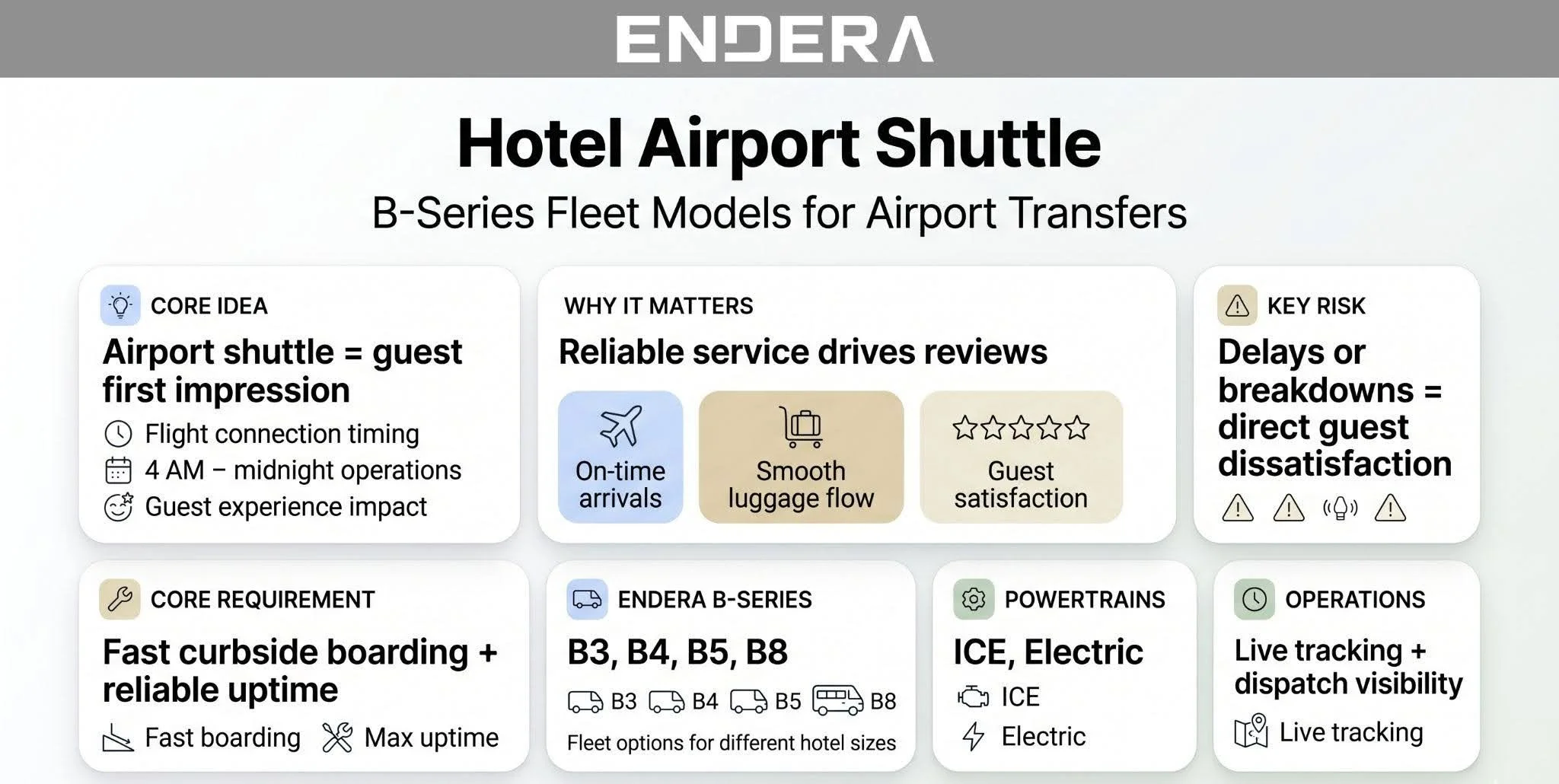
A hotel airport shuttle runs on a schedule defined by the airline industry, not the property's own operations. Flights don't wait, and a guest who misses a connection because the shuttle was late or broke down doesn't separate those two things when they write the review. The route is short, the cycle is frequent, and the vehicle has to be ready across a window that often runs from 4 AM to midnight. Airport shuttle operations test vehicle reliability, staging logistics, and driver management in ways that a hotel loop or attraction run simply doesn't.
What Distinguishes the Best-Performing Programs
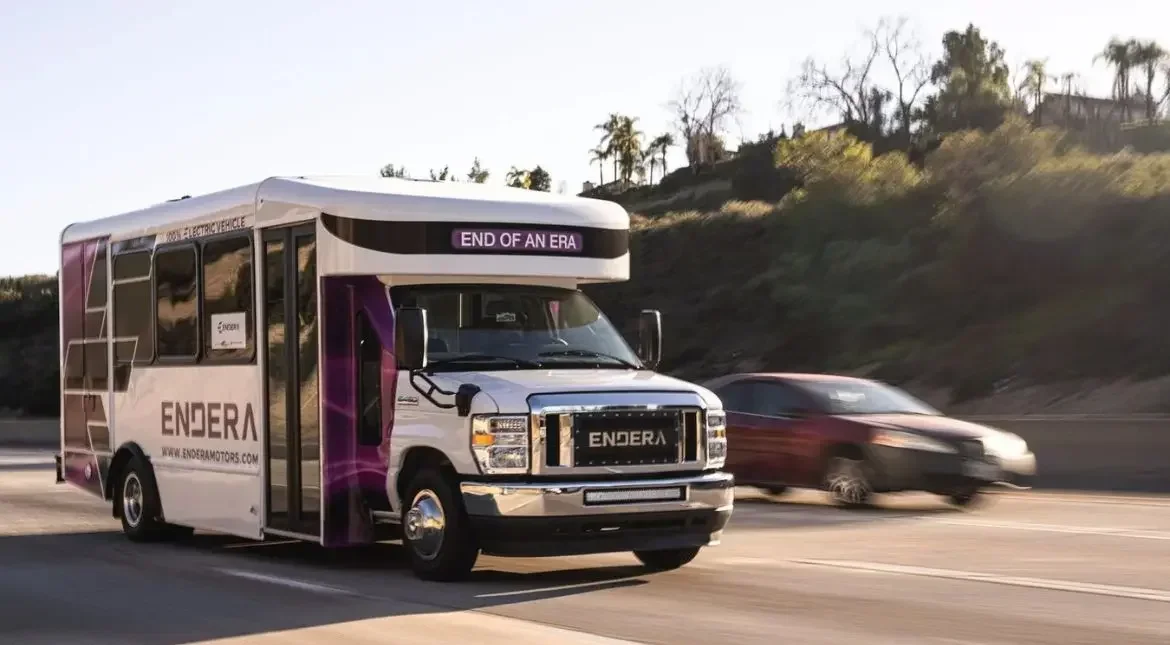
The hotel airport shuttle programs that run without friction share a few common characteristics: vehicles that are maintained to a consistent standard, a real-time tracking system that lets guests know where the shuttle is before they're standing at the curb, and a manufacturer relationship that supports the vehicle over its full service life rather than ending at delivery. Endera builds the B-Series commercial shuttle line for exactly this operational profile — high-frequency, high-visibility routes where the vehicle is also the first physical impression a guest has of the property.
Running an airport route and ready to replace or upgrade your fleet? Endera's team can spec the right vehicle for your property's staging setup and passenger volume.
Airport Ground Transportation Permitting: What Hotels Need to Know
The Permit Requirement at Most Commercial Airports
Most U.S. airports require hotel shuttles to hold a ground transportation permit to operate on airport property. Rules vary, with some charging per-trip fees or requiring vehicle-specific permits and training. Major airports like Denver International, Reagan National, and Dulles all enforce such programs, and violations can lead to fines or suspension.
Vehicle Requirements Within Permit Programs
Airport permits often include strict vehicle standards, requiring shuttles to be clean, safe, and free of visible damage like cracked glass, torn seating, or broken mirrors. Many airports allow inspections at any time, which can affect permit renewal for older fleets. Newer, purpose-built shuttle platforms with documented maintenance histories are better positioned to meet these requirements than aging converted vans.
Staging, Dwell Time, and Curbside Rules
Airport courtesy shuttle operators are assigned designated staging areas separate from public traffic lanes, and most airports impose strict dwell time limits at the commercial curb — typically five minutes or less for active passenger loading. Hotels operating on a fixed schedule need vehicles that can load luggage and passengers efficiently within that window. Endera's B-Series features a 92-inch interior width — the widest available in the cutaway shuttle class — which directly supports faster, more organized boarding and deplaning within those dwell constraints.
Why Curb Throughput Is the Real Operational Constraint
Most airport shuttle discussions treat operations as a scheduling problem — tighten dispatch intervals, add vehicles, improve on-time performance. In practice, the binding constraint is airport curb throughput, where physical space and regulatory limits define how many shuttle events can actually occur per hour. The FAA's airport design guidance (AC 150/5300-13B) explicitly treats landside circulation, staging, and curbside access as capacity-constrained systems — not open-flow environments — because terminal access roads and passenger loading zones operate under fixed geometric and safety constraints.
Queue Physics, Not Dispatch Logic
This creates a hidden operational reality: shuttle performance is governed by queue physics, not dispatch logic. When arrival banks cluster during morning and evening flight surges, multiple hotels compete for the same limited curb positions simultaneously. Under these conditions, a missed slot doesn't create a minor delay — it triggers a queue position reset, where vehicles can fall back significantly depending on staging availability and enforcement cycles.
How Congestion Propagates Through the System
Curbside systems are now managed as congestion-control environments, where dwell time and staging determine throughput more than demand. U.S. DOT ITS research shows that small bottlenecks can cascade into broader delays across the network. For hotel shuttles, performance depends less on trip capacity and more on reliably maintaining curb access during peak congestion, making throughput the key operational constraint.
The B-Series Lineup for Airport Shuttle Operations
B3: Boutique Properties and Low-Volume Routes
The B3 at 23 feet is the right answer for boutique hotels, limited-service properties near smaller regional airports, and programs where average passenger count per run is consistently low. Not every hotel airport shuttle runs at capacity, and operating a 28-foot bus at three passengers per trip adds fuel, maintenance, and staging cost without adding guest value. The B3 handles tight airport staging areas and hotel driveways that weren't designed for larger vehicles without the maneuvering tradeoffs that come with longer configurations.
B4: The Standard for Most Hotel Airport Programs
The 24-foot B4 is Endera’s most widely used hotel airport shuttle configuration, covering most mid-size and full-service routes and fitting standard airport staging areas. It’s available in ICE and electric versions, and in many states may be operated without a CDL depending on configuration, improving staffing flexibility. The electric model scored 90.1 in Altoona testing—the highest in its class—providing strong third-party durability validation for fleet investment decisions.
B5: High-Volume Properties and Hub Airport Routes
The B5 at 25 feet handles higher passenger loads and is available in both ICE and electric variants. For full-service hotels near major hub airports running frequent flights with high load factors, the B5 reduces the number of individual shuttle trips required per hour — a meaningful operational efficiency when vehicles are operating on tight airport dwell-time windows. Six B5 models operate at the Illumina corporate campus, demonstrating the vehicle's ability to handle high-frequency, high-visibility routes over extended daily operating windows.
B8: Conference Hotels and High-Volume Arrivals
The B8 at 28 feet is built for maximum passenger capacity per run — conference hotels managing group arrivals, casino resort properties running continuous airport loops, and any operation where the volume of passengers per flight requires a larger vehicle to avoid multiple sequential trips. It runs on an ICE powertrain. The B8 is most effective as a dedicated high-volume vehicle within a mixed fleet, paired with B4s or B5s for standard daily routes, rather than as the sole configuration for a property's entire shuttle program.
Electric Shuttle Options for Hotel Airport Routes
Why Airport Routes Are Good Candidates for Electrification
Hotel airport shuttle routes have a route profile that suits electric powertrains well. The distances are short, the schedule is predictable, and the vehicle returns to the property between runs — which enables managed depot charging between cycles rather than requiring public charging infrastructure. The energy cost per mile on an electric shuttle is substantially lower than on a gasoline or LPG equivalent, and that difference compounds across a route that runs 18 or more hours daily.
DC Fast Charging and Turnaround Requirements
Endera builds DC fast charging as a standard feature across its electric vehicle lineup — not an optional upgrade. For a hotel airport shuttle running on 30-to-45-minute cycles, the ability to add meaningful charge during a brief staging window is what makes the electric operating model viable. A vehicle that requires a four-hour charge window between runs doesn't fit an airport operation. Endera also provides turnkey charging infrastructure — site assessment, charger procurement, and installation — so hotel facilities teams handle the vehicle and charging setup through one relationship rather than two.
ESG Reporting and Sustainability Commitments
For hotel brands with active sustainability programs — and most major flag brands now carry formal ESG reporting requirements — a zero-emission airport shuttle fleet is a visible, documentable operational change. It reduces scope 1 emissions from owned fleet operations, is visible to guests who notice that the shuttle is quiet and clean, and can be referenced in corporate sustainability reports in a way that program-level changes often can't. Properties that are already under pressure from brand standards to demonstrate emissions progress have a concrete reason to specify electric on the next fleet replacement cycle.
The Airport Run Defines How Guests Experience the Property Before They Arrive
A hotel airport shuttle that runs on time, looks well-maintained, and gives guests a live ETA before they walk out of the terminal sets a tone that the lobby, the check-in process, and the room need to maintain. One that runs late, breaks down, or leaves guests standing with no information sets a different tone — and that one is harder to recover from. Endera's B-Series is built for the reliability, appearance standards, and operational consistency that hotel airport shuttle programs require, backed by a manufacturer that builds the vehicle, the software, and the charging infrastructure as a single integrated system.
Let's talk through your property's airport route — configuration, current availability, and what makes sense for your infrastructure.
FAQs
Do hotel airport shuttles require a permit to operate at the airport?
Yes, at virtually every commercial airport in the United States. Hotel courtesy shuttles must hold a valid ground transportation permit issued by the airport authority before operating on airport property. Permit requirements vary by airport but typically include annual renewal, per-vehicle registration, proof of insurance, and vehicle inspection. Properties should contact the ground transportation office at their serving airport before finalizing vehicle procurement to confirm current requirements.
Which Endera B-Series model is best for a hotel airport shuttle?
The B4 at 24 feet is the most widely deployed model for hotel airport operations. It handles the capacity and maneuverability requirements of most commercial airport staging environments and is available in ICE and electric powertrains. Properties with higher passenger volume or hub airport routes may prefer the B5. The B3 is appropriate for boutique properties or regional airports where average passenger count per run is consistently low.
Does Endera offer electric hotel airport shuttle buses?
Yes. The B4 and B5 are both available in electric variants. Endera also provides turnkey charging infrastructure — site assessment, charger procurement, and installation — as part of its EV offering. DC fast charging is standard across Endera's electric lineup, supporting the turnaround times that high-frequency airport routes require.
What is Endera Go and how does it improve the airport guest experience?
Endera Go is the passenger-facing app in Endera's software platform. It provides guests with real-time shuttle location, live ETAs based on actual vehicle position and traffic conditions, and available seat counts — accessible through a mobile app powered by onboard vehicle technology and Google API. For guests waiting curbside after a flight, a live ETA they can trust reduces perceived wait time and removes a common source of friction in the airport pickup experience.
How much can a hotel save by switching to an electric airport shuttle?
The SP+ deployment at San Diego International Airport has forecasted nearly $20,000 in annual savings per vehicle compared to LPG or CNG models. Actual savings depend on route length, energy costs, and current fleet fuel type. The combination of lower per-mile fuel cost, reduced drivetrain maintenance, and manageable depot charging costs makes the electric operating model financially favorable for most high-frequency hotel airport routes over the vehicle's service lifecycle.
Can Endera configure a hotel airport shuttle with luggage storage?
Yes. The B-Series floor plan is configurable to include luggage racks and dedicated storage appropriate for airport transfer operations. Configuration options — including luggage storage, seating layout, and ADA accessibility — are discussed during the specification process, allowing properties to build the interior around their specific operational requirements.
Do hotel airport shuttle drivers need a CDL?
CDL requirements depend on vehicle passenger capacity and vary by state. Endera's B3, B4, and B5 models are configurable to stay below CDL thresholds in most states, which gives hotel HR and operations teams more flexibility in driver scheduling — particularly for early morning and late-night airport runs. The specific configuration and applicable state requirements should be confirmed with the Endera sales team before finalizing an order.