
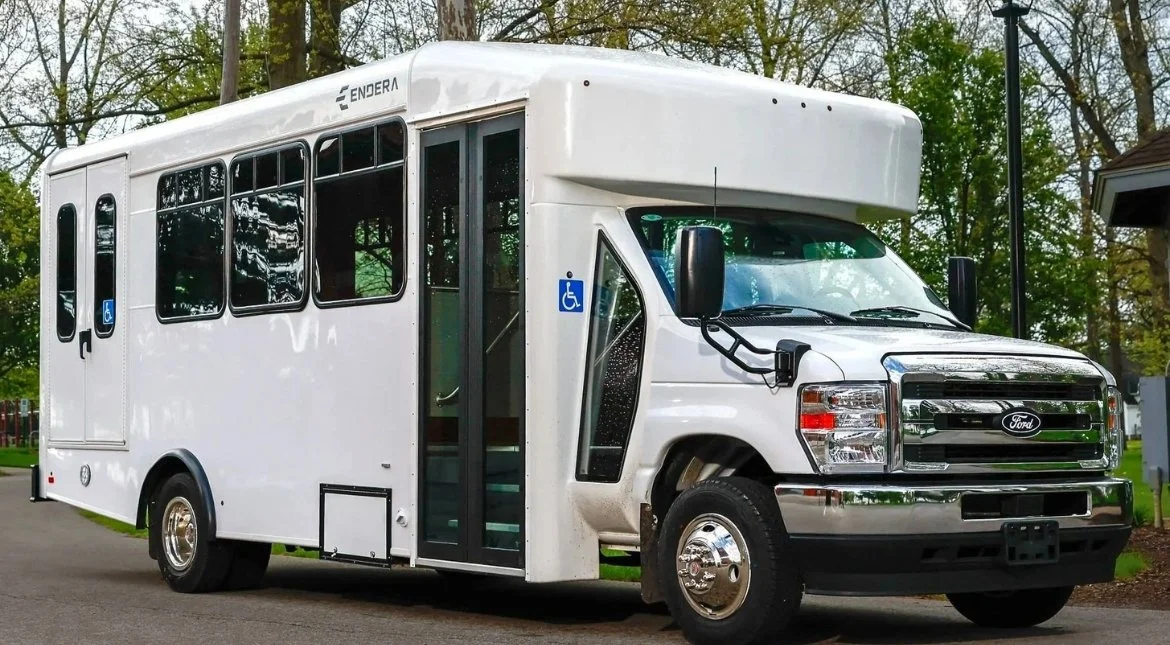
Transportation Is Part of What Assisted Living Actually Provides
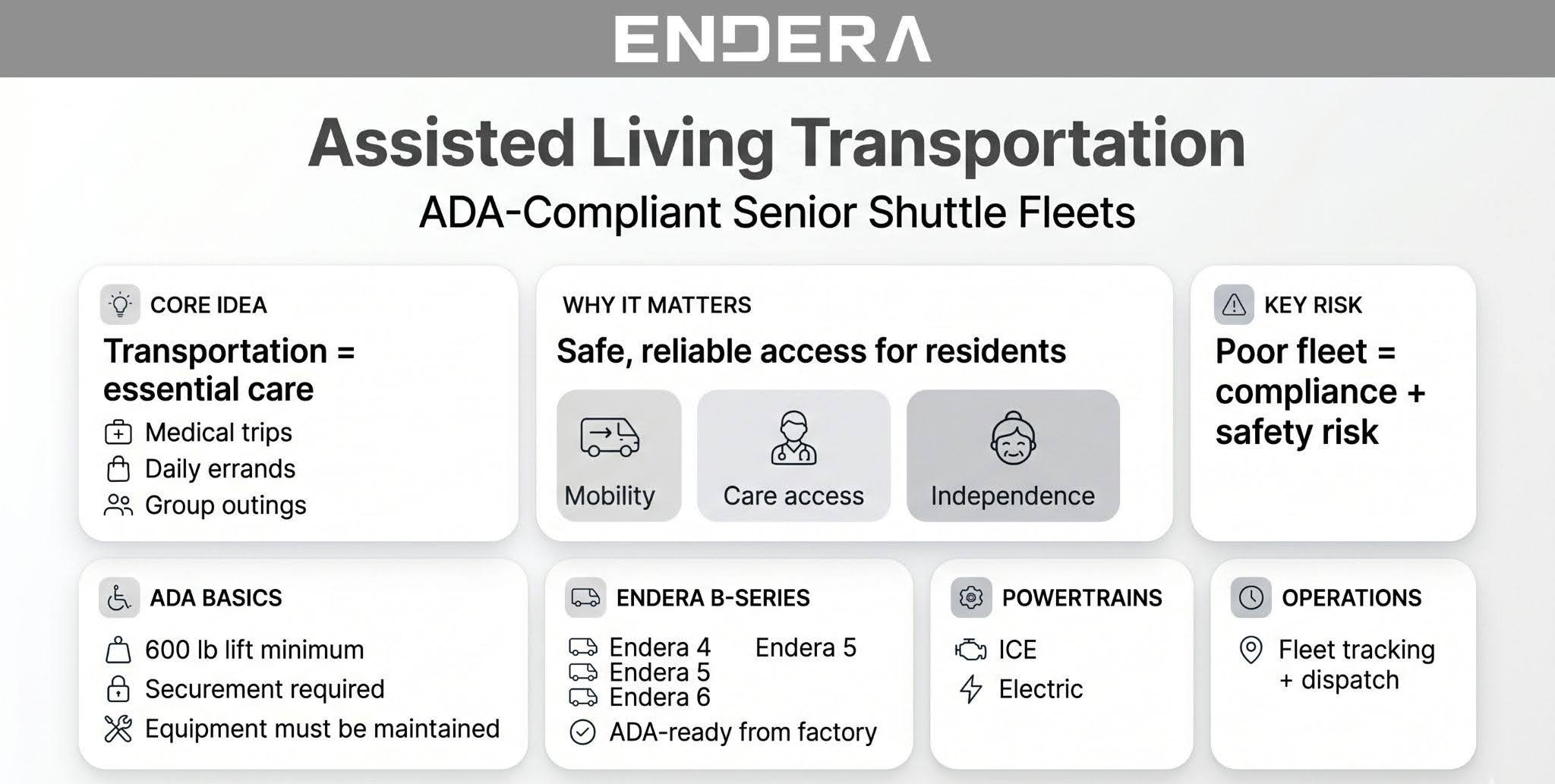
Why Fleet Quality Reflects on the Facility
For most assisted living residents, the facility's vehicle is their primary connection to the world outside the building. Medical appointments, grocery runs, group outings, and family visits all depend on transportation that works — reliably, safely, and with the accessibility equipment in proper operating condition every time it's needed. A facility that invests in quality residential care but runs a poorly maintained or under-equipped shuttle sends a message to residents and families that it is difficult to walk back.
The Three Trip Types That Define Senior Care Transportation
Assisted living facilities typically run three distinct categories of transport: medical appointments, which are scheduled in advance and often require one-on-one staff escort; shopping and errand runs, which operate on recurring weekly or bi-weekly schedules; and social and recreational outings, which are group-oriented and planned around the activity calendar. Each category has different scheduling requirements and passenger profiles, but all three require a vehicle that is genuinely accessible — not theoretically accessible with equipment that hasn't been tested that week.
Where Endera Fits
Endera builds the B-Series commercial shuttle line with ADA-compliant floor plan configurations, lift integration, and securement systems engineered into the vehicle from the production stage. For assisted living operators evaluating fleet options, the distinction between a vehicle built for accessible transport and one modified after delivery matters in ways that show up over the service lifecycle — in lift reliability, floor structural integrity, and the consistency of the securement layout relative to the seating configuration around it.
Configuring a shuttle for your resident mix? Endera's team can walk you through lift ratings, floor plan options, and what's currently available.
ADA Requirements for Senior Care Fleet Vehicles
What Federal Standards Require
Under 49 CFR Parts 37 and 38, vehicles used in demand-responsive transportation for individuals with disabilities must meet specific standards for lift capacity, securement area dimensions, handrail placement, and interior circulation space. Wheelchair lifts must have a minimum design load of 600 pounds and must permit both inboard and outboard positioning on the platform. The securement area must provide a clear floor space of at least 30 inches by 48 inches, positioned as near the accessible entrance as practicable.
The Wheelchair Weight Inflation Gap
Most discussions of assisted living transportation default to regulatory shorthand: 600-pound lift capacities, ADA-compliant securement systems, and general "wheelchair accessible" labeling. While these thresholds align with federal minimums under the FTA's ADA regulations, they increasingly fail to reflect real-world mobility-device weights and loading conditions in senior care environments. The practical reality is that modern power wheelchairs can exceed 400 pounds before accounting for the passenger.
Why the Gap Is Growing
When you add occupant body weight, oxygen tanks, ventilators, bariatric seating systems, and personal storage attachments, total boarding loads can push far beyond historical design assumptions. The U.S. Access Board's ADA Accessibility Standards similarly emphasize minimum compliance thresholds rather than operational variability across user populations — leaving a gap between "compliant" and "fit-for-purpose" that most transportation planning discussions never address.
Compliant Doesn't Mean Adequate
This creates a critical procurement blind spot for assisted living operators: a vehicle can be fully ADA-compliant while still being functionally undersized for the residents it actually serves. As resident acuity increases and facilities retain individuals with higher dependency levels for longer periods, transportation systems must be evaluated on real load distribution rather than nominal compliance figures.
The Right Question for the Next Decade
The more operationally relevant question is no longer whether a lift meets ADA minimums, but whether it can safely accommodate the heaviest realistic mobility configuration likely to board over the next decade. That distinction is rarely addressed in procurement planning, even though it directly affects safety margins, fleet longevity, and service reliability. Interior circulation width, handrail positioning, and step height all affect how comfortably ambulatory residents with walkers or limited mobility can board and move through the vehicle — details worth confirming during specification, not after a vehicle is on the lot.
The Maintenance Obligation Under ADA
49 CFR Part 37 also creates an ongoing maintenance obligation for accessible features. Lifts, ramps, securement devices, handrails, and communication devices must be kept in good operating condition. If a feature is out of order, it must be repaired promptly — and in the interim, an alternative accessible vehicle or option must be available. For assisted living operators running a single-vehicle fleet, a lift that fails inspection without a backup plan creates an immediate compliance gap. Pre-trip lift testing is standard practice, and annual load tests are required under most state NEMT and paratransit program standards.
The Endera B-Series for Assisted Living and Senior Care
ADA Configuration Built Into the Floor Plan
Endera builds ADA-compliant lift integration and wheelchair securement positioning into the B-Series floor plan at the production stage. The lift position, securement station layout, and floor structure are designed together — not modified after a standard body is complete. This matters for the long-term structural integrity of the vehicle and for the consistency of securement placement relative to the seating rows that ambulatory passengers occupy alongside wheelchair users.
Interior Dimensions for Senior Passenger Comfort
Endera's B-Series features interior dimensions that support comfortable boarding and movement for passengers with limited mobility. The 92-inch interior width — the widest available in the cutaway shuttle class — provides meaningful aisle space for walkers, canes, and staff escorts assisting residents. The 78-inch center aisle ceiling height gives attendants the headroom to assist passengers safely during boarding and securement without the physical awkwardness that creates both safety risk and discomfort.
B4 for Small to Mid-Size Assisted Living Programs
The B4 at 24 feet is the most practical configuration for most assisted living shuttle programs. It accommodates a mix of wheelchair securement positions and ambulatory seating, handles the duty cycle of daily medical runs and weekly group outings, and is available in both ICE and electric powertrains. The composite body construction — salt and water tested before installation — holds up to the frequent cleaning cycles that senior care environments require and resists the exterior degradation that appears on conventional body materials over a 10-to-12-year service lifecycle.
B5 for Larger Communities and Higher-Volume Programs
The B5 at 25 feet provides additional passenger capacity for larger assisted living communities running full-group social outings or multi-stop medical transport routes where more residents travel simultaneously. It is available in both ICE and electric variants. For continuing care retirement communities with independent living, assisted living, and memory care populations all drawing on the same transport program, the B5's capacity reduces the number of vehicle trips needed per scheduled outing without stepping up to a vehicle footprint that creates staging or parking complications at the facility.
Electric Shuttle Options for Senior Care Facilities
The Case for Electric in an Assisted Living Context
Assisted living facility shuttle routes are operationally well-suited to electric powertrains. The distances are predictable, the vehicles return to the facility between runs, and charging can be scheduled around the gaps in the daily route cycle. A quieter, smoother-riding electric shuttle also improves the experience for residents with sensory sensitivities, hearing impairment, or vestibular conditions that make a loud, vibrating vehicle uncomfortable — a practical passenger experience benefit that is distinct from the environmental argument.
Charging Infrastructure for Senior Care Properties
Endera provides turnkey charging infrastructure alongside its electric vehicles — site assessment, charger procurement, and installation — so facilities teams don't need to manage two separate vendor relationships to get the system running. For assisted living operators who are adding one or two electric vehicles to replace an aging fleet, this simplifies the procurement significantly. DC fast charging is standard across Endera's electric lineup, which supports the turnaround requirements of a facility running multiple daily trip categories on a single vehicle.
A Senior Care Shuttle Program Reflects What the Facility Values
Transportation quality communicates something about a facility's standards that prospective residents and their families notice during tours and remember after move-in. A vehicle that is clean, accessible, reliably maintained, and operated by a trained staff member signals the same level of intentionality as the facility's physical environment and care programming. Endera builds the B-Series as a complete accessible transport system — vehicle, floor plan, software, and charging infrastructure — from a manufacturer that treats accessibility as a design requirement rather than a product feature.
Talk to Endera's sales team about which configuration fits your facility's resident population, trip profile, and infrastructure — and what's currently available for your program.
FAQs
Does the Endera B-Series meet ADA requirements for assisted living transportation?
Yes. Endera configures the B-Series with ADA-compliant lift integration and wheelchair securement systems built into the floor plan at the production stage. Lift specifications and securement area dimensions meet federal minimums under 49 CFR Parts 37 and 38. Facilities with residents using larger power wheelchairs or mobility aids that exceed federal lift minimums should confirm specific lift weight ratings with the Endera sales team during the configuration process.
What lift capacity is recommended for an assisted living shuttle?
Federal minimums require a 600-pound lift design load. Industry guidance and many state programs recommend specifying lifts rated to 800 pounds or higher to accommodate the full range of power wheelchairs and mobility aids in common use among senior populations. Endera's sales team can confirm available lift options for each B-Series configuration and help facilities match the spec to their specific resident population.
Which Endera model is best for an assisted living facility?
The B4 at 24 feet is the most practical configuration for most assisted living programs — it accommodates a mix of wheelchair and ambulatory seating, handles daily medical and social trip cycles, and is available in ICE and electric powertrains. Larger communities running full-group outings or multi-stop routes may prefer the B5 at 25 feet. Configuration details, including securement positions and ambulatory seating count, should be discussed with the Endera sales team based on the facility's specific resident mix.
Are electric Endera shuttles appropriate for senior care facility routes?
Yes, for most assisted living route profiles. Facility shuttle routes are typically short, scheduled, and return-to-base — characteristics that suit electric vehicle performance well. Electric shuttles also provide a quieter, smoother ride that benefits residents with sensory or vestibular sensitivities. Endera provides turnkey charging infrastructure alongside the vehicle, covering site assessment, charger procurement, and installation.
Does Endera provide fleet management software for assisted living transport programs?
Yes. Every Endera commercial shuttle comes available with Endera Dispatch — providing real-time GPS tracking, geofence management, route performance data, and state-of-charge visibility for EV fleets. Endera Go provides residents and their families with live vehicle location and ETAs through a mobile app. Both platforms run on hardware built into the vehicle rather than a third-party telematics add-on.
What maintenance obligations apply to ADA accessibility equipment on facility shuttles?
Under 49 CFR Part 37, lifts, ramps, securement devices, handrails, and communication devices must be kept in good operating condition and repaired promptly when out of order. Pre-trip lift testing is standard practice, and annual load tests are required under most state NEMT and paratransit program standards. Facilities operating a single-vehicle fleet should have a contingency plan for accessible transport if the primary vehicle's lift is out of service.
Can Endera configure a shuttle with both wheelchair positions and ambulatory seating for mixed-mobility resident populations?
Yes. Endera's B-Series floor plan is configurable to include both wheelchair securement positions and standard ambulatory seating in the same vehicle. The number and placement of each depend on the section count and the specific floor plan selected. This configuration is the most practical answer for facilities whose resident population includes both ambulatory passengers and those using wheelchairs or scooters — which describes most assisted living communities.