
Hospital Transportation Is Not a Standard Commercial Shuttle Problem
Why Healthcare Campus Operations Are Different
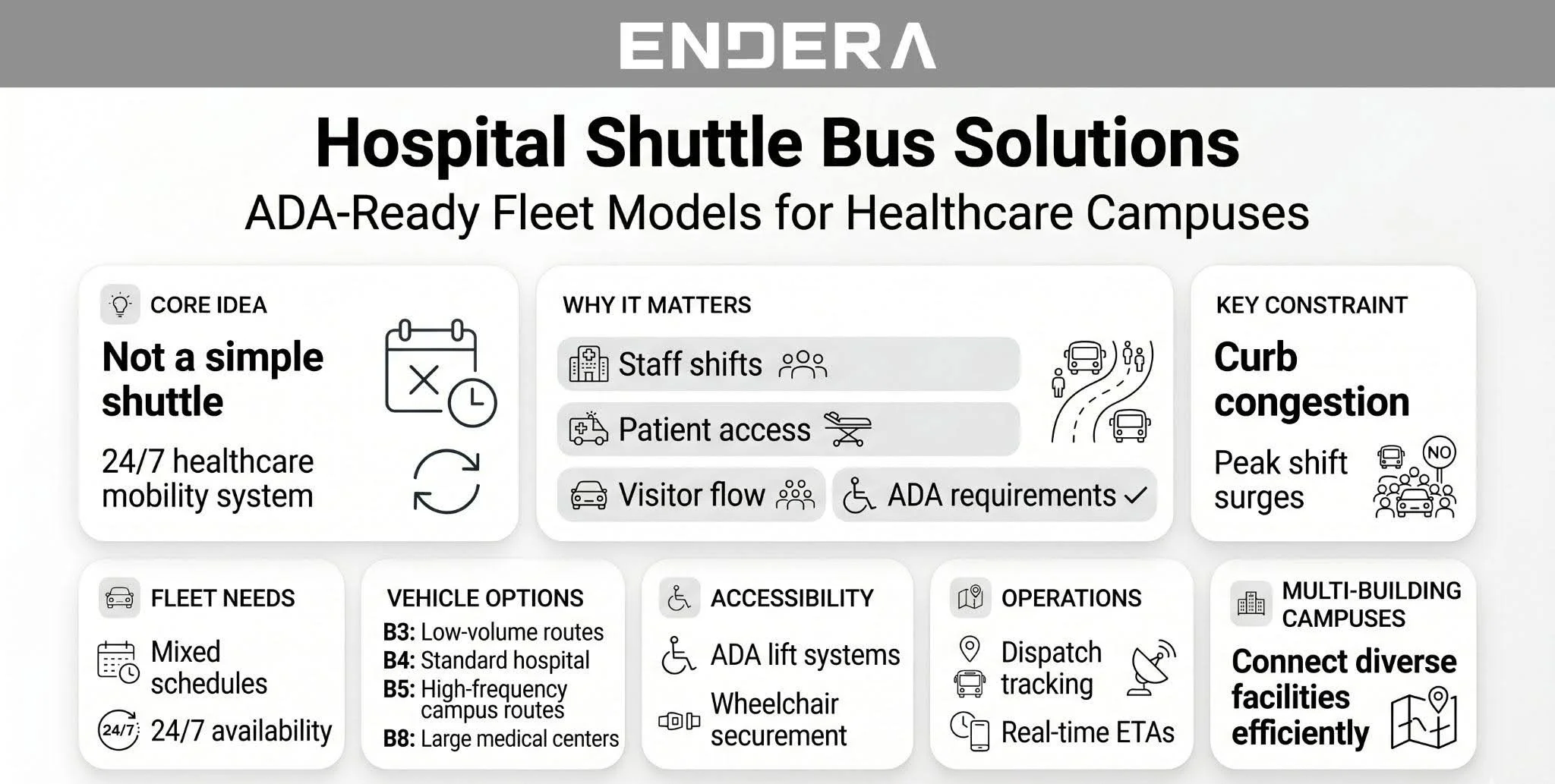
A corporate campus shuttle runs a predictable schedule tied to standard business hours. A hospital runs 24 hours a day, seven days a week, with shift changes at irregular intervals, patient volumes that fluctuate by season and day, and a passenger population that spans staff, patients, visitors, and vendors — each with different timing needs and physical requirements. The vehicle and the software managing it have to work across all of those populations without a pause in service that a corporate or hospitality program could absorb.
The Four Distinct Use Cases on a Healthcare Campus
Hospital shuttle programs typically cover four separate functions: parking-to-entrance circulation for staff, patients, and visitors; inter-campus transfers between buildings within a health system; transit-to-campus connections for employees commuting by train or bus; and patient transport for scheduled outpatient appointments. Each function has a different scheduling structure, a different passenger profile, and in some cases different ADA requirements. A single vehicle specification doesn't always serve all four equally well — which is why healthcare fleet procurement benefits from a manufacturer that offers configuration flexibility rather than a single fixed model.
Where Endera Fits
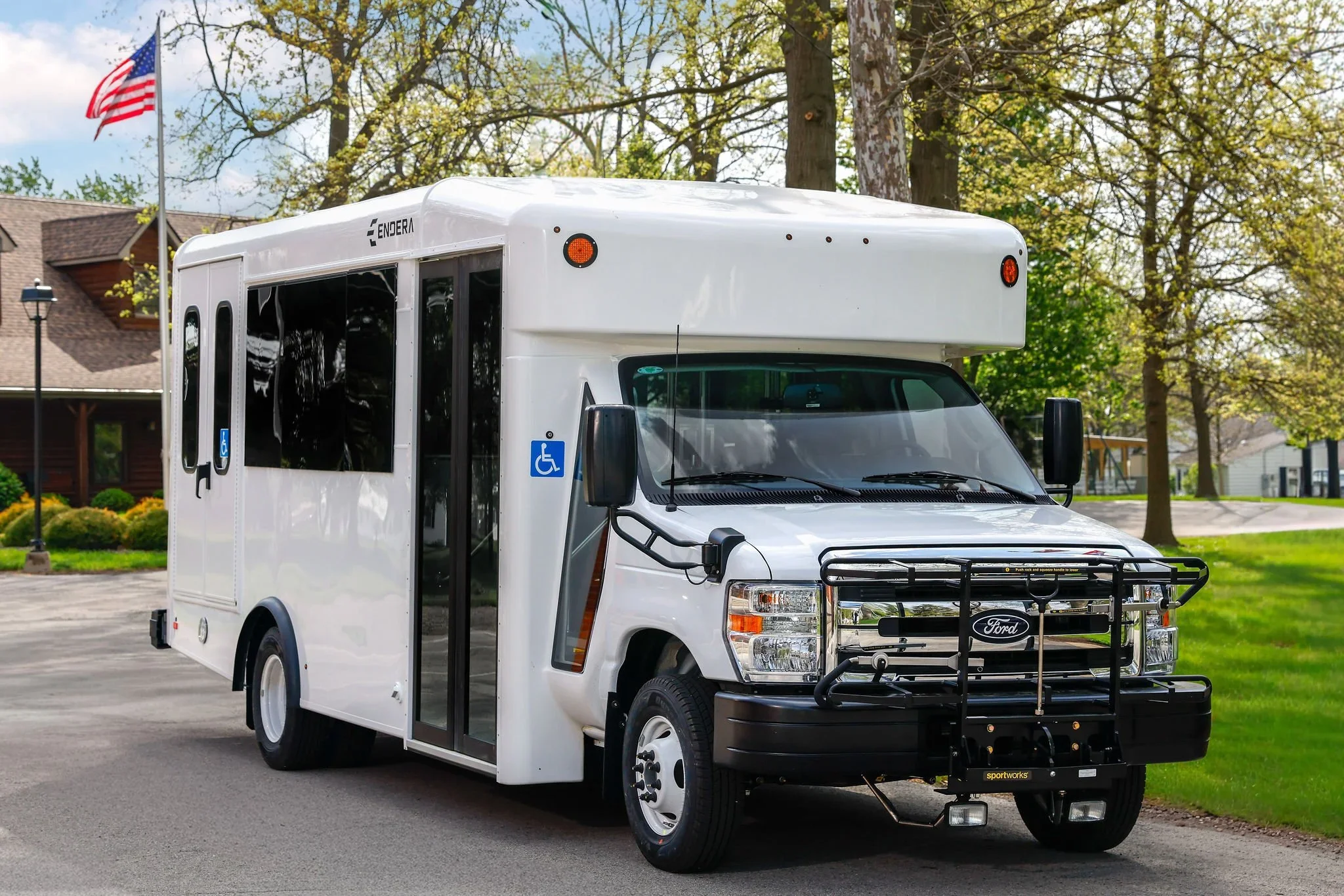
Endera builds the B-Series commercial shuttle line with ADA-compliant floor plan configurations, lift integration, and securement systems for exactly this kind of multi-population, multi-function operation. Every B-Series model is available in ICE, propane, CNG, and electric powertrains, and the integrated software platform — Endera Dispatch and Endera Go — gives healthcare facilities teams the operational visibility and passenger-facing tracking that hospital transport programs require.
Managing a complex healthcare campus transport program? Endera's team can help you match vehicle configurations to your shift patterns, route types, and passenger populations.
The Hospital Flow Physics Gap: Why the Curb Determines Performance
What Most Hospital Shuttle Content Gets Wrong
Most hospital shuttle content frames transportation in familiar planning terms: 24/7 operations, shift-based scheduling, and a basic choice between fixed-route or on-demand service. What this misses is that hospital mobility is governed less by scheduling theory and more by flow physics inside constrained physical environments — especially at the curb.
Micro-Burst Demand, Not Smooth Peaks
In practice, hospital transportation systems are dominated by short, high-intensity micro-bursts of demand rather than smooth peaks. Shift changes at nursing stations, imaging departments, and support services often converge within narrow 10-to-20-minute windows, producing stacked boarding demand that cannot be solved simply by adding vehicles. At the same time, parking-to-entrance routes frequently funnel multiple mobility systems into the same limited curb space — staff shuttles, visitor drop-offs, rideshare vehicles, and ambulances all competing for priority access.
Capacity Is a Curb Problem, Not a Fleet Problem
A major blind spot in most transportation planning is the assumption that capacity is a fleet-sizing problem. In reality, it is often a curb congestion problem. The most important constraints are not how many shuttles exist, but how long each vehicle can dwell, how quickly passengers can board or disembark, and how efficiently queues clear without blocking emergency access.
The Research Behind the Constraint
The U.S. DOT Curb Management Resources highlight curb management as a critical urban mobility constraint, particularly where multiple modes compete for limited frontage space. Research from the National Academies Transportation Research Board similarly emphasizes that curbside congestion can become the primary bottleneck in high-frequency transport systems regardless of fleet capacity.
What This Means for Hospital Shuttle Design
Within hospital campuses, shuttle performance is determined less by route design and more by how effectively the system manages curb dwell time, queue stacking, and overlapping priority flows — especially in emergency-adjacent environments where clearance delays can ripple into clinical operations. Vehicles that board and disembark passengers quickly — with wide interiors, efficient door configurations, and properly positioned ADA equipment — reduce dwell time per stop in ways that directly affect throughput during peak micro-burst windows.
The Endera B-Series for Healthcare Campus Operations
B3: Targeted Routes and Lower-Volume Circulation
The B3 at 23 feet is the right answer for targeted healthcare routes where passenger volume per run is consistently low — satellite clinic shuttles, medical office building circulators, and on-campus routes where a larger vehicle would run mostly empty. It is ICE-only and the most maneuverable configuration in the B-Series lineup, suited to tight campus road layouts and structured parking facilities where turning radius matters.
B4: The Standard for Most Healthcare Shuttle Programs
The B4 at 24 feet is the most widely deployed configuration in commercial shuttle operations and covers the broadest range of healthcare use cases — parking-to-entrance circulation, transit connection runs, and inter-campus transfers on moderate-volume routes. It is available in both ICE and electric powertrains and is configurable with ADA lift and securement systems. The electric B4 earned a score of 90.1 on the Altoona Bus Testing Program — the highest in its class — providing documented third-party durability validation for facilities making multi-unit fleet commitments.
B5: High-Frequency and Multi-Population Routes
The B5 at 25 feet handles the higher loads and continuous cycle requirements of large health system campuses running frequent routes across multiple shift windows. It is available in both ICE and electric variants. For health systems running simultaneous staff and patient routes with overlapping schedules, the B5's capacity reduces the number of vehicle trips needed per shift without stepping up to a vehicle footprint that creates staging issues at hospital drop-off areas.
B8: Large-Volume Campus Transport
The B8 at 28 feet is Endera's highest-capacity shuttle model — appropriate for large academic medical centers, regional hospital campuses with distributed parking structures, and any healthcare operation where maximum passenger movement per run is the priority. It runs on an ICE powertrain and functions best as a dedicated high-volume route vehicle within a mixed fleet rather than the sole configuration for a campus-wide program.
Electric Shuttle Options for Healthcare Fleet Operators
Where Electric Fits a Hospital Shuttle Program
Parking-to-entrance routes and on-campus circulators are strong candidates for electric powertrains. The distances are short, the vehicles return to a fixed staging area between runs, and charging can be scheduled during the low-demand windows between shift peaks. A quieter, smoother electric shuttle also reduces noise in proximity to patient care areas — a practical consideration for hospital campuses where shuttle routes pass near inpatient buildings or outdoor patient spaces.
Charging Infrastructure for Healthcare Facilities
Endera provides turnkey charging infrastructure alongside its electric vehicles — site assessment, charger procurement, and installation. For hospital facilities teams managing complex physical plant operations, handling vehicle procurement and charging infrastructure through a single vendor relationship simplifies coordination and ensures the charging system is sized for the actual fleet load. DC fast charging is standard across Endera's electric lineup, supporting the rapid turnaround times that continuous healthcare campus routes require.
Mixed Fleets for 24-Hour Operations
Healthcare campuses running around-the-clock operations often need a mixed fleet — electric vehicles on high-frequency daytime routes where charging windows exist, and ICE or propane vehicles on overnight and irregular-schedule routes where predictable charging logistics are harder to maintain. Endera's dual-track model — building ICE, propane, CNG, and electric variants on the same platform — lets facilities teams configure each vehicle to its actual route profile. Endera Dispatch manages all powertrain types within a single fleet view, eliminating the need for separate management systems across the mixed fleet.
A Hospital Shuttle Program That Reflects the Facility's Standard of Care
The quality of a hospital's shuttle program communicates something about the institution's operational standards. A vehicle that is clean, accessible, reliably maintained, and on schedule signals the same level of organizational competence as the clinical environment it supports. One that is poorly maintained, inaccessible to patients with mobility needs, or frequently delayed introduces friction into an experience that is already stressful for most people who need it.
Endera builds the B-Series as a complete accessible transport system — vehicle, floor plan, software, and charging infrastructure — from a manufacturer that treats accessibility and reliability as design requirements, not options. Get in touch with Endera's sales team to discuss which configuration fits your healthcare campus operations, passenger population, and infrastructure.
Frequently Asked Questions
Which Endera B-Series model is best for a hospital campus shuttle?
The B4 at 24 feet covers the broadest range of healthcare use cases — parking-to-entrance circulation, transit connections, and inter-campus transfers. It is available in ICE and electric powertrains and is configurable with ADA lift and securement systems. Larger campuses with high-frequency multi-shift routes may prefer the B5. Targeted low-volume routes such as satellite clinic circulators are often well-served by the B3.
Does Endera's B-Series meet ADA requirements for healthcare shuttle operations?
Yes. Endera configures the B-Series with ADA-compliant lift integration and wheelchair securement systems built into the floor plan at the production stage. For healthcare operators whose patient population includes individuals using heavier power wheelchairs or complex mobility equipment, lift ratings above the 600-pound federal minimum — typically 800 pounds or higher — should be confirmed with the Endera sales team during the specification process.
How should a hospital match vehicle scheduling to shift changes?
The most effective approach maps each significant shift window to a corresponding vehicle run, with capacity matched to expected ridership at that time rather than averaged across the day. A 24-hour hospital with nursing shifts at 7 AM, 3 PM, and 11 PM requires a different schedule structure than a standard 9-to-5 shuttle program. Endera's sales team can help facilities coordinators think through configuration and fleet size based on the specific shift pattern and route profile of the campus.
Are electric Endera shuttles practical for a 24-hour hospital operation?
Yes, for the right route types. Short, high-frequency routes that return to a fixed staging area — parking-to-entrance circulators, on-campus loops — are good candidates for electric. Overnight and irregular-schedule routes with fewer predictable charging windows may be better served by ICE or propane. Endera's mixed-fleet model lets hospitals configure each vehicle to its actual route rather than applying a single powertrain across the full program.
Does Endera provide fleet management software for hospital transportation programs?
Yes. Every Endera commercial shuttle comes available with Endera Dispatch — providing real-time GPS tracking, geofence management, route performance data, and state-of-charge visibility for EV fleets. Endera Go provides patients, visitors, and staff with live vehicle location and ETAs through a mobile app. Both platforms run on hardware built into the vehicle rather than a third-party telematics add-on.
Can Endera handle both vehicle procurement and charging infrastructure for a hospital fleet?
Yes. Endera provides turnkey charging infrastructure as part of its EV offering — covering site assessment, charger procurement, and installation. Healthcare facilities teams can handle both procurement items through one vendor relationship rather than coordinating two separate projects with separate timelines and contracts.
What is the difference between a hospital shuttle program and NEMT?
Hospital campus shuttle programs move staff, patients, and visitors between fixed points on or near the hospital campus — parking structures, buildings, transit stops — on a scheduled or semi-scheduled basis. Non-emergency medical transportation (NEMT) provides origin-to-destination transport for patients traveling to and from medical appointments, typically under Medicaid or private-pay arrangements. The two programs serve different functions and are often operated by different departments, though some healthcare systems use Endera vehicles for both.