
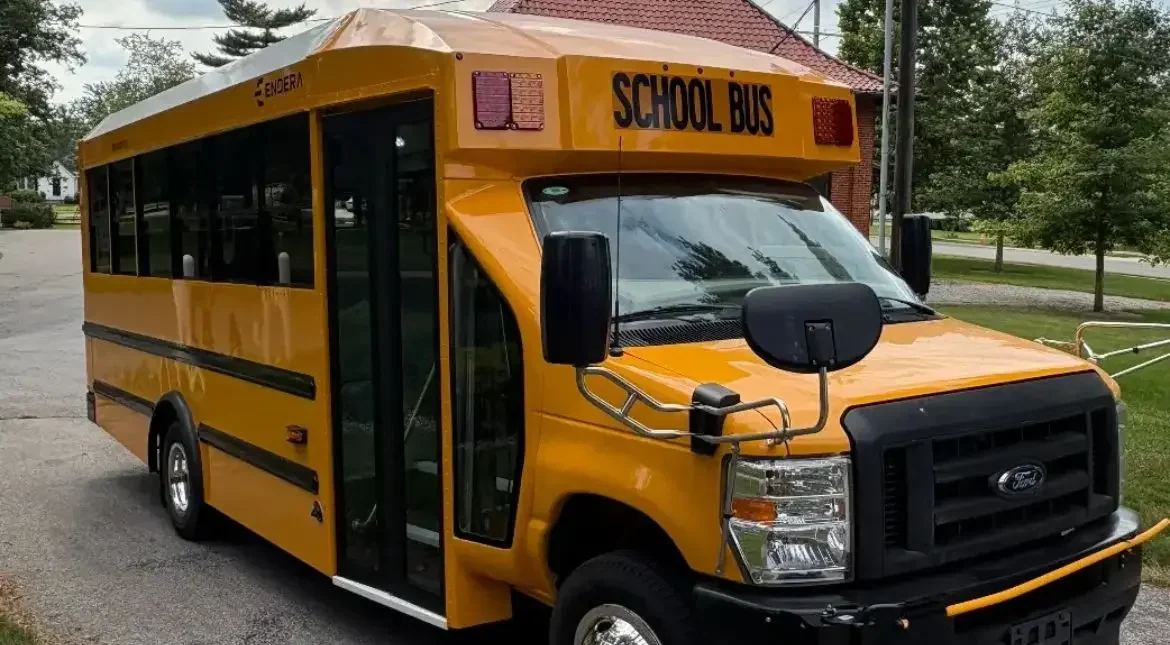
The shift toward electric school buses is no longer a future consideration for most districts — it's an active procurement decision happening right now. Federal funding has expanded significantly, state mandates are tightening in several markets, and the operational case for electrification has strengthened as real-world deployment data comes in. The question for most districts isn't whether to electrify, but which vehicle to trust with that transition.
Endera's electric Type A school buses — the Endera 4, 5, and 6 — are built around a proprietary EV powertrain developed and installed entirely in-house at the company's Ottawa, Ohio manufacturing facility. That in-house control is what separates these buses from competitors who bolt third-party electric systems onto a conventionally built body — every component is engineered to work together, with one team accountable for the whole vehicle.
Don't leave your electrification timeline to chance — connect with an Endera specialist today to map a transition plan built around your district's funding and route requirements.
The Proprietary Powertrain: Why It Matters
Designed for the Vehicle It Lives In
Most electric school buses today follow a traditional upfitter model, where the chassis, electrification, and body are handled by different companies—each handoff introducing compromises. Endera takes a different approach: its EV powertrain is designed in-house and integrated at the same facility where the body is built. The battery pack is embedded within the frame rails, lowering the center of gravity, improving stability, and adding structural protection in a collision—advantages that are difficult to achieve when systems are engineered separately.
Best-in-Class Fast Charging and Range Efficiency
Because the powertrain is optimized specifically for the dimensions and weight distribution of the Type A body it powers, Endera's electric buses achieve what the company describes as best-in-class fast charging and range efficiency. DC fast charging comes standard, which matters practically for districts running multiple routes across a school day. A bus that can charge meaningfully between morning and afternoon runs doesn't require the same infrastructure investment as one that needs a full overnight charge to complete its daily schedule — and that difference has real implications for how many chargers a district needs to install.
The Endera 4, 5, and 6 — Built Around Your District's Routes
Three Models, Genuine Configurability
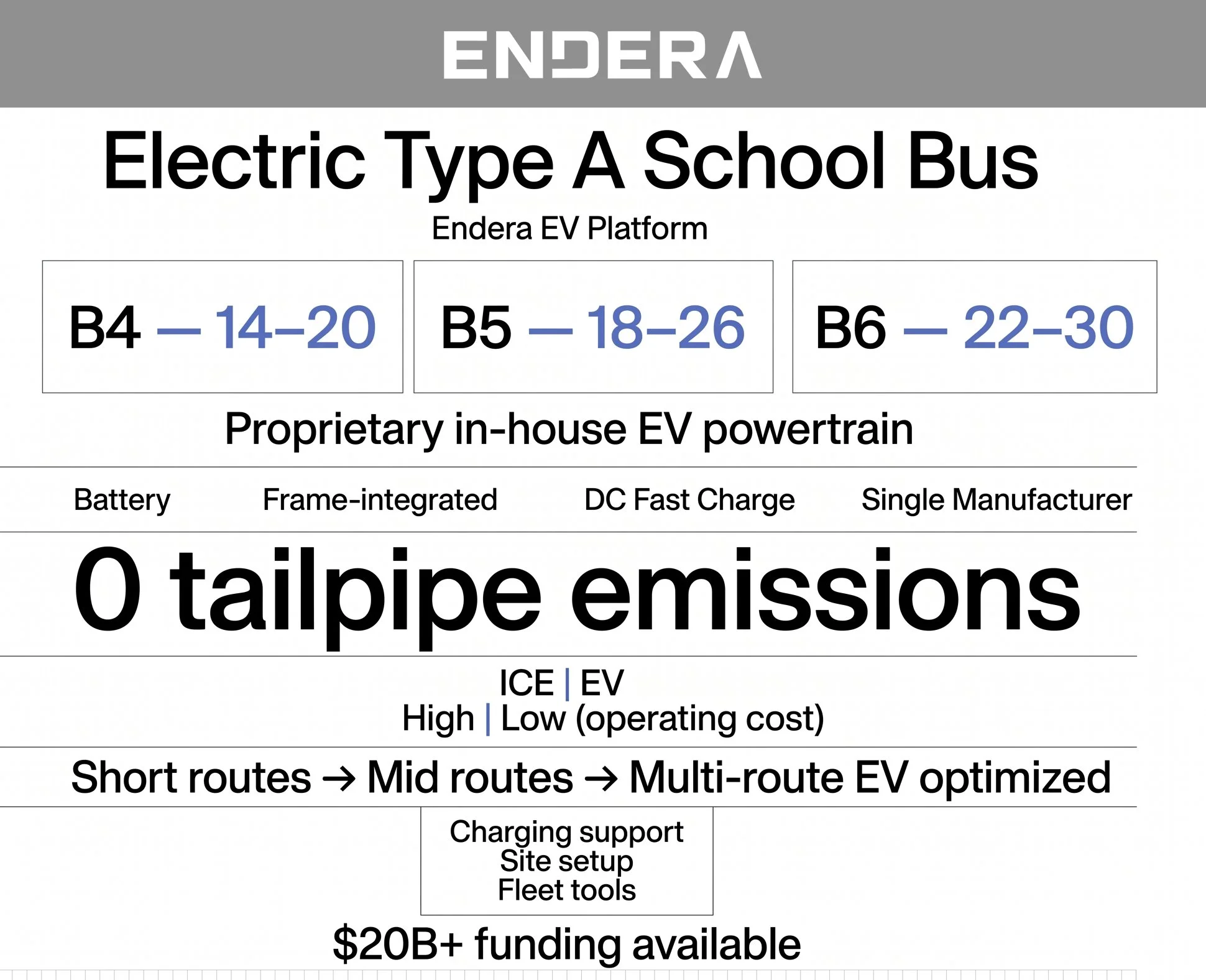
The Endera 4, 5, and 6 are available in 4 to 6 section configurations, covering seating capacity from 14 to 30 passengers depending on layout. Districts can configure each model for standard seating, ADA-accessible layouts with compliant wheelchair lifts, or combinations of seating and storage suited to specific route requirements. That level of customization is a direct result of Endera's vertically integrated manufacturing process — the production line adapts to specific floor plan requirements without the delays that come with multi-stage assembly across separate facilities.
Available on Ford and Chevrolet Chassis
The Endera 4, 5, and 6 are offered on both Ford and Chevrolet cutaway chassis, giving districts flexibility in their procurement and ongoing service preferences. Both platforms are among the most widely serviced commercial chassis in North America, which means district maintenance teams and local service providers are already familiar with the underlying vehicle — even if the EV powertrain is new to them.
Health, Environment, and the Student Case for Electric
What Diesel Exhaust Actually Does
The health argument for electric school buses is one of the strongest in the entire EV sector. Diesel exhaust is a classified carcinogen, and students boarding and riding diesel buses face repeated low-level exposure during some of the most developmentally sensitive years of their lives. The exposure is highest during loading and unloading, when the engine is idling and exhaust concentration near the bus door peaks. Electric buses eliminate that exposure entirely — no tailpipe, no idle emissions, no exhaust entering the passenger cabin.
Quieter Rides, Calmer Students
Beyond air quality, electric buses produce significantly less interior noise than diesel or even propane alternatives. Research on noise exposure in student transportation has linked elevated noise levels to reduced concentration and elevated stress in children. A quieter bus isn't just a comfort feature — for students with sensory sensitivities or learning differences, it's a meaningful improvement in the quality of their school day before they even arrive at the building.
Total Cost of Ownership: The Electric Math for Type A Routes
Where Electric Buses Win Over Time
The upfront cost of an electric school bus is higher than a comparable ICE model. That's a real consideration, and it's worth being direct about it. What changes the equation is the total cost of ownership over a 10–12 year service life — the typical lifecycle for a transit bus. The Electric School Bus Initiative notes that electricity is cheaper and more stable than diesel as a fuel source, and that maintenance costs drop substantially with fewer moving parts, no oil changes, and no exhaust system to service.
Type A Routes Are Particularly Well Suited for Electrification
| Cost Factor | ICE | Propane | CNG | Electric |
|---|---|---|---|---|
| Upfront cost | Low | Medium | Medium | High |
| Fuel cost | High | Lower | Lower | Lowest |
| Maintenance | Medium | Lower | Medium | Lowest |
| 10-year TCO | — | — | — | Often lowest |
Smaller Type A buses are especially well positioned for electrification. Their lighter weight and shorter route distances require smaller battery packs than full-size school buses — which means lower upfront cost relative to larger electric buses, faster charging, and a quicker return on investment. Lifecycle analyses have found that regenerative braking, standard on electric buses, reduces brake wear significantly over time — a meaningful maintenance saving on vehicles that stop dozens of times per route.
Real-World Charging and Route Compatibility
Specs Only Matter If the Route Supports Them
Most manufacturers focus on “120–140 miles of range” and “DC fast charging,” but real-world school bus use depends on route structure, downtime, and conditions. U.S. Department of Energy guidance stresses matching EV buses to actual route profiles, especially shorter, predictable ones. While many buses average about 50 miles per day—well within EV range—charging timing is critical. Mid-day dwell periods of 2–4 hours can support meaningful recharging, while 20–30 minute windows may only allow limited top-ups depending on charger capacity and fleet demand.
Infrastructure First, Then the Vehicle
The EPA notes that federal funding programs explicitly include charging equipment because vehicle deployment depends on it — not the other way around. Environmental conditions matter too: heating and cooling loads can materially affect range, especially in colder climates where cabin heating draws significant battery power. This makes route planning and energy management just as critical as vehicle selection.
| Scenario | Diesel | Typical EV | Endera Advantage |
|---|---|---|---|
| 2 short routes/day | Overkill | Easy | Optimized |
| 3–4 routes/day | Easy | Risky without fast charge | Viable |
| Rural long routes | Standard | Often not viable | Config-dependent |
Endera's DC fast charging standard and in-house powertrain optimization are specifically designed to keep the middle row of that table — 3 to 4 daily routes — in the viable column rather than the risky one. Specs don't determine success; operational fit does, and that's the design principle behind Endera's electric Type A lineup.
Funding the Transition: What's Available Right Now
Federal Programs That Apply to Endera's Type A Buses
The EPA Clean School Bus Program has allocated billions in federal funding for electric school bus replacement, with awards available to districts across the country. Endera's Type A electric buses qualify under this program, and the award amounts can cover a substantial portion of vehicle cost — in some cases nearly the full purchase price for high-need districts. California's HVIP provides additional point-of-sale rebates for California-based operators, and equivalent programs exist in a growing number of other states.
Endera's Grant Advisory Team Does the Work
Navigating federal and state grant programs is genuinely complex, and most smaller districts don't have staff dedicated to it. Endera's financing and grant advisory team helps districts identify every program they qualify for and manages the application process on their behalf — tapping into more than $20 billion in available EV subsidies at the federal, state, and local level. The goal is to get the funding secured before the procurement timeline closes, not after.
Zero Emissions, Full Accountability
An electric school bus is only as good as the powertrain behind it and the manufacturer standing behind that. Endera's in-house EV system, built and installed at the same facility as the bus body, means the engineering accountability doesn't get divided across three different companies. Districts get a single manufacturer, a single warranty, and a single team to call when they need something.
Your electrification decision deserves a manufacturer that owns every part of it. Contact Endera's sales team today to explore the electric Type A lineup and find the right configuration for your district.
FAQs
What makes Endera's EV powertrain different from competitors?
Endera designs and installs its EV powertrain in-house at its Ottawa, Ohio facility, where the bus body is also built. The battery pack sits within the structural frame rails — optimized specifically for the Type A body it powers — rather than being adapted from a third-party system. This integration delivers better stability, improved crash protection, and best-in-class fast charging efficiency.
Which Endera school bus models are available in electric?
All three Type A models — the Endera 4, 5, and 6 — are available in full electric configurations, as well as ICE, propane, and CNG variants for districts not yet ready to fully electrify.
How does DC fast charging work for school bus operations?
DC fast charging comes standard on Endera's electric Type A buses, allowing meaningful charge recovery between morning and afternoon route cycles. This reduces the number of chargers a district needs and lowers the overall infrastructure investment required to operate an electric fleet.
Are Endera electric school buses eligible for EPA Clean School Bus funding?
Yes. Endera's electric Type A buses qualify for the EPA Clean School Bus Program, which provides grant funding for electric school bus replacement. Endera's financing team assists districts with identifying and applying for this and other available programs.
Do Endera electric buses comply with Buy America requirements?
Yes. With approximately 65% of components sourced from within Ohio, Endera's manufacturing model supports Buy America compliance for federally funded procurement contracts.
What chassis options are available for Endera electric school buses?
The Endera 4, 5, and 6 are available on both Ford and Chevrolet cutaway chassis, giving districts flexibility in their procurement and service preferences.
How does Endera support districts new to electric bus operations?
Beyond the vehicle itself, Endera provides turnkey charging infrastructure services — including site assessments, charger procurement, and installation — as well as fleet management software with state-of-charge monitoring and route performance data. The goal is to make the operational transition as straightforward as the procurement process.