
Dispatch Software for a Bus Fleet Is a Different Problem Than GPS Tracking
Why Generic Fleet Software Falls Short
Most fleet management platforms were built around diesel trucks — fuel levels, mileage logs, maintenance intervals, and driver scheduling. Those functions are useful, but they don't address what a commercial bus fleet actually needs to operate efficiently. Endera builds its dispatch platform specifically for the shuttle and school bus operations it manufactures — not as a generic telematics add-on, but as a system developed alongside the vehicles it manages.
Want to see how Dispatch handles your specific fleet setup? Endera's team can walk you through the platform alongside the vehicle and charging infrastructure discussion.
The Gap Between Tracking and Actually Managing a Fleet
Bus dispatch involves coordinating departure times, passenger loads, route adherence, real-time traffic response, and — for electric fleets — state-of-charge management across multiple vehicles running simultaneous routes. Bolting an EV layer onto a platform that wasn't built for it produces a system that tracks location accurately but misses the variables that actually determine whether a vehicle completes its route or doesn't.
What Changes When the Fleet Is Electric
State of charge is the variable that separates EV fleet management from everything that came before it. A diesel bus that's low on fuel pulls over, refuels in minutes, and continues. A shuttle bus that drops below a viable charge threshold mid-route is a service failure with no quick fix.
Why the Data Source Matters
Managing state of charge accurately means knowing, in real time, what each vehicle has available, how much the current route will consume, and when to prioritize charging before the margin disappears. Doing that accurately requires data coming directly from the vehicle's powertrain — not estimates derived from a third-party device attached to a bus it wasn't designed to read.
What Endera Dispatch Actually Does
Onboard Processing, Not Just a Dashboard
Endera Dispatch is built around an onboard hardware system that processes real-time data at the vehicle level using AI and edge computing. This is a meaningful architectural distinction from telematics platforms that collect data remotely and process it in the cloud after the fact. Processing at the vehicle level means the system responds to conditions as they develop — traffic changes, route deviations, geofence entries — without waiting for a data round-trip. For fleet managers overseeing continuous operations like airport shuttle loops or campus transit, the difference between real-time response and a ten-second lag matters when the next route decision needs to happen now.
GPS Tracking and Real-Time Route Mapping
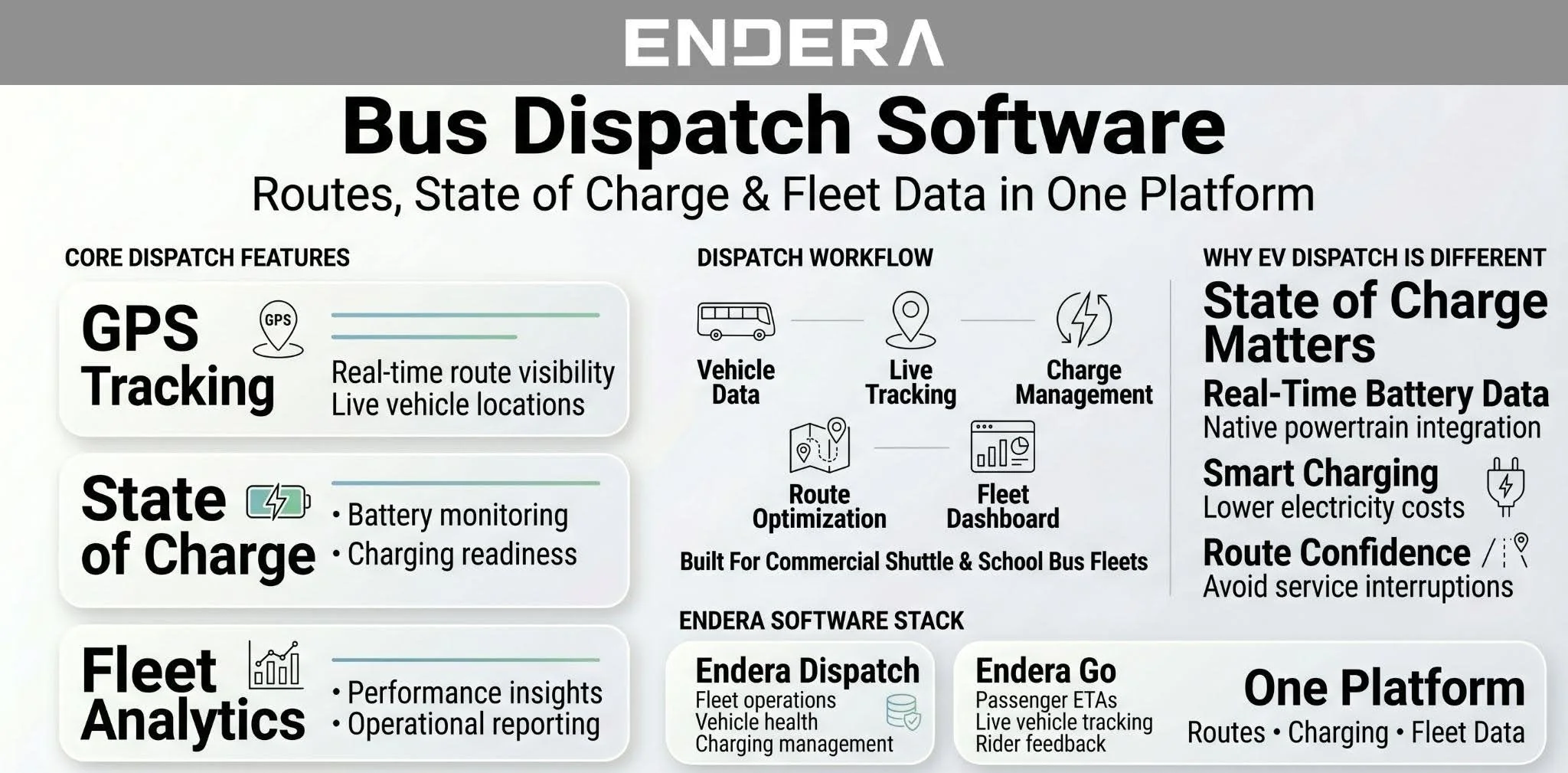
Endera Dispatch tracks all active routes in real time using GPS that adapts to traffic and operational changes. It flags deviations automatically and updates route data without manual input. Geofencing adds oversight through zone tracking, speed monitoring, and entry/exit alerts, all built into a single dashboard used by fleet managers.
Scalable Across Fleet Size
The system is designed to scale from small to large fleets without loss of functionality. Dispatch logic, routing, and state-of-charge monitoring remain consistent as fleets grow, avoiding the need for tier changes or system migration. For operators running mixed ICE and EV fleets, a single platform manages all vehicle types during the transition instead of requiring separate systems.
State of Charge Management: The Core EV Dispatch Problem
Why SoC Management Is an Operational Priority, Not a Feature
Managing state of charge in an EV fleet is complex because real-world range varies with load, weather, terrain, battery age, and driving behavior. A vehicle that finishes a route with ample charge one day may not have the same margin under different conditions. Without real consumption data, dispatch decisions rely on assumptions that can fail when accuracy matters most.
How Dispatch Manages Charging and Energy Costs
Endera’s software optimizes charging by aligning usage patterns, downtime, and grid capacity to schedule off-peak charging automatically. This helps avoid higher peak electricity rates that can significantly raise operating costs. For budget-sensitive fleets, it provides direct, measurable savings through automated energy cost management.
SaaS Charging Access Without Grid Upgrades
A key barrier to electrifying small fleets is the cost of upgrading electrical infrastructure for charging. Endera addresses this through SaaS contracts and charging partnerships that reduce or eliminate the need for full depot grid upgrades. This is especially useful for hospitality, university, and small municipal operators running only a few electric vehicles without large upfront infrastructure investments.
Actionable Reporting and the Integrated Dashboard
What the Dashboard Consolidates
Endera Dispatch consolidates GPS tracking, vehicle data, and rider feedback from Endera Go into a single dashboard. Fleet managers can view location, charge levels, and service reports without switching systems. Built-in reporting tools also support compliance, performance tracking, and internal analysis without requiring a dedicated data analyst.
Using Fleet Data to Improve Operations Over Time
A dispatch platform’s value comes from accumulated operational data over time—route performance, charging cycles, vehicle health, and driver behavior. This enables better decisions on scheduling, maintenance, and efficiency. Endera Dispatch surfaces these insights directly in the dashboard instead of requiring manual data aggregation.
How Endera Dispatch Differs From Third-Party Telematics
Built Alongside the Vehicle, Not Added to It
Endera Dispatch differs from third-party telematics in that it’s built alongside the vehicle hardware. External systems are designed to work across many manufacturers and rely on translated or inferred data, while Dispatch uses native powertrain data from Endera buses. This is especially important for state-of-charge monitoring, where direct data provides more accurate battery readings than third-party estimates.
No Integration Tax
When a fleet operator purchases a vehicle from one manufacturer, a telematics subscription from a second vendor, and a charging management service from a third, they're paying an integration tax — in time, in subscription costs, in troubleshooting overhead when the systems disagree, and in the data gaps that appear at the seams between platforms. Endera's approach is to remove those seams by building the vehicle, the software, and the charging infrastructure as components of the same system. For fleet managers who have navigated the complexity of multi-vendor fleet technology, the operational simplicity of a single integrated platform isn't a small benefit.
Endera Go: The Passenger Side of the Software Stack
Real-Time ETAs Powered by Onboard Data
Endera Go is the rider-facing component that runs alongside Dispatch. Powered by onboard technology and Google API, it provides passengers with precise estimated arrival times based on actual vehicle position and traffic conditions — not scheduled times that may or may not reflect what's happening on the road.
The platform's position on real-time accuracy is direct: if a vehicle shows up in the Go app, it's on the road. For airport shuttle passengers, campus transit riders, and hotel guests waiting at a pickup point, the difference between an ETA they can trust and a scheduled time they have to guess about is a meaningful part of the service experience.
Rider Feedback as Operational Data
Endera Go includes an integrated rider feedback mechanism that lets operators configure the level of engagement — one-way feedback collection or two-way communication — based on their operational preference. The feedback data feeds into the Dispatch dashboard, connecting what passengers are experiencing on a route with what the fleet manager is seeing in the operations view. A pattern of feedback about a specific route, vehicle, or time window becomes actionable operational data rather than anecdotal complaint volume that a dispatcher has no systematic way to address.
Endera Dispatch Is the Right Tool for Fleets Running Endera Vehicles
Third-party dispatch platforms offer broad compatibility across many vehicle types. For operators running Endera shuttles and school buses, the depth of integration available through Endera Dispatch — native powertrain data, built-in state-of-charge management, charging optimization, and a passenger app that connects directly to the same data source — is what makes it the right tool for the job. The platform was built for these vehicles, in the same facility where the vehicles are built, by the same organization that manages the service relationship after delivery.
Get in touch with Endera's team to explore Dispatch's capabilities and see how it fits your fleet's operations.
FAQs
1. What is Endera Dispatch and how does it work?
Endera Dispatch is an AI-powered fleet management platform built into every Endera vehicle. It uses onboard hardware and edge computing to process real-time data at the vehicle level, providing GPS-powered route mapping, geofence management, state-of-charge monitoring, and charging schedule optimization. The system is developed in-house alongside Endera's vehicle hardware, so the data it reads from the powertrain is native rather than translated through a third-party interface.
2. How does Endera Dispatch manage state of charge for electric bus fleets?
Dispatch monitors state of charge in real time, drawing directly from the vehicle's powertrain data. The software analyzes usage patterns across the fleet and schedules charging sessions to align with off-peak utility rates and vehicle downtime windows — reducing energy costs compared to unmanaged depot charging. Grid allowance monitoring ensures charging sessions don't exceed infrastructure capacity during peak demand.
3. Does Endera Dispatch work for mixed ICE and EV fleets?
Yes. Endera builds vehicles across ICE, propane, CNG, and electric powertrains, and Dispatch is designed to handle all of them within the same platform. For fleets in transition — running some electric vehicles while maintaining ICE units — this means a single dispatch view covers the full fleet without requiring separate systems for different powertrain types.
4. What is Endera Go and how does it connect to Dispatch?
Endera Go is the passenger-facing app that runs alongside Dispatch. Powered by onboard technology and Google API, it provides riders with real-time vehicle location and precise ETAs. Rider feedback collected through Go feeds into the Dispatch dashboard, connecting passenger experience data with fleet operations visibility in the same interface.
5. Can Endera Dispatch generate custom reports for compliance or client reporting?
Yes. The Dispatch dashboard includes custom reporting tools available at no additional cost. Operators can configure reports around route performance, vehicle health, charge cycle data, and other operational metrics — useful for institutional client reporting, public transit compliance documentation, and internal fleet analysis.
6. How does Endera's software handle charging access for fleets without full depot infrastructure?
Endera offers SaaS contracts and strategic charging partnerships specifically designed for commercial EVs, providing access to charging without requiring a full private grid upgrade. This is built into the software's energy management layer, which optimizes charging schedules and monitors grid allowance alongside route and dispatch operations.
7. Is Endera Dispatch available on vehicles purchased through dealer partners?
Yes. Endera Dispatch is included with every Endera commercial shuttle, whether purchased directly or through a dealer partner network. The software relationship is maintained through Endera regardless of the sales channel, ensuring consistent access to updates, feature additions, and support.